
ADHD in Adults: Symptoms and Diagnosis
Updated May 2026
A comprehensive guide to identifying ADHD in the adult population including diagnostic criteria and common symptoms.
Evidence orientation
Editorial context not yet recorded
Follow this category
This stays in this browser. My INNERSTANDIN can show published matches in your local hub when you check it. It does not send email, push, or alert notifications.
Local learning review
A private browser aid for revisiting ideas. It is not an alert or a health recommendation.
Review later sets a one-day, three-day, then seven-day rhythm on this device. Choose it only when you want to revisit this article.
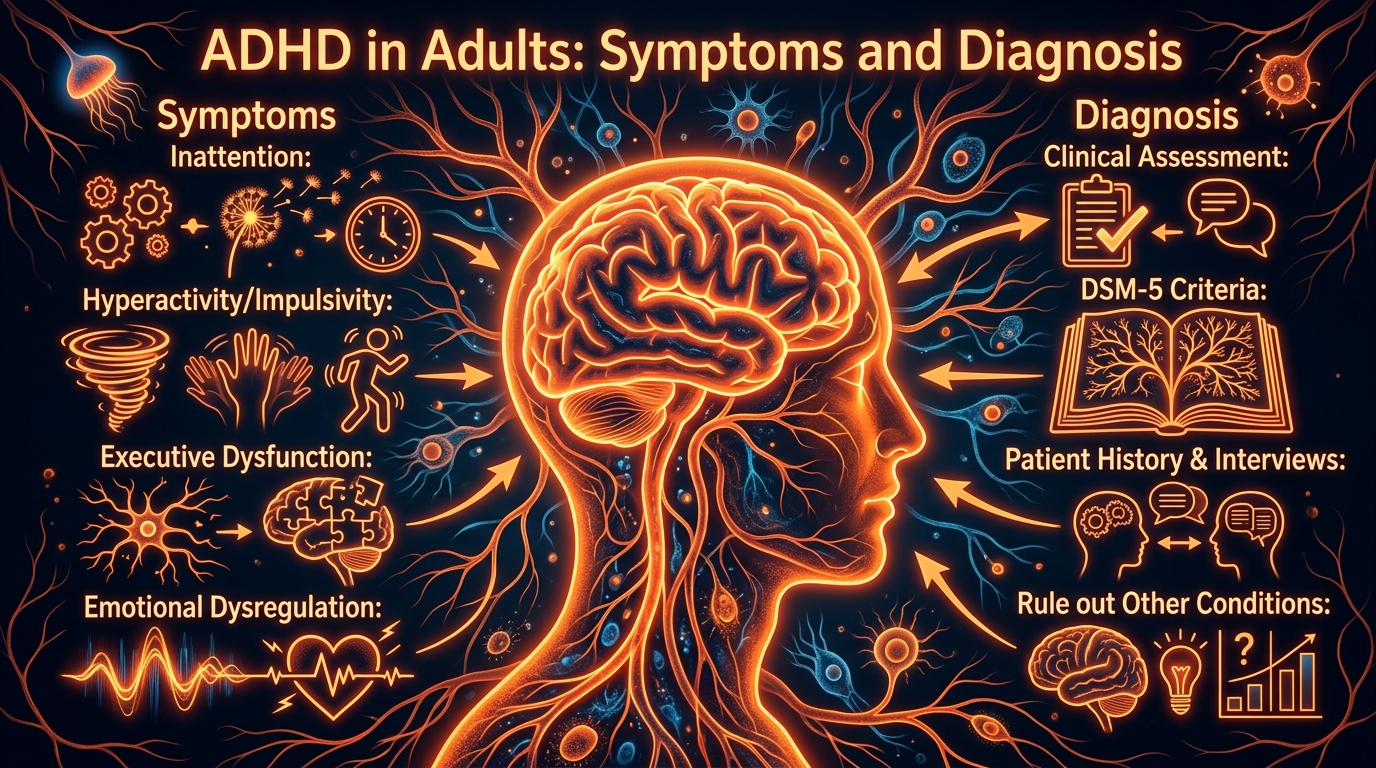
For decades, Attention Deficit Hyperactivity Disorder (ADHD) was viewed almost exclusively through the lens of paediatric medicine. It was the ‘disorder of the schoolboy’—characterised by physical overactivity and disruptive classroom behaviour. However, the scientific and clinical understanding of ADHD has undergone a seismic shift. We now recognise ADHD as a lifelong neurodevelopmental condition that persists into adulthood for an estimated 50–65% of those diagnosed in childhood. Furthermore, a ‘lost generation’ of adults—particularly women and those with the inattentive presentation—are only now discovering that their lifelong struggles with organisation, focus, and emotional regulation have a clinical name.
In the UK, awareness has surged, leading to a significant increase in referrals. Yet, navigating the path to a diagnosis within the NHS or private sector remains complex. This article provides an authoritative overview of how ADHD manifests in the adult brain, the specific symptoms to look for, and the rigorous diagnostic process required under UK clinical guidelines.
Part 1: Understanding Adult ADHD
ADHD is not a behaviour problem or a lack of willpower; it is a complex neurodevelopmental condition related to the brain’s ‘executive functions.’ These functions, governed largely by the prefrontal cortex, act as the brain’s management system, overseeing task initiation, focus, emotional regulation, and impulse control.
In adults with ADHD, the brain’s dopamine and noradrenaline signalling pathways function differently. This leads to a persistent pattern of inattention and/or hyperactivity-impulsivity that interferes with daily functioning or development. For an adult to be diagnosed, these symptoms must have been present since childhood (typically before the age of 12), even if they were not formally identified at the time.
The Three Presentations
According to the DSM-5 (the diagnostic manual used alongside the ICD-11 in the UK), ADHD presents in three ways:
- Predominantly Inattentive Presentation: Characterised by difficulties with organisation, following instructions, and sustaining mental effort. (Formerly often referred to as ADD).
- Predominantly Hyperactive-Impulsive Presentation: Characterised by physical restlessness, talkativeness, and acting without thinking.
- Combined Presentation: A mixture of both inattentive and hyperactive-impulsive symptoms.
Part 2: Symptoms in Adulthood – The Lived Experience
Adult ADHD rarely looks like the ‘bouncing off the walls’ stereotype seen in children. Instead, symptoms often internalise or evolve into sophisticated (but exhausting) coping mechanisms.
1. Inattention and Executive Dysfunction
In adults, inattention is often the most debilitating aspect of the condition. It manifests as:
- ‘Executive Dysfunction’: The inability to break down complex tasks into manageable steps. An adult might stare at a pile of laundry or a work report, feeling physically unable to start, a phenomenon often called ‘ADHD paralysis.’
- Poor Working Memory: Forgetting why you walked into a room, losing keys or wallets daily, and struggling to hold multiple pieces of information in mind at once.
- Chronic Procrastination: Not due to laziness, but due to a genuine difficulty in estimating how long tasks take (‘time blindness’) and a lack of ‘activation energy’ for tasks that do not provide immediate dopamine.
- Distractibility: Being pulled away from a task by external stimuli (a bird outside) or internal stimuli (a sudden unrelated thought).
2. Hyperactivity: From Physical to Mental
In adults, the ‘H’ in ADHD often transforms. While a child might run around a classroom, an adult might experience:
- Internal Restlessness: A feeling of being ‘driven by a motor’ internally, even when sitting still.
- Racing Thoughts: A mind that never shuts off, leading to sleep onset insomnia.
- Fidgeting: Constant tapping of pens, shaking a leg, or skin-picking.
- Excessive Talking: Often interrupting others or finishing their sentences because the brain is moving faster than the conversation.
3. Impulsivity
Impulsivity in adulthood can have serious real-world consequences:
- Financial Impulsivity: Making ‘dopamine purchases’ online or struggling to stick to a budget.
- Social Impulsivity: Blurring out comments that are later regretted, or making major life changes (quitting a job, ending a relationship) on a whim.
- Low Frustration Tolerance: Becoming disproportionately angry at minor delays, such as traffic jams or slow internet.
4. Emotional Dysregulation and RSD
While not part of the formal DSM-5 diagnostic criteria, emotional dysregulation is a core feature for many UK clinicians.
- Rejection Sensitive Dysphoria (RSD): An intense, often overwhelming emotional pain triggered by the perception of being rejected, criticised, or teased.
- Mood Lability: Rapid shifts in mood that are reactive to the environment (unlike the longer cycles seen in Bipolar Disorder).
Part 3: The ‘Lost Generation’ and Gender Differences
One of the most significant shifts in UK psychiatry is the recognition of ADHD in women. Historically, girls were less likely to be diagnosed because they more frequently present with the inattentive type. Instead of being disruptive, they might be ‘daydreamers.’
In adulthood, women with undiagnosed ADHD often ‘mask’ their symptoms—working twice as hard as their peers to appear organised, often leading to burnout, chronic fatigue, and misdiagnoses of depression or anxiety. For many women, the hormonal fluctuations of the menstrual cycle, pregnancy, and perimenopause can significantly exacerbate ADHD symptoms, as oestrogen levels influence dopamine efficacy in the brain.
Part 4: The Diagnostic Pathway in the UK
In the UK, ADHD is a recognised disability under the Equality Act 2010. However, obtaining a diagnosis involves a structured and often lengthy process governed by the NICE Guidelines (NG87).
Step 1: The General Practitioner (GP)
The journey usually begins at the GP surgery. In the UK, a GP cannot diagnose ADHD, but they act as the gatekeeper to specialist services.
- The Consultation: You should prepare a list of symptoms and how they affect your life (work, relationships, home).
- The ASRS Scale: Most GPs will ask you to complete the Adult ADHD Self-Report Scale (ASRS), a short screening questionnaire.
- The Referral: If the GP agrees there is evidence of ADHD, they should refer you to a specialist (usually a local NHS Adult ADHD clinic or a Community Mental Health Team).
Step 2: NHS Wait Times and 'Right to Choose'
NHS wait times for ADHD assessments in the UK currently range from several months to five years, depending on the Integrated Care Board (ICB) area. This is often referred to as a ‘postcode lottery.’
"The 'Right to Choose' (England only):"
Under the NHS Constitution, patients in England have the right to choose which provider they are referred to for their first outpatient appointment. This means if an NHS-contracted private provider (such as Psychiatry-UK or ADHD 360) has a shorter waitlist, you can request that your GP refers you there, with the cost covered by the NHS.
Step 3: The Specialist Assessment
A formal diagnosis must be made by a specialist—usually a psychiatrist or a specialist nurse practitioner. An assessment typically lasts 90 minutes to 3 hours and includes:
- Clinical Interview: A deep dive into your current struggles.
- Developmental History: This is vital. ADHD is neurodevelopmental, so the clinician must find evidence that symptoms were present in childhood. They may ask to see old school reports (looking for comments like "bright but distracted" or "easily led") or speak to a parent or sibling.
- Standardised Tools: Clinicians often use the DIVA-5 (Diagnostic Interview for ADHD in Adults), which systematically compares childhood and adult behaviours against the diagnostic criteria.
- Informing Others: You may be asked to provide an 'informant report'—a questionnaire filled out by a partner or close friend who sees your daily struggles.
Part 5: Differential Diagnosis and Comorbidities
A crucial part of the UK assessment process is "differential diagnosis." Because ADHD symptoms overlap with many other conditions, the clinician must ensure the symptoms aren't better explained by something else.
Common Overlaps:
- Anxiety and Depression: Chronic failure to meet one’s own potential due to ADHD often leads to secondary depression and anxiety.
- Autism Spectrum Disorder (ASD): There is a high co-occurrence between ADHD and Autism (often colloquially called 'AuDHD'). While ADHD is about seeking stimulation, ASD often involves sensory sensitivity and a need for routine.
- Bipolar Disorder: The impulsivity and energy of ADHD can be mistaken for hypomania, though ADHD symptoms are chronic rather than episodic.
- CPTSD (Complex Post-Traumatic Stress Disorder): Trauma can mimic the hypervigilance and distractibility of ADHD. A specialist must untangle whether the symptoms pre-date the trauma.
Part 6: Post-Diagnostic Support in the UK
A diagnosis is often a moment of profound emotional upheaval—a mixture of relief ("I'm not lazy or broken") and grief for the life that might have been lived if help had come sooner.
Medication
In the UK, NICE guidelines recommend medication as a first-line treatment for adults if symptoms significantly impact their lives.
- Stimulants: (e.g., Methylphenidate/Lisdexamfetamine). These increase the availability of dopamine and noradrenaline.
- Non-stimulants: (e.g., Atomoxetine). Often used if stimulants are not tolerated or effective.
- Titration: This is the process of slowly increasing the dose while monitoring heart rate, blood pressure, and side effects. In the UK, once a patient is stable on medication, they move to a Shared Care Agreement (SCA), where the specialist oversees the treatment but the GP issues the monthly prescriptions.
Non-Pharmacological Support
Diagnosis is the start, not the end. Support in the UK includes:
- Access to Work: A Department for Work and Pensions (DWP) grant that pays for practical support, such as ADHD coaching, noise-cancelling headphones, or specialist software to help you stay in employment.
- CBT (Cognitive Behavioural Therapy): Specifically adapted for ADHD to help with emotional regulation and ‘unlearning’ negative self-beliefs.
- Reasonable Adjustments: Under the Equality Act, UK employers are required to make changes to help neurodivergent staff (e.g., flexible hours, quiet workspaces).
Part 7: The Importance of Recognition
The rise in adult ADHD diagnoses in the UK is not a "trend" or a "contagion," as some media outlets suggest. Rather, it is the result of better clinical screening and a societal move away from stigmatising neurodivergence.
For an adult, a diagnosis is the key to self-compassion. It allows for a shift from "I am a failure" to "I have a brain that works differently." Understanding the unique architecture of the ADHD brain—its capacity for hyperfocus, creativity, and outside-the-box thinking—can allow an adult to finally build a life that works with their neurobiology rather than against it.
Summary Checklist for UK Adults:
- Reflect: Do your symptoms date back to childhood?
- Record: Keep a ‘symptom diary’ for two weeks to show your GP.
- Screen: Complete the ASRS questionnaire.
- Advocate: If your GP is dismissive, seek a second opinion or research ‘Right to Choose’ options.
- Evidence: Locate old school reports if possible.
ADHD in adults is a profound but manageable condition. With the correct diagnosis and a holistic support plan—encompassing medication, lifestyle changes, and workplace adjustments—adults with ADHD can move from a state of constant ‘survival mode’ to one of thriving.
"References & Resources for UK Residents:"
- NICE Guideline [NG87]: Attention deficit hyperactivity disorder: diagnosis and management.
- ADHD UK: A leading charity providing peer support and advocacy.
- AADD-UK: The site for Adult Attention Deficit Disorder in the UK.
- NHS Website: Information on ADHD symptoms and the ‘Right to Choose’ pathway.
This article is provided for informational and educational purposes only. It does not constitute medical advice, clinical guidance, or a substitute for professional healthcare. Information reflects cited research at time of publication. Always consult a qualified healthcare professional before acting on any health information.
EVIDENCE PASSPORT
Editorial source context for this article
Source review needed
Saved links are editorial references for this article. They may support specific claims rather than every sentence. Open and assess each source in context. This passport does not independently verify them.
Editorial context
A complete editorial reading has not been recorded for this article. Source links remain available for you to open and assess directly.
Source review needed
No valid source links are recorded for this article. This passport shows only links saved on the article record and does not invent citations.
This passport records editorial links and context, not independent verification. Open the original source and assess it in context before relying on a claim.
Medical Disclaimer
The information in this article is for educational purposes only and does not constitute medical advice, diagnosis, or treatment. Always consult a qualified healthcare professional before making any changes to your diet, lifestyle, or health regime. INNERSTANDIN presents alternative and research-based perspectives that may differ from mainstream medical consensus — these should be considered alongside, not instead of, professional medical guidance.
Read Full DisclaimerContinue the thread
Keep this question moving.
Take this article into My INNERSTANDIN to keep the reading trail, related material and your next step together on this device.
Explore this in the Body Map
See where this hits your biology. Interactive anatomy, threats, and protective protocols.
Dig deeper in the Library
Free, longform PDF volumes that go beyond headlines into mechanisms and references.