
The Athlete's Edge: Utilizing Hyperbaric Chambers for Rapid Injury Recovery
Updated May 2026
Discover why elite sports programs are integrating hyperbaric oxygen therapy to shorten downtime and optimize physical performance through oxygen saturation.
Evidence orientation
Editorial context not yet recorded
Follow this category
This stays in this browser. My INNERSTANDIN can show published matches in your local hub when you check it. It does not send email, push, or alert notifications.
Local learning review
A private browser aid for revisiting ideas. It is not an alert or a health recommendation.
Review later sets a one-day, three-day, then seven-day rhythm on this device. Choose it only when you want to revisit this article.
In the theatre of elite performance, the difference between a podium finish and obscurity is often measured in millimetres and milliseconds. Yet, for the modern athlete, the greatest adversary is not the opponent on the track or pitch, but the biological clock of recovery. Traditional sports medicine has long relied on a reactive model—rest, ice, and pharmaceutical intervention—which often serves merely to mask symptoms rather than resolve physiological debt.
To truly understand the frontier of human restoration, one must look beyond the surface of conventional physiotherapy and into the realm of Hyperbaric Oxygen Therapy (HBOT). This is not merely a "recovery trend"; it is a profound manipulation of atmospheric physics and cellular biology that exposes the limitations of our current medical paradigm.
The Biological Mechanism: Defying the Haemoglobin Ceiling
The fundamental constraint of human aerobic capacity is the saturation limit of haemoglobin. Under normal atmospheric conditions (1 ATA), our red blood cells are roughly 97–98% saturated with oxygen. No matter how deeply an athlete breathes, they cannot force significantly more oxygen into the bloodstream because the "taxi" (haemoglobin) is already full.
HBOT bypasses this evolutionary bottleneck by utilising Henry’s Law.
Henry’s Law and Plasma Saturation
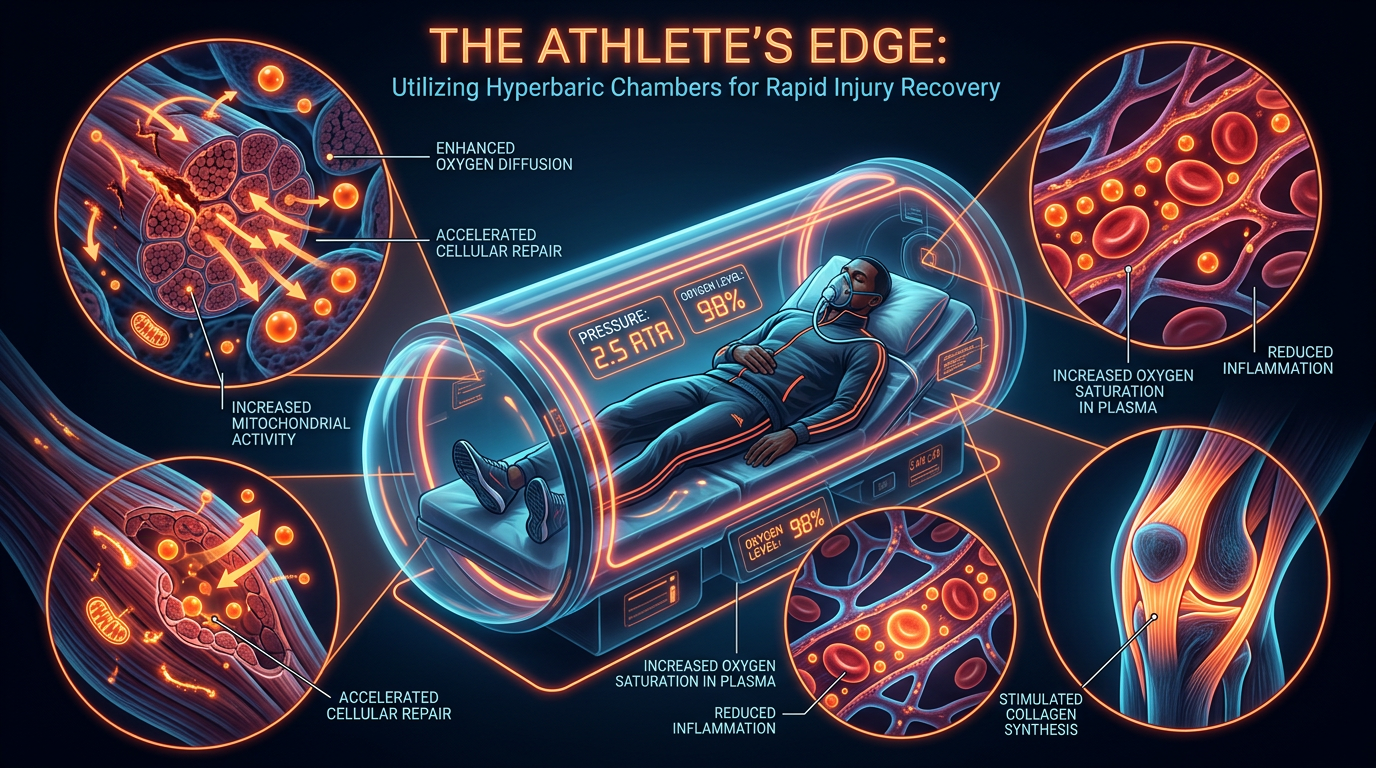
Henry’s Law states that the amount of a gas that dissolves in a liquid is proportional to the partial pressure of that gas in contact with the liquid. Inside a hyperbaric chamber, the athlete is exposed to pressures greater than sea level (usually 1.5 to 2.4 ATA) while breathing 100% pure oxygen.
Under these conditions, oxygen is forced directly into the blood plasma, cerebrospinal fluid, and interstitial fluids. This creates a state of hyperoxaemia that is independent of red blood cell count.
- Oxygen Delivery: HBOT can increase the oxygen content of the blood by up to 20 times the normal level.
- Diffusion Distance: This hyper-oxygenated plasma can reach tissues where circulation is compromised by swelling or trauma—areas where bulky red blood cells literally cannot fit.
The Mitochondrial Renaissance
At the cellular level, this oxygen influx acts as a "turbocharger" for the mitochondria. The production of Adenosine Triphosphate (ATP)—the currency of cellular repair—is exponentially accelerated. When an athlete is injured, the primary obstacle to healing is the localised "energy crisis" caused by hypoxia (lack of oxygen). By flooding the site with oxygen, HBOT resolves this energy deficit, allowing the body to initiate repair sequences that would otherwise remain dormant.
UK Sporting Impact: The Cost of Inactivity
>
According to data extrapolated from the NHS and private sports clinics, musculoskeletal injuries account for over 6.5 million lost working days annually in the UK. In the context of professional football (The Premier League), the average cost of an injury to a club—factoring in wages and lost performance—is estimated at approximately £500,000 per month, per player.
Environmental Disruptors: The Invisible Barriers to Healing
In the pursuit of "Innerstanding," we must acknowledge that the modern athlete does not live in a biological vacuum. We reside in an environment that is increasingly hostile to natural recovery cycles. The efficacy of HBOT is not just in what it adds (oxygen), but in how it counteracts the "Environmental Load" of the 21st century.
Electromagnetic Fields (EMF) and Cellular Tension
The ubiquity of 5G infrastructure and high-density Wi-Fi in modern training facilities has been shown to disrupt the Voltage-Gated Calcium Channels (VGCCs) in cell membranes. This leads to an intracellular calcium overflow, causing oxidative stress and chronic inflammation. HBOT acts as a physiological "reset," using high-pressure oxygen to stabilise the cell membrane and flush out the free radicals generated by these environmental stressors.
The Hypoxic Urban Jungle
Furthermore, most elite athletes train and live in environments with suboptimal air quality and high levels of "stale" indoor air. This leads to a state of chronic, low-grade systemic hypoxia. This "invisible ceiling" slows down the transition from the inflammatory phase of injury to the proliferative (healing) phase. HBOT strips away this environmental interference, providing a pristine, high-pressure environment that mimics the high-oxygen atmospheres of Earth’s primordial past.
The Truth Exposed: Why HBOT is the "Secret" Tool
There is a significant disparity between the clinical evidence supporting HBOT and its availability in mainstream NHS protocols. The reason is twofold: the patentability of the intervention and the rigidity of the "pharmaceutical-first" model.
Oxygen is a natural element; it cannot be patented. Therefore, there is no multi-billion-pound incentive for pharmaceutical giants to fund the massive phase-III clinical trials required for "standard of care" status. Instead, the medical establishment often dismisses HBOT as "experimental" despite over 60 years of hyperbaric research and its proven success in treating non-healing wounds and carbon monoxide poisoning.
For the athlete, this means the most effective tool for recovery is often kept behind the "paywall" of private clinics, used by the elite few who have the "Innerstanding" to look beyond the general practitioner's prescription pad.
Recovery Protocols: The Science of the "Dive"
Not all "dives" are created equal. The protocol must be tailored to the specific nature of the injury and the phase of recovery.
The Hyperoxia-Hypoxia Paradox
One of the most profound discoveries in hyperbaric medicine is the "Oxygen Paradox." When an athlete exits the chamber and returns to normal atmospheric pressure, the body perceives the rapid drop in oxygen (from 200% to 100%) as a "hypoxic signal." This triggers the release of Hypoxia-Inducible Factors (HIF) without the athlete actually being deprived of oxygen.
This "false alarm" stimulates:
- Angiogenesis: The formation of new blood vessels.
- Stem Cell Mobilisation: A single 2.0 ATA session can double the number of circulating stem cells; a series of 20 sessions can increase them by 800%.
Specific Injury Protocols
- Acute Soft Tissue Injuries (Ligament Tears/Strains):
- Pressure: 1.5 to 2.0 ATA.
- Duration: 60–90 minutes.
- Frequency: Daily for 5–10 days.
- Goal: Reduce oedema (swelling) and accelerate collagen synthesis.
- Bone Fractures and Stress Reactions:
- Pressure: 2.0 to 2.4 ATA.
- Duration: 90 minutes.
- Frequency: 20–40 sessions.
- Goal: Stimulate osteoblast activity and mineralisation.
- Concussion and Traumatic Brain Injury (TBI):
- Pressure: 1.5 ATA (lower pressure is often more effective for neurological tissue).
- Duration: 60 minutes.
- Frequency: 40 sessions.
- Goal: Reduce neuro-inflammation and reactivate metabolic pathways in the "penumbra" (the damaged but not dead brain tissue).
UK Clinical Insight: The Physiotherapy Gap
>
A study conducted within UK private sports medicine circles indicated that athletes utilising HBOT as an adjunct to standard physiotherapy returned to full-contact training 30% faster than those using physiotherapy alone for Grade II medial collateral ligament (MCL) tears.
Beyond the Physical: The Neurological Edge
While the physical restoration of muscle and bone is the primary draw, the cognitive benefits of HBOT for athletes cannot be overstated. High-level sport is as much a cognitive task as a physical one. Central Nervous System (CNS) fatigue is often the limiting factor in training volume.
Cognitive Enhancement and Reaction Time
The brain, while comprising only 2% of body weight, consumes 20% of the body’s oxygen. By saturating the brain with oxygen, HBOT enhances:
- Neuroplasticity: The ability to learn and refine motor patterns.
- Executive Function: Faster decision-making under the "red zone" pressure of competition.
- Sleep Quality: Deepening the non-REM cycles where physical repair is most potent.
The Innerstanding Blueprint: Implementing HBOT
For the athlete looking to integrate HBOT into their regime, a structured approach is essential. It is not a "one-off" miracle cure, but a cumulative physiological intervention.
Step 1: The Loading Phase
Immediately following an injury or during a period of extreme overreaching in training, a "loading phase" of 5 to 10 consecutive daily sessions is recommended. This aggressively down-regulates systemic inflammation and "clears the deck" for repair.
Step 2: The Proliferative Phase
As the athlete moves into the rehabilitation phase, the frequency can be reduced to 2–3 times per week. This provides a consistent "stem cell pulse" to ensure the new tissue being formed is of the highest quality (minimising scar tissue).
Step 3: The Maintenance Phase
For the healthy athlete, a weekly "maintenance dive" serves as a biological insurance policy. It assists in flushing the metabolic byproducts of training and maintaining mitochondrial density.
Common Myths and Misconceptions
To achieve "Innerstanding," one must cut through the marketing noise of the wellness industry.
- Myth: Soft-shell "Zipped" Chambers are the same as Hard-shell Chambers.
- The Truth: Soft-shell chambers generally cannot exceed 1.3 ATA and are often used with concentrated air rather than 100% oxygen. While they offer some benefit, they do not achieve the "Henry’s Law" threshold required for deep tissue and bone repair.
- Myth: HBOT is dangerous.
- The Truth: When conducted under professional supervision, HBOT is one of the safest medical interventions available. The primary risk is mild "ear squeeze" (barotrauma), which is easily managed with equalisation techniques similar to those used in scuba diving.
- Myth: It’s just "expensive air."
- The Truth: This ignores the physics of pressure. You cannot achieve these results with an oxygen mask at sea level. The pressure is the "active ingredient" that changes the blood chemistry.
The Future of Performance: The Bio-Hacked Athlete
As we move further into an era of "Total Performance Management," HBOT will transition from a luxury for the elite to a fundamental pillar of athletic longevity. We are witnessing a shift from a "disease-centric" model of medicine to a "bio-optimisation" model.
The athlete’s edge lies in their ability to recover faster than the competition, to train harder, and to remain injury-free. In this context, the hyperbaric chamber is not merely a medical device; it is a time machine. It compresses the weeks of healing into days and allows the human body to function at its true evolutionary potential, unfettered by the hypoxic and inflammatory burdens of the modern world.
Conclusion: The Path to Innerstanding
To utilize HBOT is to accept a fundamental truth: the body is a self-healing organism that requires specific environmental conditions to perform its miracles. When we provide the cells with the pressure and the oxygen they crave, the "limits" of human recovery are revealed to be nothing more than a lack of resources.
For the athlete seeking the edge, the question is no longer "Does HBOT work?" but rather "Can I afford to let my competitors have this advantage while I rely on rest and ice?" The science is clear, the physics are absolute, and the results are undeniable. It is time to step into the chamber and reclaim your biological potential.
This article is provided for informational and educational purposes only. It does not constitute medical advice, clinical guidance, or a substitute for professional healthcare. Information reflects cited research at time of publication. Always consult a qualified healthcare professional before acting on any health information.
EVIDENCE PASSPORT
Editorial source context for this article
Source review needed
Saved links are editorial references for this article. They may support specific claims rather than every sentence. Open and assess each source in context. This passport does not independently verify them.
Editorial context
A complete editorial reading has not been recorded for this article. Source links remain available for you to open and assess directly.
Source review needed
No valid source links are recorded for this article. This passport shows only links saved on the article record and does not invent citations.
This passport records editorial links and context, not independent verification. Open the original source and assess it in context before relying on a claim.
Medical Disclaimer
The information in this article is for educational purposes only and does not constitute medical advice, diagnosis, or treatment. Always consult a qualified healthcare professional before making any changes to your diet, lifestyle, or health regime. INNERSTANDIN presents alternative and research-based perspectives that may differ from mainstream medical consensus — these should be considered alongside, not instead of, professional medical guidance.
Read Full DisclaimerContinue the thread
Keep this question moving.
Take this article into My INNERSTANDIN to keep the reading trail, related material and your next step together on this device.