
Ayurvedic Chronobiology vs Circadian Disruption
Updated May 2026
This article explores how ancient Vedic timing aligns with modern circadian biology to mitigate light pollution in the UK. We analyze the molecular mechanisms of melatonin suppression caused by artificial nocturnal environments.
Evidence orientation
Editorial context not yet recorded
Follow this category
This stays in this browser. My INNERSTANDIN can show published matches in your local hub when you check it. It does not send email, push, or alert notifications.
Local learning review
A private browser aid for revisiting ideas. It is not an alert or a health recommendation.
Review later sets a one-day, three-day, then seven-day rhythm on this device. Choose it only when you want to revisit this article.
Overview
For millennia, the Vedic sages of ancient India maintained a profound understanding of time—not merely as a linear progression of minutes, but as a biological imperative. This science, known as Dinacharya (daily routine) and Ritucharya (seasonal routine), suggests that our health is inextricably linked to the solar and lunar cycles. Today, modern science has rebranded this ancient wisdom as Chronobiology. However, as we descend further into the "Age of Information," we are witnessing a catastrophic decoupling of human physiology from the natural world.
In the United Kingdom, a nation defined by its high-latitude seasonal swings and an aggressive rollout of short-wavelength LED infrastructure, the population is currently participating in an uncontrolled biological experiment. The modern paradigm—characterised by 24/7 connectivity, artificial nocturnal illumination, and the "always-on" industrialised mindset—directly contradicts the rhythmic requirements of our genome. This article serves as a deep-dive analysis into the molecular collision between Ayurvedic Chronobiology and Circadian Disruption, exposing how the abandonment of ancient timing is driving the current epidemic of chronic disease in the West.
As a researcher for INNERSTANDING, I contend that the "blue-light" crisis is not merely a matter of poor sleep; it is a fundamental disruption of the Suprachiasmatic Nucleus (SCN), the master pacemaker of the body, leading to a state of internal desynchronisation that no pharmaceutical intervention can fully rectify.
The Biology — How It Works
To understand the conflict, we must first define the biological machinery at play. In the Ayurvedic tradition, the 24-hour cycle is divided into six four-hour blocks, governed by the three Doshas: Vata (Air/Ether), Pitta (Fire/Water), and Kapha (Earth/Water).
- Kapha Phase (06:00 – 10:00): A period of heaviness and stability. Physiologically, this aligns with the post-dawn surge in Cortisol and the gradual increase in blood pressure.
- Pitta Phase (10:00 – 14:00): The peak of metabolic fire (Agni). This corresponds to the zenith of the sun, where digestive enzymes and the thermogenic capacity of the body are at their maximum.
- Vata Phase (14:00 – 18:00): A time of movement and mental agility. Modern chronobiology notes this as the peak for coordination and reaction time.
This cycle repeats at night, but with different physiological focuses. The second Pitta phase (22:00 – 02:00) is not for external digestion, but for internal cellular "housecleaning" and liver detoxification. This is the exact window that modern society has most violently disrupted.
The Master Clock
In Western terminology, the orchestrator is the Suprachiasmatic Nucleus, a cluster of approximately 20,000 neurons located in the hypothalamus. The SCN receives direct input from the retina via the Retinohypothalamic Tract (RHT).
Callout Fact: The SCN is so sensitive that even a brief pulse of light (as low as 100 lux) during the biological night can shift the circadian phase and suppress melatonin production for hours.
The SCN does not act alone; it synchronises peripheral clocks located in the liver, heart, and adipose tissue. When we eat or work during the "wrong" Ayurvedic phase—such as consuming a heavy meal during the evening Vata phase—we create "circadian misalignment," where the master clock in the brain is out of sync with the peripheral clock in the gut.
Mechanisms at the Cellular Level
At the core of our existence is a molecular metronome. Every cell in the human body contains a set of "clock genes" that function through a Transcription-Translation Feedback Loop (TTFL). This is where the ancient concept of Prana (life force) meets modern genetics.
The CLOCK/BMAL1 Complex
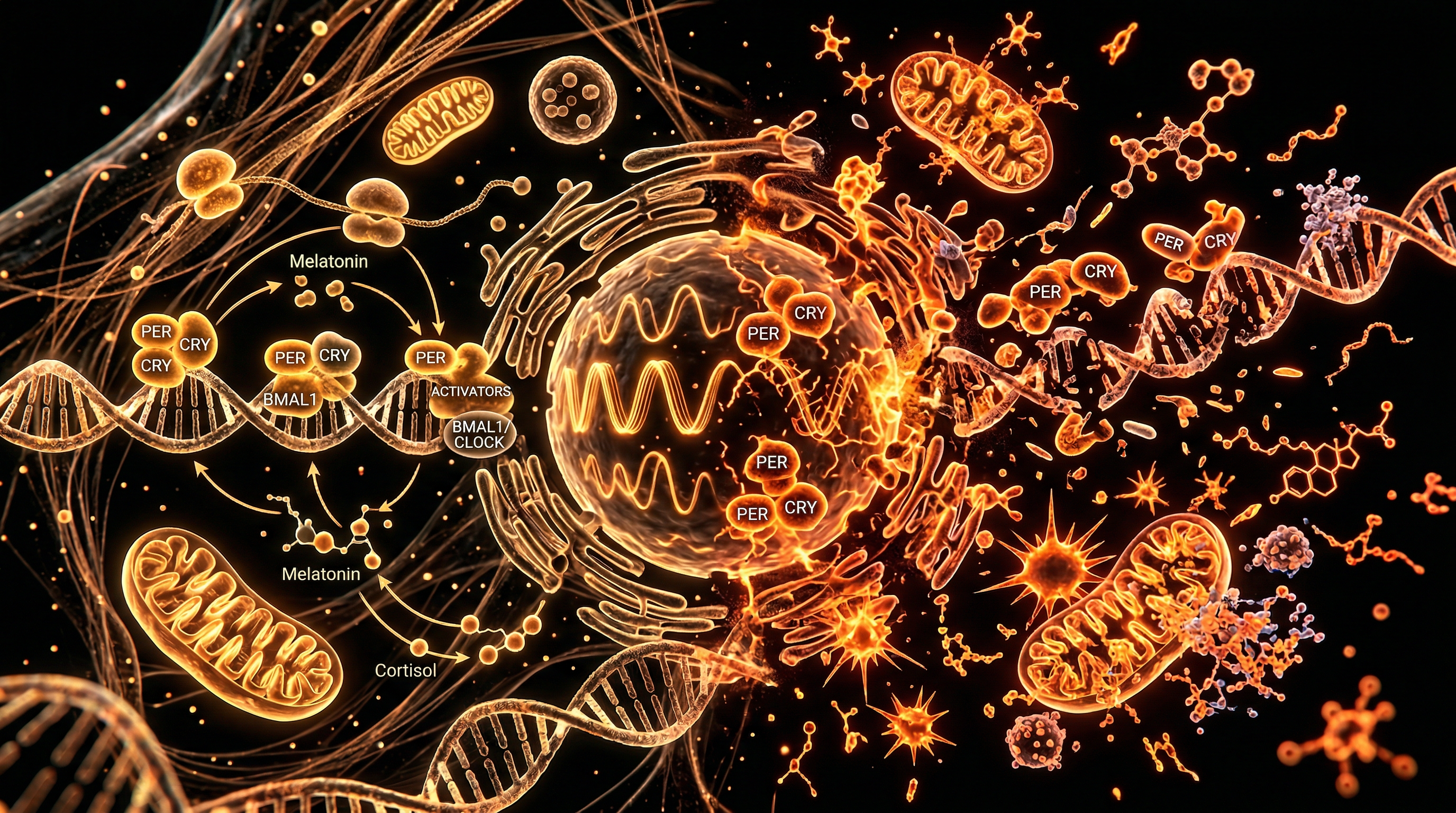
The primary drivers of this loop are two proteins: CLOCK (Circadian Locomotor Output Cycles Kaput) and BMAL1 (Brain and Muscle ARNT-Like Protein 1).
- These proteins bind together and enter the cell nucleus to activate the transcription of Period (PER) and Cryptochrome (CRY) genes.
- As PER and CRY proteins build up in the cytoplasm, they eventually re-enter the nucleus to inhibit the activity of CLOCK and BMAL1.
- This self-regulating loop takes approximately 24 hours to complete.
The Role of Melanopsin and OPN4
The bridge between the environment and this genetic loop is a photopigment called Melanopsin, found in intrinsically photosensitive Retinal Ganglion Cells (ipRGCs). Unlike the rods and cones we use for vision, ipRGCs are specifically tuned to detect blue light (wavelengths around 460-480nm).
When blue light hits the retina, it signals the SCN to suppress the Pineal Gland’s secretion of Melatonin (N-acetyl-5-methoxytryptamine). In Ayurveda, melatonin could be viewed as a manifestation of Soma—the cooling, nourishing lunar energy required for tissue repair (Ojas). Without melatonin, the PER/CRY inhibition is delayed, the cellular clock is reset, and the body remains in a state of "pseudo-daytime," preventing the critical Pitta-led detoxification that should occur at night.
Mitochondrial Entrainment
Recent research indicates that our mitochondria—the powerhouses of our cells—are also circadian-dependent. They undergo cycles of fission and fusion regulated by the clock. Artificial light at night (ALAN) interrupts mitochondrial dynamics, leading to the accumulation of reactive oxygen species (ROS) and DNA damage.
Environmental Threats and Biological Disruptors
The modern UK environment is a hostile landscape for the human circadian system. We are currently facing a "Triple Threat" of biological disruptors that were non-existent during the era when Vedic protocols were established.
1. The LED Revolution
The transition from incandescent bulbs (which emit a warm, amber spectrum) to High-Intensity Discharge (HID) and LED (Light Emitting Diode) lighting has been a disaster for chronobiology. Standard cool-white LEDs contain a massive spike in the 450nm blue range.
Statistic: Modern LED streetlights in the UK often have a Colour Temperature of 4000K or higher, which is significantly more suppressive to melatonin than the old sodium-vapour lamps (approx. 2000K).
2. The "Skyglow" Phenomenon
In cities like London, Manchester, and Birmingham, the concept of "true dark" has vanished. Skyglow—the scattering of artificial light in the atmosphere—ensures that even with curtains drawn, the body is often exposed to lux levels that exceed the threshold for circadian disruption.
3. Digital Enclosure
The average Briton spends upwards of 8 hours a day staring at backlit screens. These devices are held close to the face, maximising the irradiance on the ipRGCs. This "digital sun" trickery informs the brain that it is forever midday, perpetually suspending the body in a state of high-alert Pitta energy and preventing the transition to the restful Kapha state required for sleep onset.
The Cascade: From Exposure to Disease
What happens when the Ayurvedic Dinacharya is ignored and the molecular clock is shattered? The result is not just tiredness; it is a systemic physiological collapse.
Metabolic Syndrome and Insulin Resistance
The pancreas has its own internal clock. Insulin sensitivity is highest in the morning (Kapha/early Pitta) and lowest in the evening. When we consume high-carbohydrate meals late at night under blue light, the body is metabolically incapable of processing the glucose. This leads to chronic hyperinsulinaemia and, eventually, Type 2 Diabetes.
Oncogenesis (Cancer Risk)
Melatonin is one of the body’s most potent endogenous antioxidants and oncostatic agents. It inhibits the proliferation of various cancer cells, particularly those of the breast and prostate.
- The IARC Classification: The International Agency for Research on Cancer has classified "shift work that involves circadian disruption" as a Group 2A probable carcinogen.
- Chronic suppression of melatonin by nocturnal light removes the "natural chemotherapy" the body performs every night.
Neurodegeneration and the Glymphatic System
During sleep, specifically during the deep stages facilitated by a correct circadian rhythm, the brain’s Glymphatic System becomes ten times more active. This system flushes out Beta-Amyloid and Tau proteins—the metabolic waste products linked to Alzheimer’s disease. By disrupting the rhythm through late-night light exposure, we are essentially preventing our brains from "taking out the trash."
What the Mainstream Narrative Omits
The mainstream medical discourse focuses heavily on "sleep hygiene" as a secondary lifestyle factor, rather than a primary driver of pathology. However, there are deeper, more "suppressed" truths regarding why this crisis continues unabated.
The Economic Incentive for Circadian Slavery
The global economy relies on 24/7 production and consumption. A population that adheres to an Ayurvedic routine (sleeping at 22:00 and waking at 04:00-06:00) is a population that is less likely to engage in late-night impulse shopping, digital consumption, or shift labour. There is an implicit "biological tax" imposed on the working class, who are disproportionately affected by shift work and poor-quality urban lighting.
The Pharmaceutical Oversight
The medical-industrial complex benefits from treating the symptoms of circadian disruption (insomnia, depression, metabolic syndrome) rather than the cause (light pollution and rhythmic misalignment). Statins, metformin, and SSRIs are often prescribed for conditions that could be significantly mitigated by "Darkness Therapy" and rhythmic entrainment.
The Inadequacy of "Blue Light Filters"
Many mainstream sources suggest that "Night Shift" modes on smartphones are a sufficient solution. This is a half-truth. While reducing blue light helps, the intensity (irradiance) of the light and the mental stimulation of the content still stimulate the SCN. Furthermore, these filters do nothing to address the skin’s peripheral clocks, which have also been shown to be light-sensitive through Opsin-3 and Opsin-4 receptors in the dermis.
The UK Context
The United Kingdom presents a unique set of challenges for maintaining chronobiological integrity.
Latitude and Seasonal Affective Disorder (SAD)
The UK’s northern latitude (50°N to 60°N) means that in winter, the "photoperiod" (daylight length) is extremely short. This naturally increases the body’s demand for melatonin and rest. However, the modern UK lifestyle demands the same productivity in December as in June. This creates a "Seasonal Mismatch" where the Pitta-driven demands of the economy clash with the Vata/Kapha requirements of the British winter.
The British Housing Crisis and Light Pollution
Many UK dwellings, particularly in high-density urban areas, are not designed with "light hygiene" in mind. Thin walls and lack of proper shutters mean that street lighting—now largely converted to high-Kelvin LEDs by local councils to "save energy"—floods bedrooms.
Important Callout: A study by the University of Exeter found that the UK's transition to LED street lighting has significantly increased the "blue-light" contribution to skyglow, making it harder for urban residents to achieve deep, reparative sleep.
The NHS Burden
The National Health Service is currently buckling under the weight of chronic diseases that have a direct link to circadian disruption. From obesity to mental health crises, the "Circadian Gap" is costing the UK economy billions in lost productivity and healthcare expenditure, yet circadian rhythm testing is almost non-existent in standard GP diagnostics.
Protective Measures and Recovery Protocols
To combat the "Modern Paradigm," we must look back to the Vedic principles of Dinacharya and integrate them with modern "Bio-hacking" techniques.
1. The Brahma Muhurta Awakening
Ayurveda suggests waking during the Brahma Muhurta (approx. 1.5 hours before sunrise). In modern terms, this is when the body begins its natural transition from melatonin to cortisol. Waking at this time and exposing the eyes to the infrared-rich light of the dawn sun sets the SCN for the entire day.
2. Solar Grounding (The Morning Spike)
Within 30 minutes of waking, one should view natural sunlight (even through UK clouds). This triggers the "Cortisol Awakening Response" (CAR), which acts as a reset button for the master clock.
- Action: 10-20 minutes of outdoor exposure without sunglasses.
3. The 10-3-2-1-0 Rule
This is a modern protocol that aligns perfectly with Ayurvedic Pitta/Vata timings:
- 10 hours before bed: No more caffeine (protecting the Vata/nervous system).
- 3 hours before bed: No more food (allowing Pitta to focus on internal cellular repair rather than digestion).
- 2 hours before bed: No more work (calming the mind).
- 1 hour before bed: No more screens (eliminating blue light).
- 0: The number of times you hit the snooze button in the morning.
4. Environmental Shielding
- Blackout Curtains: Non-negotiable for UK urban dwellers.
- Red Light Environments: After sunset, switch all indoor lighting to red-spectrum bulbs (under 600nm). Red light does not suppress melatonin.
- Blue-Blocking Glasses: If screens must be used, high-quality, orange-tinted glasses that block 100% of light below 500nm are essential.
5. Ayurvedic Nutritional Timing
Aligning food intake with Agni (digestive fire).
- Lunch: Should be the largest meal (12:00 – 13:00), when the sun is highest and the SCN signals the liver and pancreas to be at peak efficiency.
- Dinner: Light and early (before 19:00), ensuring the body is in a fasted state when the glymphatic "cleaning" begins at night.
Summary: Key Takeaways
The collision between Ayurvedic Chronobiology and the Modern Circadian Paradigm is perhaps the most significant overlooked health crisis of the 21st century. As we have explored, the ancient Vedic timings were not mere cultural traditions; they were a sophisticated manual for the management of the human endocrine and genetic systems.
- The Molecular Reality: Our genes (CLOCK/BMAL1) are programmed to follow the sun. Artificial light at night is a "mutagen" for our internal timing.
- The UK Threat: Short-wavelength LED streetlights and northern latitudes make the UK population particularly vulnerable to melatonin suppression and seasonal misalignment.
- The Systemic Cascade: Circadian disruption leads to a predictable path of insulin resistance, cancer, and neurodegeneration.
- The Solution: A return to Dinacharya—prioritising dawn light, sunset darkness, and metabolic timing—is the only way to reclaim our biological sovereignty.
As researchers at INNERSTANDING, we must recognise that "Health" is not found in a pill, but in the rhythm. To ignore the timing of our biology is to invite chaos into the cellular architecture of our lives. The light bulb was a triumph of physics, but a tragedy for physiology. It is time we re-learned the art of the dark.
This article is provided for informational and educational purposes only. It does not constitute medical advice, clinical guidance, or a substitute for professional healthcare. Information reflects cited research at time of publication. Always consult a qualified healthcare professional before acting on any health information.
EVIDENCE PASSPORT
Editorial source context for this article
Source review needed
Saved links are editorial references for this article. They may support specific claims rather than every sentence. Open and assess each source in context. This passport does not independently verify them.
Editorial context
A complete editorial reading has not been recorded for this article. Source links remain available for you to open and assess directly.
Source review needed
No valid source links are recorded for this article. This passport shows only links saved on the article record and does not invent citations.
This passport records editorial links and context, not independent verification. Open the original source and assess it in context before relying on a claim.
Medical Disclaimer
The information in this article is for educational purposes only and does not constitute medical advice, diagnosis, or treatment. Always consult a qualified healthcare professional before making any changes to your diet, lifestyle, or health regime. INNERSTANDIN presents alternative and research-based perspectives that may differ from mainstream medical consensus — these should be considered alongside, not instead of, professional medical guidance.
Read Full DisclaimerContinue the thread
Keep this question moving.
Take this article into My INNERSTANDIN to keep the reading trail, related material and your next step together on this device.