
Blue Light Toxicity: The Photochemical Stress on Retinal Pigment Epithelium
Updated May 2026
Evaluating the metabolic strain placed on the RPE by short-wavelength artificial light from digital screens. It identifies the biochemical pathways leading to lipofuscin accumulation and eventual cellular death.
Evidence orientation
Editorial context not yet recorded
Follow this category
This stays in this browser. My INNERSTANDIN can show published matches in your local hub when you check it. It does not send email, push, or alert notifications.
Local learning review
A private browser aid for revisiting ideas. It is not an alert or a health recommendation.
Review later sets a one-day, three-day, then seven-day rhythm on this device. Choose it only when you want to revisit this article.
Overview
In the modern era, we are currently participating in a global, uncontrolled biological experiment. For millions of years, the human visual system evolved under the balanced, full-spectrum radiance of the sun—a source of light where high-energy blue wavelengths are always tethered to, and mitigated by, restorative near-infrared and red frequencies. Today, that ancestral harmony has been shattered. We have transitioned into an "Indoor Generation," spending upwards of 90% of our lives bathed in the harsh, flickering, and narrow-band emission of Light Emitting Diodes (LEDs) and Liquid Crystal Displays (LCDs).
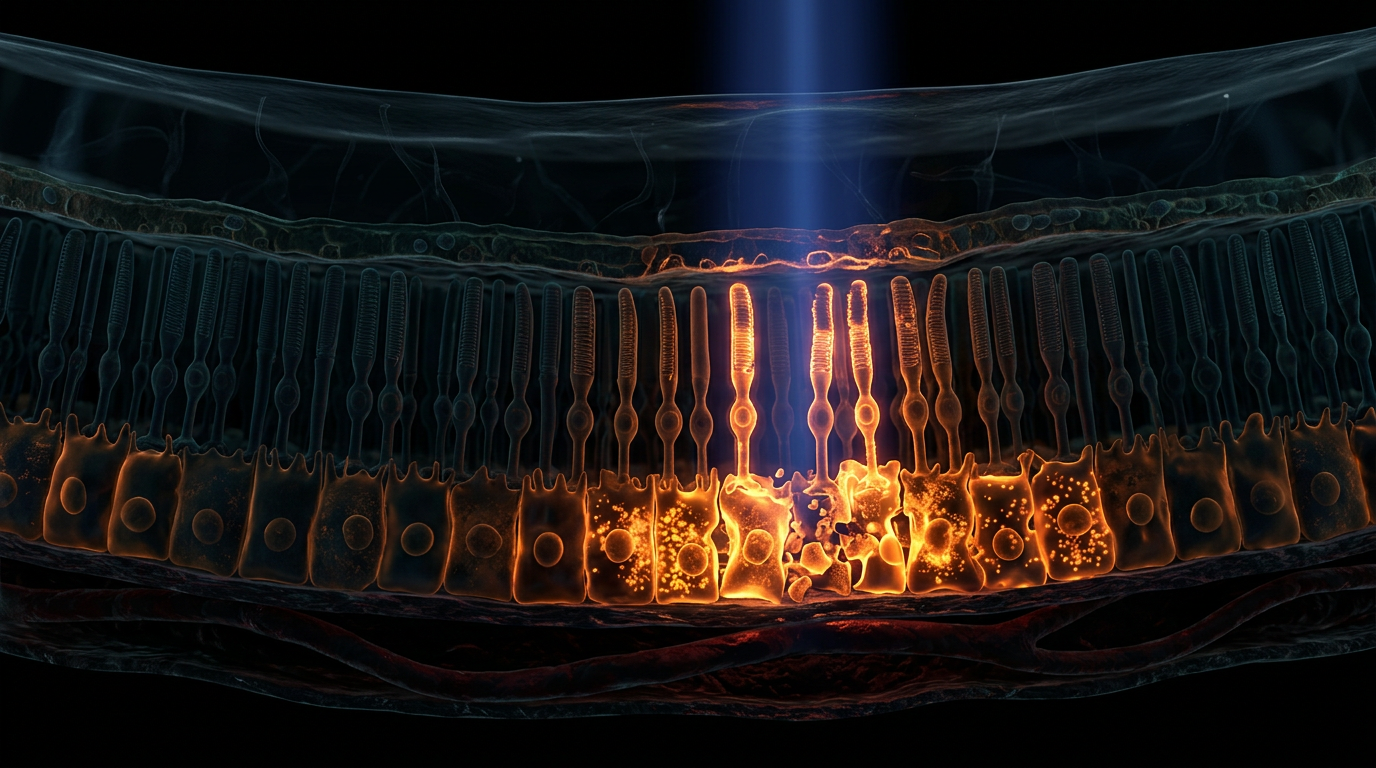
At the heart of this transition lies a hidden metabolic crisis: Blue Light Toxicity. While the mainstream media and industry-funded "experts" often downplay the risks as mere "digital eye strain," the biological reality is far more sinister. We are witnessing a direct, photochemical assault on the Retinal Pigment Epithelium (RPE), the single layer of post-mitotic cells that serves as the life-support system for our vision.
The Retinal Pigment Epithelium is arguably the most metabolically active tissue in the human body. It is responsible for the regeneration of visual pigments, the transport of nutrients, and the disposal of toxic metabolic by-products. When exposed to the high-energy short-wavelength light (400–490 nm) emitted by digital screens, the RPE undergoes a process of photochemical stress. This is not a heat-based burn, but a sub-lethal, cumulative degradation of cellular integrity.
This article serves as a comprehensive technical exposé for INNERSTANDING, detailing how artificial blue light acts as a catalyst for cellular senescence, the accumulation of "cellular sludge" known as lipofuscin, and the eventual apoptotic death of retinal cells. We will look past the marketing gloss of "blue light filters" to reveal the molecular mechanism of how our digital environment is accelerating the path toward irreversible vision loss.
The Biology — How It Works
To understand the toxicity of blue light, one must first appreciate the delicate architecture of the posterior segment of the eye. The retina is not a passive film in a camera; it is an outgrowth of the central nervous system, a complex neural tissue that processes light into electrical signals.
The Role of the Retinal Pigment Epithelium (RPE)
The RPE is a monolayer of hexagonal cells situated between the neurosensory retina (photoreceptors) and the choroid (the blood supply). Its functions are multifaceted and critical:
- Phagocytosis: Every day, the outer segments of your rods and cones are shed. The RPE acts as a "janitor," engulfing and digesting these discarded tips to prevent toxic buildup.
- The Visual Cycle: The RPE recycles "spent" Vitamin A (all-trans-retinal) back into its light-sensitive form (11-cis-retinal), allowing you to continue seeing.
- Light Absorption: It contains high concentrations of melanin and lipofuscin to absorb stray light and protect the underlying tissues.
- Blood-Retinal Barrier: It controls the transport of nutrients from the blood to the photoreceptors and removes metabolic waste.
The "Blue Light" Paradox
Light exists on a spectrum of energy. Wavelengths are inversely proportional to energy; the shorter the wavelength, the higher the photon energy. Blue light (400-490nm) sits right next to Ultraviolet (UV) light on the spectrum. While the cornea and lens are remarkably efficient at filtering out UV-B and most UV-A, they are almost completely transparent to visible blue light.
Fact 1: Unlike UV light, which is largely absorbed by the front of the eye, over 95% of high-energy visible (HEV) blue light reaches the retina, where it can strike the RPE directly.
When these high-energy photons hit the retina, they don't just "show" us the colour blue. They provide enough energy to kick-start photochemical reactions that would not occur under lower-energy (red or orange) light. In a natural environment, this blue light is always accompanied by high levels of Near-Infrared (NIR) light. NIR light (600nm to 1500nm) has been shown to prime the mitochondria for repair and stimulate the production of cytochrome c oxidase. Artificial LEDs, however, produce a massive "Blue Spike" at approximately 450nm with almost zero output in the protective NIR range. This "un-coupled" blue light is the primary driver of modern retinal stress.
Mechanisms at the Cellular Level
The toxicity of blue light is primarily mediated through the production of Reactive Oxygen Species (ROS) and the degradation of the RPE's digestive capacity. This is a three-pronged attack involving mitochondrial disruption, lysosomal failure, and the formation of the "death molecule," A2E.
1. The Mitochondrial Heist
The RPE cells are packed with mitochondria to fuel their immense metabolic demands. Blue light is known to be absorbed by mitochondrial chromophores, such as cytochrome c oxidase and flavin-containing enzymes. When excessive blue light hits these enzymes, it disrupts the electron transport chain. Instead of producing ATP (cellular energy), the mitochondria begin to leak electrons, reacting with oxygen to create superoxide radicals and hydrogen peroxide. This state of oxidative stress damages mitochondrial DNA (mtDNA), creating a vicious cycle of energy failure and further radical production.
2. The Accumulation of Lipofuscin
Lipofuscin is often called the "age pigment." It is a fluorescent, yellowish-brown granular material that accumulates within the lysosomes of RPE cells over a lifetime. It is composed of the undigested remains of photoreceptor outer segments. In a healthy, young eye, the RPE can clear this waste. However, under the constant barrage of artificial blue light, the RPE becomes overwhelmed.
3. The A2E Catalyst
The most toxic component of lipofuscin is a pyridinium bis-retinoid called A2E (N-retinylidene-N-retinylethanolamine). A2E is a byproduct of the visual cycle. Crucially, A2E is a photosensitizer. This means that when A2E is exposed to blue light, it becomes highly unstable. It reacts with oxygen to form epoxides—reactive molecules that attack the lysosomal membranes of the RPE cell.
Fact 2: When A2E within the RPE is irradiated with 430nm-450nm blue light, it triggers a "photochemical explosion" that ruptures cellular membranes, leading to immediate lysosomal leakage and cell death.
Once the lysosomal membrane is breached, digestive enzymes leak into the cytoplasm, essentially causing the cell to digest itself from the inside out. This is a non-apoptotic form of cell death that triggers inflammation in the surrounding tissue.
Environmental Threats and Biological Disruptors
The threat of blue light is not merely theoretical; it is a consequence of our specific technological environment. We have replaced the "incandescent age" (which was rich in red/infrared light) with the "LED age."
The 450nm Spike
Most white LEDs used in smartphones, tablets, and office lighting are actually Blue LEDs coated with a yellow phosphor. The phosphor converts some of the blue light into longer wavelengths to create a "white" appearance. However, if you look at the spectral power distribution (SPD) of these devices, there is a massive, sharp spike at 450nm. This is precisely the wavelength that is most efficiently absorbed by A2E and causes the most significant mitochondrial damage.
Proximity and Inverse Square Law
A common industry counter-argument is that "the sun has more blue light than a phone." While true in absolute terms, this ignores the Inverse Square Law and the duration of exposure. We do not stare directly at the sun. We do, however, stare directly at backlit LED screens for 8 to 12 hours a day, often at a distance of less than 30 centimetres. The intensity of light on the retina increases exponentially as the source moves closer.
Night-time Exposure and the Circadian Mismatch
The RPE follows a circadian rhythm. Phagocytosis (the cleaning process) typically peaks in the morning, following the onset of light. By exposing ourselves to artificial blue light late into the night, we disrupt the melatonin cycle. Melatonin is not just a "sleep hormone"; it is one of the most potent antioxidants produced within the eye.
Fact 3: Melatonin is synthesized locally in the retina and RPE. Exposure to blue light at night suppresses this local melatonin production, stripping the RPE of its primary internal defence mechanism against oxidative damage.
The Cascade: From Exposure to Disease
The cumulative effect of these photochemical insults leads to a predictable clinical progression. This is the "Cascade of Decay" that INNERSTANDING seeks to highlight before the damage becomes irreversible.
Phase 1: Metabolic Fatigue
Initially, the damage manifests as "Digital Eye Strain" (asthenopia). This is often misdiagnosed as purely muscular fatigue of the ciliary muscles. In reality, it is also the result of metabolic exhaustion in the RPE and the depletion of the macular pigment (lutein and zeaxanthin) as it tries to quench the incoming blue photons.
Phase 2: Chronic Inflammation and Drusen
As RPE cells become dysfunctional, they stop efficiently transporting waste to the choroid. This waste begins to build up between the RPE and the underlying Bruch's membrane. Clinically, these deposits are known as Drusen. Drusen are the "hallmark" of early Age-Related Macular Degeneration (AMD). Their presence indicates that the RPE is no longer keeping up with the toxic load.
Phase 3: Geographic Atrophy (Dry AMD)
As lipofuscin levels reach a critical threshold and blue light exposure continues, RPE cells begin to die off in "patches." This is called Geographic Atrophy. Because the photoreceptors (the cells that actually see) depend entirely on the RPE for survival, they die shortly after the RPE is gone. This leads to permanent blind spots in the central vision.
Phase 4: Neovascularization (Wet AMD)
In a desperate attempt to bring more oxygen and nutrients to the dying retina, the body may trigger the growth of new, "leaky" blood vessels from the choroid. These vessels bleed and scar, leading to rapid and profound vision loss. While "Wet AMD" is treatable with painful intraocular injections, "Dry AMD" (the result of RPE atrophy) currently has no pharmaceutical cure.
Fact 4: Recent studies suggest that the "blue light hazard" may be a significant contributor to the global rise in "Early-Onset AMD," with cases being diagnosed in individuals in their 40s and 50s, whereas it was previously considered a disease of the elderly.
What the Mainstream Narrative Omits
The consumer electronics industry and certain ophthalmological associations often claim that there is "no evidence" that blue light from screens causes eye disease. This is a carefully worded semantic trap. When they say "no evidence," they mean there are no 50-year longitudinal human clinical trials—because the technology hasn't existed that long. However, the mechanistic evidence is overwhelming.
The Myth of "Low Intensity"
Industry advocates argue screen intensity is too low to cause thermal damage. This is a straw man argument. The danger of blue light in the RPE is photochemical, not thermal. Photochemical damage is cumulative. Like radiation exposure, it is the total "dose" over time (Intensity x Duration) that determines the pathology.
The "Blue Light Filter" Deception
Many "blue light blocking" glasses sold today are essentially useless. Most clear "blue-cut" lenses only filter about 10-15% of the blue light, specifically in the 400-420nm range. They do almost nothing to block the 450nm peak found in LEDs. Furthermore, many software "Night Shift" modes merely change the colour temperature without significantly reducing the photon flux of the blue light spike.
The Suppression of Red Light Therapy
The mainstream narrative almost never mentions the Red/Blue balance. In nature, blue light is always balanced by the presence of red and infrared light. Studies have shown that pre-exposing or concurrently exposing retinal cells to 670nm (deep red) light can protect them from blue-light-induced death. This is because red light improves mitochondrial efficiency and reduces ROS production. By stripping red light out of our environment and replacing it with pure blue/white LEDs, we have removed the biological "antidote" to light-induced stress.
The UK Context
In the United Kingdom, the blue light crisis is exacerbated by specific cultural and environmental factors. The UK's high latitude means that for several months of the year, natural sunlight is scarce, and the population relies heavily on artificial, indoor lighting.
The British Workplace
The UK has one of the highest rates of "VDU" (Visual Display Unit) usage in Europe. British office workers spend an average of 9 hours a day in front of screens, often under high-intensity fluorescent or LED ceiling lights which lack any restorative red frequencies. The Health and Safety (Display Screen Equipment) Regulations 1992 are woefully outdated, focusing on ergonomic posture while completely ignoring the spectral health of the ocular environment.
The Schools Crisis
Perhaps most concerning is the rapid adoption of tablets and "interactive whiteboards" in UK schools. Children’s eyes are even more vulnerable than adults'. Before the age of 10, the lens of a child’s eye is extremely clear, allowing even more blue light to reach the retina. We are effectively "solar-burning" the retinas of the next generation before they reach adulthood.
The NHS Burden
Age-Related Macular Degeneration is already the leading cause of sight loss in the UK, affecting over 600,000 people. The cost to the NHS and the UK economy is billions of pounds annually. If the blue light hypothesis continues to be ignored by public health bodies, we are facing an "AMD epidemic" that will overwhelm the healthcare system in the coming decades.
Fact 5: The Macular Society UK has noted that the number of people with AMD is expected to double by 2050, a trajectory that aligns perfectly with the total "LED-ification" of our environment.
Protective Measures and Recovery Protocols
Understanding the toxicity of blue light is the first step. The second is implementing a rigorous "Ocular Hygiene" protocol to mitigate the damage. At INNERSTANDING, we advocate for a biological approach to protection.
1. Optical Shielding (The Amber Standard)
For any screen use after sunset, or for prolonged high-intensity work, "clear" blue blockers are insufficient. You require Amber or Red-tinted lenses that are lab-certified to block 100% of light up to 450nm and at least 50% up to 500nm. This significantly reduces the excitation of A2E in the RPE.
2. Spectral Balancing (Red Light Therapy)
Introduce 670nm - 850nm (Red and Near-Infrared) light back into your environment. Spending 5–10 minutes in front of a high-quality red light therapy device in the morning can "prime" the mitochondria in your RPE, making them more resilient to the blue light stress they will face during the day.
3. Nutritional Fortification: The Macular Pigment
The body has a natural "internal blue blocker": the Macular Pigment. This is a layer of carotenoids (Lutein, Zeaxanthin, and Meso-zeaxanthin) that sits directly in front of the RPE.
- Lutein & Zeaxanthin: Found in dark leafy greens (kale, spinach) and egg yolks. They act as "optical filters," absorbing blue light before it hits the RPE.
- Astaxanthin: Often called the "King of Carotenoids," it is one of the few antioxidants capable of crossing the blood-retinal barrier to neutralize singlet oxygen and ROS within the RPE itself.
- DHA (Omega-3): The photoreceptor membranes are made of DHA. However, DHA is highly susceptible to "lipid peroxidation" by blue light. Ensuring high levels of high-quality Omega-3 is vital for membrane repair.
4. Environmental Modification
- Flicker Reduction: Many cheap LEDs flicker at high frequencies (Pulse Width Modulation), which stresses the RPE's metabolic rate. Switch to "flicker-free" lighting.
- The 20-20-20 Rule (Expanded): Every 20 minutes, look 20 feet away for 20 seconds, but do so while looking toward a source of natural, indirect sunlight or a red-biased incandescent bulb.
- Software is not enough: Do not rely solely on "Night Mode." Lower the "Backlight" or "Brightness" setting of your monitor to the lowest comfortable level. This reduces the total photon flux (the number of "bullets" hitting your retina).
5. Sunlight Exposure
Paradoxically, the best way to protect against artificial light is more natural light. Morning sunlight (low-angle sun) is rich in Near-Infrared light and helps set the circadian rhythm of the RPE, ensuring that its "cleaning" and "repair" cycles are functioning at peak efficiency.
Summary: Key Takeaways
The Retinal Pigment Epithelium is the silent casualty of the digital revolution. While our devices offer convenience and connectivity, they do so by emitting a specific, high-energy frequency of light that our eyes were never designed to process in such high doses or for such long durations.
- Blue light is a photochemical toxin, not a thermal one. It damages the RPE through oxidative stress and the production of Reactive Oxygen Species (ROS).
- A2E (Lipofuscin) is the "ticking time bomb" in your eyes. When triggered by 450nm blue light, it causes lysosomal rupture and cell death.
- Artificial LEDs are "unbalanced." Unlike the sun, they provide toxic blue spikes without the protective and regenerative near-infrared wavelengths.
- The mainstream narrative ignores the cumulative dose. Just because a screen doesn't "burn" your eyes instantly doesn't mean it isn't causing progressive, sub-clinical degradation.
- The UK is at high risk. Our indoor-centric, screen-heavy culture is creating a perfect storm for a future epidemic of macular degeneration.
- Protection is possible. By using high-quality amber filters, supplementing with macular carotenoids, and utilizing red light therapy, we can fortify our RPE against the digital assault.
We must move beyond "eye strain" and start talking about retinal preservation. The eyes are the windows to the soul, but they are also a delicate piece of biological hardware that is currently being overwritten by a digital frequency for which there is no evolutionary precedent. Protect your RPE today, or lose your vision tomorrow.
"Stay vigilant. Stay INNERSTANDING."
This article is provided for informational and educational purposes only. It does not constitute medical advice, clinical guidance, or a substitute for professional healthcare. Information reflects cited research at time of publication. Always consult a qualified healthcare professional before acting on any health information.
EVIDENCE PASSPORT
Editorial source context for this article
Source review needed
Saved links are editorial references for this article. They may support specific claims rather than every sentence. Open and assess each source in context. This passport does not independently verify them.
Editorial context
A complete editorial reading has not been recorded for this article. Source links remain available for you to open and assess directly.
Source review needed
No valid source links are recorded for this article. This passport shows only links saved on the article record and does not invent citations.
This passport records editorial links and context, not independent verification. Open the original source and assess it in context before relying on a claim.
Medical Disclaimer
The information in this article is for educational purposes only and does not constitute medical advice, diagnosis, or treatment. Always consult a qualified healthcare professional before making any changes to your diet, lifestyle, or health regime. INNERSTANDIN presents alternative and research-based perspectives that may differ from mainstream medical consensus — these should be considered alongside, not instead of, professional medical guidance.
Read Full DisclaimerContinue the thread
Keep this question moving.
Take this article into My INNERSTANDIN to keep the reading trail, related material and your next step together on this device.
Explore this in the Body Map
See where this hits your biology. Interactive anatomy, threats, and protective protocols.