
Breakthroughs in AMD Treatment: From Stem Cells to Gene Therapy
Updated May 2026
A comprehensive look at the future of retinal health and the cutting-edge therapies aimed at reversing vision loss in elderly patients.
Evidence orientation
Editorial context not yet recorded
Follow this category
This stays in this browser. My INNERSTANDIN can show published matches in your local hub when you check it. It does not send email, push, or alert notifications.
Local learning review
A private browser aid for revisiting ideas. It is not an alert or a health recommendation.
Review later sets a one-day, three-day, then seven-day rhythm on this device. Choose it only when you want to revisit this article.
The human eye is often described as the window to the soul, but physiologically, it is the most metabolically demanding organ in the body. Within this complex optical system, the macula—a tiny area at the centre of the retina—is responsible for our sharpest vision, allowing us to read, recognise faces, and discern intricate details. When this area falters, the world literally darkens.
Age-Related Macular Degeneration (AMD) has long been framed by the medical establishment as an inevitable consequence of longevity. However, emerging research suggests that AMD is not merely a "wear and tear" condition, but a complex intersection of mitochondrial failure, environmental toxicity, and genetic susceptibility. We are currently witnessing a paradigm shift. We are moving away from the "wait and see" approach of the past towards a future defined by regenerative cellular patches and genetic rewiring.
In the United Kingdom, AMD is the leading cause of sight loss, affecting over 600,000 people. Projections suggest that by 2050, the number of individuals with late-stage AMD in the UK will rise to 1.3 million due to an ageing population and modern lifestyle stressors.
The Biological Mechanisms: A Failure of Cellular Housekeeping
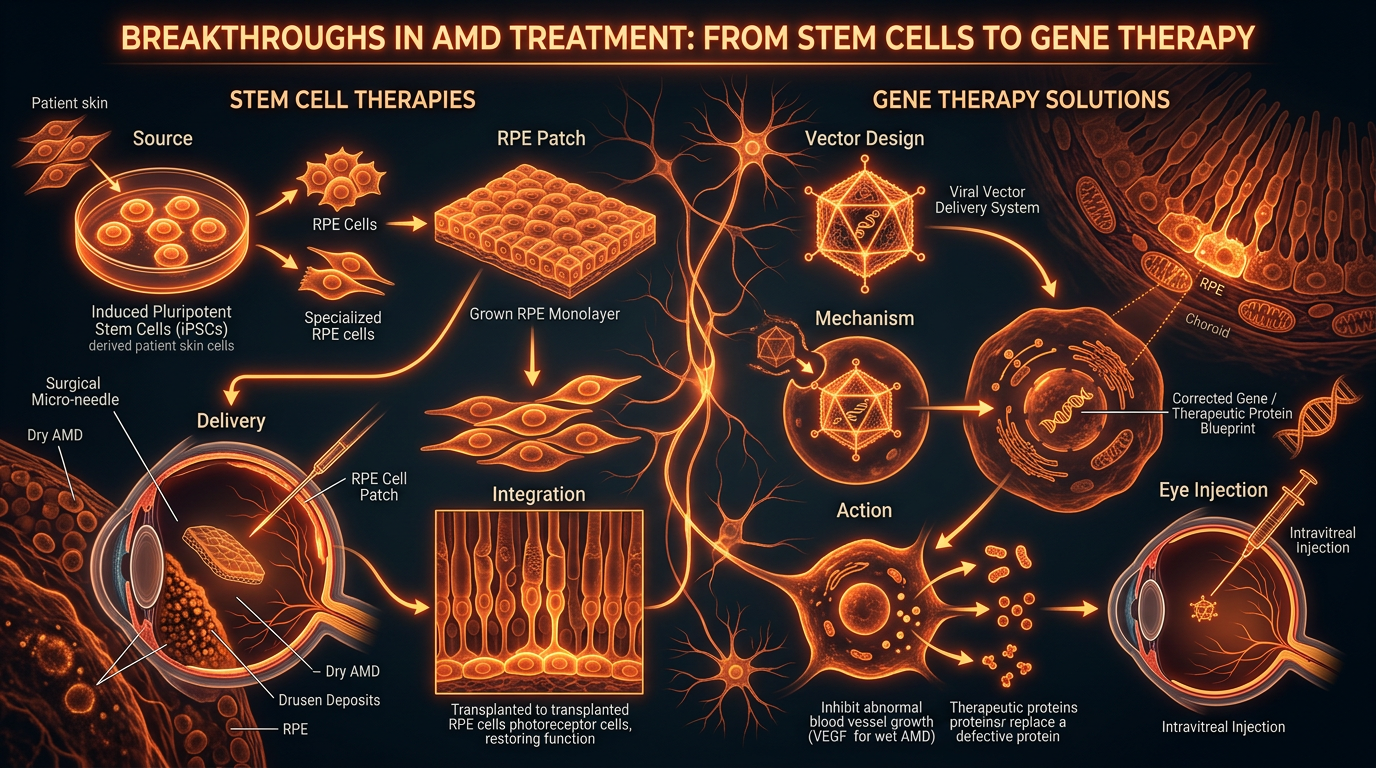
To understand the breakthroughs, one must first grasp the failure. AMD is primarily a disease of the Retinal Pigment Epithelium (RPE). The RPE is a single layer of cells that acts as the "caretaker" for the photoreceptors. It provides nutrients, absorbs excess light, and, crucially, removes metabolic waste.
The Drusen Enigma
The earliest clinical sign of AMD is the accumulation of drusen—small, yellow deposits of fatty proteins (lipids) under the retina. In the "truth-exposing" light of modern biochemistry, drusen are not just random debris; they are the result of "incomplete digestion." When the RPE cells become overwhelmed by oxidative stress, they lose their ability to process discarded photoreceptor outer segments. This leads to the formation of lipofuscin, a fluorescent "age pigment" that is essentially cellular sludge.
Dry vs. Wet: The Pathological Divergence
- Dry AMD (Geographic Atrophy): Characterised by the slow, progressive death of RPE cells. There is currently no widely available NHS treatment that can reverse this, though it accounts for 90% of cases.
- Wet AMD (Neovascular): A more aggressive form where the body, in a desperate attempt to bring oxygen to dying tissues, grows abnormal, leaky blood vessels behind the retina. While "anti-VEGF" injections can manage this, they do not cure the underlying cause.
Environmental Disruptors: The Modern Assault on Sight
The mainstream narrative often ignores the environmental catalysts that accelerate macular decay. If AMD were purely genetic or age-related, we would not see such a staggering rise in its prevalence in industrialised nations.
The Blue Light Hazard and Circadian Mismatch
We evolved under the full-spectrum light of the sun, which includes a balanced ratio of Near-Infrared (NIR) and visible light. Modern LED lighting and digital screens emit high-energy visible (HEV) blue light without the protective, regenerative NIR counter-balance. This blue light penetrates deep into the retina, triggering the production of reactive oxygen species (ROS) that damage the mitochondria within the RPE.
The Seed Oil Hypothesis
Recent independent research has scrutinised the role of polyunsaturated fatty acids (PUFAs), specifically linoleic acid found in industrial seed oils (sunflower, rapeseed, soybean). These oils are highly prone to oxidation. When they integrate into the retinal membranes, they react with blue light to form toxic by-products like 4-HNE, which accelerates the formation of drusen.
Glyphosate and Micronutrient Chelation
The widespread use of glyphosate in British agriculture has a secondary effect: it chelates (binds to) essential minerals like zinc and copper. The macula has the highest concentration of zinc in the human body, where it is a vital co-factor for antioxidant enzymes. A mineral-depleted food supply is, therefore, a direct contributor to retinal vulnerability.
Breakthroughs in Stem Cell Therapy: The London Project
The most promising frontier for "curing" blindness lies in the London Project to Cure Blindness, a collaboration between Moorfields Eye Hospital and UCL.
The "Patch" Technology
Researchers have developed a method to grow a single layer of RPE cells from human embryonic stem cells. These cells are arranged on a synthetic scaffold, creating a "patch." This patch is then surgically inserted under the retina of patients with severe wet AMD.
- The Result: In clinical trials, patients who could not read even with glasses were able to read up to 80 words per minute after the transplant.
- The Implication: This proves that the retina is not "dead," but rather "malnourished" due to RPE failure. By replacing the caretaker cells, the existing photoreceptors can be revived.
3D Bio-printing the Retina
Beyond simple patches, scientists are now using 3D bio-printing to create complex, multi-layered retinal tissues. By using "bio-ink" containing stem cells, they can replicate the delicate architecture of the blood-retina barrier, offering hope for those with advanced Geographic Atrophy.
Gene Therapy: Rewriting the Ocular Script
While stem cells replace the hardware, gene therapy seeks to fix the software. Many individuals with AMD have a genetic predisposition involving the Complement Factor H (CFH)—a part of the immune system that, when overactive, attacks the retina.
Targeting the Complement System
New gene therapies involve injecting a viral vector (a harmless virus) into the eye. This vector carries instructions for the retinal cells to produce proteins that inhibit the immune system's attack on the macula. This essentially "turns off" the inflammation that drives Dry AMD.
Sustained-Release Anti-VEGF
For Wet AMD, the current "gold standard" involves monthly injections into the eyeball. This is both distressing for the patient and a burden on the NHS. Gene therapy breakthroughs now allow the eye itself to become a "bio-factory." A one-time injection can program retinal cells to continuously produce anti-VEGF proteins, potentially eliminating the need for lifelong injections.
According to the Macular Society, the cost of sight loss to the UK economy is estimated at £28 billion annually. Investing in gene therapy and stem cell research is not just a medical imperative, but an economic one.
Recovery Protocols: A Biocentric Approach
High-authority research must acknowledge that while we wait for mainstream clinical availability of gene patches, there are "innerstanding" protocols that can halt or even reverse early-stage macular stress.
1. Photobiomodulation (PBM)
The use of 670nm red/near-infrared light has shown remarkable results in clinical trials. A brief exposure (3 minutes) to deep red light in the morning has been shown to "recharge" the mitochondria in the RPE cells, improving contrast sensitivity in older adults.
2. Targeted Nutraceuticals
The AREDS2 study is the mainstream benchmark, but it is often insufficient. A more robust protocol includes:
- Astaxanthin: A potent carotenoid that crosses the blood-retina barrier.
- Saffron: Recent trials suggest 20mg of saffron daily can improve retinal flicker sensitivity.
- Lutein and Zeaxanthin: Specifically sourced from organic, whole-food origins to ensure bioavailability.
- Taurine: The most abundant amino acid in the retina, crucial for membrane stability.
3. Mitohormesis and Autophagy
To clear out the "cellular trash" (drusen), one must activate the body's natural recycling system: autophagy.
- Intermittent Fasting: Reduces systemic inflammation and encourages the RPE to clear metabolic waste.
- Cold Exposure: Increases Mitochondrial Uncoupling Proteins (UCPs), which can reduce oxidative stress in high-metabolic tissues like the retina.
The Truth Exposed: The Iatrogenic Blind Spot
The tragedy of modern AMD treatment is that it often ignores the bio-electrical nature of the eye. The eye is not a mechanical camera; it is a living crystalline structure that requires a specific electromagnetic environment.
The medical-industrial complex focuses heavily on lucrative injections (Anti-VEGF) while neglecting the preventative "environmental hygiene" that could stop AMD before it starts. There is little profit in advising patients to sit in the morning sun, avoid seed oils, or wear blue-blocking glasses after sunset. However, for the individual seeking to preserve their vision, these "low-tech" interventions are as critical as the "high-tech" gene therapies.
The Future: A Multi-Modal Approach
The eradication of AMD will not come from a single "magic bullet." It will be a combination of:
- Genetic Screening: Identifying CFH risk factors in one's 30s.
- Environmental Modification: Protecting the RPE from the digital light era.
- Regenerative Surgery: Using stem-cell patches to replace "burnt out" RPE layers.
The breakthroughs we are seeing today in the London Project and CRISPR trials suggest that blindness from AMD may soon become a choice rather than a destiny. By understanding the biological mechanisms and the environmental disruptors, we can move from a state of passive decay to active ocular regeneration.
Conclusion: The Vision Reclaimed
We are moving past the era where a diagnosis of AMD meant a slow descent into a grey, blurred world. The integration of stem cell biology and gene editing is providing the tools to rebuild the retina. However, the "innerstanding" of this condition requires us to look beyond the eyeball. We must address the metabolic health of the entire organism, the toxicity of our modern diet, and the unnatural light environments we inhabit.
The breakthroughs are here. The science is definitive. The preservation of sight in the 21st century is no longer a matter of luck, but a matter of applying this high-level research to our daily lives while supporting the clinical advancements that will eventually restore sight to the millions currently in the dark.
Summary of Key Findings:
- RPE Replacement: Stem cell patches are successfully restoring reading-level vision in UK clinical trials.
- Genetic Editing: Gene therapy is turning the eye into a self-sustaining pharmacy, reducing the need for invasive injections.
- Mitochondrial Health: AMD is a systemic metabolic failure manifesting in the eye; red light therapy and autophagy are essential preventative measures.
- Environmental Toxins: Blue light and oxidized PUFAs are the primary drivers of the modern AMD epidemic.
This article is provided for informational and educational purposes only. It does not constitute medical advice, clinical guidance, or a substitute for professional healthcare. Information reflects cited research at time of publication. Always consult a qualified healthcare professional before acting on any health information.
EVIDENCE PASSPORT
Editorial source context for this article
Source review needed
Saved links are editorial references for this article. They may support specific claims rather than every sentence. Open and assess each source in context. This passport does not independently verify them.
Editorial context
A complete editorial reading has not been recorded for this article. Source links remain available for you to open and assess directly.
Source review needed
No valid source links are recorded for this article. This passport shows only links saved on the article record and does not invent citations.
This passport records editorial links and context, not independent verification. Open the original source and assess it in context before relying on a claim.
Medical Disclaimer
The information in this article is for educational purposes only and does not constitute medical advice, diagnosis, or treatment. Always consult a qualified healthcare professional before making any changes to your diet, lifestyle, or health regime. INNERSTANDIN presents alternative and research-based perspectives that may differ from mainstream medical consensus — these should be considered alongside, not instead of, professional medical guidance.
Read Full DisclaimerContinue the thread
Keep this question moving.
Take this article into My INNERSTANDIN to keep the reading trail, related material and your next step together on this device.
Explore this in the Body Map
See where this hits your biology. Interactive anatomy, threats, and protective protocols.