
Decoding SIBO Breath Tests: Methane, Hydrogen, and Hydrogen Sulfide Explained
Updated May 2026
Learn how to interpret SIBO breath test results, distinguishing between hydrogen, methane, and hydrogen sulfide overgrowth for targeted treatment.
Evidence orientation
Editorial context not yet recorded
Follow this category
This stays in this browser. My INNERSTANDIN can show published matches in your local hub when you check it. It does not send email, push, or alert notifications.
Local learning review
A private browser aid for revisiting ideas. It is not an alert or a health recommendation.
Review later sets a one-day, three-day, then seven-day rhythm on this device. Choose it only when you want to revisit this article.
For decades, the British medical establishment has relegated chronic bloating, abdominal pain, and erratic bowel habits to the "dustbin diagnosis" of Irritable Bowel Syndrome (IBS). Patients were told their symptoms were a byproduct of stress or "functional" issues—essentially implying the pathology was psychological or idiopathic.
However, emerging research and clinical precision suggest a more tangible culprit. It is now estimated that up to 78% of those diagnosed with IBS actually suffer from Small Intestinal Bacterial Overgrowth (SIBO). This is not merely a "disorder of the mind," but a fundamental breakdown of the biological machinery of the upper gastrointestinal tract. To understand SIBO is to understand the gas chromatography of the human breath—the window into the microbial fermentation occurring within the small intestine.
The Biological Mechanism: Why the Breath Reveals the Gut
The human body does not produce hydrogen or methane gas. These gases are the exclusive metabolic byproducts of microbial fermentation. In a healthy state, the majority of our microbiome resides in the large intestine (colon). When bacteria or archaea migrate upwards into the small intestine—an area designed for nutrient absorption, not fermentation—they hijack our caloric intake.
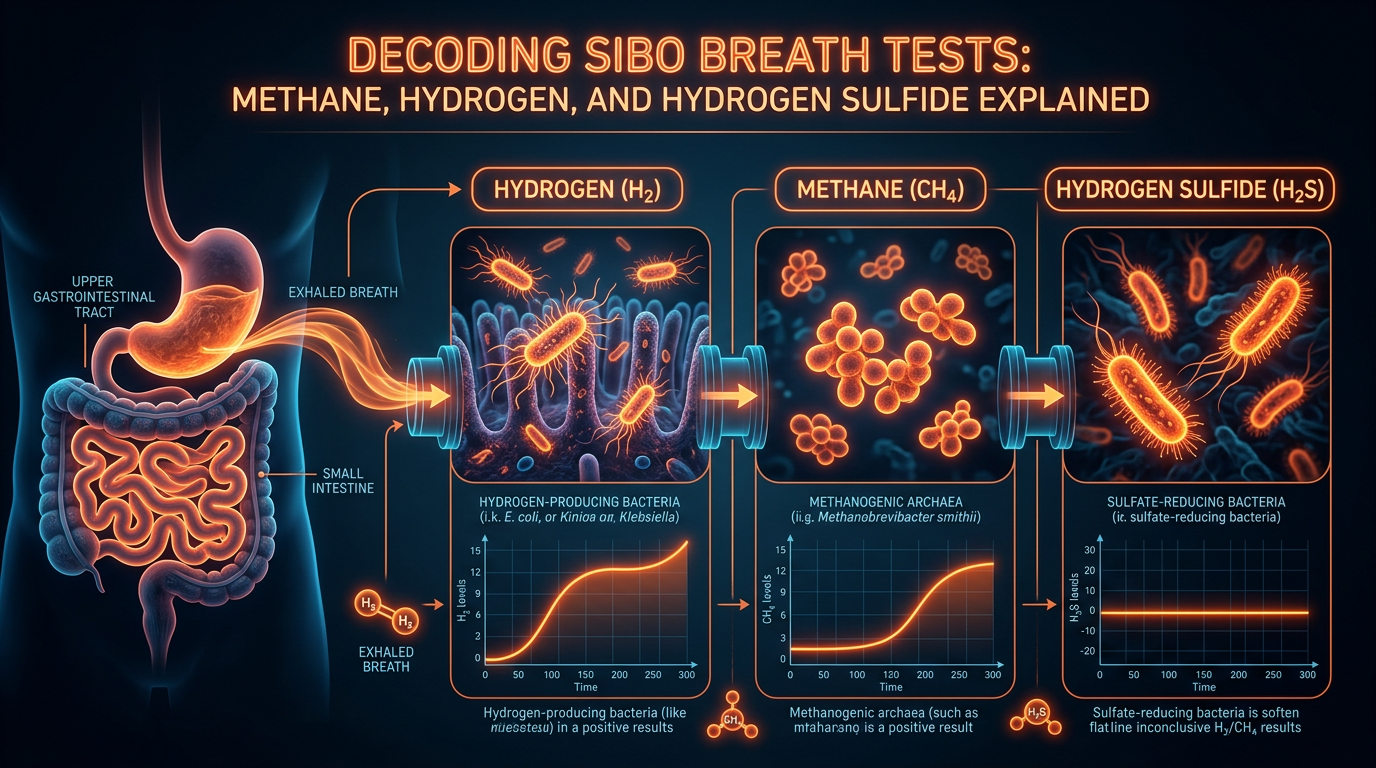
When we consume carbohydrates, these misplaced microbes ferment the sugars, releasing gases that diffuse through the intestinal wall into the bloodstream. These gases travel to the lungs and are exhaled. By measuring the concentrations of these gases over a three-hour window following a "substrate challenge" (usually lactulose or glucose), we can map the location and severity of the overgrowth.
The Migrating Motor Complex (MMC): The Silent Custodian
The primary mechanism preventing SIBO is the Migrating Motor Complex (MMC). This is a distinct electromechanical wave of motility that occurs every 90 to 120 minutes during a fasting state (between meals and overnight). It acts as a "cleansing wave," sweeping residual food and bacteria into the colon.
When the MMC is impaired—through stress, food poisoning (Post-Infectious IBS), or environmental toxins—bacteria stagnate. This stagnation allows for the colonisation of the small intestine, leading to the diverse gas profiles we see in breath testing.
The Three Horsemen: Hydrogen, Methane, and Hydrogen Sulfide
Modern diagnostics have evolved beyond the binary. We now recognise three distinct gases, each representing a unique microbial ecosystem and requiring a specific therapeutic approach.
1. Hydrogen (H2) - The Fermentation Accelerator
Hydrogen-dominant SIBO is typically associated with "classical" SIBO. It is produced by various gram-negative bacteria, such as E. coli and Klebsiella, as they ferment carbohydrates.
- Clinical Presentation: Often associated with osmotic diarrhoea, urgent bowel movements, and rapid-onset bloating (the "food baby" effect) within 30–60 minutes of eating.
- Biochemical Significance: Hydrogen acts as the primary fuel source for other microbes. It is the "currency" of the small intestine.
- Threshold for Diagnosis: A rise of ≥20 parts per million (ppm) from the lowest preceding value within 90–120 minutes.
2. Methane (CH4) - The Methanogen Overgrowth
In a shift of nomenclature, methane-dominant cases are now officially termed Intestinal Methanogen Overgrowth (IMO). This is because the organisms responsible—Methanobrevibacter smithii—are not bacteria, but Archaea, an entirely different kingdom of life.
- Clinical Presentation: Methane is highly correlative with chronic constipation. Methane gas acts as a paralytic to the gut wall, slowing transit time (the "methane brake").
- Biochemical Significance: Methanogens consume four molecules of hydrogen to produce one molecule of methane. This is why some patients may show low hydrogen levels but high methane; the methanogens are "eating" the hydrogen.
- Threshold for Diagnosis: Any level ≥10 ppm at any point during the test is considered positive.
3. Hydrogen Sulfide (H2S) - The Toxic Flatline
Until recently, hydrogen sulfide was the "missing link" in SIBO testing. Patients would present with clear SIBO symptoms but produce a "flatline" on traditional tests (0 ppm for both H2 and CH4). This occurred because H2S-producing bacteria (like Desulfovibrio and Bilophila wadsworthia) were consuming the hydrogen before the test could detect it.
- Clinical Presentation: Foul-smelling gas (rotten eggs), visceral hypersensitivity (pain), and systemic symptoms like brain fog, bladder irritation, and intolerance to sulfur-rich foods (broccoli, eggs, garlic).
- Biochemical Significance: H2S is a potent gasotransmitter. In low doses, it’s beneficial; in the high doses found in SIBO, it is mitochondrial-toxic and can damage the intestinal lining.
- Threshold for Diagnosis: A rise of ≥3 ppm is considered positive on specialised Trio-Smart breath tests.
"In the United Kingdom, it is estimated that 1 in 10 people suffer from IBS-like symptoms, with a significant proportion remains undiagnosed for SIBO due to a lack of standardised testing within the NHS. Private pathology reports suggest that of those testing for SIBO, nearly 30% exhibit the previously 'invisible' hydrogen sulfide profile."
Environmental Disruptors: The Truth-Exposing Reality
The prevalence of SIBO in the UK is not an accident of evolution. It is a direct result of environmental stressors that have dismantled our natural defences.
The Glyphosate Factor
The UK’s agricultural reliance on glyphosate-based herbicides is a major disruptor. Glyphosate acts as a broad-spectrum antibiotic and mineral chelator. It specifically targets the shikimate pathway—a metabolic pathway found in beneficial gut bacteria but not in humans. By selectively killing off "good" microbes and allowing "bad" ones like Clostridia to thrive, it creates the dysbiotic environment necessary for SIBO to take hold.
The PPI Trap
Proton Pump Inhibitors (PPIs) are among the most over-prescribed drugs in the UK. By suppressing stomach acid, they remove the first line of defence against ingested bacteria. Low stomach acid (hypochlorhydria) ensures that bacteria entering the mouth survive the transit into the small intestine, leading to colonisation.
Ultra-Processed Diets and Emulsifiers
The modern British diet is replete with emulsifiers (carboxymethylcellulose and polysorbate 80). These compounds act like detergents, thinning the protective mucus layer of the gut. This allows bacteria to adhere directly to the intestinal epithelial cells, triggering inflammation and further slowing the Migrating Motor Complex.
The Testing Dilemma: Lactulose vs. Glucose
One of the most contentious areas in SIBO diagnostics is the choice of substrate.
- Glucose: Highly accurate for diagnosing overgrowth in the proximal (upper) small intestine. However, because glucose is rapidly absorbed by the human body, it rarely reaches the distal (lower) small intestine. This leads to a high rate of false negatives.
- Lactulose: A synthetic sugar that humans cannot digest. It travels the entire length of the small intestine, making it superior for detecting overgrowth in the ileum (the most common site for SIBO).
The Truth Exerted: Many conventional practitioners prefer glucose because it is "cleaner," but for the chronic patient, lactulose provides a more comprehensive map of the entire 20-foot stretch of the small intestine.
Recovery Protocols: Beyond the "Kill Phase"
Mainstream medicine often treats SIBO with a single round of Rifaximin (a non-absorbable antibiotic). While often effective for Hydrogen SIBO, this "one-size-fits-all" approach frequently fails, leading to relapse within months. A truly integrative recovery protocol must be multi-phasic.
1. The Targeted Kill Phase
Treatment must be gas-specific:
- Hydrogen: Rifaximin (550mg, 3x daily) or herbal antimicrobials like Berberine and Neem.
- Methane: Rifaximin plus Neomycin (or Allicin/Garlic extract) to target the archaea.
- Hydrogen Sulfide: Bismuth subsalicylate combined with Oregano oil and Uva Ursi.
2. The Prokinetic Phase (The Critical Missing Step)
The highest failure rate in SIBO treatment is due to the lack of prokinetics. Once the bacteria are cleared, the "broom" (the MMC) must be restarted to prevent re-colonisation.
- Natural Prokinetics: Ginger root, 5-HTP, and MotilPro.
- Pharmaceutical Prokinetics: Low-dose Erythromycin or Prucalopride (Resolor), taken at bedtime.
3. Diet as a Bridge, Not a Destination
The Low FODMAP diet is the gold standard for symptom management, but it is not a cure. Long-term restriction of fermentable fibres leads to a "starving" of the colonic microbiome, which can cause permanent damage to microbial diversity.
- The Protocol: Use Low FODMAP during the kill phase to reduce gas pressure, but begin a slow reintroduction of diversely fermented fibres as soon as the prokinetic phase is established.
"Statistical data from UK-based integrative clinics show that patients who use a prokinetic after treatment have a 60% lower relapse rate compared to those who only use antibiotics."
The INNERSTANDING Perspective: A Holistic Synthesis
To truly "innerstand" SIBO is to recognise that the overgrowth is a symptom, not the root cause. The bacteria are the opportunistic squatters; the root cause is the "broken house"—be it through a damaged MMC, low stomach acid, or environmental toxicity.
We must move away from the "war on bacteria." Even the "pathogenic" microbes in SIBO are often just normal residents in the wrong postcode. The goal of breath testing is not merely to find something to kill, but to identify the specific nature of the ecological imbalance.
Summary Checklist for the Informed Patient:
- Test, Don't Guess: Insist on a 3-gas breath test (H2, CH4, H2S) using lactulose.
- Address Motility: If you don't fix the Migrating Motor Complex, the SIBO will return.
- Environmental Audit: Filter your water (to remove chlorine and fluoride), choose organic where possible to avoid glyphosate, and evaluate the necessity of PPIs.
- Vagus Nerve Support: The gut-brain axis governs motility. Stress management isn't "woo-woo"—it’s a physiological requirement for the MMC to function.
The path to gastrointestinal health is not found in masking symptoms with antacids or "living with" a vague IBS diagnosis. It is found in the rigorous, scientific decoding of our internal atmosphere. By understanding the gases we exhale, we can finally reclaim the health of the terrain within.
This article is provided for informational and educational purposes only. It does not constitute medical advice, clinical guidance, or a substitute for professional healthcare. Information reflects cited research at time of publication. Always consult a qualified healthcare professional before acting on any health information.
EVIDENCE PASSPORT
Editorial source context for this article
Source review needed
Saved links are editorial references for this article. They may support specific claims rather than every sentence. Open and assess each source in context. This passport does not independently verify them.
Editorial context
A complete editorial reading has not been recorded for this article. Source links remain available for you to open and assess directly.
Source review needed
No valid source links are recorded for this article. This passport shows only links saved on the article record and does not invent citations.
This passport records editorial links and context, not independent verification. Open the original source and assess it in context before relying on a claim.
Medical Disclaimer
The information in this article is for educational purposes only and does not constitute medical advice, diagnosis, or treatment. Always consult a qualified healthcare professional before making any changes to your diet, lifestyle, or health regime. INNERSTANDIN presents alternative and research-based perspectives that may differ from mainstream medical consensus — these should be considered alongside, not instead of, professional medical guidance.
Read Full DisclaimerContinue the thread
Keep this question moving.
Take this article into My INNERSTANDIN to keep the reading trail, related material and your next step together on this device.