
Deep Ketosis vs. Cycling: Navigating the Spectrum of Metabolic Health
Updated May 2026
Exploring the physiological differences between maintaining long-term nutritional ketosis and strategic carbohydrate refeeds to optimize thyroid function.
Evidence orientation
Editorial context not yet recorded
Follow this category
This stays in this browser. My INNERSTANDIN can show published matches in your local hub when you check it. It does not send email, push, or alert notifications.
Local learning review
A private browser aid for revisiting ideas. It is not an alert or a health recommendation.
Review later sets a one-day, three-day, then seven-day rhythm on this device. Choose it only when you want to revisit this article.
In the contemporary landscape of nutritional science, a reductionist tug-of-war has emerged. On one side stands the orthodox medical establishment, still tethered to the vestiges of the ‘Eatwell Plate’ and a glucose-centric paradigm. On the other, an increasingly vocal community of ‘keto-maximalists’ who view the presence of dietary carbohydrates as an inherent biological error.
At INNERSTANDING, we recognise that truth rarely resides at the extremes of a pendulum’s swing. To achieve true metabolic mastery, one must look beyond the macronutrient ratios and delve into the cellular signalling pathways that govern human longevity. The objective is not merely to ‘lose weight’, but to achieve metabolic flexibility—the ancestral ability to switch seamlessly between burning glucose and oxidising fatty acids.
This treatise explores the nuances of deep ketosis versus metabolic cycling, exposing the physiological mechanisms that the mainstream often overlooks.
The Biological Mechanisms of Deep Ketosis: More Than a Fuel Shift
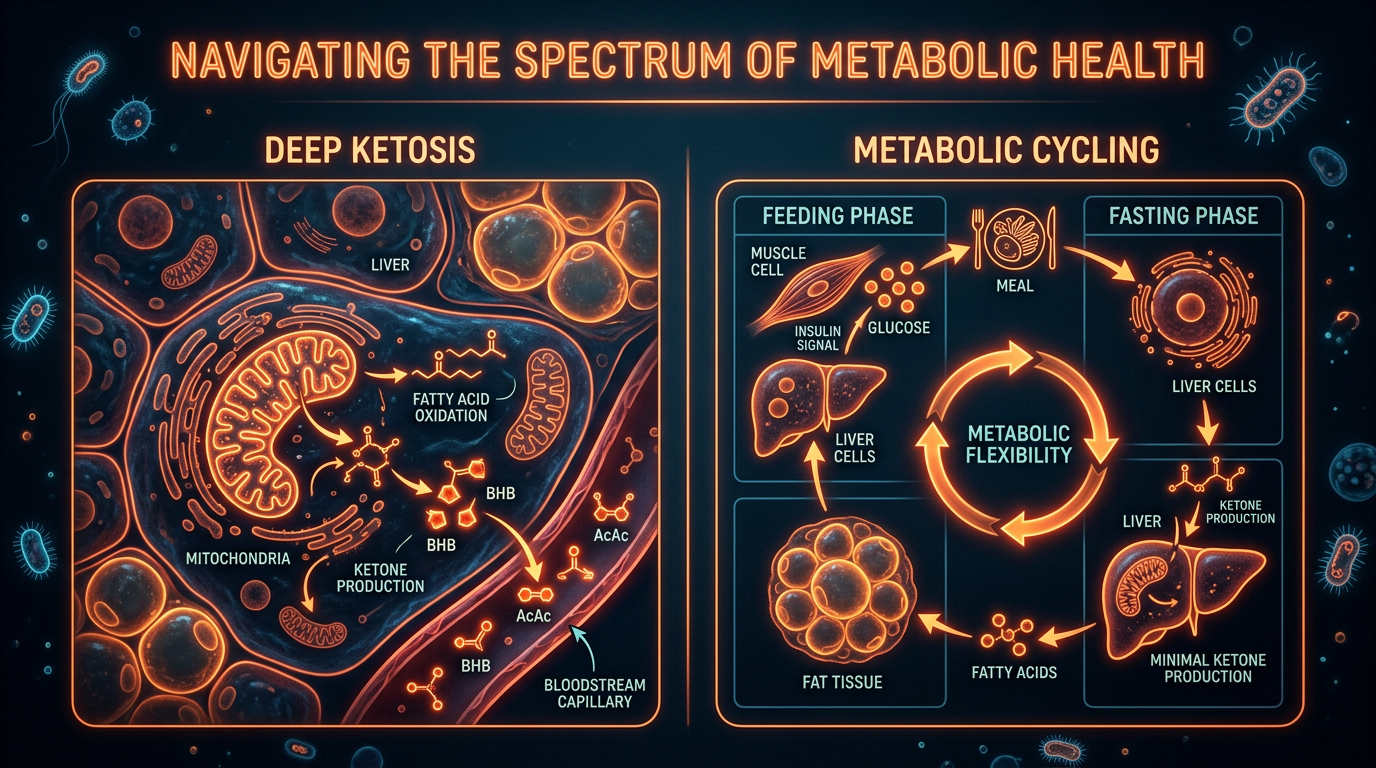
Ketosis is frequently mischaracterised as a mere ‘dietary hack’. In reality, it is an evolutionary survival mechanism—a sophisticated physiological state known as adaptive thermogenesis. When the body is deprived of exogenous glucose, the liver converts adipose tissue into water-soluble molecules: Acetoacetate, Beta-hydroxybutyrate (BHB), and Acetone.
BHB: The Master Signalling Molecule
While the primary purpose of BHB is to provide ATP for the brain when glucose is scarce, its role as a histone deacetylase (HDAC) inhibitor is where the ‘magic’ of deep ketosis resides. By inhibiting HDACs, BHB alters gene expression, upregulating the production of:
- BDNF (Brain-Derived Neurotrophic Factor): Often referred to as ‘Miracle-Gro’ for the brain, enhancing neuroplasticity and cognitive resilience.
- SOD and Catalase: Endogenous antioxidants that neutralise oxidative stress more effectively than any external supplement.
- FOXO3a: A longevity gene associated with stress resistance and cellular repair.
Mitochondrial Uncoupling and Efficiency
Deep, sustained ketosis induces ‘mitochondrial uncoupling’. This process allows mitochondria to ‘leak’ protons, which reduces the production of Reactive Oxygen Species (ROS). In simpler terms, burning ketones is ‘cleaner’ than burning glucose, resulting in less cellular ‘exhaust’ and reduced systemic inflammation.
According to the Health Survey for England, approximately 28% of adults in the UK are living with obesity, and a further 36% are overweight. This metabolic crisis is fundamentally a crisis of mitochondrial dysfunction and insulin resistance, where the body has lost its ability to enter deep ketosis even during periods of fasting.
The Trap of Chronic Ketosis: Why the Pendulum Must Swing
If deep ketosis is so restorative, why not remain there indefinitely? This is where the ‘truth-exposing’ element of our research becomes critical. The human body is not a static machine; it is a rhythmic, biological system.
The Thyroid and Leptin Connection
Prolonged, uninterrupted ketosis can signal to the hypothalamus that the environment is in a state of permanent famine. This can lead to a down-regulation of the thyroid gland, specifically the conversion of T4 to the active T3 hormone. T3 is essential for metabolic rate and protein synthesis. Furthermore, chronic low insulin levels can lead to a drop in Leptin, the satiety hormone, eventually triggering a ‘starvation response’ that stalls weight loss and disrupts reproductive hormones.
The Role of Insulin as an Anabolic Signal
Mainstream keto-advocates often demonise insulin, but insulin is a vital anabolic signal. It is required for:
- Electrolyte Retention: The kidneys require insulin to reabsorb sodium. This explains why chronic keto-dieters often suffer from ‘keto flu’ or heart palpitations—they are in a perpetual state of mineral wastage.
- mTOR Activation: While we want to suppress mTOR (the growth pathway) for autophagy, we must occasionally activate it to maintain muscle mass and bone density.
Metabolic Cycling: The Art of the Strategic Refeed
Metabolic cycling (or the Cyclical Ketogenic Diet - CKD) is the practice of moving between deep ketosis and periods of controlled carbohydrate intake. This is not a ‘cheat meal’; it is a physiological reset.
Seasonal and Circadian Synchronicity
Our ancestors did not have access to tropical fruits in the depths of a British winter, nor were they in ketosis during the height of the summer harvest.
- The Winter Metabolism (Deep Ketosis): Focuses on cellular cleanup (autophagy), fat oxidation, and mitochondrial repair.
- The Summer Metabolism (Cycling): Focuses on growth, hormonal replenishment, and glycogen restoration.
The Mechanism of Glucose Disposal
By cycling, we train the GLUT4 transporters to remain sensitive. When a metabolically flexible individual consumes carbohydrates after a period of ketosis, the insulin response is efficient, shuttling glucose directly into the muscles rather than storing it as visceral fat.
- Phase 1: Deep Depletion (3–4 weeks): Establishing the enzymatic machinery to burn fat.
- Phase 2: The Pulse (Weekly or Bi-weekly): Introducing complex, ancestral carbohydrates (tubers, seasonal fruits) to signal hormonal safety.
- Phase 3: The Flow: Transitioning to a state where the body can switch fuels within hours, not weeks.
Environmental Disruptors: The Invisible Barriers to Flexibility
One cannot discuss metabolic health without addressing the modern environment. Even the most rigorous ketogenic protocol can be undermined by ‘environmental obesogens’ and disruptors prevalent in the UK today.
Blue Light and Insulin Resistance
The Master Clock in the brain (the Suprachiasmatic Nucleus) regulates insulin sensitivity. Exposure to artificial blue light from screens after sunset suppresses melatonin and elevates cortisol. Elevated nocturnal cortisol triggers hepatic gluconeogenesis—the liver dumps glucose into the bloodstream even if you haven't eaten a single carb.
Public Health England has noted a significant rise in Type 2 Diabetes diagnoses among younger demographics. While diet is a factor, the 'light environment' and disrupted circadian rhythms play a silent, yet devastating role in metabolic rigidity.
Endocrine Disruptors and PFAS
Chemicals found in non-stick cookware, plastic packaging, and UK tap water (PFAS or 'forever chemicals') act as 'mimetics'. They can bind to hormone receptors, interfering with the signalling of PPAR-alpha, the receptor responsible for fat burning. If your chemical ‘load’ is too high, your body will prioritise toxicant sequestration in fat cells over fat oxidation.
The INNERSTANDING Recovery Protocol: Reclaiming the Spectrum
To move from metabolic rigidity to high-authority health, one must follow a structured recovery of the biological systems.
1. Circadian Alignment
Before adjusting macronutrients, one must adjust light exposure.
- Morning: 10 minutes of direct sunlight to set the cortisol/melatonin rhythm.
- Evening: Eliminate blue light 2 h before bed to prevent nocturnal glucose spikes.
2. The ‘Ancestral Aperture’ (Time-Restricted Feeding)
The UK’s ‘grazing’ culture is a metabolic disaster. Recovery begins with narrowing the feeding window.
- Aim for a 16:8 or 18:6 window.
- Ensure the final meal is consumed at least 3 hours before sleep to allow the heart rate to drop and autophagy to begin.
3. Micronutrient Fortification
Ketosis is a demanding metabolic state. Without the following co-factors, cycling fails:
- Magnesium Bisglycinate: Essential for over 300 enzymatic reactions, including ATP production.
- Potassium/Sodium Balance: Using high-quality sea salt (e.g., Celtic or Maldon) to support the adrenal glands during the transition into ketosis.
- Omega-3 (DHA/EPA): To maintain cell membrane fluidity, allowing insulin receptors to function correctly.
4. Strategic Carbohydrate Selection
When cycling out of deep ketosis, the source of glucose is paramount. We advocate for the ‘Cellular over Acellular’ rule.
- Acellular Carbs (Avoid): Flour, refined sugars, processed grains. These hit the system too fast, causing massive insulin spikes.
- Cellular Carbs (Favour): Sweet potatoes, squash, berries, and fermented sourdough. These contain intact cellular walls and fibre, slowing the glucose release and feeding the gut microbiome.
Truth-Exposing: The Industry of ‘Perpetual Ketosis’
The health-optimisation industry often pushes ‘exogenous ketones’ and ‘keto-branded’ processed foods as a shortcut. The truth is that exogenous ketones can actually inhibit lipolysis (the breakdown of your own body fat) because the body senses an energy surplus and shuts down its endogenous production.
Furthermore, the obsession with ‘testing blood strips’ can lead to a psychological state of orthorexia. High ketone levels in the blood do not always equate to high levels of cellular health; they can simply reflect a lack of ketone utilisation by the tissues.
Statistics from the ONS suggest that the 'Wellness' sector in the UK is growing, yet metabolic markers are declining. This suggests a disconnect between the products being sold and the biological reality of the consumers.
Conclusion: Mastering the Pendulum
Deep ketosis is a powerful therapeutic tool—a ‘reset’ button for the human genome. It clears cellular debris, sharpens the mind, and silences the fires of inflammation. However, it is a state of intensity, not a state of permanence.
The ultimate expression of metabolic health is the ability to feast and fast, to burn glucose during high-intensity output and ketones during rest and repair. By navigating the spectrum between deep ketosis and strategic cycling, and by mitigating the environmental disruptors of the 21st century, we move beyond ‘dieting’.
We enter a state of INNERSTANDING—where we no longer follow a set of rigid rules, but rather listen to the biological signals of a body that is finally, and fully, metabolically free.
- Deep Ketosis: For repair, longevity, and neurological clarity.
- Cycling: For hormonal health, physical performance, and social integration.
- The Result: Absolute metabolic flexibility.
This article is provided for informational and educational purposes only. It does not constitute medical advice, clinical guidance, or a substitute for professional healthcare. Information reflects cited research at time of publication. Always consult a qualified healthcare professional before acting on any health information.
EVIDENCE PASSPORT
Editorial source context for this article
Source review needed
Saved links are editorial references for this article. They may support specific claims rather than every sentence. Open and assess each source in context. This passport does not independently verify them.
Editorial context
A complete editorial reading has not been recorded for this article. Source links remain available for you to open and assess directly.
Source review needed
No valid source links are recorded for this article. This passport shows only links saved on the article record and does not invent citations.
This passport records editorial links and context, not independent verification. Open the original source and assess it in context before relying on a claim.
Medical Disclaimer
The information in this article is for educational purposes only and does not constitute medical advice, diagnosis, or treatment. Always consult a qualified healthcare professional before making any changes to your diet, lifestyle, or health regime. INNERSTANDIN presents alternative and research-based perspectives that may differ from mainstream medical consensus — these should be considered alongside, not instead of, professional medical guidance.
Read Full DisclaimerContinue the thread
Keep this question moving.
Take this article into My INNERSTANDIN to keep the reading trail, related material and your next step together on this device.
Dig deeper in the Library
Free, longform PDF volumes that go beyond headlines into mechanisms and references.