
Direct-to-Cell: Merging Satellite and Cellular Ecosystems
Updated May 2026
Examining the technical hurdles and commercial potential of Non-Terrestrial Networks (NTN) in providing seamless global 5G coverage via low-earth orbit satellites.
Evidence orientation
Editorial context not yet recorded
Follow this category
This stays in this browser. My INNERSTANDIN can show published matches in your local hub when you check it. It does not send email, push, or alert notifications.
Local learning review
A private browser aid for revisiting ideas. It is not an alert or a health recommendation.
Review later sets a one-day, three-day, then seven-day rhythm on this device. Choose it only when you want to revisit this article.
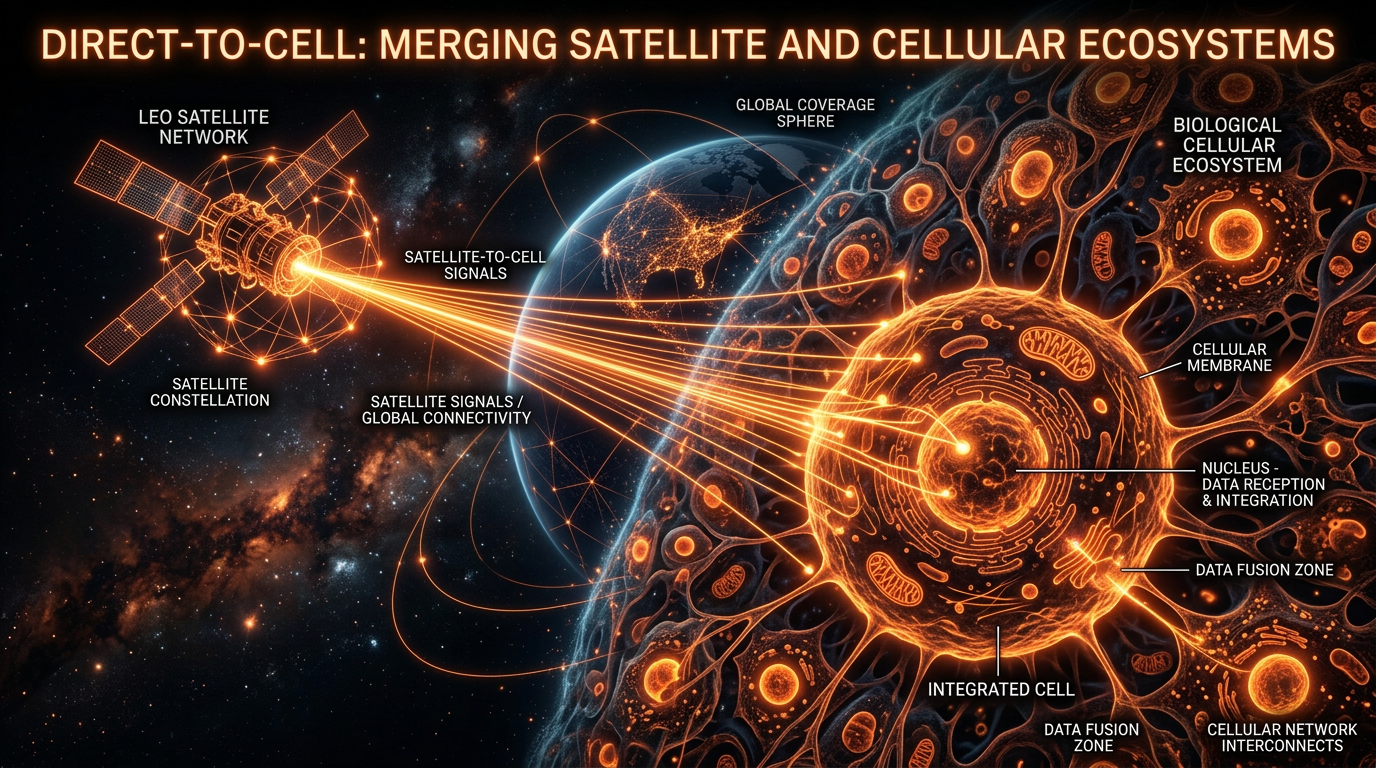
The Silent Integration: An Introduction to Direct-to-Cell Technology
For decades, the boundary between the terrestrial cellular network and the orbital satellite array was clearly defined. Mobile phones communicated with local masts, while satellite phones required specialised, bulky hardware to reach geostationary orbits. That boundary has now been dissolved. We are witnessing the birth of Direct-to-Cell (D2C) technology—a seamless integration where standard LTE and 5G smartphones connect directly to Low-Earth Orbit (LEO) satellite constellations.
Whilst industry narratives focus on "closing the digital divide" and "ubiquitous connectivity," the biological and atmospheric reality is far more complex. We are effectively enclosing the planet in a high-frequency electromagnetic canopy. This research piece investigates the mechanics of D2C, its disruption of the Earth’s natural electrical circuits, the biological consequences of constant pulse-modulated exposure, and the necessary protocols for physiological recovery.
The Orbital Infrastructure: How D2C Operates
Direct-to-Cell technology bypasses the need for ground-based intermediate hardware. Companies such as SpaceX (Starlink), AST SpaceMobile, and Lynk Global are deploying "cell towers in space."
Phased Array Beamforming
Unlike traditional satellites that broadcast broad signals, D2C satellites use sophisticated phased-array antennas. These create narrow, high-intensity beams that "track" individual handsets on the Earth’s surface. This requires massive computational power to compensate for the Doppler shift caused by satellites travelling at 17,000 mph.
Spectrum Integration
D2C utilises existing terrestrial spectrum (typically 600 MHz to 900 MHz and the 1.9 GHz mid-band). By using these frequencies, the industry ensures that the billions of devices already in pockets are hardware-ready for orbital connection.
According to recent UK telecommunications data, the government’s 'Wireless Infrastructure Strategy' aims for nationwide 5G coverage by 2030, with satellite integration cited as a primary method for reaching the final 5% of the UK landmass that remains 'topographically challenged.'
Environmental Disruptors: The Atmospheric Toll
The transition from terrestrial-only to orbital-integrated wireless systems introduces stressors into the upper atmosphere that have remained largely unexamined by mainstream regulatory bodies.
Ionospheric Perturbation
The Earth’s ionosphere acts as a protective shield and a resonant cavity for the planet’s natural electrical heartbeat. D2C technology requires thousands of satellites to pulse high-frequency signals through the ionosphere constantly. There is growing concern among biophysicists that this "electromagnetic smog" in the LEO region may interfere with the Schumann Resonance (7.83 Hz)—the frequency to which all mammalian biology is evolutionary tuned.
Chemical Alteration of the Stratosphere
The sheer volume of rocket launches required to maintain these constellations—given that LEO satellites have a lifespan of only five years—is injecting tonnes of alumina and soot into the stratosphere. This not only depletes the ozone layer but increases the "dielectric constant" of the atmosphere, potentially altering how natural solar radiation interacts with the planet's surface.
- Alumina Injection: Reflects solar energy but traps terrestrial heat.
- Plasma Tracks: Re-entering satellites create plasma trails that are highly conductive, potentially altering the global atmospheric electrical circuit.
Biological Mechanisms: The Impact of Continuous Exposure
The primary concern with D2C is the removal of "Electromagnetic Silent Zones." Previously, one could retreat to rural or wilderness areas to escape high-frequency radiation. With D2C, the signal is delivered from above, meaning there is no topographical shield.
1. Voltage-Gated Calcium Channels (VGCCs)
The most documented mechanism of non-ionising radiation harm is the activation of VGCCs. Research pioneered by Dr Martin Pall demonstrates that pulsed microwave radiation triggers these channels in the cell membrane, leading to an influx of calcium ions into the cytoplasm.
- The Result: An immediate increase in nitric oxide (NO), which reacts with superoxide to form peroxynitrite.
- The Damage: Peroxynitrite creates potent free radicals that cause oxidative stress, DNA single-strand breaks, and mitochondrial dysfunction.
2. Melatonin Suppression and Circadian Disruption
The human pineal gland is magnetosensitive. The introduction of a global satellite grid increases the "background noise" of the electromagnetic environment. Even at low intensities, pulsed RF (Radio Frequency) radiation has been shown to suppress the production of melatonin—the body’s primary antioxidant and sleep regulator.
3. Blood-Brain Barrier (BBB) Permeability
Studies have indicated that exposure to cellular frequencies can increase the permeability of the Blood-Brain Barrier. This allows toxins, heavy metals, and pathogens—which would normally be filtered out—to enter the brain tissue, potentially accelerating neurodegenerative conditions.
The Truth Exposed: Regulatory Oversight and "Thermal Only" Fallacies
The UK regulatory body, OFCOM, alongside international bodies like ICNIRP, continues to rely on a "thermal-only" safety paradigm. This suggests that if the radiation does not heat human tissue, it is safe.
In the UK, current safety guidelines are based on SAR (Specific Absorption Rate) levels established in the late 1990s. These guidelines do not account for the pulsed nature of 5G and D2C signals, which biological systems perceive as high-frequency stressors regardless of thermal output.
The reality is that biological effects occur at levels millions of times lower than the thermal threshold. By merging satellite and cellular ecosystems, we are participating in a global experiment without an "unexposed" control group.
Recovery Protocols: Navigating a Wireless World
As the D2C canopy becomes permanent, individuals must take proactive steps to maintain biological integrity. Recovery is not about total avoidance—which is becoming impossible—but about increasing the body's resilience and reducing the cumulative load.
Environmental Mitigation
- Create a Sleep Sanctuary: Use "Faraday" shielding (silver-threaded canopies or EMF-blocking paint) for bedrooms. This provides the pineal gland with the "electromagnetic silence" required for deep repair.
- Hardwire Where Possible: Use Ethernet adapters for mobile devices at home. Disable 'Wi-Fi Calling' and 'Bluetooth' when not in use.
- Analog Retreats: Periodically visit areas with heavy forest canopy; while satellite signals penetrate, the biological dampening effect of dense nature provides significant relief to the nervous system.
Physiological Support
- Magnesium Supplementation: Since RF radiation over-activates calcium channels, maintaining high magnesium levels (a natural calcium channel blocker) is critical.
- NRF2 Activation: Consume foods high in sulforaphane (broccoli sprouts) and polyphenols to stimulate the body’s endogenous antioxidant production to combat peroxynitrite damage.
- Earthing (Grounding): Physical contact with the Earth’s surface allows the body to discharge built-up static electricity and "re-sync" with the Earth’s DC (Direct Current) field, counteracting the AC (Alternating Current) stress of the grid.
The "Innerstanding" Perspective
True "innerstanding" comes from recognising that our bodies are not just chemical machines, but exquisite electrical antennae. Our hearts, brains, and cells communicate via micro-currents. The D2C merger represents a profound interference with this internal dialogue.
Conclusion: The Final Frontier of Connectivity
Direct-to-Cell technology is marketed as the ultimate convenience—the end of the "No Service" notification. However, the price of this convenience is the loss of the Earth's electromagnetic pristine zones. As we merge the satellite and cellular ecosystems, we are effectively rewriting the atmospheric conditions under which life has evolved.
We must shift our perspective from viewing these technologies as mere "tools" to recognising them as environmental modifiers. High-authority research dictates that while the digital age offers unprecedented connectivity, the preservation of our biological "signal-to-noise ratio" must become our highest priority.
The integration is here. The question is no longer whether we can stop the signal, but whether we can fortify the human vessel to withstand it.
"References & Technical Context:"
- Impact of LEO Satellites on the Schumann Resonance (Theoretical Biophysics Journal).
- The Role of VGCCs in Non-Ionizing Radiation Sensitivity (Pall, M.).
- UK Wireless Infrastructure Strategy 2023.
- Atmospheric Chemistry and Physics: The impact of rocket emissions on the stratospheric ozone.
This article is provided for informational and educational purposes only. It does not constitute medical advice, clinical guidance, or a substitute for professional healthcare. Information reflects cited research at time of publication. Always consult a qualified healthcare professional before acting on any health information.
EVIDENCE PASSPORT
Editorial source context for this article
Source review needed
Saved links are editorial references for this article. They may support specific claims rather than every sentence. Open and assess each source in context. This passport does not independently verify them.
Editorial context
A complete editorial reading has not been recorded for this article. Source links remain available for you to open and assess directly.
Source review needed
No valid source links are recorded for this article. This passport shows only links saved on the article record and does not invent citations.
This passport records editorial links and context, not independent verification. Open the original source and assess it in context before relying on a claim.
Medical Disclaimer
The information in this article is for educational purposes only and does not constitute medical advice, diagnosis, or treatment. Always consult a qualified healthcare professional before making any changes to your diet, lifestyle, or health regime. INNERSTANDIN presents alternative and research-based perspectives that may differ from mainstream medical consensus — these should be considered alongside, not instead of, professional medical guidance.
Read Full DisclaimerContinue the thread
Keep this question moving.
Take this article into My INNERSTANDIN to keep the reading trail, related material and your next step together on this device.