
FOXO4-DRI: The Selective Removal of Toxic Senescent Cells
Updated May 2026
This peptide interferes with p53-FOXO4 interactions to induce apoptosis in 'zombie' senescent cells. Purging these cells is a revolutionary approach to reversing biological aging and systemic inflammation.
Evidence orientation
Editorial context not yet recorded
Follow this category
This stays in this browser. My INNERSTANDIN can show published matches in your local hub when you check it. It does not send email, push, or alert notifications.
Local learning review
A private browser aid for revisiting ideas. It is not an alert or a health recommendation.
Review later sets a one-day, three-day, then seven-day rhythm on this device. Choose it only when you want to revisit this article.
Overview
The quest for human longevity has transitioned from the realm of speculative fiction into the precision of molecular biology. At the vanguard of this revolution is a peptide known as FOXO4-DRI. As a senior researcher for INNERSTANDING, I have observed the shifting paradigms of gerontology, moving away from merely treating the symptoms of age-related decline and toward the literal excision of the biological drivers of decay.
The primary driver of what we commonly call "ageing" is the accumulation of senescent cells. These are often referred to as 'zombie cells'—biologically active yet replicatively arrested entities that refuse to die. Under normal physiological conditions, a cell that has reached the end of its life cycle or has sustained irreparable DNA damage undergoes apoptosis (programmed cell death). However, senescent cells evade this fate. Instead, they linger in the tissues, secreting a pro-inflammatory cocktail of chemicals that poisons neighbouring healthy cells.
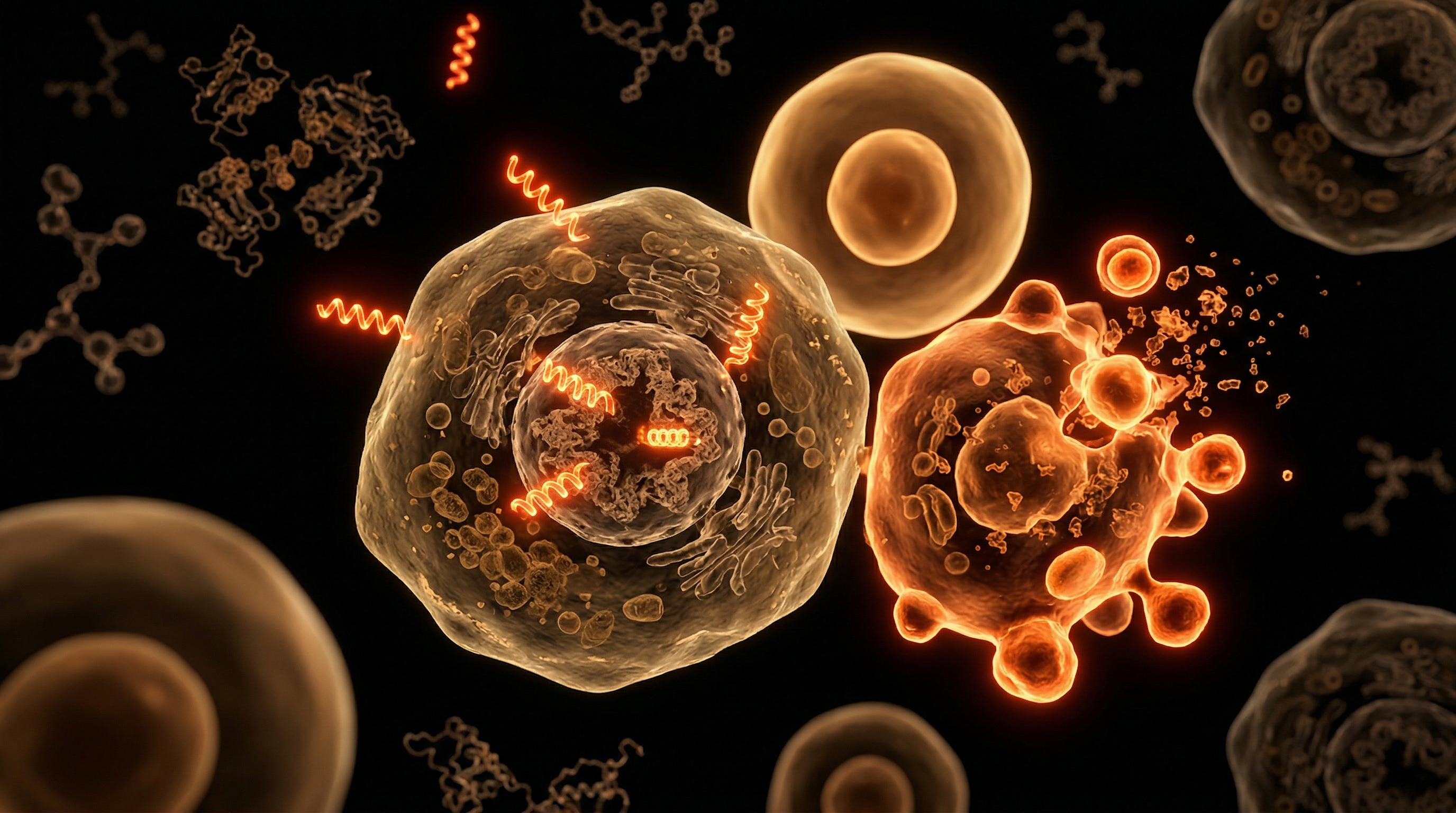
FOXO4-DRI is a synthetic peptide designed to disrupt the protective mechanisms that allow these zombie cells to persist. By interfering with specific protein-protein interactions, it forces these toxic cells to finally undergo apoptosis, thereby "purging" the body of the primary source of systemic inflammation. This is not merely an anti-ageing intervention; it is a fundamental reset of the cellular environment.
"Senescence is the underlying engine of modern chronic disease. By selectively removing these cells, we are no longer managing decline; we are engineering its reversal."
The implications of FOXO4-DRI extend far beyond aesthetic rejuvenation. We are talking about the restoration of organ function, the reversal of frailty, and the mitigation of the "inflammaging" cascade that underpins everything from cardiovascular disease to neurodegeneration. In this report, we will dissect the sophisticated biochemistry of this peptide, the environmental factors that have accelerated our cellular decline, and the reasons why this groundbreaking science remains on the fringes of mainstream medical practice.
The Biology — How It Works
To understand FOXO4-DRI, one must first understand the delicate balance between cell survival and cell death. The human body is a site of constant turnover. When a cell becomes dysfunctional due to oxidative stress, telomere shortening, or oncogenic activation, the p53 protein—often called the "Guardian of the Genome"—is activated.
The p53 protein serves as a molecular judge. It decides whether a cell can be repaired or if it must be destroyed for the good of the organism. In a healthy system, p53 initiates apoptosis. However, senescent cells have evolved a "cheat code" to bypass this judgement.
The Forkhead Box O4 (FOXO4) Shield
Senescent cells overexpress a protein called FOXO4. This protein acts as a biological bodyguard for the senescent cell. It binds to p53 and sequesters it, preventing p53 from entering the mitochondria or the nucleus to trigger the death signal. Essentially, FOXO4 holds p53 hostage, forcing the cell to remain in a state of permanent, toxic suspension.
The DRI Innovation: D-Retro-Inverso
The "DRI" in FOXO4-DRI stands for D-Retro-Inverso. This is a masterpiece of peptide engineering. Natural peptides are composed of L-amino acids, which are easily broken down by the body’s enzymes (proteases). This makes them poor candidates for systemic therapy because they disappear before they can do their job.
The DRI modification involves two specific changes:
- D-Amino Acids: The peptide is built using the "mirror image" versions of amino acids (D-form), which human proteases do not recognise and cannot digest.
- Retro-Inverso: The sequence of the amino acids is reversed.
This combination creates a peptide that maintains the exact three-dimensional shape (topology) required to bind to its target, but with a biological half-life that is exponentially longer than a standard peptide. This allows FOXO4-DRI to circulate through the bloodstream, penetrate tissues, and remain active long enough to seek out and neutralise the FOXO4-p53 complex.
Targeted Elimination
FOXO4-DRI is a senolytic. Unlike traditional chemotherapy, which kills rapidly dividing cells (often harming healthy ones in the process), senolytics are designed to be selective. FOXO4-DRI specifically targets the interaction that is unique to senescent cells. Healthy cells do not rely on the FOXO4-p53 shield for survival; therefore, they remain untouched by the peptide. This selectivity is the "holy grail" of regenerative medicine: the ability to prune the dead wood without damaging the living forest.
Mechanisms at the Cellular Level
At the sub-cellular level, the action of FOXO4-DRI is a orchestrated tactical strike. When the peptide enters a senescent cell, its high affinity for the p53-binding site on the FOXO4 protein allows it to "out-compete" the native p53.
Breaking the Molecular Handshake
The interaction between FOXO4 and p53 is a specific molecular handshake. FOXO4-DRI acts as a wedge, prying these two proteins apart. Once p53 is liberated from its FOXO4 cage, it is free to resume its natural function.
Statistical Fact: Research in murine models demonstrated that targeted removal of senescent cells via FOXO4-DRI resulted in a 25% increase in remaining lifespan and a significant restoration of kidney function and fur density.
Mitochondrial-Mediated Apoptosis
Once p53 is released, it migrates to the mitochondria, the powerhouses of the cell. Here, p53 triggers the release of cytochrome c, which activates a series of enzymes known as caspases. These are the executioners of the cell. They begin a systematic dismantling of the cell's internal structures, packaging the cellular debris into neat "blebs" that can be safely cleared away by the immune system (macrophages).
The SASP Neutralisation
The most profound mechanism of FOXO4-DRI is not just the death of the cell, but the cessation of the SASP (Senescence-Associated Secretory Phenotype). Senescent cells are not dormant; they are hyper-metabolic. They pump out a toxic slurry of:
- Pro-inflammatory cytokines (IL-1, IL-6, IL-8)
- Chemokines
- Matrix Metalloproteinases (MMPs)
- Growth factors
This SASP is "contagious." It induces senescence in neighbouring healthy cells, a phenomenon known as the "bystander effect." By eliminating the source of the SASP, FOXO4-DRI stops the systemic fire at its source, allowing the local tissue microenvironment to return to a state of homeostasis.
Environmental Threats and Biological Disruptors
Why is the accumulation of senescent cells such a crisis in the modern era? While senescence is a natural biological process, our modern environment has become a "senescence accelerator." We are currently living through an unprecedented biological mismatch between our ancient genomes and our synthetic surroundings.
The Chemical Burden
The modern world is saturated with xenobiotics—synthetic chemicals that mimic or disrupt biological pathways. Pesticides like glyphosate, industrial solvents, and plasticisers (BPA and phthalates) are known to induce oxidative stress and DNA damage. When the body's repair mechanisms are overwhelmed by this constant chemical barrage, cells take the "escape hatch" of senescence rather than repairing themselves.
EMFs and Non-Ionising Radiation
While the mainstream narrative often dismisses the biological impact of non-ionising radiation, peer-reviewed research indicates that constant exposure to high-frequency Electromagnetic Fields (EMFs) can disturb the voltage-gated calcium channels in our cell membranes. This leads to an influx of calcium into the cytoplasm, triggering oxidative stress and mitochondrial dysfunction—both of which are primary triggers for the p53-FOXO4 interaction.
The Dietary Disaster: Ultra-Processed Foods and Seed Oils
The consumption of highly processed polyunsaturated fatty acids (PUFAs), such as linoleic acid found in seed oils, leads to the accumulation of lipid peroxidation products like 4-HNE. These toxic byproducts cross-link proteins and damage DNA. Furthermore, the high-sugar, high-insulin environment of the modern Western diet inhibits autophagy (the body's natural cellular cleaning process). When autophagy is suppressed, the body cannot clear out damaged proteins, forcing more cells into a senescent state to prevent them from becoming cancerous.
"Our environment is currently a 'senescence-positive' environment. We are being aged at a rate that far exceeds our evolutionary capacity for repair."
The Cascade: From Exposure to Disease
The progression from environmental exposure to systemic disease is a predictable biological cascade. It begins with the "first hit"—DNA damage or metabolic stress—and ends with the total collapse of organ systems.
Step 1: The Accumulation
In youth, the immune system—specifically Natural Killer (NK) cells—is efficient at identifying and removing senescent cells. As we age, or as we are exposed to the environmental threats mentioned above, the immune system itself becomes senescent (immunesenescence). The "janitors" of the body go on strike. Consequently, senescent cells begin to accumulate exponentially in the skin, the lungs, the cardiovascular system, and the brain.
Step 2: The Chronic Inflammation Loop
As the burden of zombie cells grows, the SASP output reaches a tipping point. This is the origin of "Inflammaging." This low-grade, chronic systemic inflammation is silent. It doesn’t feel like a fever; it feels like stiff joints, brain fog, and fatigue. This inflammation degrades the extracellular matrix, making tissues less elastic and more prone to scarring (fibrosis).
Step 3: Organ-Specific Pathology
The cascade eventually manifests as clinical disease:
- Cardiovascular: Senescent cells in the endothelium (blood vessel lining) promote plaque buildup and arterial stiffness.
- Neurodegeneration: In the brain, senescent astrocytes and microglia secrete neurotoxins that contribute to the formation of amyloid plaques and tau tangles.
- Metabolic: Senescent cells in adipose (fat) tissue drive insulin resistance, leading to Type 2 Diabetes.
- Musculoskeletal: The breakdown of cartilage in joints is directly correlated with the concentration of senescent chondrocytes.
FOXO4-DRI is designed to intervene at Step 1 and 2, preventing the inevitability of Step 3. By removing the "rotten apples" from the barrel, we prevent the "rot" from spreading through the entire organism.
What the Mainstream Narrative Omits
One must ask: If a peptide exists that can selectively reverse cellular ageing and clear the primary driver of chronic disease, why is it not front-page news? Why is it not being prescribed by every GP in the country?
The Profitability of Chronic Disease
The current pharmaceutical model is built on the management of chronic conditions, not their eradication. A patient who takes a daily statin, a daily metformin, and a daily blood pressure medication is a lifelong customer. A senolytic therapy like FOXO4-DRI, which would theoretically be administered in "pulses" (perhaps once every few months or years), represents a threat to the trillion-dollar "sickness industry."
The "Ageing is Natural" Fallacy
Regulatory bodies like the FDA and the MHRA do not currently classify "ageing" as a disease. Because it is not a disease, pharmaceutical companies cannot easily run clinical trials for "anti-ageing." They must instead target specific, narrow conditions like "osteoarthritis of the knee" or "age-related macular degeneration." This fragmentation of medicine ignores the underlying systemic cause—senescence—and forces the science into slow, expensive, and often futile regulatory silos.
The Suppression of Peer-to-Peer Biohacking
There is also a concerted effort to delegitimise the "biohacking" and "grey market" peptide communities. While safety is paramount, the mainstream narrative often uses "safety concerns" as a veil to suppress the public's access to life-extending technologies. By keeping these compounds in the realm of "experimental research chemicals," the establishment maintains control over the timeline of human longevity.
The UK Context
In the United Kingdom, the landscape for senolytic research and FOXO4-DRI is particularly complex. The UK has one of the fastest-ageing populations in Europe, creating a "silver tsunami" that threatens to bankrupt the National Health Service (NHS).
The NHS Crisis and Longevity
The NHS is currently designed for acute care and the management of late-stage chronic disease. It is poorly equipped for preventative, molecular-level interventions. However, Britain is also home to some of the world's leading researchers in cellular senescence, particularly at institutions like the University of Exeter and the University of Cambridge. There is a "tug of war" between the brilliant scientific discoveries happening on British soil and the bureaucratic inertia of the British medical establishment.
Regulatory Hurdles: The MHRA
The Medicines and Healthcare products Regulatory Agency (MHRA) is notoriously conservative. For a peptide like FOXO4-DRI to reach the British public, it must navigate a decade of trials costing hundreds of millions of pounds. Meanwhile, the British public is suffering from record levels of multi-morbidity.
"The UK is in a unique position: we possess the intellectual capital to lead the longevity revolution, yet we are shackled by a regulatory framework that prioritises the status quo over radical life extension."
Furthermore, the UK's "Postcode Lottery" in healthcare means that even if such therapies were approved, access would likely be restricted to the wealthy or those in specific geographic hubs, further widening the health inequality gap.
Protective Measures and Recovery Protocols
While the full clinical application of FOXO4-DRI is still being refined, the science suggests that we can already take steps to mitigate the accumulation of senescent cells and prepare the body for senolytic interventions.
Pulsed Dosing Strategy
Senolytics are not meant to be taken daily. The goal is to "clear the field" and then allow the body to regenerate. In experimental settings, FOXO4-DRI is administered in a pulsed fashion—several doses over a short period (e.g., three doses over six days), followed by a long "rest period" of several months. This allows for the removal of the zombie cells without disrupting the transient, beneficial roles that senescence can play in acute wound healing.
Synergistic Compounds (The Senolytic Stack)
To maximise the efficacy of FOXO4-DRI, researchers often look at synergistic compounds that attack the survival pathways of senescent cells from different angles:
- Quercetin and Dasatinib: The most famous senolytic combination. Quercetin is a plant flavonol that targets the BCL-2 pro-survival pathway.
- Fisetin: Found in strawberries, this is a potent natural senolytic that has shown great promise in human trials for reducing the SASP.
- Piperlongumine: A compound from long pepper that induces apoptosis in senescent cells by increasing oxidative stress specifically within those cells.
Lifestyle Foundations: Autophagy and Hormesis
Before considering peptide intervention, one must address the "biological terrain."
- Fast Intermittently: Fasting is the most potent natural trigger for autophagy. It forces the body to "eat" its own damaged proteins and can kill off weaker senescent cells.
- Hyperthermic Conditioning (Sauna): Heat stress induces heat shock proteins that assist in protein folding and cellular repair.
- Cold Exposure: Cold-water immersion boosts the immune system’s ability to clear cellular debris.
- Avoidance of "Seed Oils" and Refined Sugars: Reducing the intake of linoleic acid and high-fructose corn syrup lowers the baseline rate of senescence induction.
Recovery and Stem Cell Activation
Once senescent cells are cleared, a "vacuum" is created in the tissue. The body must fill this space with new, healthy cells. This requires the activation of stem cells. Supporting this phase with adequate protein intake, GHK-Cu (copper peptides), and perhaps hyperbaric oxygen therapy (HBOT) can ensure that the "clearance" phase is followed by a robust "rebuilding" phase.
Summary: Key Takeaways
The emergence of FOXO4-DRI marks a turning point in human history. We are no longer passive observers of our own decay. We have identified the "zombie cells" that drive our decline and have engineered a precision molecular tool to eliminate them.
- The Mechanism: FOXO4-DRI works by uncoupling the FOXO4-p53 complex, allowing p53 to trigger apoptosis specifically in senescent cells.
- The Selective Advantage: Unlike broad-spectrum toxins, this peptide is highly selective, sparing healthy cells and targeting only the "zombie" population.
- The Environmental Factor: Modern toxins, EMFs, and poor diet have accelerated our cellular ageing, making senolytic therapy a necessity rather than a luxury.
- The Resistance: The medical and pharmaceutical establishment is incentivised to manage symptoms rather than provide cures, leading to the relative obscurity of FOXO4-DRI.
- The Protocol: Effective senolytic therapy involves "pulsed" interventions, lifestyle modifications to trigger autophagy, and a focus on cellular regeneration.
The removal of toxic senescent cells is the single most potent lever we have to pull in the fight against ageing and chronic disease. As we peel back the layers of mainstream misinformation, the truth becomes clear: the power to biologically "reset" our systems is already within our grasp. It is time for a new paradigm of health—one that is defined by the selective purging of the old to make way for the new.
At INNERSTANDING, we remain committed to bringing these suppressed biological truths to the fore. The age of the zombie cell is coming to an end. The age of cellular rejuvenation has begun.
This article is provided for informational and educational purposes only. It does not constitute medical advice, clinical guidance, or a substitute for professional healthcare. Information reflects cited research at time of publication. Always consult a qualified healthcare professional before acting on any health information.
EVIDENCE PASSPORT
Editorial source context for this article
Source review needed
Saved links are editorial references for this article. They may support specific claims rather than every sentence. Open and assess each source in context. This passport does not independently verify them.
Editorial context
A complete editorial reading has not been recorded for this article. Source links remain available for you to open and assess directly.
Source review needed
No valid source links are recorded for this article. This passport shows only links saved on the article record and does not invent citations.
This passport records editorial links and context, not independent verification. Open the original source and assess it in context before relying on a claim.
Medical Disclaimer
The information in this article is for educational purposes only and does not constitute medical advice, diagnosis, or treatment. Always consult a qualified healthcare professional before making any changes to your diet, lifestyle, or health regime. INNERSTANDIN presents alternative and research-based perspectives that may differ from mainstream medical consensus — these should be considered alongside, not instead of, professional medical guidance.
Read Full DisclaimerContinue the thread
Keep this question moving.
Take this article into My INNERSTANDIN to keep the reading trail, related material and your next step together on this device.