
Healing the Blueprint: Combining CRISPR Gene Editing with Stem Cell Therapy
Updated May 2026
Investigating the synergy between precise genomic editing and regenerative medicine to cure hereditary diseases at their cellular origin.
Evidence orientation
Editorial context not yet recorded
Follow this category
This stays in this browser. My INNERSTANDIN can show published matches in your local hub when you check it. It does not send email, push, or alert notifications.
Local learning review
A private browser aid for revisiting ideas. It is not an alert or a health recommendation.
Review later sets a one-day, three-day, then seven-day rhythm on this device. Choose it only when you want to revisit this article.
Introduction: The Sovereign Template
For decades, the medical establishment has operated under a paradigm of "maintenance"—a slow, often profitable management of decay. However, we are currently witnessing the most significant shift in biological understanding since the discovery of the double helix. We are no longer mere observers of our genetic fate; we are becoming its architects.
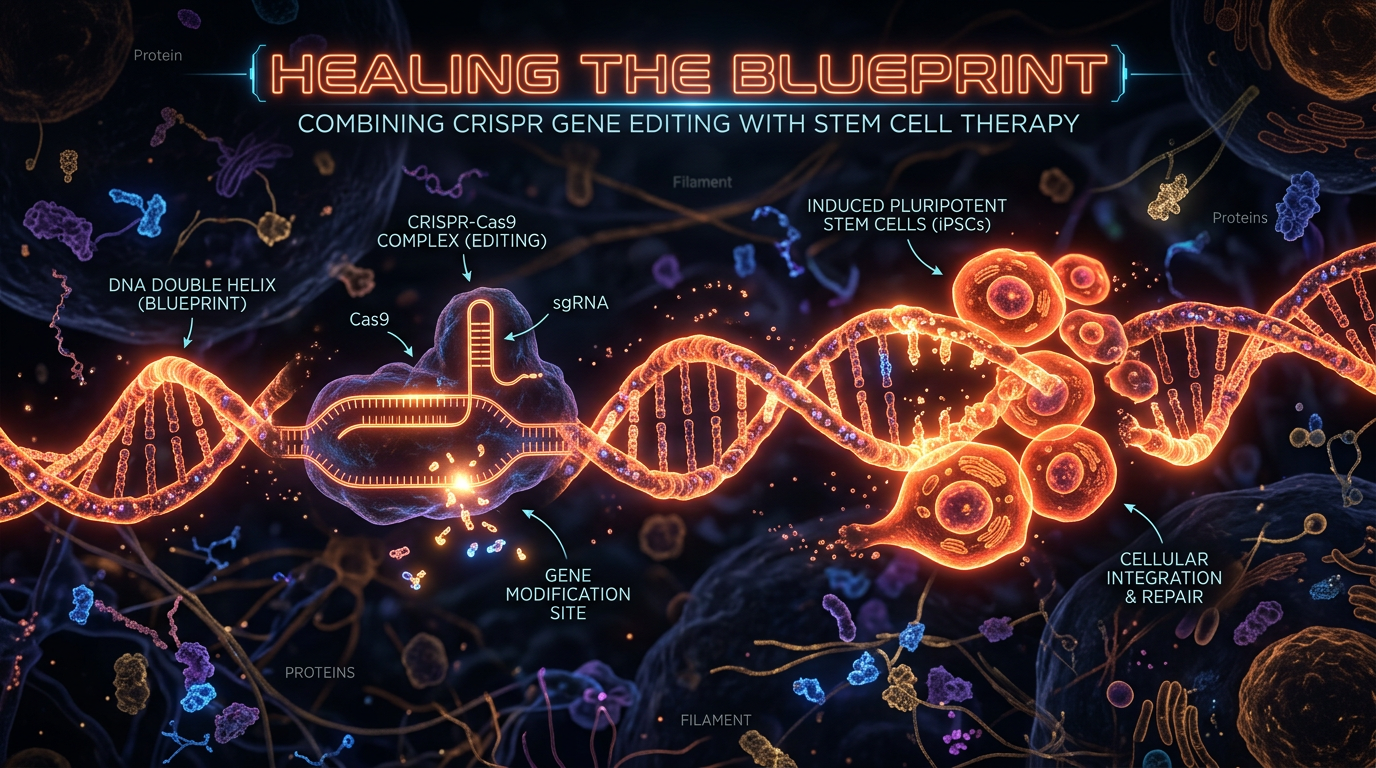
At the heart of this revolution lies the convergence of two formidable technologies: CRISPR-Cas9 gene editing and Stem Cell Therapy. When combined, these tools offer more than just a treatment for symptoms; they provide a mechanism to "Heal the Blueprint." This is the process of returning the human biological template to its original, uncorrupted state, free from the ancestral and environmental "noise" that manifests as chronic disease.
In this high-authority investigation, we delve into the mechanics of genomic restoration, expose the environmental factors actively degrading our DNA, and outline the protocols required to reclaim biological sovereignty.
I. The Biological Mechanics: The God Key and the Substrate
To understand the synergy between CRISPR and stem cells, one must view the body as a self-correcting information system. Genetic diseases and cellular ageing are essentially "coding errors" or "data corruption" within the nuclear archives.
1. CRISPR-Cas9: The Molecular Scalpel
CRISPR (Clustered Regularly Interspaced Short Palindromic Repeats) is a system derived from bacterial immune responses. In a clinical setting, it acts as a programmable pair of molecular scissors. By utilising a Guide RNA (gRNA), scientists can target a specific sequence of DNA with pinpoint accuracy, allowing the Cas9 enzyme to excise a mutated gene or insert a functional one.
2. Stem Cells: The Universal Substrate
Stem cells, particularly Induced Pluripotent Stem Cells (iPSCs), are the "blank slates" of the body. They possess the unique ability to differentiate into any cell type—be it myocardial, neurological, or hepatic.
3. The Convergence: Ex Vivo Gene Therapy
The most potent application of these technologies is the ex vivo approach. This involves:
- Harvesting: Extracting somatic cells (often skin or blood) from the patient.
- Reprogramming: Reverting these cells to a pluripotent stem cell state.
- Editing: Using CRISPR to repair the genetic defect within these stem cells.
- Expansion and Re-infusion: Growing a vast population of these "corrected" cells and re-introducing them into the patient’s body.
Unlike traditional organ transplants, this protocol uses the patient’s own genetic material, eliminating the risk of graft-versus-host disease and the need for lifelong immunosuppression.
UK Health Insight: According to the Genetic Alliance UK, approximately 1 in 17 people will be affected by a rare genetic disease at some point in their lives. The NHS currently spends over £3.4 billion annually on the management of rare diseases, much of which could be mitigated through one-time curative gene-editing interventions.
II. The Truth Exposed: Why the Blueprint is Failing
If we possess the technology to edit the blueprint, we must ask: why is our collective health declining at an exponential rate? The truth-exposing reality is that our genomic integrity is under constant bombardment from a modern environment that is fundamentally mismatched with our evolutionary biology.
The Epigenetic Landscape
While CRISPR can fix the "hard drive" (the DNA), the "software" (the epigenome) is being corrupted by external signals. Epigenetics refers to the chemical tags (methyl groups) that sit atop our DNA, dictating which genes are turned on or off.
Environmental Disruptors and "Genomic Noise"
The modern world is saturated with Xenobiotics—foreign chemical substances that interfere with cellular signalling. These disruptors do not just cause temporary illness; they cause "epigenetic scarring" that can be passed down through generations.
- Endocrine Disruptors (EDCs): Phthalates and Bisphenol A (BPA), ubiquitous in UK municipal water and food packaging, mimic hormones and "mis-programme" stem cell differentiation, often leading to infertility and metabolic disorders.
- Glyphosate and Agricultural Runoff: This herbicide, widely used in British industrial farming, has been linked to DNA strand breaks and the inhibition of mitochondrial function, effectively starving the cell of the energy required for natural repair.
- Electromagnetic Fields (EMF): Emerging research suggests that chronic exposure to high-frequency non-ionising radiation may induce oxidative stress, leading to premature telomere shortening—the biological fuse of the stem cell.
III. The Role of Stem Cells in Regenerative Recovery
The true power of combining CRISPR with stem cells lies in the concept of "Regenerative Niche Restoration." In many chronic conditions, the body’s endogenous stem cell "niches" (the microenvironments where stem cells reside) become toxic or exhausted.
Reversing Cellular Senescence
As we age, our cells enter a state of "senescence"—they stop dividing but refuse to die, secreting pro-inflammatory cytokines known as the SASP (Senescence-Associated Secretory Phenotype). This "zombie cell" state poisons the surrounding tissue.
By using CRISPR to knock out specific genes associated with senescence (such as p16INK4a) in harvested stem cells, researchers can create "super-cells" that, when re-infused, not only replace damaged tissue but also secrete "youthful" paracrine factors that rejuvenate the existing cellular population.
Case Study: Haemoglobinopathies
In the UK, the most advanced application of this technology is seen in the treatment of Sickle Cell Disease and Beta-Thalassaemia. By using CRISPR to silence the BCL11A gene in a patient’s haematopoietic stem cells, doctors can "flip a switch" that restarts the production of foetal haemoglobin, effectively curing a condition that previously required a lifetime of blood transfusions.
IV. Recovery Protocols: Optimising the Blueprint
While clinical CRISPR therapy is still emerging into the mainstream, the principles of "Blueprint Healing" can be applied immediately through rigorous biological optimisation. To support the integrity of our DNA and the potency of our internal stem cell reserves, one must adopt a protocol of Genomic Hygiene.
1. Nutritional Epigenetic Support
To maintain the "methyl donors" required for accurate DNA replication, the body requires specific micronutrients:
- Methyl-Cobalamin (B12) and Folate: Essential for the 1-carbon cycle that repairs DNA.
- Sulforaphane: Found in cruciferous vegetables (broccoli sprouts), this compound activates the Nrf2 pathway, the body’s primary defence against oxidative DNA damage.
- NAD+ Precursors: Nicotinamide Riboside (NR) or NMN are vital for the function of Sirtuins, proteins that "clean" the DNA and repair double-strand breaks.
2. Environmental Detoxification
One cannot heal the blueprint while the architect is being poisoned.
- Water Filtration: Utilising high-grade reverse osmosis systems to remove fluoride and heavy metals that disrupt stem cell signalling.
- Circadian Alignment: Stem cell proliferation is regulated by the biological clock. Exposure to natural sunlight at dawn and the elimination of "blue light" after sunset are non-negotiable for genomic stability.
- Cold Stress (Thermogenesis): Short, controlled exposure to cold (ice baths or cold showers) has been shown to mobilise mesenchymal stem cells and increase the production of "cold-shock proteins" that protect RNA integrity.
3. Autophagy and Cellular Cleansing
The process of Autophagy ("self-eating") is the body’s way of clearing out damaged organelles and misfolded proteins.
- Intermittent Fasting: A 16–18 hour fast triggers the cellular "trash collection" system, ensuring that the substrate CRISPR would edit is as clean as possible.
- Senolytic Agents: Natural compounds like Quercetin and Fisetin act as mild senolytics, helping the body clear out the "zombie cells" that interfere with stem cell niche health.
Statistical Reality: A report by Public Health England suggests that lifestyle-related chronic diseases—many of which have an underlying basis in epigenetic degradation—account for 70% of total NHS expenditure. Addressing the "Blueprint" rather than the "Symptom" is the only path to fiscal and biological sustainability.
V. The Ethical Frontier: Truth and Sovereignty
As we move toward a future where we can "edit out" suffering, we must remain vigilant. The technology to "Heal the Blueprint" carries with it the risk of "Proprietary Biology." We must ensure that the "God Key" of CRISPR is used to restore the original human template, rather than to create a "patented" version of humanity.
The Truth of Bio-Sovereignty
The medical-industrial complex has long benefited from a population that is "just well enough to work, but sick enough to need medication." CRISPR and Stem Cell therapy represent a "Cure Paradigm." A cure, by definition, is a bad business model. This is why the path to these therapies has been fraught with regulatory hurdles and astronomical price tags.
True "Innerstanding" involves recognising that our biology is our most sacred property. The ability to rewrite our genetic code is not just a medical procedure; it is an act of reclaiming our evolutionary trajectory.
VI. Conclusion: The Resurrection of the Template
The combination of CRISPR Gene Editing and Stem Cell Therapy is the ultimate expression of regenerative medicine. It represents a transition from "victim of genetics" to "master of the genome." By understanding the mechanisms of DNA repair, identifying the environmental pollutants that degrade our code, and implementing rigorous recovery protocols, we can begin the process of healing the blueprint.
We are at the end of the era of "managed decline." The future belongs to those who realise that their DNA is not a static script, but a dynamic symphony that can be retuned to the frequency of optimal health.
- The Goal: Genomic Purity.
- The Method: CRISPR-Augmented Stem Cell Restoration.
- The Result: The restoration of the original human blueprint.
The technology exists. The knowledge is here. The sovereign evolution of the human species has begun.
This article is provided for informational and educational purposes only. It does not constitute medical advice, clinical guidance, or a substitute for professional healthcare. Information reflects cited research at time of publication. Always consult a qualified healthcare professional before acting on any health information.
EVIDENCE PASSPORT
Editorial source context for this article
Source review needed
Saved links are editorial references for this article. They may support specific claims rather than every sentence. Open and assess each source in context. This passport does not independently verify them.
Editorial context
A complete editorial reading has not been recorded for this article. Source links remain available for you to open and assess directly.
Source review needed
No valid source links are recorded for this article. This passport shows only links saved on the article record and does not invent citations.
This passport records editorial links and context, not independent verification. Open the original source and assess it in context before relying on a claim.
Medical Disclaimer
The information in this article is for educational purposes only and does not constitute medical advice, diagnosis, or treatment. Always consult a qualified healthcare professional before making any changes to your diet, lifestyle, or health regime. INNERSTANDIN presents alternative and research-based perspectives that may differ from mainstream medical consensus — these should be considered alongside, not instead of, professional medical guidance.
Read Full DisclaimerContinue the thread
Keep this question moving.
Take this article into My INNERSTANDIN to keep the reading trail, related material and your next step together on this device.