
Induced Pluripotency: Rewriting the Rules of Cellular Aging
Updated May 2026
Reprogramming adult cells back to an embryonic state offers a radical new path for personalized medicine. This piece explains the Nobel-winning technology of Yamanaka factors and their clinical applications.
Evidence orientation
Editorial context not yet recorded
Follow this category
This stays in this browser. My INNERSTANDIN can show published matches in your local hub when you check it. It does not send email, push, or alert notifications.
Local learning review
A private browser aid for revisiting ideas. It is not an alert or a health recommendation.
Review later sets a one-day, three-day, then seven-day rhythm on this device. Choose it only when you want to revisit this article.
Overview
For over a century, the fundamental dogma of biology was that cellular development was a "one-way street." According to the Weismann Barrier theory, once a cell differentiated from an embryonic state into a specialised adult cell—such as a neuron, a cardiomyocyte, or a skin fibroblast—its identity was fixed. Ageing was viewed as an inevitable entropic decay, a slow accumulation of damage that could, at best, be managed but never reversed.
This paradigm was shattered in 2006 by the pioneering work of Shinya Yamanaka. By introducing a specific cocktail of four transcription factors into adult skin cells, Yamanaka proved that the biological clock could not only be paused but wound back to zero. These "reprogrammed" cells, known as Induced Pluripotent Stem Cells (iPSCs), regained the ability to become any cell type in the human body, effectively achieving biological immortality in vitro.
Today, we stand at a precipice. The science of induced pluripotency is no longer confined to the petri dish. We are moving toward in-vivo partial reprogramming—the ability to rejuvenate the tissues of a living organism without reverting them all the way to a stem cell state, which would cause organ failure. This article explores the staggering potential of iPSC technology to rewrite the rules of human longevity, while exposing the environmental hurdles and institutional resistances that currently impede a future where "age" is merely a malleable variable.
The Biology — How It Works
The magic of induced pluripotency lies in the manipulation of the epigenome. While every cell in your body contains the same DNA sequence, the expression of that DNA is controlled by chemical tags—methylation and acetylation—that tell a cell whether to be a liver cell or a light-sensing cell in the retina.
The Yamanaka Factors (OSKM)
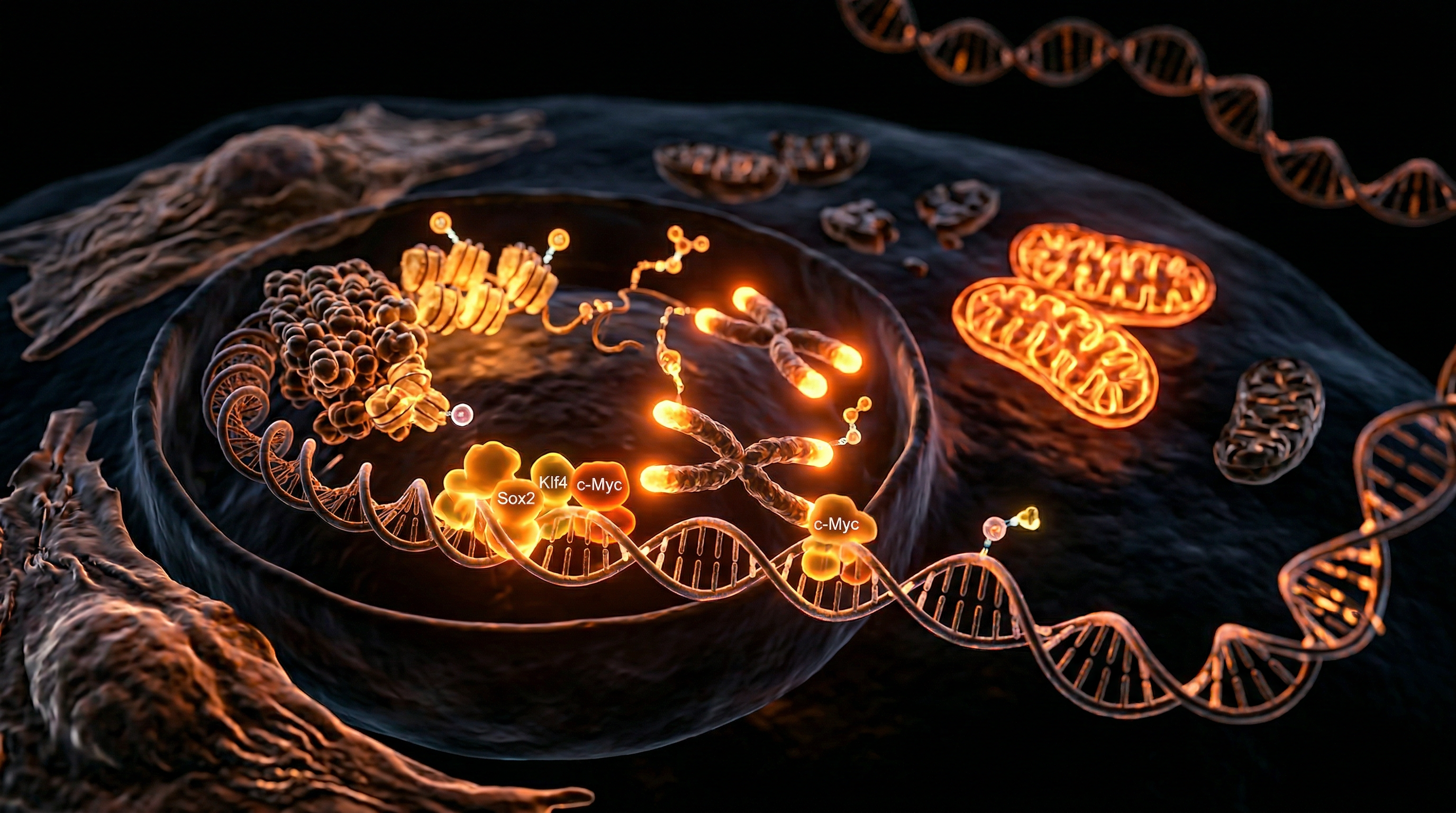
The breakthrough identified four specific transcription factors, now immortalised in the literature as the Yamanaka Factors:
- Oct4 (Octamer-binding transcription factor 4): The master regulator of pluripotency. It is essential for maintaining the undifferentiated state of embryonic stem cells.
- Sox2 (Sex determining region Y-box 2): Works in tandem with Oct4 to regulate the expression of genes that keep the cell in a "blank slate" state.
- Klf4 (Kruppel-like factor 4): Involved in cell cycle regulation and preventing apoptosis (programmed cell death) during the stressful process of reprogramming.
- c-Myc: A potent oncogene that accelerates metabolism and chromatin remodelling, though it carries a risk of inducing cancer if not strictly controlled.
Waddington’s Epigenetic Landscape
To understand the biology, one must visualise Waddington’s Landscape. Imagine a marble (a pluripotent stem cell) at the top of a rugged hill. As it rolls down, it enters various "valleys" (differentiation pathways). Once it reaches the bottom, it is tucked into a deep groove (a specialised adult cell).
"Induced pluripotency is the biochemical equivalent of pushing the marble back up the hill to the summit, restoring its 'potential energy' to become anything once again."
The Process of Reversion
The reprogramming process involves a massive "reset" of the cell's identity. Within days of exposure to OSKM factors, the cell undergoes:
- Mesenchymal-to-Epithelial Transition (MET): The cell changes its physical shape and structural integrity.
- Metabolic Shifting: The cell moves from oxidative phosphorylation (typical of adult cells) to glycolysis (typical of rapidly dividing embryonic cells).
- Epigenetic Scrubbing: The "age-related" methyl tags on the DNA are erased, returning the cell to a chronological age of zero.
Mechanisms at the Cellular Level
Beneath the surface of gene expression, the rejuvenation of an iPSC involves the repair of fundamental biological machinery that usually breaks down over decades.
Telomere Restoration
One of the hallmarks of ageing is the shortening of telomeres—the protective caps at the ends of chromosomes. When telomeres become too short, the cell enters senescence. During iPSC reprogramming, the enzyme telomerase is reactivated, lengthening the telomeres and restoring the cell's replicative capacity.
Mitochondrial Rejuvenation
Ageing is often defined by "mitochondrial dysfunction." Old mitochondria become bloated, inefficient, and leak reactive oxygen species (ROS) that damage the cell. Reprogramming triggers mitophagy—the destruction of old, "clunky" mitochondria—and replaces them with a fresh, vibrant population of organelles. This restores the bioenergetic profile of a youth.
Protein Homeostasis (Proteostasis)
As we age, our cells become "cluttered" with misfolded proteins and metabolic waste (lipofuscin). Induced pluripotency reactivates the proteasome and autophagy pathways, effectively "power-washing" the cellular interior. This removal of aggregate-prone proteins is why iPSC technology is being heavily researched as a cure for neurodegenerative diseases like Alzheimer’s and Parkinson’s.
The Horvath Clock Reset
The Horvath Clock measures biological age based on DNA methylation patterns. In every successful iPSC conversion, the Horvath age is reset to zero. Crucially, recent research into partial reprogramming (expressing OSKM factors for a short period) has shown that we can reset the clock's age without losing the cell's identity. This means a 60-year-old heart cell could potentially be "refreshed" to a 20-year-old state while remaining a functional heart cell.
Environmental Threats and Biological Disruptors
While the science of iPSCs offers a path to rejuvenation, our modern environment acts as a constant "de-programmer," accelerating cellular ageing and hindering our innate regenerative capacities.
Endocrine Disruptors and Xenohormones
Chemicals such as Bisphenol A (BPA), phthalates, and PFAS (polyfluoroalkyl substances) interfere with the very signaling pathways that OSKM factors attempt to regulate. These "forever chemicals" lodge in adipose tissue and create a persistent state of "epigenetic noise," making it harder for cells to maintain their differentiated identity and easier for them to slip into a pro-inflammatory senescent state.
Glyphosate and the Gut-Brain-Stem Cell Axis
The pervasive use of glyphosate in industrial agriculture has been linked to the disruption of the Shikimate pathway in gut bacteria. However, emerging research suggests it also affects human cellular integrity by substituting for the amino acid glycine in protein synthesis. This results in misfolded proteins that overwhelm the cell’s proteostasis mechanisms, the very systems iPSC technology seeks to repair.
Technogenic Stress: EMFs and VGCCs
The exposure to high-frequency Electromagnetic Fields (EMFs) from modern telecommunications has been shown to over-activate Voltage-Gated Calcium Channels (VGCCs). This leads to an influx of intracellular calcium, triggering a cascade of nitric oxide and superoxide that forms peroxynitrite—a potent oxidant that damages DNA and accelerates the "ticking" of the epigenetic clock.
- Oxidative Stress: Excessive free radicals directly damage the epigenome.
- Heavy Metal Accumulation: Lead, mercury, and aluminium act as "epigenetic mutagens."
- Microplastics: Now found in human blood and placentas, these particles cause physical irritation and chronic low-grade inflammation.
The Cascade: From Exposure to Disease
The journey from environmental exposure to systemic disease is a cascade that iPSC technology is uniquely positioned to interrupt.
Step 1: Epigenetic Drift
Environmental toxins do not necessarily change our DNA sequence (mutations), but they change how it is "read." This is known as epigenetic drift. Over time, the cell loses its "operating manual." A skin cell starts to express genes that should only be active in the gut; a neuron loses its ability to fire correctly.
Step 2: The Senescence-Associated Secretory Phenotype (SASP)
When a cell is too damaged to function but refuses to die, it becomes a senescent cell (a "zombie cell"). These cells secrete a toxic cocktail of pro-inflammatory cytokines, growth factors, and proteases known as SASP.
"SASP is contagious; it spreads 'ageing' to neighbouring healthy cells like a biological rot."
Step 3: Tissue Exhaustion and Chronic Disease
As the pool of healthy adult stem cells is depleted by inflammation and senescence, the body loses its ability to repair itself. This manifests as the "diseases of ageing":
- Sarcopenia: Loss of muscle mass.
- Macular Degeneration: Loss of vision.
- Osteoarthritis: Decay of cartilage.
- Cognitive Decline: Loss of synaptic plasticity.
iPSC technology allows us to take the patient's own "rotting" cells, clean them of this epigenetic noise in a lab, and re-introduce healthy, youthful progenitor cells back into the body.
What the Mainstream Narrative Omits
The potential for iPSCs to revolutionise medicine is often downplayed or skewed in mainstream media. There are "uncomfortable truths" regarding the economics and politics of cellular rejuvenation.
The Patentability of "Natural" Rejuvenation
Pharmaceutical giants thrive on chronic treatments, not one-time cures. A drug that you must take every day for 30 years for high blood pressure is a "blockbuster." A cellular therapy that resets your vascular age and removes the need for blood pressure medication is a "threat to the bottom line." Because iPSC therapies often use the patient's own cells (autologous), they are difficult to "productise" and patent in the traditional sense.
The "Sickness Industry" vs. The Wellness Paradigm
Mainstream medicine is structured around reactive care. We wait for the organ to fail, then we transplant or prescribe. iPSC technology represents proactive regenerative care. There is significant institutional resistance to moving the "Point of Care" from the hospital pharmacy to the high-tech cellular laboratory.
Regulatory Gatekeeping
The regulatory hurdles for stem cell therapies are intentionally Byzantine. By classifying a patient’s own processed cells as "advanced therapy medicinal products" (ATMPs), regulatory bodies like the FDA and EMA have made the cost of clinical trials so astronomical that only the largest corporations can afford to play. This effectively "shuts out" smaller, innovative clinics that could offer these treatments at a fraction of the cost.
The Ethics of "The Genetic Divide"
There is a hushed conversation in elite circles regarding the "biological class system." While the public is told that life extension is "unethical" or "unnatural," significant private funding is flowing into secretive longevity projects (such as Altos Labs). The "omitted truth" is that the technology to significantly slow or reverse human ageing likely already exists, but it is being sequestered for those with the capital to bypass standard regulatory channels.
The UK Context
The United Kingdom occupies a unique position in the global iPSC landscape, balancing a rich history of stem cell research with a rigid and struggling public health system.
The "Golden Triangle" and Clinical Excellence
The cluster of Oxford, Cambridge, and London remains a global powerhouse for iPSC research. The Francis Crick Institute and the Wellcome Sanger Institute are at the forefront of mapping the "Cell Atlas," which is essential for perfect reprogramming.
The NHS Challenge
The National Health Service (NHS) is currently ill-equipped to handle the transition to personalised regenerative medicine. The infrastructure required for "bedside" cell reprogramming—where a patient’s blood is taken, reprogrammed, and re-injected within a local facility—simply does not exist.
"In the UK, the tension lies between world-class laboratory science and a 1940s-model delivery system that struggles to provide basic dental care, let alone advanced iPSC-derived organoids."
Post-Brexit Regulatory Flexibility?
There was hope that post-Brexit, the Medicines and Healthcare products Regulatory Agency (MHRA) would create a more agile framework for regenerative medicine. While some progress has been made with the "Innovative Licensing and Access Pathway" (ILAP), the UK still largely follows the restrictive European model, stifling the growth of a domestic "rejuvenation hub."
The UK Biobank: A Hidden Asset
The UK Biobank is one of the world's most comprehensive genetic and health resources. It provides British researchers with an unparalleled dataset to study how iPSC-based interventions might interact with specific genetic backgrounds, potentially making the UK the world leader in Precision Rejuvenation.
Protective Measures and Recovery Protocols
While we wait for full-scale iPSC therapies to become legally and financially accessible, there are "bio-hacks" and clinical protocols that can protect your current cellular pool and mimic some of the effects of induced pluripotency.
1. Activating Endogenous Autophagy
To "clean" your cells as iPSCs do, you must activate autophagy.
- Time-Restricted Feeding: A minimum of 16 hours of fasting triggers the breakdown of misfolded proteins.
- Periodic Prolonged Fasting: 3-to-5-day fasts (under supervision) can trigger a "stem cell reset" in the immune system.
2. Senolytic Supplementation
Senolytics are compounds that selectively induce death in "zombie" (senescent) cells.
- Quercetin and Dasatinib: The most famous combination (Dasatinib is a prescription drug, but Quercetin is a natural flavonoid found in onions and apples).
- Fisetin: A potent senolytic found in strawberries. High-dose "pulsed" protocols (e.g., two days a month) are currently being studied in human trials for their ability to lower the "SASP" burden.
3. NAD+ Restoration
Mitochondrial rejuvenation requires Nicotinamide Adenine Dinucleotide (NAD+).
- NMN (Nicotinamide Mononucleotide): A direct precursor to NAD+ that has been shown in animal models to mimic some effects of partial reprogramming.
- NR (Nicotinamide Riboside): Another effective precursor.
- Cold Stress: Regular exposure to cold (ice baths/cold showers) naturally boosts NAD+ levels and activates "brown fat," improving metabolic flexibility.
4. Protecting the Epigenome
- Methyl Donors: Ensure adequate intake of B12, Folate, and TMG (Trimethylglycine) to support healthy DNA methylation.
- EMF Mitigation: Turning off Wi-Fi at night and reducing direct contact with transmitting devices to lower VGCC-induced oxidative stress.
- Glyphosate Avoidance: Prioritising organic produce to reduce the intake of glycine-mimics that cause protein misfolding.
5. Emerging "Home-Office" Therapies
- Red and Near-Infrared Light Therapy (Photobiomodulation): Using specific wavelengths (660nm and 850nm) to stimulate cytochrome c oxidase in the mitochondria, increasing ATP production and cellular repair.
- Hyperbaric Oxygen Therapy (HBOT): Recent Israeli studies have shown that specific HBOT protocols can lengthen telomeres and reduce senescent cell populations in humans.
Summary: Key Takeaways
Induced pluripotency is not merely a scientific curiosity; it is the most significant medical discovery of the 21st century. It transforms the human body from a "disposable vessel" into a "repairable machine."
- The Clock Can Be Reset: Yamanaka factors (OSKM) prove that cellular age is a reversible epigenetic state, not a permanent physical decay.
- Identity vs. Age: The future of medicine lies in partial reprogramming—rejuvenating the cell's function without losing its "job" within the body.
- Environmental Resistance: Modern toxins (PFAS, Glyphosate, EMFs) are "pro-ageing" agents that actively degrade the epigenetic landscape, making natural repair more difficult.
- The Economic Barrier: The "Sickness Industry" is incentivised to treat symptoms rather than deploy regenerative "cures." Regulatory barriers currently maintain this status quo.
- Actionable Rejuvenation: Through fasting, senolytics, and NAD+ boosters, individuals can currently "nudge" their biology toward a more pluripotent-like state of repair.
The rules of cellular ageing have been rewritten. The challenge now is not whether we can rejuvenate the human body, but whether we will be allowed to, and how we protect our biological integrity in an increasingly toxic world. The era of "The Infinite Human" is technically possible; its arrival depends on the democratization of this suppressed biological truth.
This article is provided for informational and educational purposes only. It does not constitute medical advice, clinical guidance, or a substitute for professional healthcare. Information reflects cited research at time of publication. Always consult a qualified healthcare professional before acting on any health information.
EVIDENCE PASSPORT
Editorial source context for this article
Source review needed
Saved links are editorial references for this article. They may support specific claims rather than every sentence. Open and assess each source in context. This passport does not independently verify them.
Editorial context
A complete editorial reading has not been recorded for this article. Source links remain available for you to open and assess directly.
Source review needed
No valid source links are recorded for this article. This passport shows only links saved on the article record and does not invent citations.
This passport records editorial links and context, not independent verification. Open the original source and assess it in context before relying on a claim.
Medical Disclaimer
The information in this article is for educational purposes only and does not constitute medical advice, diagnosis, or treatment. Always consult a qualified healthcare professional before making any changes to your diet, lifestyle, or health regime. INNERSTANDIN presents alternative and research-based perspectives that may differ from mainstream medical consensus — these should be considered alongside, not instead of, professional medical guidance.
Read Full DisclaimerContinue the thread
Keep this question moving.
Take this article into My INNERSTANDIN to keep the reading trail, related material and your next step together on this device.