
Published May 2026
An in-depth investigation into why most magnesium supplements fail and how to optimize cellular absorption through biology-first principles.
Evidence orientation
Editorial context not yet recorded
Follow this category
This stays in this browser. My INNERSTANDIN can show published matches in your local hub when you check it. It does not send email, push, or alert notifications.
Local learning review
A private browser aid for revisiting ideas. It is not an alert or a health recommendation.
Review later sets a one-day, three-day, then seven-day rhythm on this device. Choose it only when you want to revisit this article.
1. Overview
Bioavailability is often the "missing link" in the conversation around nutritional supplementation. For many individuals, the decision to take a magnesium supplement is driven by a genuine need—addressing fatigue, muscle cramps, or sleep disturbances. However, without an INNERSTANDIN of bioavailability, this effort can be largely wasted. Bioavailability refers to the proportion of a nutrient that enters the circulation when introduced into the body and is so able to have an active effect. In the case of magnesium, this process is complex and fraught with biological hurdles.
Most high-street supplements rely on magnesium oxide or other cheap inorganic salts. While these may list high elemental magnesium counts on the label, their absorption rate in the human gut is notoriously poor, often as low as 4%. This discrepancy between what is swallowed and what is actually absorbed by the cells creates a "supplementation gap" that leaves many people still deficient despite daily dosing. This article will deconstruct the biological mechanisms of magnesium transport and explain why the form of your supplement is more important than the dose.
2. The Biology — How It Works
The journey of magnesium through the human body begins in the oral cavity, but the critical work occurs in the stomach and small intestine. Magnesium must be ionised—separated into its active ionic form (Mg2+)—to be absorbed. This requires an acidic environment. In the stomach, gastric acid (hydrochloric acid) plays a vital role in breaking down magnesium compounds. If stomach acid is insufficient (hypochlorhydria), even high-quality supplements may remain unabsorbed.
Once in the small intestine, primarily the jejunum and ileum, magnesium is absorbed via two distinct pathways: paracellular transport and transcellular transport. Paracellular transport occurs between the cells of the intestinal lining and is driven by electrochemical gradients and "solvent drag." This pathway accounts for the majority of absorption when magnesium intake is high. However, when intake is low or when the gut barrier is compromised, the transcellular pathway becomes dominant. This involves active transport proteins that "pull" magnesium through the cell itself.
3. Mechanisms at the Cellular Level
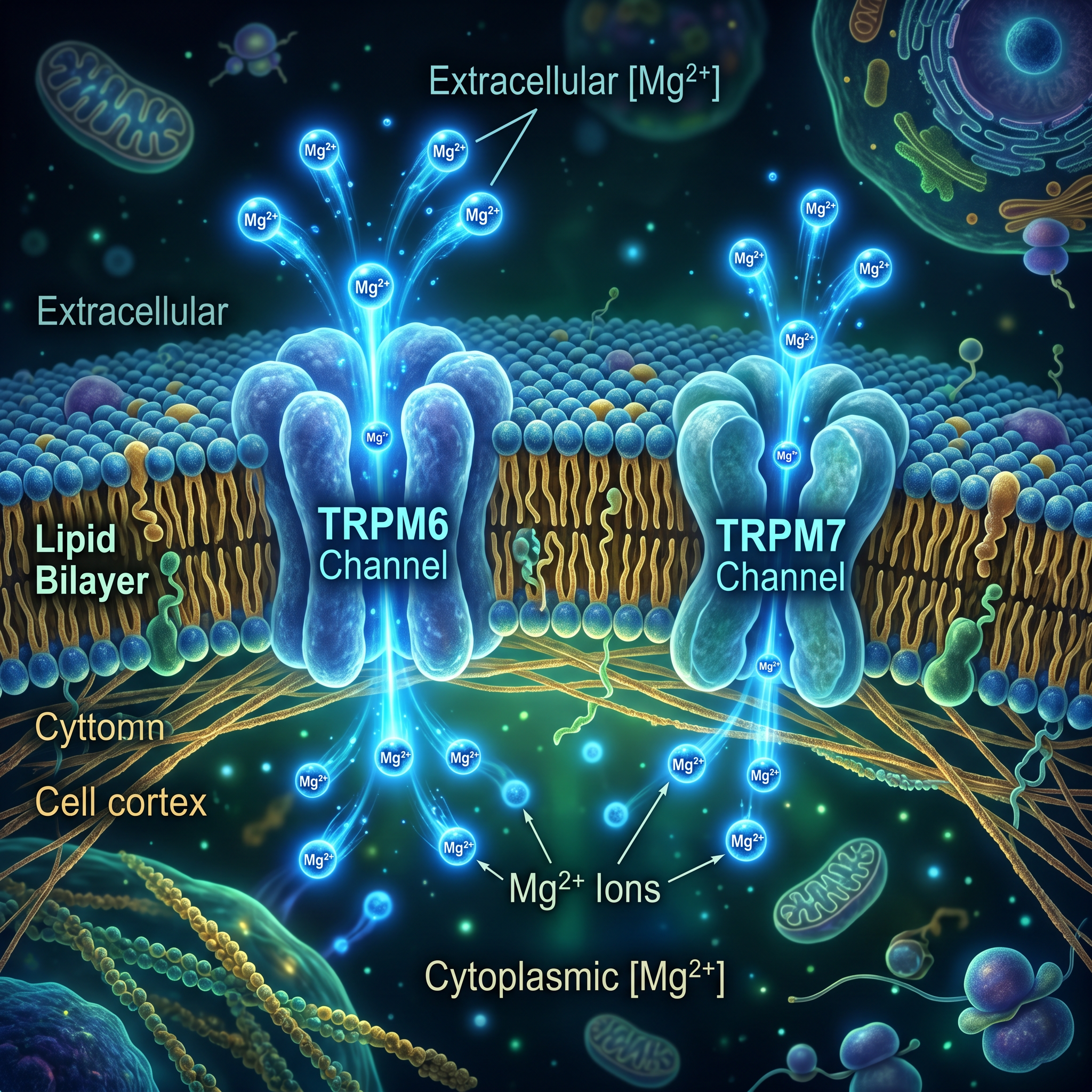
At the cellular level, the transcellular transport of magnesium is mediated by specific ion channels known as TRPM6 and TRPM7 (Transient Receptor Potential Melastatin). TRPM6 is primarily expressed in the intestinal epithelium and the renal tubules, acting as the "gatekeeper" for magnesium entry into the body and its retention in the kidneys. TRPM7 is expressed ubiquitously and is essential for maintaining intracellular magnesium homeostasis.
Once magnesium enters the cytosol, it must be carefully regulated. It is not just floating freely; it is bound to various proteins and molecules, most notably ATP. In fact, ATP is biologically active only when it is bound to a magnesium ion, forming the Mg-ATP complex. This complex is the fundamental energy currency of the cell. Without sufficient intracellular magnesium, the mitochondria cannot effectively power cellular processes, leading to a cascade of dysfunction.
4. Environmental Threats and Biological Disruptors
Modern life presents numerous threats to magnesium status. One of the most significant is soil depletion. Intensive agricultural practices have stripped the soil of essential minerals, meaning that even a diet rich in vegetables may contain significantly less magnesium than it did 50 years ago. Furthermore, the use of glyphosate (a common herbicide) acts as a potent mineral chelator, binding to magnesium in the soil and rendering it unavailable to plants.
Within the body, biological disruptors like chronic stress trigger the release of cortisol, which increases the excretion of magnesium through the kidneys. Pharmaceutical interactions are also a major concern. Proton pump inhibitors (PPIs), commonly used for acid reflux, significantly reduce stomach acid, thereby blocking the ionisation and absorption of magnesium. Chronic use of PPIs has been linked to severe hypomagnesemia in numerous clinical studies.
5. The Cascade: From Exposure to Disease
When bioavailability is poor and environmental disruptors are present, a state of intracellular magnesium deficiency begins to develop. This is often invisible to standard medical testing but has profound systemic consequences. At the cellular level, the lack of Mg-ATP leads to mitochondrial dysfunction. Cells become less efficient at producing energy and more susceptible to oxidative stress.
This cellular failure initiates a "cascade" that can manifest as chronic conditions. In the cardiovascular system, magnesium deficiency leads to increased arterial stiffness and hypertension. In the nervous system, it contributes to neuroinflammation and an increased risk of neurodegenerative diseases. Metabolic syndrome, insulin resistance, and type 2 diabetes are also closely linked to low magnesium status, as magnesium is a critical cofactor for insulin receptor sensitivity.
6. What the Mainstream Narrative Omits
The mainstream medical narrative surrounding magnesium is often oversimplified. The most common error is the reliance on serum magnesium testing. Only about 1% of the body's magnesium is found in the blood; the rest is stored in the bones and within the cells. The body will maintain serum levels at all costs, leaching magnesium from the tissues to keep blood levels stable. Therefore, a "normal" serum test can mask a severe intracellular deficiency.
Furthermore, the marketing of magnesium supplements often prioritises profit over efficacy. Magnesium oxide is the most common form sold in pharmacies because it is cheap to manufacture and has a high elemental weight. However, its bioavailability is so poor that it often acts more as a laxative than a systemic mineral source. The mainstream narrative rarely distinguishes between these forms, leading consumers to believe that any magnesium supplement is sufficient.
7. The UK Context
In the United Kingdom, the magnesium crisis is particularly acute. Data from the National Diet and Nutrition Survey (NDNS) indicates that a significant portion of the British population is not meeting the Lower Reference Nutrient Intake (LRNI) for magnesium. Young adults and the elderly are at the highest risk. The British diet, which is increasingly high in ultra-processed foods, is inherently low in magnesium-rich whole foods like leafy greens, nuts, and seeds.
UK soil quality is another factor. Decades of heavy farming in regions like East Anglia have led to substantial mineral loss. Furthermore, the UK's water supply varies significantly in mineral content. In "soft water" areas, the natural magnesium content of drinking water is negligible, removing an important secondary source of the mineral. When combined with the high levels of stress and pharmaceutical use in the UK population, the result is a systemic "magnesium gap."
8. Protective Measures and Recovery Protocols
To restore magnesium levels effectively, one must choose highly bioavailable forms. Chelated forms, where magnesium is bound to an amino acid or organic acid, are generally superior as they bypass the common absorption hurdles.
- Magnesium Glycinate: Bound to glycine, this form is highly absorbable and has a calming effect on the nervous system.
- Magnesium Malate: Bound to malic acid, it is excellent for energy production and muscle recovery.
- Magnesium Taurate: Bound to taurine, it supports cardiovascular health.
- Magnesium Threonate: The only form known to effectively cross the blood-brain barrier, making it ideal for cognitive health.
Cofactors are also essential. Vitamin D3 requires magnesium for its activation, but high doses of D3 can also deplete magnesium levels. Vitamin B6, particularly in the form of P5P, enhances the entry of magnesium into the cells. Boron is another important trace mineral that helps the kidneys retain magnesium.
9. Summary: Key Takeaways
INNERSTANDIN magnesium bioavailability is the first step toward true cellular health.
- Form Matters: Avoid inorganic salts like magnesium oxide; choose chelated forms like glycinate or malate.
- Biology First: Ensure adequate stomach acid and gut health for optimal ionisation and absorption.
- Mind the Gap: Standard serum tests are unreliable; look for RBC magnesium testing or monitor symptoms.
- UK Context: Be aware of the challenges posed by soil depletion and the British diet.
- Systemic Support: Use cofactors like B6 and D3 to ensure magnesium reaches the cells where it is needed most.
By moving beyond the mainstream narrative and focusing on the biological reality of magnesium transport, you can transform your health at the foundational level.
This article is provided for informational and educational purposes only. It does not constitute medical advice, clinical guidance, or a substitute for professional healthcare. Information reflects cited research at time of publication. Always consult a qualified healthcare professional before acting on any health information.
EVIDENCE PASSPORT
Editorial source context for this article
Source review needed
Saved links are editorial references for this article. They may support specific claims rather than every sentence. Open and assess each source in context. This passport does not independently verify them.
Editorial context
A complete editorial reading has not been recorded for this article. Source links remain available for you to open and assess directly.
Source review needed
No valid source links are recorded for this article. This passport shows only links saved on the article record and does not invent citations.
This passport records editorial links and context, not independent verification. Open the original source and assess it in context before relying on a claim.
Medical Disclaimer
The information in this article is for educational purposes only and does not constitute medical advice, diagnosis, or treatment. Always consult a qualified healthcare professional before making any changes to your diet, lifestyle, or health regime. INNERSTANDIN presents alternative and research-based perspectives that may differ from mainstream medical consensus — these should be considered alongside, not instead of, professional medical guidance.
Read Full DisclaimerReady to learn more?
Continue your journey through our classified biological research.
Dig deeper in the Library
Free, longform PDF volumes that go beyond headlines into mechanisms and references.