
Published May 2026
Explore the essential biological synergy between magnesium and ATP production, and why energy is impossible without this vital mineral.
Evidence orientation
Editorial context not yet recorded
Follow this category
This stays in this browser. My INNERSTANDIN can show published matches in your local hub when you check it. It does not send email, push, or alert notifications.
Local learning review
A private browser aid for revisiting ideas. It is not an alert or a health recommendation.
Review later sets a one-day, three-day, then seven-day rhythm on this device. Choose it only when you want to revisit this article.
1. Overview
In the world of biological health, we often talk about magnesium for relaxation and mitochondria for energy. However, these two pillars are not independent; they are fundamentally entwined. Magnesium is the essential "key" that unlocks the energy stored in ATP (Adenosine Triphosphate). Without magnesium, the energy produced by our mitochondria is biologically inert—it is like having a tank full of petrol but no spark plug to ignite it.
This article explores the critical link between magnesium and mitochondrial function. We will move beyond the superficial narrative of "magnesium for sleep" and delve into the cellular reality: that every single step of energy production, from the first enzyme in the Krebs cycle to the final rotation of the ATP synthase "turbine," is magnesium-dependent. If you are struggling with energy, the solution likely lies at this intersection of mineral and organelle.
2. The Biology — How It Works
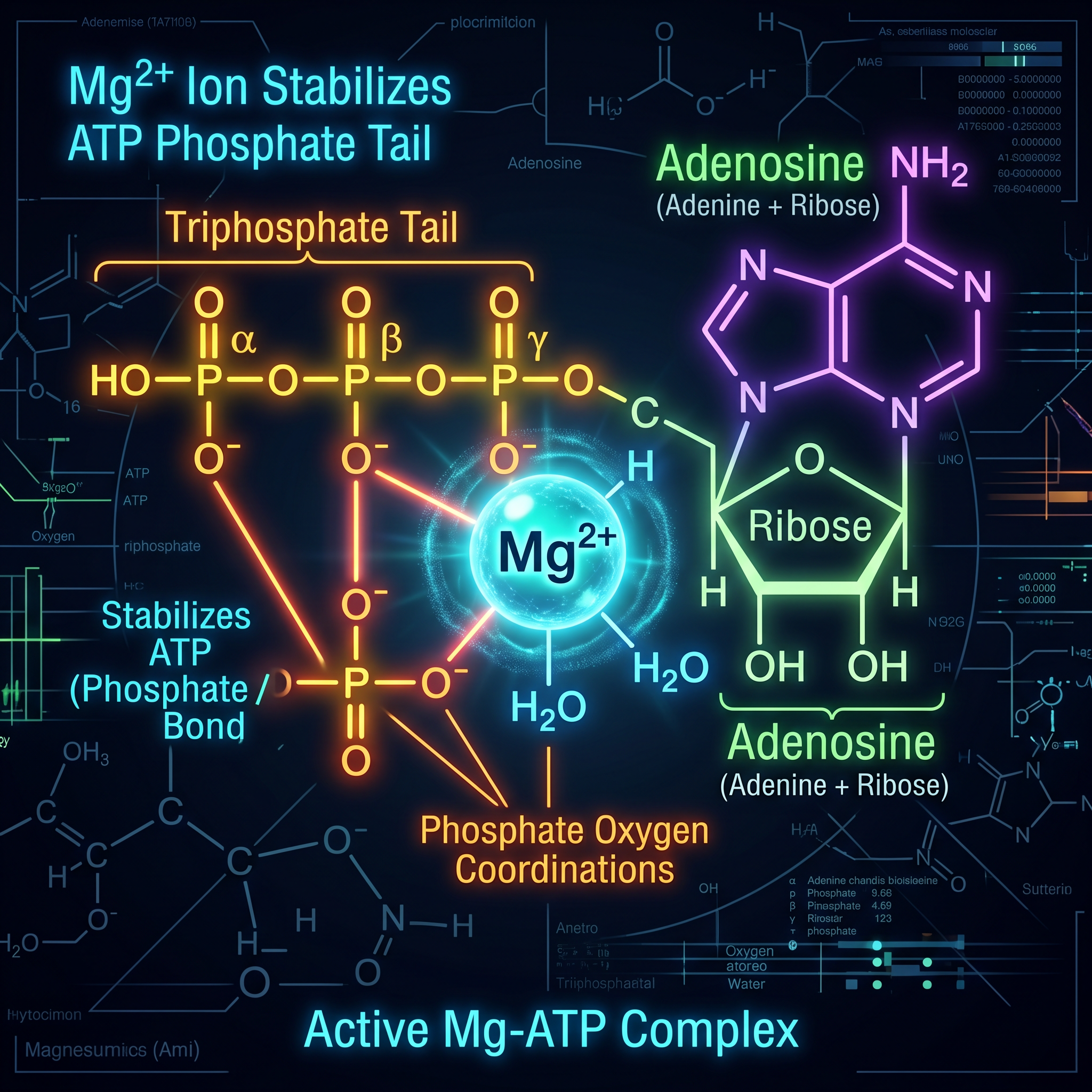
To INNERSTAND why magnesium is so vital for energy, we must look at the structure of ATP. ATP is often called the "energy currency" of the cell, but this is a simplification. Biologically, ATP exists primarily as a complex with magnesium (Mg-ATP). The magnesium ion binds to the phosphate groups of the ATP molecule, stabilizing the structure and making the high-energy bonds accessible for biochemical reactions.
Within the mitochondria, magnesium is required for the activation of various enzymes involved in the Krebs cycle, such as isocitrate dehydrogenase and alpha-ketoglutarate dehydrogenase. These enzymes are responsible for breaking down carbon chains to release electrons. Without magnesium, these processes slow to a crawl, leading to a bottleneck in energy production. Furthermore, the transport of ADP (Adenosine Diphosphate) into the mitochondria and ATP out into the cytosol is also magnesium-dependent.
3. Mechanisms at the Cellular Level
The final stage of energy production occurs at the ATP synthase complex (Complex V of the Electron Transport Chain). This molecular motor rotates at high speeds to phosphorylate ADP into ATP. This "rotation" is driven by a proton gradient, but the actual binding and release of the ATP molecules require magnesium. Magnesium ions act as electrostatic bridges, positioning the phosphate groups so that the reaction can occur with minimal energy expenditure.
Inside the mitochondrial matrix, magnesium levels are kept relatively high compared to the cytosol. This is achieved through specific transport proteins like Mrs2. These proteins maintain a "magnesium pool" that is used to regulate the rate of energy production based on the cell's needs. If the mitochondrial magnesium pool is depleted, the organelle becomes inefficient, producing more heat and more Reactive Oxygen Species (ROS) as "exhaust," rather than useful energy.
4. Environmental Threats and Biological Disruptors
The synergy between magnesium and mitochondria is easily disrupted by modern environmental factors. Excessive exposure to artificial blue light and EMFs (electromagnetic frequencies) has been shown to increase the demand for magnesium as the cell tries to counteract the resulting oxidative stress. This creates a "theft" of magnesium from the energy production pathways to the antioxidant defence pathways.
Chemical disruptors also play a role. Fluoride, commonly found in UK tap water and dental products, has a high affinity for magnesium. It can form magnesium-fluoride complexes that are insoluble and biologically unavailable. Within the mitochondria, fluoride can inhibit various magnesium-dependent enzymes, effectively "poisoning" the energy production system. Furthermore, the high consumption of refined sugar in the modern diet depletes magnesium, as the metabolism of every sugar molecule requires multiple magnesium ions as cofactors.
5. The Cascade: From Exposure to Disease
When the link between magnesium and ATP is broken, the result is a systemic energy crisis. This is the primary mechanism behind many modern "invisible" illnesses. For example, in Chronic Fatigue Syndrome (ME/CFS) and Fibromyalgia, research consistently shows lower levels of intracellular and mitochondrial magnesium, even when serum levels appear normal.
This energy failure initiates a cascade of dysfunction. Without sufficient Mg-ATP, the cell cannot maintain its electrochemical gradients. This leads to an "excitable" state in the nervous system, manifesting as anxiety, tremors, and hypersensitivity to pain. In the heart, which has the highest density of mitochondria in the body, the lack of Mg-ATP can lead to arrhythmias and reduced contractile force. The final stage of the cascade is the loss of mitochondrial membrane potential, which can trigger premature cell death and tissue degeneration.
6. What the Mainstream Narrative Omits
The mainstream health narrative rarely discusses the "biophysics" of energy. It treats fatigue as a psychological issue or a simple matter of "rest," ignoring the underlying biochemical failure. The crucial fact that ATP is useless without magnesium is almost never mentioned in general health advice.
Furthermore, the mainstream focuses on "macronutrients" (carbs, fats, proteins) while ignoring the "micronutrient" catalysts required to use them. You can be overfed and under-energised because your "biochemical machinery" lacks the magnesium necessary to process the fuel. The narrative also omits the role of "structured water" within the mitochondria, which works in tandem with magnesium and infrared light to enhance the efficiency of ATP production.
7. The UK Context
In the UK, the combination of low magnesium intake and high environmental stress creates a "perfect storm" for mitochondrial energy failure. The NHS's lack of focus on intracellular nutrient testing means that millions of people are living with undiagnosed magnesium-driven energy deficits. The "stiff upper lip" culture often leads people to push through fatigue with caffeine and sugar, both of which further deplete magnesium and strain the mitochondria.
Moreover, the prevalence of "hard water" in southern England provides some calcium, but often very little magnesium. High calcium intake without corresponding magnesium can further disrupt mitochondrial function, as calcium and magnesium compete for entry into the cell and the mitochondria. Without enough magnesium to "police" the calcium, the mitochondria can become calcified and dysfunctional.
8. Protective Measures and Recovery Protocols
Restoring the Mg-ATP link requires a dedicated protocol.
- Targeted Supplementation: Focus on Magnesium Malate or Magnesium Glycinate, which are particularly effective for energy pathways.
- Supporting the Krebs Cycle: Combine magnesium with other B-vitamin cofactors (like B1, B2, and B3) and CoQ10 to ensure the energy production line is fully staffed.
- Hydration Science: Use structured or mineral-rich water to support the electrical environment of the mitochondria.
- Light Environment: Get morning sunlight to prime your mitochondria and use red light therapy to support the ATP synthase enzyme.
- Stress Management: Reducing the "cortisol drain" on your magnesium stores is essential for protecting your mitochondrial energy pool.
9. Summary: Key Takeaways
Energy is a magnesium-dependent biological process.
- The Vital Complex: ATP is not energy until it becomes Mg-ATP.
- The Bottleneck: Magnesium is required for every enzyme in the Krebs cycle.
- The Disruptor: Fluoride, sugar, and stress are the primary enemies of the Mg-ATP link.
- The Result: Deficiency leads to chronic fatigue, brain fog, and systemic failure.
- The Restoration: Use bioavailable magnesium and respect the light/electrical needs of your mitochondria.
By INNERSTANDIN the essential link between magnesium and mitochondria, you can move beyond "managing" fatigue and start restoring your cellular power at the most fundamental level.
This article is provided for informational and educational purposes only. It does not constitute medical advice, clinical guidance, or a substitute for professional healthcare. Information reflects cited research at time of publication. Always consult a qualified healthcare professional before acting on any health information.
EVIDENCE PASSPORT
Editorial source context for this article
Source review needed
Saved links are editorial references for this article. They may support specific claims rather than every sentence. Open and assess each source in context. This passport does not independently verify them.
Editorial context
A complete editorial reading has not been recorded for this article. Source links remain available for you to open and assess directly.
Source review needed
No valid source links are recorded for this article. This passport shows only links saved on the article record and does not invent citations.
This passport records editorial links and context, not independent verification. Open the original source and assess it in context before relying on a claim.
Medical Disclaimer
The information in this article is for educational purposes only and does not constitute medical advice, diagnosis, or treatment. Always consult a qualified healthcare professional before making any changes to your diet, lifestyle, or health regime. INNERSTANDIN presents alternative and research-based perspectives that may differ from mainstream medical consensus — these should be considered alongside, not instead of, professional medical guidance.
Read Full DisclaimerReady to learn more?
Continue your journey through our classified biological research.
Explore this in the Body Map
See where this hits your biology. Interactive anatomy, threats, and protective protocols.
Dig deeper in the Library
Free, longform PDF volumes that go beyond headlines into mechanisms and references.