
Major Autohemotherapy (MAH): A Clinical Guide to Systemic Oxidative Support
Updated May 2026
Discover the science behind Major Autohemotherapy, a leading oxidative procedure used to modulate the immune system and reduce systemic inflammation.
Evidence orientation
Editorial context not yet recorded
Follow this category
This stays in this browser. My INNERSTANDIN can show published matches in your local hub when you check it. It does not send email, push, or alert notifications.
Local learning review
A private browser aid for revisiting ideas. It is not an alert or a health recommendation.
Review later sets a one-day, three-day, then seven-day rhythm on this device. Choose it only when you want to revisit this article.
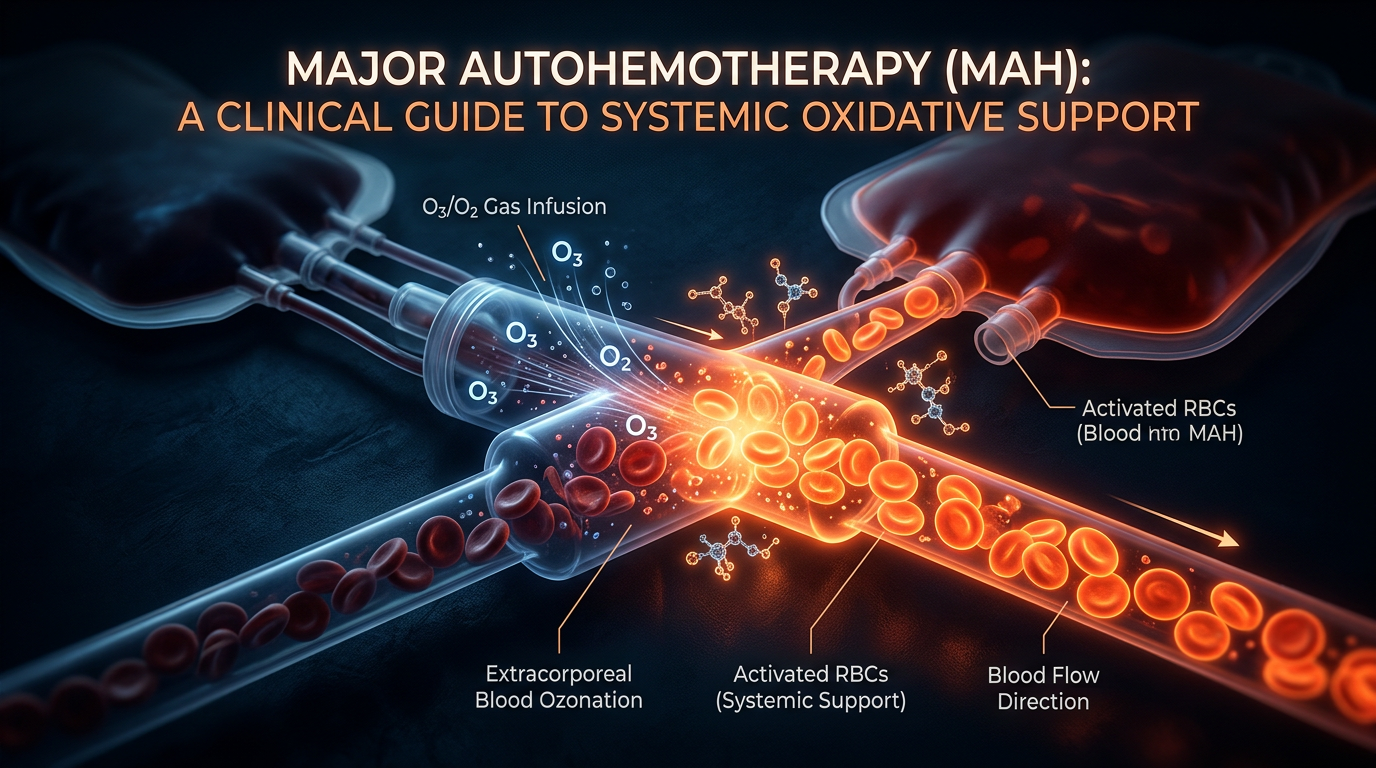
Major Autohemotherapy (MAH): A Clinical Guide to Systemic Oxidative Support
In the contemporary landscape of allopathic medicine, the concept of ‘oxidative stress’ is frequently weaponised as a purely pathological phenomenon. Patients are exhorted to consume vast quantities of exogenous antioxidants to neutralise the supposed ‘threat’ of reactive oxygen species (ROS). However, this reductionist view ignores a fundamental biological truth: oxygen is not merely a fuel for combustion, but the primary signalling molecule for cellular regeneration.
Major Autohemotherapy (MAH) stands at the vanguard of bio-oxidative medicine, challenging the prevailing pharmaceutical dogma. By introducing precise, controlled doses of medical-grade ozone ($O_3$) into a patient’s own blood, MAH triggers a sophisticated hormetic response—a ‘priming’ of the antioxidant system that restores redox homeostasis and enhances mitochondrial efficiency. This guide explores the biochemical nuances, the environmental necessity, and the clinical application of MAH as a cornerstone of systemic recovery.
The Biological Mechanism: Hormesis and the Nrf2 Pathway
The therapeutic efficacy of MAH does not stem from the ozone itself entering the systemic circulation—ozone is far too reactive for that. Instead, it acts as a biological ‘trigger.’ When medical-grade ozone is introduced to venous blood in a sterile environment, it reacts instantaneously with polyunsaturated fatty acids (PUFAs) and water in the plasma. This reaction generates two distinct sets of messengers:
- Reactive Oxygen Species (ROS): Short-lived molecules (primarily hydrogen peroxide) that act as immediate signalling triggers for erythrocytes and leucocytes.
- Lipid Oxidation Products (LOPs): More stable molecules (ozonides and aldehydes) that circulate throughout the body, acting as long-distance messengers to various tissues.
#### The Nrf2 Master Switch
The most significant action of these LOPs is the activation of the Nrf2 (Nuclear factor erythroid 2-related factor 2) pathway. Under normal conditions, Nrf2 is tethered in the cytoplasm. The controlled oxidative stimulus of MAH releases Nrf2, allowing it to migrate to the nucleus where it binds to the Antioxidant Response Element (ARE).
This triggers the de novo synthesis of a vast array of protective enzymes, including:
- Superoxide Dismutase (SOD): The primary defence against mitochondrial decay.
- Glutathione Peroxidase: The master regulator of cellular detoxification.
- Catalase: Essential for the neutralisation of hydrogen peroxide.
- Haeme Oxygenase-1 (HO-1): A potent anti-inflammatory and cytoprotective enzyme.
Unlike exogenous supplements, which provide a transient and often poorly absorbed supply of antioxidants, MAH forces the body to upregulate its own internal laboratory. It is the difference between giving a man a fish and teaching him to manage the entire fishery.
Oxygenation and the Erythrocyte Response
Beyond enzymatic upregulation, MAH profoundly alters haematological dynamics. Chronic disease states are almost universally characterised by ‘sludge blood’—a state of hyper-coagulability and poor erythrocyte flexibility.
MAH facilitates:
- Enhanced 2,3-DPG Production: This molecule shifts the oxyhaemoglobin dissociation curve to the right, forcing red blood cells to release their oxygen cargo more readily into the peripheral tissues.
- Improved Erythrocyte Deformability: Ozone increases the electrical charge on the red blood cell membrane, preventing the ‘Rouleaux effect’ (clumping) and allowing cells to navigate the narrowest capillaries to deliver oxygen to previously hypoxic zones.
- Nitric Oxide Release: MAH stimulates the vascular endothelium to release nitric oxide, inducing vasodilation and improving systemic perfusion.
UK Health Insight: The Burden of Chronic Fatigue
According to the National Institute for Health and Care Excellence (NICE), an estimated 250,000 people in the UK suffer from Myalgic Encephalomyelitis (ME/CFS). Clinical observations suggest that a significant proportion of these cases are rooted in mitochondrial dysfunction and persistent cellular hypoxia—conditions that MAH is specifically designed to address by restoring oxidative metabolism.
Environmental Disruptors: The Modern Hypoxic Taint
The necessity for MAH is exacerbated by the unprecedented environmental assault of the 21st century. The modern human is no longer living in the ‘goldilocks’ zone of biological compatibility. We are subjected to a cocktail of disruptors that suppress oxygen utilisation:
- Persistent Organic Pollutants (POPs) and PFAS: These ‘forever chemicals’ accumulate in the fatty tissues and interfere with mitochondrial membrane potential, effectively ‘stifling’ cellular respiration.
- Microplastics: Emerging research indicates that nanoplastics can penetrate the blood-brain barrier and induce chronic low-grade neuroinflammation, further taxing the redox system.
- Electromagnetic Smog (EMF): Non-ionising radiation has been shown to alter calcium signalling and increase the production of peroxynitrites, leading to oxidative damage that bypasses traditional antioxidant defences.
- Atmospheric Oxygen Decline: While the official atmospheric concentration of oxygen remains at 20.9%, urban environments and poorly ventilated workspaces often suffer from significantly lower levels, compounded by high CO2 and particulate matter.
In this context, MAH serves as a ‘biological reset,’ flushing the system with the oxidative signals necessary to purge accumulated toxins and restore cellular communication.
Clinical Protocols: The Art of Oxidative Administration
The administration of MAH is a precise clinical procedure that must be conducted under strict medical supervision. Unlike ‘wellness’ trends, true MAH requires pharmaceutical-grade oxygen and a high-precision ozone generator to ensure the exact gamma ($\gamma$) concentration is achieved.
#### The Standard MAH Procedure
- Venous Access: A sterile cannula is inserted, and 100ml to 200ml of blood is drawn into a vacuum glass bottle or specialised ozone-resistant bag.
- Anticoagulation: A precise amount of sodium citrate (or occasionally heparin) is added to prevent coagulation without altering the blood’s biochemistry.
- Ozonation: An equal volume of ozone gas (typically at a concentration of 20–40 $\mu$g/ml) is introduced to the blood. The blood is gently swirled, turning a bright cherry red as the haemoglobin becomes fully saturated.
- Re-infusion: The ozonated blood is returned to the patient via gravity or an infusion pump.
#### Dosing and Frequency (The Hormetic Curve)
The success of MAH lies in the Hormetic Window. Too little ozone provides no stimulus; too much ozone can overwhelm the body’s compensatory mechanisms.
- Initial Phase: Often termed the ‘Loading Phase,’ protocols typically involve two treatments per week for 5–10 weeks.
- Maintenance Phase: Once redox homeostasis is achieved, monthly sessions are often sufficient to maintain the upregulated Nrf2 state and manage environmental toxic load.
- Concentration Staging: Practitioners usually begin at a lower concentration (20 $\mu$g/ml) to gauge the patient's oxidative capacity, gradually increasing to 40 $\mu$g/ml as the body’s endogenous antioxidant levels rise.
Recovery Protocols and Nutrient Co-factors
To maximise the efficacy of Major Autohemotherapy, the patient’s nutritional substrate must be optimised. MAH is a catalyst; it requires the correct ‘building blocks’ to produce the desired enzymatic outcome.
- The Selenium Connection: Selenium is the essential co-factor for glutathione peroxidase. Without adequate selenium levels, the Nrf2 activation triggered by MAH cannot be fully realised.
- Magnesium and ATP: Since MAH improves mitochondrial function, magnesium (the ‘spark plug’ of the mitochondria) must be present in abundance to facilitate the increased ATP production.
- Hydration and Electrolytes: Oxidative therapies require a fluid medium. Proper cellular hydration ensures that LOPs can circulate efficiently and that the resulting metabolic waste products are cleared via the renal system.
- Post-Treatment ‘Quenching’: Whilst we want the oxidative signal to work, many practitioners recommend high-dose Vitamin C or Alpha-Lipoic Acid administered several hours after or the day after MAH to mop up residual metabolites and support the liver.
Truth-Exposing: Why Isn't This Standard Care?
The sceptic might ask: “If MAH is so effective for chronic fatigue, cardiovascular health, and autoimmune modulation, why is it relegated to the ‘alternative’ sphere?”
The answer lies in the economics of the medical-industrial complex. Ozone is a gas derived from oxygen; it cannot be patented. It is inexpensive to produce and, once the equipment is purchased, the cost per treatment is minimal compared to biological drugs or lifelong pharmacological interventions.
Furthermore, MAH treats the system, not the symptom. Allopathic medicine is structured around the ‘one drug, one target’ model. MAH, by targeting the very foundation of cellular life—oxygen and redox signalling—defies the categorisation required for the current insurance-based medical model. It is a therapy that promotes sovereignty, reducing the patient’s long-term reliance on the pharmaceutical supply chain.
Contraindications and Safety
Despite its profound effects, MAH is remarkably safe when performed correctly. In a landmark study involving over 5 million treatments in Germany, the rate of adverse effects was found to be just 0.0007%. However, certain contraindications remain absolute:
- G6PD Deficiency (Favism): This genetic condition compromises the red blood cell’s ability to handle oxidative stress. Testing for G6PD is a prerequisite for MAH.
- Uncontrolled Hyperthyroidism: Ozone can further stimulate metabolic activity, which may be dangerous in an acute thyrotoxic state.
- Active Haemorrhage: Due to the transient anti-platelet effect of ozone.
- Pregnancy: While no evidence of harm exists, clinical caution dictates avoidance during pregnancy.
The Future of Bio-Oxidative Medicine
As we move deeper into an era of antibiotic resistance, viral mutations, and environmental degradation, the role of systemic oxidative support will only grow in importance. Major Autohemotherapy represents a bridge between ancient biological wisdom and modern biochemical precision.
It is more than a medical procedure; it is a tactical intervention against the 'rusting' of the human form. By harnessing the power of the $O_3$ molecule, we are not merely treating disease; we are restoring the fundamental vitality that defines our species. For those seeking INNERSTANDING of their own physiological potential, MAH offers a path to reclaim the oxygen-rich heritage that modern life has attempted to extinguish.
The paradigm is shifting. The era of suppressing the body is ending; the era of prompting the body’s own genius has begun. MAH is the catalyst for that transformation.
This article is provided for informational and educational purposes only. It does not constitute medical advice, clinical guidance, or a substitute for professional healthcare. Information reflects cited research at time of publication. Always consult a qualified healthcare professional before acting on any health information.
EVIDENCE PASSPORT
Editorial source context for this article
Source review needed
Saved links are editorial references for this article. They may support specific claims rather than every sentence. Open and assess each source in context. This passport does not independently verify them.
Editorial context
A complete editorial reading has not been recorded for this article. Source links remain available for you to open and assess directly.
Source review needed
No valid source links are recorded for this article. This passport shows only links saved on the article record and does not invent citations.
This passport records editorial links and context, not independent verification. Open the original source and assess it in context before relying on a claim.
Medical Disclaimer
The information in this article is for educational purposes only and does not constitute medical advice, diagnosis, or treatment. Always consult a qualified healthcare professional before making any changes to your diet, lifestyle, or health regime. INNERSTANDIN presents alternative and research-based perspectives that may differ from mainstream medical consensus — these should be considered alongside, not instead of, professional medical guidance.
Read Full DisclaimerContinue the thread
Keep this question moving.
Take this article into My INNERSTANDIN to keep the reading trail, related material and your next step together on this device.
Explore this in the Body Map
See where this hits your biology. Interactive anatomy, threats, and protective protocols.
Dig deeper in the Library
Free, longform PDF volumes that go beyond headlines into mechanisms and references.