
The Melanopsin Mutiny: How Artificial Blue Light Hijacks the Master Clock
Published April 2026
An investigative look at the discovery of ipRGCs and how the blue light spike in modern LEDs hijacks the master circadian clock, leading to systemic health degradation.
Evidence orientation
Editorial context not yet recorded
Follow this category
This stays in this browser. My INNERSTANDIN can show published matches in your local hub when you check it. It does not send email, push, or alert notifications.
Local learning review
A private browser aid for revisiting ideas. It is not an alert or a health recommendation.
Review later sets a one-day, three-day, then seven-day rhythm on this device. Choose it only when you want to revisit this article.
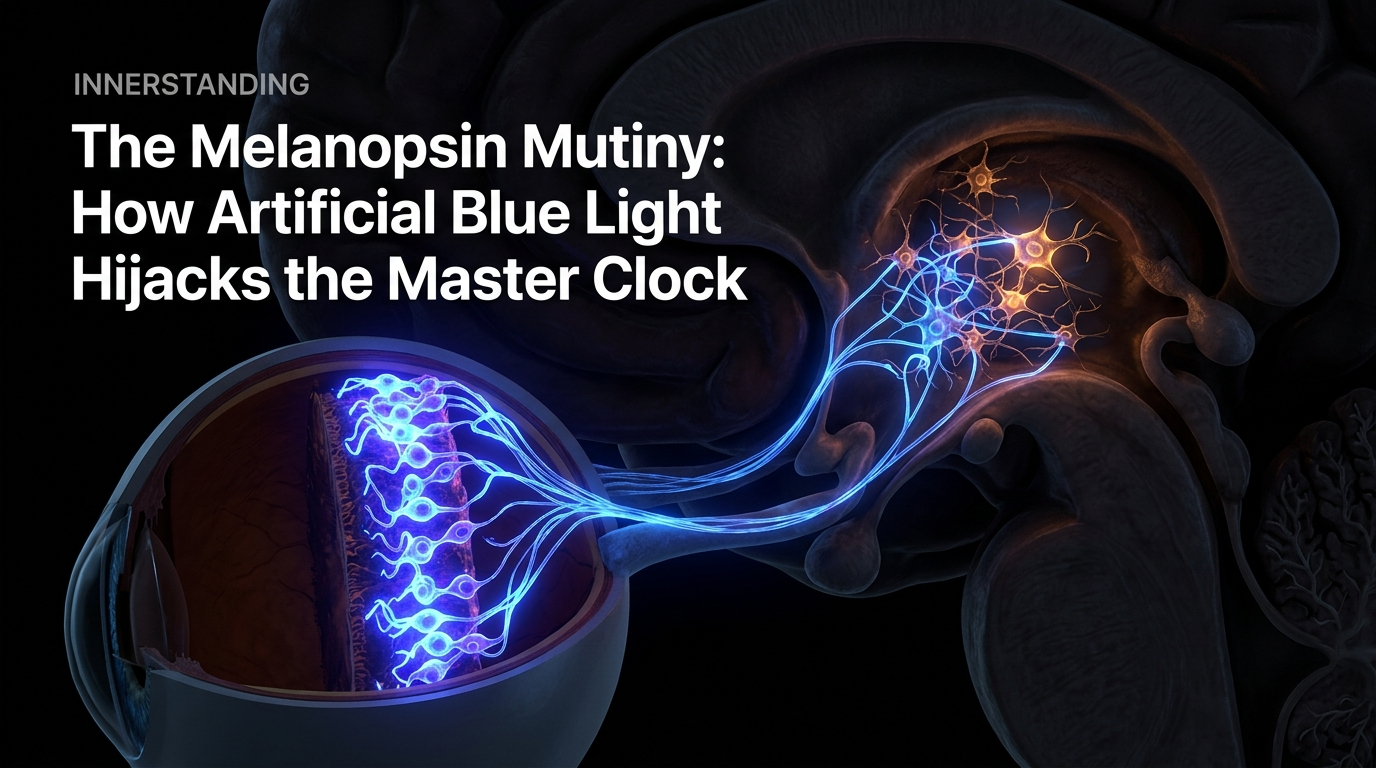
For over a century, the medical consensus regarding the eye was limited to its role in vision. We understood the rods and cones as the primary transducers of light into electrical signals for the brain. However, the 21st-century discovery of Intrinsically Photosensitive Retinal Ganglion Cells (ipRGCs) has revolutionised our understanding of how light regulates human health. These cells contain a photopigment called melanopsin, which is specifically sensitive to short-wavelength blue light around 460-480 nanometers. Unlike rods and cones, ipRGCs do not contribute to visual images; instead, they send signals directly to the Suprachiasmatic Nucleus (SCN), the master circadian clock located in the hypothalamus.
This pathway is the primary regulator of our sleep-wake cycle, hormonal secretion, and metabolic rhythm. When we expose ourselves to artificial blue light from LEDs and screens after sunset, we are essentially sending a 'high noon' signal to the brain, leading to a state of chronic circadian misalignment that mainstream medicine often ignores in the context of chronic disease. THE BIOLOGY OF CIRCADIAN DISRUPTION. The SCN operates as a conductor for every peripheral clock in the body, from the liver to the pancreas. When the SCN receives blue-light signals at night, it immediately suppresses the production of melatonin by the pineal gland.
Melatonin is frequently mischaracterised as merely a 'sleep hormone,' but its physiological role is far more profound. It is a potent systemic antioxidant and a key regulator of mitochondrial health. By artificially extending the 'light phase' of our day, we deprive our cells of the essential repair mechanisms that occur only in the absence of blue light. This leads to a persistent elevation of evening cortisol and a suppression of the parasympathetic nervous system, creating a state of physiological stress that underpins modern metabolic syndrome. THE SPECTRAL DEFICIT OF MODERN LEDS.
Natural sunlight is a full-spectrum source, providing a rich balance of blue, green, red, and near-infrared (NIR) wavelengths. In contrast, the white LEDs that dominate our homes and offices are essentially blue lights coated with a phosphor layer to appear white. They lack the restorative red and near-infrared frequencies found in firelight and incandescent bulbs. Red light has been shown to stimulate cytochrome c oxidase in the mitochondria, facilitating cellular energy production and repair. When we consume high-energy blue light without the balancing effects of red light, we induce oxidative stress in the retina and throughout the body.
This 'spectral poverty' is a hidden driver of premature cellular aging and systemic inflammation that is rarely addressed in standard health check-ups. RECLAIMING THE PHOTIC ENVIRONMENT. To protect our biological integrity, we must adopt a more sophisticated relationship with light. This involves more than just 'limiting screen time.' It requires a strategic approach to the photic environment: viewing natural sunlight early in the day to anchor the circadian rhythm, and aggressively filtering blue light after dusk. The use of high-quality blue-blocking glasses that filter 100% of light below 550nm, replacing high-Kelvin LED bulbs with warm-toned incandescent or specifically designed 'sleep-safe' bulbs, and utilising red-light therapy can help bridge the gap between our evolutionary requirements and our modern reality.
This article is provided for informational and educational purposes only. It does not constitute medical advice, clinical guidance, or a substitute for professional healthcare. Information reflects cited research at time of publication. Always consult a qualified healthcare professional before acting on any health information.
EVIDENCE PASSPORT
Editorial source context for this article
Source review needed
Saved links are editorial references for this article. They may support specific claims rather than every sentence. Open and assess each source in context. This passport does not independently verify them.
Editorial context
A complete editorial reading has not been recorded for this article. Source links remain available for you to open and assess directly.
Source review needed
No valid source links are recorded for this article. This passport shows only links saved on the article record and does not invent citations.
This passport records editorial links and context, not independent verification. Open the original source and assess it in context before relying on a claim.
Medical Disclaimer
The information in this article is for educational purposes only and does not constitute medical advice, diagnosis, or treatment. Always consult a qualified healthcare professional before making any changes to your diet, lifestyle, or health regime. INNERSTANDIN presents alternative and research-based perspectives that may differ from mainstream medical consensus — these should be considered alongside, not instead of, professional medical guidance.
Read Full DisclaimerContinue the thread
Keep this question moving.
Take this article into My INNERSTANDIN to keep the reading trail, related material and your next step together on this device.
Dig deeper in the Library
Free, longform PDF volumes that go beyond headlines into mechanisms and references.