
Mesenchymal Signaling: The Hidden Language of Tissue Repair
Updated May 2026
Mesenchymal stem cells use paracrine signaling to orchestrate complex healing processes across the body. We examine the molecular pathways that allow these cells to communicate with damaged tissues.
Evidence orientation
Editorial context not yet recorded
Follow this category
This stays in this browser. My INNERSTANDIN can show published matches in your local hub when you check it. It does not send email, push, or alert notifications.
Local learning review
A private browser aid for revisiting ideas. It is not an alert or a health recommendation.
Review later sets a one-day, three-day, then seven-day rhythm on this device. Choose it only when you want to revisit this article.
Overview
For decades, the standard biological model viewed Mesenchymal Stem Cells (MSCs) as simple "building blocks"—dormant reserve units waiting to be transformed into bone, cartilage, or fat. This reductionist view, while convenient for early textbooks, ignored the most profound capability of these cellular entities. We now understand that MSCs are not merely construction materials; they are the primary architects and intelligence officers of the body’s regenerative landscape.
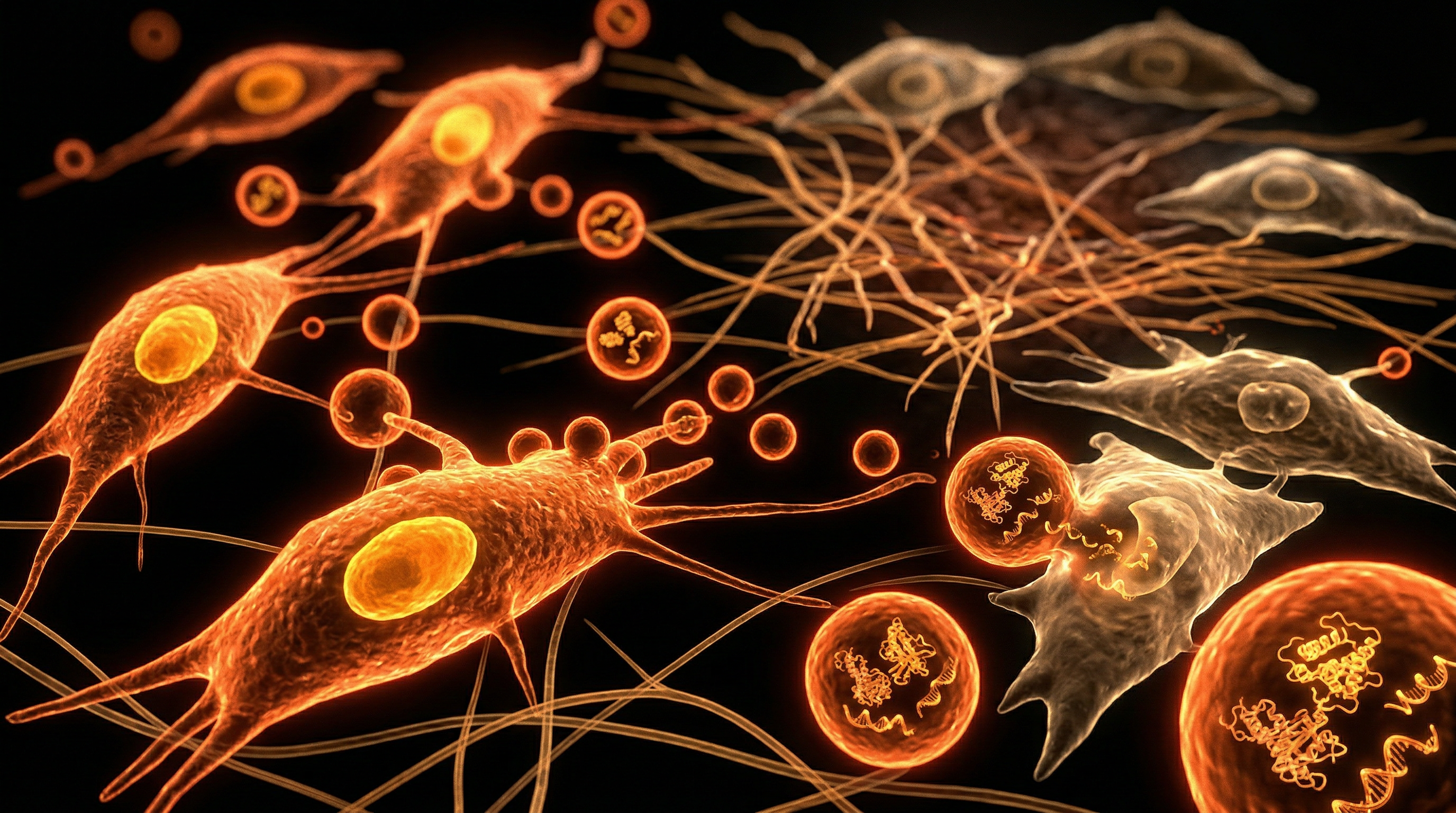
The true power of the MSC lies in its paracrine signaling capacity—a sophisticated, clandestine language of molecular exchange that allows these cells to "sense" injury and "prescribe" a specific pharmacological cocktail of proteins, lipids, and genetic instructions to surrounding tissues. This is not a passive process. It is a highly dynamic, real-time bio-computation that determines whether a wound heals cleanly or descends into chronic inflammation and fibrosis.
At INNERSTANDING, we posit that this "hidden language" is being systematically disrupted by the modern environment. In this comprehensive investigation, we peel back the layers of mainstream stem cell marketing to reveal the intricate mechanisms of mesenchymal communication, the environmental saboteurs silencing these vital signals, and the protocols required to restore the body’s internal dialogue.
Fact: The global regenerative medicine market is projected to reach $150 billion by 2030, yet the vast majority of these funds are directed toward exogenous (external) cell therapies rather than the optimisation of the body's existing, endogenous signaling pathways.
The Biology — How It Works
To understand the language of repair, one must first identify the speakers. Mesenchymal Stem Cells (often more accurately termed Medicinal Signaling Cells by pioneers like Dr. Arnold Caplan) are found in almost every vascularised tissue in the human body. They reside in a specialised niche known as the perivascular space, specifically as pericytes wrapped around the smallest blood vessels.
The Pericyte-to-MSC Transition
When a tissue experiences trauma—whether through mechanical injury, chemical insult, or pathogen invasion—the pericyte detaches from the blood vessel wall. This detachment is the "call to arms." Upon release, the pericyte undergoes a phenotypic shift, becoming an active MSC. It is now mobile, sensing the chemical gradients (chemotaxis) produced by the site of injury.
Sensing the Microenvironment
MSCs are equipped with an array of receptors, including Toll-like receptors (TLRs), which allow them to survey the landscape. They can distinguish between:
- DAMPs (Damage-Associated Molecular Patterns): Released by our own dying cells.
- PAMPs (Pathogen-Associated Molecular Patterns): Released by invading bacteria or viruses.
Depending on the signals received, the MSC modifies its "output." If the environment is overly inflamed (Pro-inflammatory/Th1), the MSC secretes anti-inflammatory cytokines to dampen the response. If the environment is immunosuppressed, it can, conversely, stimulate the immune system. This immunomodulatory role is the cornerstone of tissue homeostasis.
The Secretome: The Vocabulary of Repair
The sum total of everything an MSC secretes is known as the secretome. It is not a random excretion but a carefully curated message containing:
- Growth Factors: Such as VEGF (Vascular Endothelial Growth Factor) to grow new blood vessels.
- Cytokines: Interleukins that manage the inflammatory "volume."
- Chemokines: Signals that call in other repair cells, like macrophages.
- Extracellular Vesicles (EVs): The "envelopes" containing the most complex data.
Mechanisms at the Cellular Level
The most revolutionary discovery in mesenchymal science is the role of Extracellular Vesicles (EVs), specifically exosomes. For a long time, these were dismissed as "cellular debris" or "trash bags." We now know they are the high-speed fibre-optic cables of biological communication.
Exosomes: The Quantum Envelopes
Exosomes are tiny lipid-bilayer spheres (30–150 nm) that are packed with microRNA (miRNA), messenger RNA (mRNA), and functional proteins. Because they are so small and possess a protective lipid coating, they can travel through the interstitial fluid and the bloodstream, bypassing the barriers that usually degrade naked genetic material.
When an exosome reaches a target cell (such as a damaged muscle cell or a struggling neuron), it fuses with that cell’s membrane. It then "unloads" its cargo:
- MicroRNA Silencing: The exosome can deliver specific miRNAs that shut down the production of inflammatory proteins within the target cell.
- Protein Delivery: It can deliver pre-formed enzymes to jump-start metabolic processes.
- Mitochondrial Transfer: In a stunning display of cellular altruism, MSCs can actually donate their own mitochondria to damaged cells via tunnelling nanotubes (TNTs). This provides an immediate "energy rescue" to cells on the verge of death.
The Epigenetic Handshake
Mesenchymal signaling is not just a "one-way" broadcast. It involves a "handshake" where the recipient cell’s state dictates how it interprets the MSC’s signal. This is epigenetic modulation. The MSC signals can actually re-programme the gene expression of surrounding tissues, turning off the "death genes" (apoptosis) and turning on the "growth genes" (proliferation).
Horizontal Gene Transfer
We are witnessing a form of horizontal gene transfer within our own bodies. The MSC acts as a mobile genetic laboratory, synthesising the specific RNA sequences needed to repair a specific defect and delivering them directly to the "factory floor" of the damaged tissue. This level of precision puts modern pharmaceutical interventions to shame.
Environmental Threats and Biological Disruptors
If the mesenchymal signaling system is so robust, why does the modern human struggle with chronic non-healing wounds, osteoarthritis, and systemic degeneration? The answer lies in molecular sabotage. Our industrialised environment is saturated with compounds that specifically target and silence these signaling pathways.
The Glyphosate Interference
The herbicide glyphosate (the active ingredient in Roundup) is perhaps the most insidious disruptor. Glyphosate is an analogue of the amino acid glycine. MSCs rely heavily on glycine to produce collagen and to synthesise the signaling proteins in their secretome. When glyphosate is present, it can be mistakenly incorporated into these proteins, causing them to misfold. A misfolded signal is a "garbled" message; the recipient cell cannot "read" it, and the repair process stalls.
Electromagnetic Fields (EMFs) and Calcium Channel Leakage
Research into Voltage-Gated Calcium Channels (VGCCs) suggests that non-ionising radiation from 5G, Wi-Fi, and smart meters can cause an abnormal influx of calcium into the cell. MSC signaling is highly dependent on precise calcium oscillations. When the cell is flooded with calcium due to external EMF stress, the "rhythm" of signaling is lost. The MSC becomes "electrically deaf," unable to sense the chemical gradients of injury.
Microplastics and Nanoparticles
The infiltration of microplastics and heavy metals (such as aluminium and mercury) into the perivascular niche creates a "physical static." These particles can be endocytosed (swallowed) by MSCs, triggering internal oxidative stress. Instead of secreting repair signals, the MSC is forced to expend its energy on its own survival, leading to a state of premature senescence.
Pharmaceutical Dampening: The Corticosteroid Trap
Mainstream medicine’s reliance on Corticosteroids and high-dose NSAIDs (Non-Steroidal Anti-Inflammatory Drugs) is fundamentally at odds with mesenchymal biology. While these drugs reduce pain, they do so by "muting" the entire inflammatory conversation. Because MSCs require the initial "danger signal" (DAMPs) to activate, suppressing all inflammation prevents the MSCs from ever leaving their perivascular niches. We are trading long-term repair for short-term symptom relief.
The Cascade: From Exposure to Disease
When mesenchymal signaling fails, the body does not simply stay "the same." It enters a downward spiral of maladaptive repair. This cascade is the root cause of what is often mislabelled as "age-related" disease.
Phase 1: Signal Attenuation
The first stage is a weakening of the paracrine broadcast. Wounds take longer to heal, and "niggles" in joints don't resolve. At the cellular level, the exosomes being produced are "empty" or contain "noise" (stress-induced miRNAs).
Phase 2: The Fibrotic Pivot
If an MSC arrives at an injury site but receives "garbled" or "toxic" signals from the environment (due to the presence of pollutants), it may deviate from its repair programme. Instead of promoting functional tissue regeneration, it may differentiate into a myofibroblast. This leads to fibrosis—the deposition of stiff, non-functional scar tissue.
- In the heart: This leads to heart failure.
- In the lungs: Pulmonary fibrosis.
- In the liver: Cirrhosis.
- In the kidneys: Chronic Kidney Disease (CKD).
Phase 3: Inflammaging and Senescence
Without the "cleanup" signals from healthy MSCs, the body accumulates senescent cells ("zombie cells"). These cells refuse to die and instead secrete their own toxic cocktail known as the SASP (Senescence-Associated Secretory Phenotype). The SASP poisons the remaining healthy MSCs, creating a feedback loop of systemic inflammation—the "hidden language" has been replaced by a "scream of distress."
Phase 4: Autoimmune Confusion
In the final stage of the cascade, the loss of MSC-mediated immunomodulation leads the immune system to lose its "self-tolerance." Without the MSCs constantly "educating" the T-cells and B-cells in the local tissues, the immune system begins to attack the body's own structures, resulting in the explosion of autoimmune conditions seen across the Western world.
What the Mainstream Narrative Omits
The current medical establishment focuses almost exclusively on stem cell injections. While these can be effective, they are a "top-down" approach that ignores the underlying biological terrain. The "suppressed truth" is that your endogenous (native) MSCs are potentially more powerful than any lab-grown injection, provided they are not being poisoned.
The "Cell Replacement" Myth
The mainstream narrative suggests that the benefit of stem cell therapy comes from the injected cells "becoming" the new tissue. This is largely false. Research shows that injected MSCs rarely survive more than a few days and almost never integrate into the host tissue. Their true benefit is the "kiss and run" effect—the massive burst of paracrine signaling they release before they die, which "wakes up" the patient's own dormant repair cells.
Why Endogenous Activation is Ignored
There is no "patent" on the activation of your own MSCs. You cannot sell a proprietary molecule for a process that can be triggered by specific wavelengths of light, periods of fasting, or the removal of environmental toxins. The industry is incentivised to view the body as a "broken machine" needing external parts, rather than a "self-healing intelligence" needing the removal of obstructions.
The Exosome Patent Wars
We are currently in the midst of a massive corporate land grab for exosome patents. Companies are trying to isolate specific mesenchymal "messages" and turn them into synthetic drugs. This reductionist approach misses the point: the MSC secretes a symphony, not a single note. Isolating one miRNA or one protein from the secretome will never match the efficacy of the holistic cellular response.
The UK Context
In the United Kingdom, the state of mesenchymal signaling is particularly precarious. A combination of post-industrial environmental legacies, dietary habits, and a rigid healthcare model has created a "perfect storm" for regenerative failure.
The Post-Industrial Toxic Burden
Large swathes of the UK—particularly the Midlands, the North of England, and the Clyde Valley—suffer from the persistence of heavy metals in the soil and water tables. Lead, cadmium, and arsenic from the Industrial Revolution are still "bioavailable" in our environment. As we have established, heavy metals are potent silencers of MSC communication.
The Fluoridation Conflict
The UK remains one of the few European countries where water fluoridation is still practiced in several regions (including the North East and parts of the West Midlands). While debated as a dental intervention, from a biological signaling perspective, fluoride is a known enzyme disruptor that can interfere with the G-protein coupled receptors that MSCs use to navigate the body.
The NHS and the "Biochemical Silo"
The National Health Service (NHS) is remarkably efficient at acute care but struggles with the "Signaling Model" of health. Most UK GPs are not trained in redox biology or paracrine signaling. Consequently, the UK population is often over-prescribed drugs like statins and proton pump inhibitors (PPIs). Recent studies have suggested that long-term PPI use can impair the acidification process required for the proper formation of exosomes, further silencing the hidden language of repair.
Statistics: Over 15 million people in England alone live with a chronic condition that the current medical model manages but does not "repair." This represents a massive failure of mesenchymal signaling on a national scale.
Protective Measures and Recovery Protocols
Restoring the language of tissue repair is not about finding a "miracle cure"; it is about Signal Optimisation and Noise Reduction. By following a protocol designed to support mesenchymal health, one can reactivate the body’s internal repair shop.
1. Environmental Detoxification (Noise Reduction)
- Water Filtration: Use a high-quality reverse osmosis system to remove fluoride, glyphosate, and microplastics from drinking water.
- EMF Hygiene: Minimise exposure to high-frequency radiation, especially during sleep (the prime time for MSC activity). Switch off Wi-Fi routers and keep mobile phones out of the bedroom.
- Organic Nutrition: Prioritise sulfur-rich vegetables (broccoli, garlic, onions) to provide the precursors for glutathione, the body’s master antioxidant that protects the MSC niche.
2. Hormetic Activation (The "Wake Up" Call)
- Intermittent Fasting: Autophagy (the cellular "cleanup" process triggered by fasting) is the most potent way to clear out the "biological static" of senescent cells and misfolded proteins.
- Photobiomodulation (Red Light Therapy): Wavelengths between 600nm and 900nm penetrate the skin and interact with cytochrome c oxidase in the mitochondria of MSCs, boosting their ATP production and signaling output.
- Cold/Heat Stress: Brief exposure to extreme temperatures (saunas or cold plunges) triggers heat-shock proteins and cold-shock proteins, which act as "molecular chaperones" ensuring that signaling proteins are folded correctly.
3. Targeted Nutrients for Signaling
- Sulforaphane: Found in broccoli sprouts, this compound activates the Nrf2 pathway, which protects the MSC secretome from oxidative damage.
- Astaxanthin: A potent lipid-soluble antioxidant that protects the delicate membranes of exosomes.
- Quercetin and Fisetin: Known as "senolytics," these flavonoids help the body clear out the senescent cells that interfere with mesenchymal messages.
- Magnesium Bisglycinate: Essential for over 300 enzymatic reactions and critical for managing the calcium channels that EMFs disrupt.
4. Movement and Mechanotransduction
MSCs are highly "mechanosensitive." They "feel" the physical forces applied to the body. Sedentary behaviour tells the MSCs that no repair is needed, leading to atrophy. Weight-bearing exercise and high-intensity movement create "mechanical signals" that travel through the fascia, telling the MSCs to maintain the structural integrity of the bone and connective tissue.
Summary: Key Takeaways
- Beyond the Building Block: Mesenchymal Stem Cells are not just replacement parts; they are the "intelligence centres" of the body, using paracrine signaling to manage repair.
- The Secretome is the Language: Communication happens via exosomes—lipid envelopes containing RNA and proteins that can reprogramme damaged cells.
- The Danger of "Biological Static": Environmental toxins like glyphosate, heavy metals, and EMFs garble the messages, leading to "signal failure."
- The Fibrotic Pivot: When signaling fails, the body stops regenerating and starts scarring, leading to the "Cascade of Disease" and chronic inflammation.
- The Endogenous Revolution: True healing comes from optimising the body's native signaling rather than relying solely on expensive, external cell injections.
- The UK Landscape: Specific regional factors in the UK, from water fluoridation to the legacy of the Industrial Revolution, make MSC protection a national health priority.
- Actionable Recovery: Through fasting, red light therapy, senolytic nutrients, and environmental detox, it is possible to "clear the lines" and restore the body's hidden language of repair.
The future of medicine is not found in a more complex chemical drug; it is found in understanding and restoring the subtle, ancient, and highly intelligent dialogue that occurs every second within our own tissues. The language of repair is already written in your DNA—you simply need to ensure the world isn't too loud for your cells to hear it.
This article is provided for informational and educational purposes only. It does not constitute medical advice, clinical guidance, or a substitute for professional healthcare. Information reflects cited research at time of publication. Always consult a qualified healthcare professional before acting on any health information.
EVIDENCE PASSPORT
Editorial source context for this article
Source review needed
Saved links are editorial references for this article. They may support specific claims rather than every sentence. Open and assess each source in context. This passport does not independently verify them.
Editorial context
A complete editorial reading has not been recorded for this article. Source links remain available for you to open and assess directly.
Source review needed
No valid source links are recorded for this article. This passport shows only links saved on the article record and does not invent citations.
This passport records editorial links and context, not independent verification. Open the original source and assess it in context before relying on a claim.
Medical Disclaimer
The information in this article is for educational purposes only and does not constitute medical advice, diagnosis, or treatment. Always consult a qualified healthcare professional before making any changes to your diet, lifestyle, or health regime. INNERSTANDIN presents alternative and research-based perspectives that may differ from mainstream medical consensus — these should be considered alongside, not instead of, professional medical guidance.
Read Full DisclaimerContinue the thread
Keep this question moving.
Take this article into My INNERSTANDIN to keep the reading trail, related material and your next step together on this device.
Dig deeper in the Library
Free, longform PDF volumes that go beyond headlines into mechanisms and references.