
Mineral Ratios: Ancient Seawater vs Sodium-Potassium Imbalance
Updated May 2026
We analyze the cellular impact of the modern UK diet's high sodium-to-potassium ratio compared to ancestral norms. This article highlights why ancient mineral sources are vital for heart health.
Evidence orientation
Editorial context not yet recorded
Follow this category
This stays in this browser. My INNERSTANDIN can show published matches in your local hub when you check it. It does not send email, push, or alert notifications.
Local learning review
A private browser aid for revisiting ideas. It is not an alert or a health recommendation.
Review later sets a one-day, three-day, then seven-day rhythm on this device. Choose it only when you want to revisit this article.
Overview
In the grand tapestry of biological evolution, the transition from multicellular organisms dwelling within the primordial sea to terrestrial life represents the most significant physiological hurdle ever cleared by our ancestors. To survive on land, we did not leave the ocean behind; rather, we encased it within our skin. This internal environment, known as the milieu intérieur, as coined by the French physiologist Claude Bernard, is a liquid matrix that must maintain a precise electrochemical composition to sustain life.
However, a silent catastrophe is unfolding within the modern human body. We have fundamentally altered the chemistry of our internal sea. For approximately 400 million years, the evolutionary blueprint of the vertebrate lineage was forged in an environment where Potassium (K) was abundant and Sodium (Na) was exceedingly scarce. Consequently, our genetic architecture is hardwired to aggressively conserve sodium while rapidly excreting potassium—a survival mechanism designed for a world that no longer exists.
In the contemporary UK landscape, the industrial food complex has inverted this ancient ratio. We are currently consuming sodium in quantities that exceed ancestral norms by ten to twenty-fold, while our potassium intake has plummeted to less than a third of what our palaeolithic ancestors consumed. This "Sodium-Potassium Inversion" is not merely a dietary footnote; it is a fundamental biological disruption that destabilises the cellular membrane potential, compromises mitochondrial efficiency, and serves as the primary driver behind the epidemic of "diseases of civilisation," including hypertension, stroke, and metabolic syndrome.
This article explores the deep-time biological origins of our mineral requirements, the molecular mechanisms by which the modern sodium-to-potassium (Na:K) imbalance destroys cellular integrity, and why restoring the Ancient Seawater Ratio is the most critical intervention for the health of the modern Briton.
The Biology — How It Works
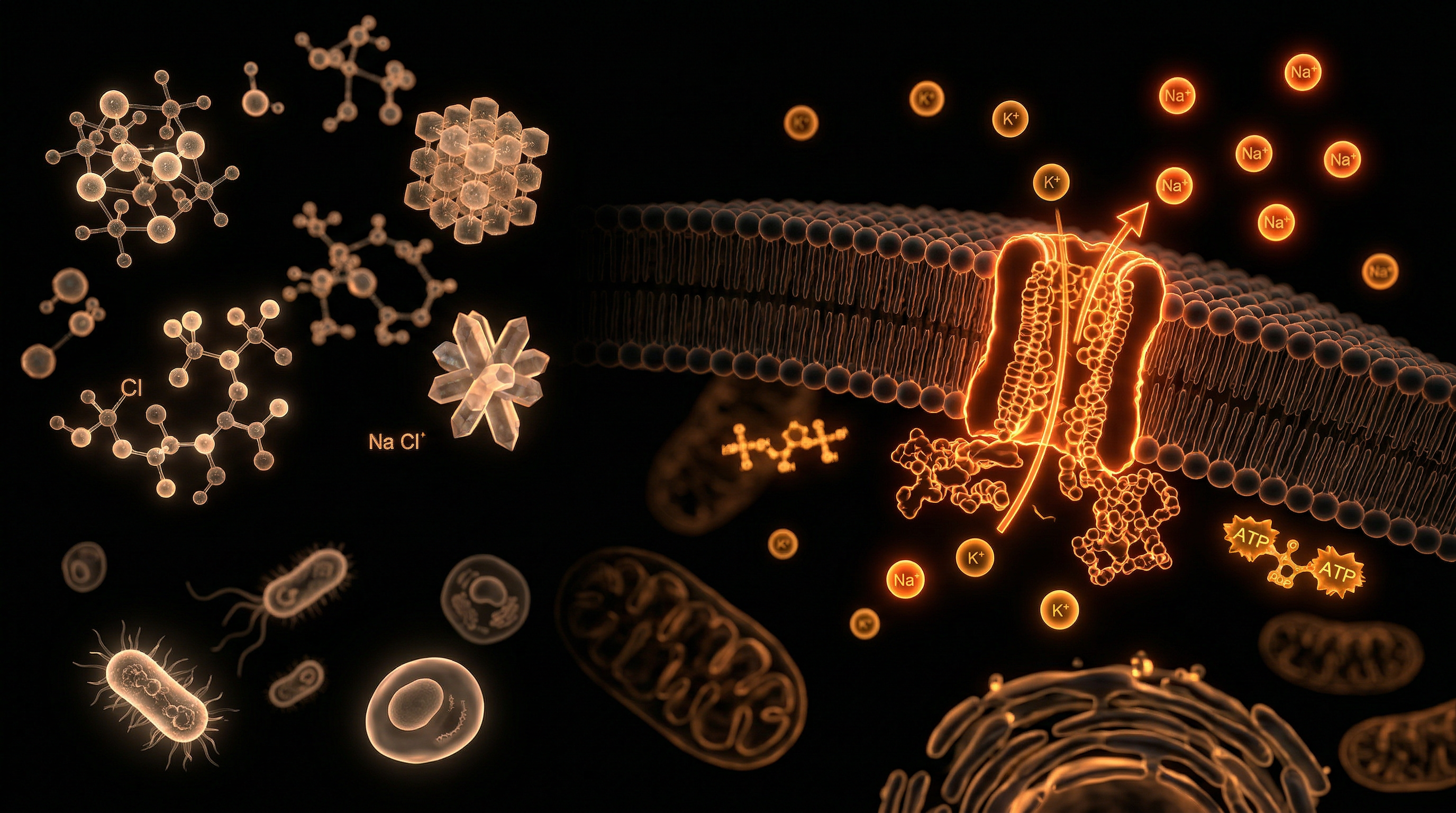
To understand why the Na:K ratio is the master lever of human health, we must look at the Sodium-Potassium Pump (Na+/K+-ATPase), a transmembrane enzyme found in the membrane of all animal cells. This pump is the single most energy-demanding process in the human body, consuming approximately 20% to 40% of all ATP (adenosine triphosphate) generated by a resting adult. In the brain, this figure rises to a staggering 70%.
The Evolutionary Mismatch
The primordial oceans where early life flourished were rich in potassium. Even as the oceans transitioned toward a more sodic composition over aeons, the interior of the cell remained a potassium-dominant sanctuary. The biological directive was clear: maintain a high-potassium environment inside the cell and a high-sodium environment outside the cell.
This creates an electrochemical gradient—essentially a biological battery.
- Intracellular Fluid (ICF): Predominantly Potassium.
- Extracellular Fluid (ECF): Predominantly Sodium.
Fact: Palaeolithic humans consumed approximately 11,000 mg of potassium per day and less than 700 mg of sodium. This is a K:Na ratio of roughly 16:1. Modern UK diets often exhibit a ratio of 1:2, representing a 32-fold shift from our evolutionary baseline.
The Maintenance of the Membrane Potential
The Na+/K+-ATPase pump works tirelessly to pump three sodium ions out of the cell for every two potassium ions it pumps in. This "uneven" trade creates a net negative charge inside the cell relative to the outside. This is known as the Resting Membrane Potential.
This electrical charge is what allows nerves to fire, muscles to contract, and—most importantly—nutrients to be transported into the cell. When the ratio is skewed by excessive dietary sodium and insufficient potassium, the "battery" loses its charge. The cell becomes "depolarised," leading to a state of chronic cellular stress and impaired signalling.
Mechanisms at the Cellular Level
The damage caused by the modern Na:K imbalance begins at the sub-cellular level, specifically within the mitochondria and the delicate structures of the vascular endothelium.
Mitochondrial Dysfunction and Oxidative Stress
When the sodium-potassium pump fails to maintain the correct gradient due to a lack of potassium, the cell begins to accumulate sodium. To maintain osmotic balance, the cell must also take in water, leading to cellular swelling (oedema). More critically, the rise in intracellular sodium triggers a secondary exchange mechanism: the Sodium-Calcium Exchanger (NCX).
In an attempt to eject the excess sodium, the cell inadvertently pulls in Calcium (Ca2+). This rise in cytosolic calcium is a "death signal" for the mitochondria. Excessive calcium within the mitochondrial matrix disrupts the electron transport chain, leading to the leakage of Reactive Oxygen Species (ROS). These free radicals damage mitochondrial DNA and lipid membranes, creating a cycle of energy depletion and inflammation.
The Endothelial Glycocalyx
The health of our arteries is dictated by the Endothelial Glycocalyx—a delicate, hair-like forest of glycoproteins that lines the interior of our blood vessels. This structure is highly sensitive to the mineral composition of the blood.
High sodium concentrations degrade the glycocalyx, stripping away this protective layer. This exposes the underlying endothelial cells to mechanical shear stress and inflammatory cytokines. Potassium, conversely, acts as a physiological "cushion," promoting the synthesis of Nitric Oxide (NO), which allows blood vessels to dilate and remain supple. Without adequate potassium, the vessels remain in a state of chronic constriction (vasoconstriction), the hallmark of hypertension.
The Role of Magnesium as the Gatekeeper
It is impossible to discuss the sodium-potassium pump without mentioning Magnesium. Magnesium acts as the essential cofactor for the Na+/K+-ATPase enzyme. If a patient is magnesium-deficient—as a vast majority of the UK population is due to soil depletion—the pump cannot function, regardless of how much potassium is consumed. Magnesium "plugs" the potassium exit channels in the cell, preventing potassium from leaking out. In the absence of magnesium, the cell becomes a "leaky bucket," unable to hold onto its vital potassium reserves.
Environmental Threats and Biological Disruptors
The shift from ancient mineral ratios to the modern imbalance is not an accident of nature; it is a direct consequence of industrialisation and the systematic degradation of our food supply.
The NPK Paradigm and Soil Depletion
Since the mid-20th century, global agriculture has been dominated by the NPK (Nitrogen, Phosphorus, Potassium) fertiliser model. While this ensures high crop yields and "green-looking" plants, it prioritises only three minerals out of the ninety-plus required for human health. Furthermore, the form of potassium used in industrial fertilisers is often Potassium Chloride (Muriate of Potash), which can be antagonistic to other essential trace minerals and does not provide the alkaline-forming potassium salts (like potassium citrate or malate) found in wild plants.
Decades of intensive farming have depleted the soil of the trace minerals that act as catalysts for potassium absorption. When the soil is dead, the food is "empty," providing calories without the mineral information required to regulate the sodium-potassium pump.
The Rise of Ultra-Processed Foods (UPFs)
In the UK, over 50% of the average diet now consists of Ultra-Processed Foods. These products are engineered for shelf-life and "palatability" (addictiveness), which invariably involves stripping away potassium and adding massive quantities of refined sodium chloride.
- Sodium as a Preservative: Sodium inhibits microbial growth, making it an essential tool for industrial food manufacture.
- Potassium Loss in Processing: The blanching, boiling, and refining of vegetables and grains strip away up to 80% of their natural potassium content.
Critical Fact: Refined table salt (NaCl) is often treated with anti-caking agents like sodium ferrocyanide (E535) and lacks the 80+ trace minerals found in ancient sea salts. This "pure" sodium is far more biologically aggressive than the complex mineral salts consumed by our ancestors.
Glyphosate and Mineral Chelation
The widespread use of Glyphosate-based herbicides represents a significant biological disruptor. Glyphosate is a potent mineral chelator, meaning it binds to minerals in the soil and in the gut, making them unavailable for absorption. Specifically, it interferes with the availability of manganese, zinc, and magnesium—all of which are required for the enzymes that regulate electrolyte balance. By disrupting the gut microbiome, glyphosate also impairs the absorption of electrolytes through the intestinal wall.
The Cascade: From Exposure to Disease
When the Na:K ratio is inverted, the body enters a state of Allostatic Load—a chronic "wear and tear" that eventually manifests as clinical disease.
The Path to Hypertension
Mainstream medicine views hypertension primarily as a "volume" problem—too much salt holds too much water, increasing blood pressure. This is a superficial understanding. In reality, hypertension is a cellular energy crisis.
- Low Potassium leads to cell depolarisation.
- High Intracellular Sodium increases intracellular calcium.
- Smooth Muscle Cells in the arterial walls contract in response to the calcium.
- Vascular Resistance increases, and the heart must pump harder to overcome it.
Hypertension is the body's desperate attempt to force blood through narrowed, stiffened vessels to deliver oxygen to oxygen-starved cells.
Insulin Resistance and Type 2 Diabetes
There is a profound and often ignored link between potassium levels and glucose metabolism. The release of insulin from the pancreas is a potassium-dependent process. When blood glucose rises, potassium must move into the cells to allow insulin to be secreted.
In a state of potassium deficiency, insulin secretion is blunted, and the cells become less sensitive to the insulin that is produced. This creates a "double-edged sword": the high-sodium diet drives the inflammation that causes insulin resistance, while the low-potassium intake prevents the body from managing the resulting high blood sugar.
Bone Density and Metabolic Acidosis
Modern diets are highly acid-forming due to the prevalence of grains and animal proteins in the absence of buffering mineral salts. To neutralise this acid, the body leaches alkaline minerals—specifically Calcium and Magnesium—from the bones.
Potassium, when consumed in its natural form (bound to organic acids like citrate or malate in fruits and vegetables), is metabolised into Bicarbonate, the body's primary buffering agent. Without this potassium-driven buffering, the skeleton is slowly dissolved to maintain the pH of the blood, leading to osteoporosis and kidney stones (which are often composed of the calcium leached from bone).
What the Mainstream Narrative Omits
The mainstream medical establishment has spent decades focused on a "Low Salt" message, yet the rates of hypertension and heart disease continue to climb. This focus on sodium alone is a reductionist error that ignores the "Potassium Gap."
The "Salt Sensitivity" Myth
Medical textbooks often claim that some people are "salt sensitive" while others are not. This is largely a misunderstanding of Potassium Sufficiency. Research has shown that individuals who consume high levels of potassium are virtually "immune" to the hypertensive effects of sodium. Sodium is only toxic in the absence of its biological antagonist: potassium. By focusing only on salt reduction, the NHS and other health bodies fail to address the root cause of the imbalance.
The Diuretic Trap
When a patient presents with high blood pressure, the standard "first-line" treatment in the UK is often a Thiazide Diuretic. While these drugs effectively lower blood pressure by forcing the kidneys to excrete sodium and water, they have a catastrophic side effect: they also force the excretion of Potassium and Magnesium.
Callout: Modern medicine "treats" a condition caused by mineral deficiency using drugs that further deplete the body of those very minerals. This creates a lifelong dependency on pharmaceutical intervention while the underlying cellular dysfunction remains unaddressed.
The Suppressed Truth about Ancient Salts
We are told that "salt is salt." This is patently false. Refined table salt is an industrial chemical. Conversely, Ancient Sea Salts (such as Celtic, Himalayan, or Redmond salt) contain a spectrum of trace minerals—including magnesium, sulphate, and potassium—that mitigate the effects of sodium. These trace elements act as biological "buffers" that prevent the rapid spike in blood pressure associated with refined sodium chloride.
The UK Context
The United Kingdom faces a unique set of challenges regarding mineral balance, rooted in its industrial history and current dietary habits.
The "Bread and Salt" Culture
The UK diet is heavily reliant on bread, which is a major, hidden source of highly refined sodium. Because British bread is often made using the Chorleywood Bread Process—a high-speed, industrial method—it lacks the slow fermentation that breaks down anti-nutrients like phytates. These phytates further bind to minerals in the gut, exacerbating the deficiency of magnesium and potassium.
Soil and Geography
Much of the UK's agricultural land, particularly in the South and East, has been farmed intensively for centuries. The mineral content of British fruits and vegetables has plummeted since the 1940s. A study published in the British Food Journal noted that the copper, magnesium, and sodium content of vegetables had fallen significantly, while the water content increased. We are literally eating "diluted" food.
The NHS and the "Low Salt" Dogma
The NHS guidelines currently recommend no more than 6g of salt per day. While well-intentioned, this advice is often given without a corresponding, equally emphatic recommendation for potassium (which should be 3,500mg to 4,700mg minimum). Furthermore, the UK's water supply in many regions is "softened" or treated in ways that remove natural magnesium and calcium, replacing them with sodium ions.
Protective Measures and Recovery Protocols
Restoring the ancient seawater ratio requires a conscious departure from the modern industrial lifestyle. It is not enough to simply "eat less salt"; one must actively "re-mineralise" the cellular environment.
1. Re-establishing the Ancestral Ratio
The target ratio for optimal cellular health is at least 3:1 or 4:1 (Potassium to Sodium). To achieve this:
- Prioritise High-Potassium Whole Foods: Avocados, spinach, swiss chard, beet greens, and potatoes (with skin) are superior sources.
- Eliminate Refined Sodium: Replace all table salt with hand-harvested, grey sea salt or "ancient" salt deposits. These should be damp to the touch, indicating the presence of magnesium chloride.
- The "Salt Secret": Take a small pinch of high-quality sea salt on the tongue before drinking water. This provides the trace minerals needed to pull the water into the cells rather than allowing it to sit in the extracellular space (causing puffiness).
2. Strategic Magnesium Supplementation
Because magnesium is the "key" that unlocks the sodium-potassium pump, supplementation is often necessary in the UK context.
- Forms: Magnesium Glycinate for sleep and anxiety; Magnesium Malate for energy and muscle function; Magnesium Bicarbonate (added to water) for the highest bioavailability and pH buffering.
- Transdermal: Magnesium chloride flakes in a foot bath or bath can bypass the digestive system, which is often compromised in those with mineral imbalances.
3. Utilising Fulvic and Humic Acids
Ancient mineral sources aren't just found in the sea; they are found in the earth. Fulvic and Humic acids are the result of millions of years of microbial decomposition of ancient vegetation. They act as "organic transporters," chelating minerals and delivering them directly across the cell membrane while simultaneously removing heavy metals. Including a high-quality fulvic acid supplement can help "reset" the soil-human connection that has been severed by industrial farming.
4. Hydration and "Structured" Water
The water inside our cells is not like the water from a tap; it is a "fourth phase" of water, a structured gel-like state (EZ water). This structure is maintained by the mineral gradients across the membrane.
- Avoid Distilled/RO Water without Re-mineralisation: Pure water can actually "leach" minerals from the body. Always add a drop of trace mineral concentrate or a pinch of ancient sea salt to filtered water.
- The Morning Mineral Tonic: A glass of filtered water with the juice of half a lemon (potassium/citrate) and a generous pinch of Celtic sea salt (sodium/trace minerals) is the most effective way to "charge" the cellular battery upon waking.
Summary: Key Takeaways
The modern epidemic of chronic disease is, at its core, an electrochemical failure. By departing from the mineral ratios that defined our species for millions of years, we have induced a state of chronic cellular depolarisation.
- The Na:K Ratio is Paramount: Total sodium intake is less important than the ratio of sodium to potassium. Aim for 4 parts potassium to 1 part sodium.
- Potassium is the "Internal Sea": It is the primary intracellular cation required for energy production, insulin sensitivity, and vascular health.
- Sodium is a "Condition-Dependent" Toxin: It only becomes harmful when potassium and magnesium are deficient.
- Industrial Food is Stripped of Information: UPFs provide "empty" sodium without the mineral "instructions" found in whole foods and ancient salts.
- The Solution is Ancestral: By returning to ancient mineral sources—sea salt, mineral-rich plants, and fulvic minerals—we can re-establish the biological sea within us.
To achieve Innerstanding of our health, we must recognise that our bodies are not machines that simply "wear out." They are sophisticated electrochemical systems that require the specific "liquidity" of the ancient oceans to function. Restoring the Sodium-Potassium balance is the first and most vital step in reclaiming our biological birthright of vitality.
This article is provided for informational and educational purposes only. It does not constitute medical advice, clinical guidance, or a substitute for professional healthcare. Information reflects cited research at time of publication. Always consult a qualified healthcare professional before acting on any health information.
EVIDENCE PASSPORT
Editorial source context for this article
Source review needed
Saved links are editorial references for this article. They may support specific claims rather than every sentence. Open and assess each source in context. This passport does not independently verify them.
Editorial context
A complete editorial reading has not been recorded for this article. Source links remain available for you to open and assess directly.
Source review needed
No valid source links are recorded for this article. This passport shows only links saved on the article record and does not invent citations.
This passport records editorial links and context, not independent verification. Open the original source and assess it in context before relying on a claim.
Medical Disclaimer
The information in this article is for educational purposes only and does not constitute medical advice, diagnosis, or treatment. Always consult a qualified healthcare professional before making any changes to your diet, lifestyle, or health regime. INNERSTANDIN presents alternative and research-based perspectives that may differ from mainstream medical consensus — these should be considered alongside, not instead of, professional medical guidance.
Read Full DisclaimerContinue the thread
Keep this question moving.
Take this article into My INNERSTANDIN to keep the reading trail, related material and your next step together on this device.
Explore this in the Body Map
See where this hits your biology. Interactive anatomy, threats, and protective protocols.