
Neurotoxicity and Nerve Compression: The Silent Impact of Heavy Metals
Updated May 2026
Accumulated heavy metals in the body can cause direct neurotoxicity, mimicking the symptoms of chronic nerve pain. Public health bodies rarely screen for these environmental toxins when treating non-specific musculoskeletal pain.
Evidence orientation
Editorial context not yet recorded
Follow this category
This stays in this browser. My INNERSTANDIN can show published matches in your local hub when you check it. It does not send email, push, or alert notifications.
Local learning review
A private browser aid for revisiting ideas. It is not an alert or a health recommendation.
Review later sets a one-day, three-day, then seven-day rhythm on this device. Choose it only when you want to revisit this article.
Overview
The modern clinical landscape is haunted by a ghost: the "idiopathic" diagnosis. Millions of individuals across the United Kingdom and the Western world suffer from debilitating chronic pain, tingling, numbness, and what appears to be classic nerve compression, yet their MRIs return clear and their electromyography (EMG) results are inconclusive. In the absence of a structural "smoking gun," such as a herniated disc or a trapped ulnar nerve, these patients are often ushered into the realm of "pain management," where symptoms are suppressed with gabapentinoids or opioids, while the underlying driver remains unaddressed.
This driver is frequently the silent accumulation of neurotoxic heavy metals. Elements such as mercury, lead, cadmium, arsenic, and aluminium have no biological role in the human body, yet they are ubiquitous in our industrialised environment. Unlike acute poisoning, which presents with dramatic clinical signs, the subclinical accumulation of these metals occurs over decades, slowly infiltrating the nervous system and mimicking the exact symptomatic profile of mechanical nerve compression.
The tragedy of modern medicine lies in its compartmentalisation. While a neurologist looks for structural damage, and a GP looks for inflammation, the toxicologist—who might identify the high levels of mercury or lead causing direct damage to the myelin sheath—is rarely consulted in a primary care setting. This article serves as a deep dive into the biochemical reality of neurotoxicity, exposing how these metals breach our natural defences, disrupt neural signalling, and create a state of chronic, "phantom" pain that is very much real at the cellular level. We are witnessing a collision between environmental health and clinical neurology, and the resulting wreckage is a public health crisis of unexplained chronic pain.
##
The Biology — How It Works
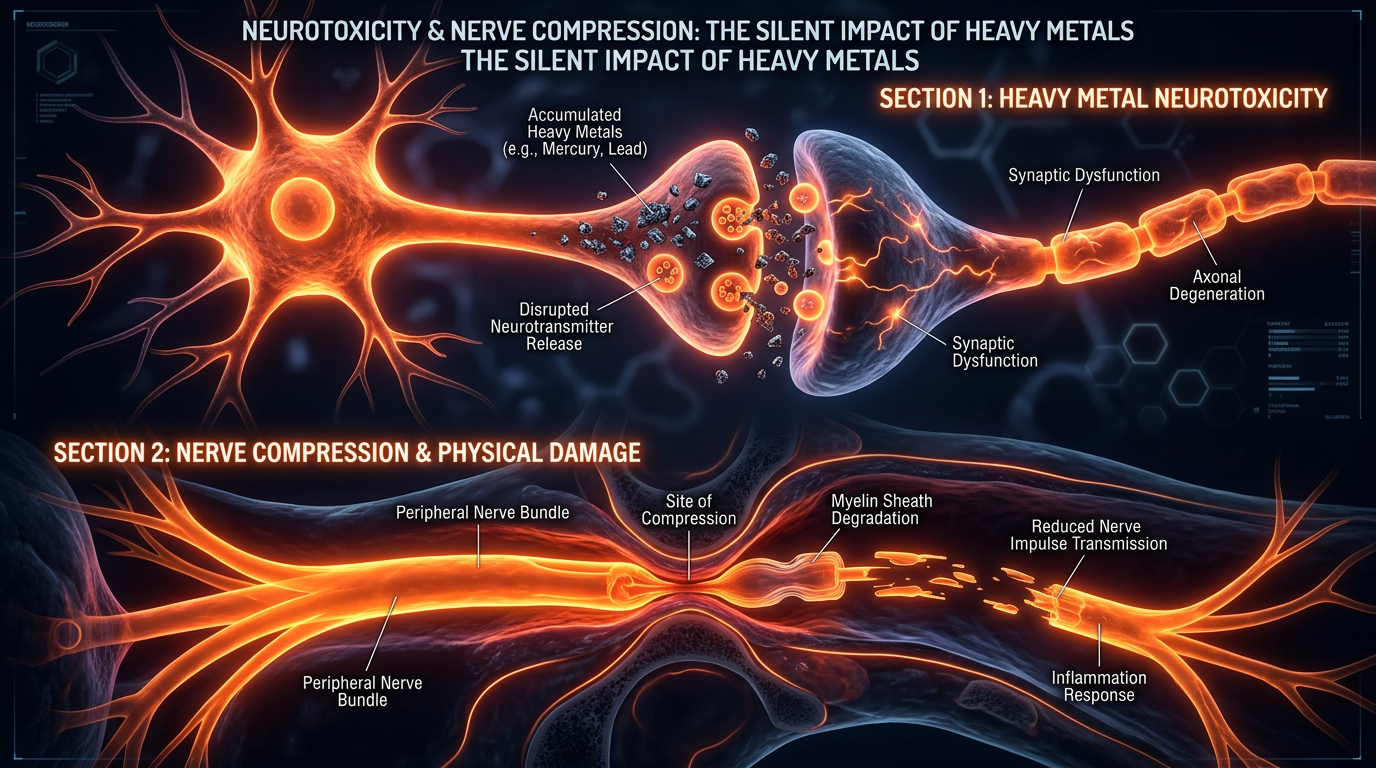
To understand how heavy metals mimic nerve compression, one must first understand the delicate architecture of the peripheral nervous system (PNS). A nerve is not merely a "wire"; it is a complex, living organ consisting of axons, Schwann cells (which produce the protective myelin sheath), and a highly specific vascular supply.
The Blood-Nerve Barrier (BNB)
Much like the brain is protected by the Blood-Brain Barrier (BBB), the peripheral nerves are shielded by the Blood-Nerve Barrier. This semi-permeable membrane is designed to maintain a stable microenvironment for neural conduction. However, certain heavy metals possess a "molecular skeleton key." Mercury (Hg), for instance, has a high affinity for sulfhydryl groups and can easily bind to transport proteins that allow it to bypass the BNB. Once inside the endoneurial space, these metals are not easily cleared; they begin to accumulate, creating a toxic reservoir that directly irritates the nerve fibres.
Mimicry of Mechanical Compression
When a nerve is physically compressed—such as in carpal tunnel syndrome—the primary damage occurs to the myelin sheath through ischaemia (lack of blood flow) and physical deformation. Heavy metals achieve a similar end through chemical means. Lead (Pb) is a potent inhibitor of enzymes involved in heme synthesis and mitochondrial function within Schwann cells. When these cells fail, the myelin sheath thins or degrades, a process known as demyelination.
In the UK, chronic pain affects between 13% and 50% of the population, yet environmental toxin screening is not included in the standard NICE (National Institute for Health and Care Excellence) guidelines for the investigation of peripheral neuropathy.
The resulting symptoms—sharp, shooting pains (neuralgia), burning sensations, and "pins and needles" (paresthesia)—are indistinguishable from those caused by a physical "pinch." The body perceives the signal of nerve distress, but the cause is not a bulging disc; it is a chemical erosion of the nerve's insulation.
Retrograde Axonal Transport
One of the most insidious aspects of heavy metal neurotoxicity is the "Trojan Horse" mechanism. Research has shown that metals like mercury can be taken up by distal nerve endings (in the hands or feet) and transported via retrograde axonal transport back to the cell body in the spinal cord or the brain. This means that a toxic exposure in the skin or through the lungs can eventually manifest as central nervous system dysfunction or spinal-level pain, bypassing the traditional diagnostic focus on the site of the pain itself.
##
Mechanisms at the Cellular Level
The damage wrought by heavy metals is not a single event but a multi-pronged assault on cellular integrity. To understand why the pain is so persistent, we must look at the four primary mechanisms of heavy-metal induced neurotoxicity.
1. Oxidative Stress and ROS Generation
Heavy metals are prolific generators of Reactive Oxygen Species (ROS). Under normal conditions, the body uses antioxidants like glutathione to neutralise these unstable molecules. However, metals like cadmium and lead bind directly to glutathione, depleting the cell's primary defence mechanism.
The resulting "oxidative burst" causes lipid peroxidation, where the fatty acids in the nerve cell membranes literally turn rancid. Given that the nervous system is the most lipid-rich environment in the body, it is uniquely susceptible to this form of damage. This leads to a state of chronic "neuro-inflammation" that lowers the threshold for pain receptors (nociceptors), causing them to fire even in the absence of a painful stimulus.
2. Mitochondrial Bioenergetic Failure
Nerve cells are incredibly energy-dependent. They require constant ATP (adenosine triphosphate) to maintain the ion pumps that allow for nerve impulses. Heavy metals, particularly arsenic and aluminium, interfere with the Krebs cycle and the electron transport chain within the mitochondria.
Research indicates that mercury can inhibit mitochondrial function at concentrations far below those currently considered "toxic" by regulatory bodies, leading to a state of "cellular starvation" in high-demand tissues like the sciatic nerve.
When the mitochondria fail, the nerve cell cannot maintain its resting potential. It becomes hyper-excitable, leading to the spontaneous firing that patients describe as "electric shocks" or "twitches." This is a classic hallmark of heavy metal toxicity mimicking radiculopathy.
3. Disruption of Calcium Signalling
Calcium is the primary messenger in the nervous system. Lead is a notorious "molecular mimic" of calcium. It can enter the nerve cell through voltage-gated calcium channels and disrupt the release of neurotransmitters. By displacing calcium, lead causes a chaotic release of excitatory neurotransmitters like glutamate, while inhibiting inhibitory signals. This creates a "perfect storm" of neurological over-activity, resulting in chronic muscle tension, cramps, and the deep, aching pain often mistaken for fibromyalgia or myofascial pain syndrome.
4. Direct Covalent Bonding to Proteins
Mercury has an extraordinary affinity for "thiol" or sulfhydryl groups. These groups are the structural anchors for many proteins and enzymes. When mercury binds to these proteins, it changes their shape and function. In the context of the nervous system, this means structural proteins like tubulin—which forms the "railway tracks" inside an axon for transporting nutrients—disintegrate. The axon literally collapses from the inside out, a process that is functionally identical to the "wallerian degeneration" seen in traumatic nerve injuries.
##
Environmental Threats and Biological Disruptors
The "Silent Impact" of heavy metals is exacerbated by the fact that exposure is no longer restricted to specific industrial occupations. We are now living in a "toxic soup" where multiple low-level exposures create a synergistic effect.
The Mercury Burden
The primary sources of mercury exposure for the average Briton are dental amalgams (silver fillings) and the consumption of long-lived predatory fish (tuna, swordfish). Dental amalgam is approximately 50% elemental mercury. While the British Dental Association maintains its safety, mercury vapour is continuously released from these fillings, especially during chewing or drinking hot liquids. This vapour is inhaled and easily crosses the blood-brain barrier.
The Lead Legacy
Despite the ban on leaded petrol in 2000, lead remains a significant threat in the UK. Victorian-era plumbing in cities like London, Manchester, and Birmingham still utilises lead pipes or lead solder. Furthermore, lead-based paint in older housing stock can become dust, which is then inhaled.
It is estimated that over 8 million homes in the UK still have lead piping or lead-soldered joints, contributing to a baseline level of lead exposure that can exacerbate neurological sensitivity in vulnerable populations.
Cadmium and the Modern Lifestyle
Cadmium is primarily introduced through tobacco smoke (including second-hand smoke) and the consumption of industrially-grown leafy greens and grains, which absorb cadmium from phosphate fertilisers. Cadmium has an exceptionally long half-life in the human body—up to 30 years. It accumulates in the kidneys and the nervous system, where it mimics the symptoms of diabetic neuropathy, even in non-diabetic patients.
Aluminium: The Ubiquitous Neurotoxin
While not a "heavy" metal in the traditional sense, aluminium's neurotoxicity is well-documented. It is found in antiperspirants, antacids, processed foods, and as an adjuvant in various medical interventions. Aluminium has a specific affinity for the central nervous system and has been implicated in the cross-linking of proteins that lead to neurodegenerative conditions and chronic "brain fog" associated with chronic pain syndromes.
##
The Cascade: From Exposure to Disease
The progression from metal exposure to chronic pain is rarely linear. It is a "cascade" where the body’s compensatory mechanisms eventually reach a breaking point.
Phase 1: Accumulation and Sequestration
In the initial years of exposure, the body attempts to protect the vital organs by sequestering heavy metals in "inert" tissues. Lead is stored in the bones; mercury is stored in the kidneys and liver. During this phase, the patient may feel "fine," but their toxic bucket is slowly filling.
Phase 2: The "Spillover" Effect
Once the storage sites are saturated, or when a physiological stressor occurs (such as menopause, pregnancy, or a major infection), these metals are mobilised back into the bloodstream. For example, during the bone loss associated with ageing, lead is released from the skeletal system, leading to a "late-onset" neurotoxicity that is often misdiagnosed as "old age" or "generalised arthritis."
Phase 3: The Sensitisation of the Nervous System
As the metals infiltrate the endoneurial space of the nerves, they trigger a "priming" of the glial cells. Glial cells are the immune cells of the nervous system. Once primed by heavy metals, they become hyper-reactive. This is known as Central Sensitisation. At this stage, the nervous system is in a state of constant high alert. The "volume" of pain signals is turned up to maximum. A light touch can feel painful (allodynia), and a minor ache feels like an unbearable surge.
Phase 4: Structural Mimicry
Eventually, the chemical damage to the myelin and the inflammation of the nerve sheath become so severe that the nerve physically swells. This swelling creates a secondary mechanical compression. For example, a nerve already inflamed by mercury may become trapped more easily in the carpal tunnel or the tarsal tunnel. In these cases, surgery to "release" the nerve often fails to provide long-term relief because the primary driver—the chemical inflammation—remains.
##
What the Mainstream Narrative Omits
The refusal of mainstream medicine to acknowledge low-level heavy metal toxicity as a primary driver of chronic pain is a systemic failure rooted in several factors.
The Fallacy of "Normal" Blood Tests
The standard NHS blood test for heavy metals only detects acute poisoning (exposure that happened in the last 24-72 hours). It does not measure the total body burden. Metals like lead and mercury quickly leave the blood and hide in the tissues (nerves, bone, fat). A patient can have "normal" blood levels while their nerves are saturated with mercury. To truly assess the burden, one must use "provoked" urine testing or hair mineral analysis, both of which are rarely utilised in conventional pain clinics.
The Pharmaceutical Bias
The current medical model is built on the management of symptoms rather than the removal of causes. There is no "patentable drug" that can safely remove heavy metals as effectively as lifestyle changes and targeted chelation or binder protocols. Gabapentin, Pregabalin, and Amitriptyline are the standard "solutions" for nerve pain. These drugs do nothing to remove the neurotoxins; they merely dampen the brain's ability to perceive the distress signals. This allows the underlying toxicity to continue its damage unhindered.
The Over-Reliance on Imaging
Modern medicine is obsessed with the MRI. If a scan shows a small bulge in a disc, that bulge is immediately blamed for the patient's pain. However, studies show that many asymptomatic people have disc bulges. By focusing solely on the structural, doctors ignore the biochemical. Many patients undergo unnecessary spinal surgeries for "nerve compression" that was actually "nerve toxicity." When the surgery fails to fix the pain (Failed Back Surgery Syndrome), the patient is often told the pain is "psychosomatic."
Statistics from the British Journal of Pain suggest that up to 40% of spinal surgeries for chronic pain do not result in significant long-term pain reduction, pointing toward non-mechanical drivers like neurotoxicity.
##
The UK Context
The United Kingdom faces a unique set of challenges regarding heavy metal exposure. As the birthplace of the Industrial Revolution, our soil and waterways bear a legacy of contamination that remains active today.
Post-Industrial Contamination
Areas in the North of England, the Midlands, and South Wales are still dealing with the environmental fallout of coal mining and heavy industry. Runoff from abandoned mines often contains high levels of arsenic and cadmium, which can enter the local food chain or private water supplies.
The Infrastructure Crisis
The UK's water infrastructure is ageing. In many major cities, the transition away from lead piping has been slow and incomplete. Furthermore, the recent scandals regarding the dumping of raw sewage into British rivers by water companies have introduced a new wave of environmental contaminants, including industrial chemicals and metals, into the ecosystems we rely on for food and recreation.
Regulatory Failures
Post-Brexit, there are concerns that the UK's "REACH" (Registration, Evaluation, Authorisation and Restriction of Chemicals) standards may diverge from the more stringent EU regulations. This potential deregulation poses a risk that higher levels of neurotoxic substances could find their way into consumer products and environmental runoff without the rigorous oversight previously required.
##
Protective Measures and Recovery Protocols
If the nervous system is being assaulted by heavy metals, the solution must be as multi-faceted as the problem itself. Recovery is not about a "quick fix" but a systematic reduction of the body burden.
1. Source Identification and Removal
The first step is always to stop the "bleeding." This involves:
- Testing drinking water for lead, copper, and arsenic (especially in older properties).
- Biological Dentistry: Consulting a dentist trained in the "SMART" (Safe Mercury Amalgam Removal Technique) protocol to safely replace silver fillings.
- Dietary Adjustments: Moving away from high-mercury fish and choosing organic produce to reduce cadmium and pesticide exposure.
2. Enhancing Natural Detoxification
The body has an innate system for removing metals, primarily through the liver and kidneys. This system requires specific co-factors:
- Selenium: Essential for the neutralisation of mercury. Selenium binds to mercury, creating a non-toxic complex (mercury selenide).
- Glutathione Support: Supplementing with N-Acetyl Cysteine (NAC), alpha-lipoic acid, and Vitamin C to replenish the body’s "master antioxidant."
- Silica: Found in certain mineral waters, silica is highly effective at binding to and removing aluminium from the brain and nervous system.
3. The Role of "Binders"
To remove metals from the gastrointestinal tract and prevent "enterohepatic recirculation" (where the liver dumps toxins into the gut, only for them to be re-absorbed), the use of binders is crucial.
- Modified Citrus Pectin (MCP): A gentle binder that can enter the bloodstream and bind to lead and arsenic.
- Zeolite and Chlorella: Effective at binding metals in the gut, though they must be of the highest purity to ensure they aren't contaminated themselves.
- Activated Charcoal: Useful for broad-spectrum toxin removal, though it must be used away from food and supplements.
4. Infrared Sauna Therapy
Heavy metals are excreted through the skin via sweat. Regular use of an infrared sauna can help mobilise metals stored in the subcutaneous fat and move them out of the body, bypassing the potentially stressed kidneys and liver.
5. Nervous System Support
While the metals are being removed, the "frayed wires" of the nervous system need support to heal.
- B-Vitamins (Activated): Methylated B12 and Folate are essential for the repair of the myelin sheath.
- Magnesium: Helps to calm the hyper-excitable "NMDA receptors" in the brain, reducing the perception of chronic pain.
- Omega-3 Fatty Acids: High-dose DHA is critical for restoring the lipid integrity of the nerve cell membranes.
##
Summary: Key Takeaways
The link between heavy metal neurotoxicity and chronic nerve pain is a scientific reality that has been sidelined by a medical system focused on structural mechanics and pharmaceutical suppression. To find true relief, we must look beyond the "pinch" and address the "poison."
- Metals Mimic Mechanics: Chronic pain that looks like nerve compression is often the result of chemical demyelination and oxidative stress caused by heavy metals.
- Standard Testing is Inadequate: Normal blood tests do not rule out heavy metal toxicity; the body burden is stored in the tissues, not the blood.
- The UK Infrastructure is a Risk: Lead pipes, industrial heritage, and modern environmental mismanagement contribute to a high toxic load for many UK citizens.
- Bioaccumulation is the "Silent Killer": Low-level exposure over decades creates a "toxic bucket" effect that eventually overflows into chronic, systemic pain.
- Recovery Requires a Protocol: Effective treatment involves removing the source, binding the toxins, and providing the nervous system with the specific nutrients it needs to repair the myelin sheath.
We must stop viewing the human body as a collection of isolated parts and start seeing it as a biological system in constant dialogue with its environment. The "Silent Impact" of heavy metals is a call to action—a demand for a cleaner environment and a more sophisticated, biologically-aware approach to the treatment of chronic pain. For the millions suffering in silence, the answer isn't just in the spine; it's in the very air they breathe, the water they drink, and the toxins they have unknowingly carried for years. It is time to clear the ghost from the machine.
This article is provided for informational and educational purposes only. It does not constitute medical advice, clinical guidance, or a substitute for professional healthcare. Information reflects cited research at time of publication. Always consult a qualified healthcare professional before acting on any health information.
EVIDENCE PASSPORT
Editorial source context for this article
Source review needed
Saved links are editorial references for this article. They may support specific claims rather than every sentence. Open and assess each source in context. This passport does not independently verify them.
Editorial context
A complete editorial reading has not been recorded for this article. Source links remain available for you to open and assess directly.
Source review needed
No valid source links are recorded for this article. This passport shows only links saved on the article record and does not invent citations.
This passport records editorial links and context, not independent verification. Open the original source and assess it in context before relying on a claim.
Medical Disclaimer
The information in this article is for educational purposes only and does not constitute medical advice, diagnosis, or treatment. Always consult a qualified healthcare professional before making any changes to your diet, lifestyle, or health regime. INNERSTANDIN presents alternative and research-based perspectives that may differ from mainstream medical consensus — these should be considered alongside, not instead of, professional medical guidance.
Read Full DisclaimerContinue the thread
Keep this question moving.
Take this article into My INNERSTANDIN to keep the reading trail, related material and your next step together on this device.
Explore this in the Body Map
See where this hits your biology. Interactive anatomy, threats, and protective protocols.
Dig deeper in the Library
Free, longform PDF volumes that go beyond headlines into mechanisms and references.