
Photobiomodulation in Optometry: The Future of Non-Invasive Vision Restoration
Updated May 2026
A deep dive into the clinical application of specific light wavelengths to treat degenerative eye conditions. This therapy represents a shift from pharmaceutical intervention to biological energy upregulation.
Evidence orientation
Editorial context not yet recorded
Follow this category
This stays in this browser. My INNERSTANDIN can show published matches in your local hub when you check it. It does not send email, push, or alert notifications.
Local learning review
A private browser aid for revisiting ideas. It is not an alert or a health recommendation.
Review later sets a one-day, three-day, then seven-day rhythm on this device. Choose it only when you want to revisit this article.
Overview
The field of optometry is currently standing at a precipice, caught between an antiquated model of palliative care and a revolutionary paradigm of biological restoration. For decades, the mainstream approach to degenerative eye diseases—such as Age-Related Macular Degeneration (AMD), Diabetic Retinopathy, and Glaucoma—has been one of managed decline. Patients are told that their sight loss is an inevitable byproduct of aging or genetics, and the primary interventions remain invasive intraocular injections or surgical procedures that target symptoms rather than root causes.
However, a "silent revolution" is occurring within the realm of biophysics. Photobiomodulation (PBM), also known as Low-Level Light Therapy (LLLT), is emerging as the most significant breakthrough in non-invasive vision restoration in the last century. PBM involves the use of specific wavelengths of red and near-infrared (NIR) light (typically in the 600nm to 1000nm range) to stimulate cellular function.
This is not a mere "alternative" therapy; it is a clinical application of fundamental biological energy upregulation. As a senior researcher for INNERSTANDING, it is my duty to highlight that the human eye is not just a camera—it is a sophisticated, light-driven biological engine. By understanding the interaction between photons and mitochondria, we can move beyond the "pharmaceutical fix" and toward a future where light itself is the medicine.
Callout Fact 1: The human retina has the highest metabolic demand of any tissue in the body, including the brain. It possesses the highest density of mitochondria per unit of tissue, making it uniquely sensitive to the energetic benefits of Photobiomodulation.
The Biology — How It Works
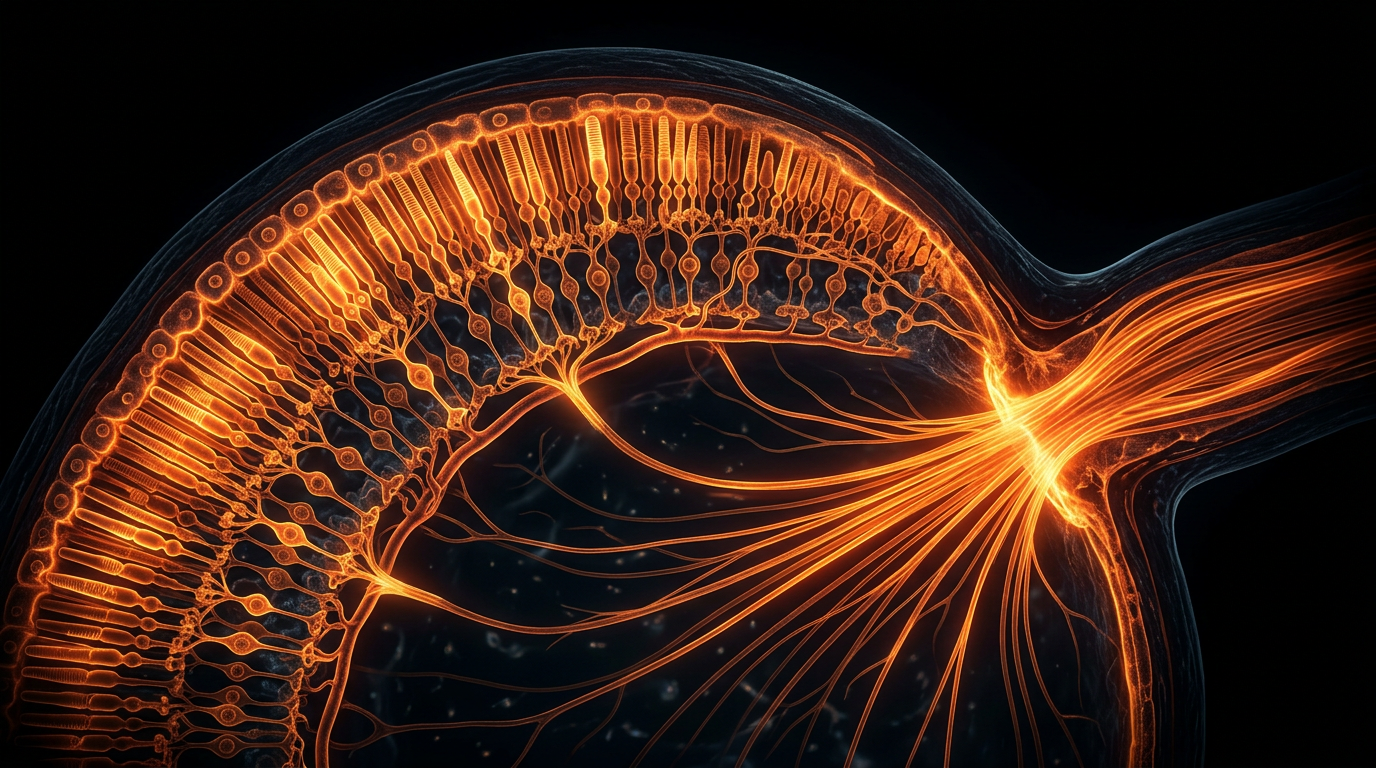
To understand why Photobiomodulation is effective, we must first understand the eye as a metabolic furnace. The retina is an extension of the central nervous system. Its primary role is to convert light into electrical signals, a process that requires an enormous, constant supply of Adenosine Triphosphate (ATP).
When we look at the spectrum of light, we find that different wavelengths penetrate human tissue to varying depths and interact with different molecular targets. While blue light (short-wavelength) is high-energy and potentially oxidative, red and near-infrared light (long-wavelength) act as metabolic balancers.
PBM works through a process called retrograde signalling. When red or NIR light photons enter the retinal cells, they are absorbed by specific photoreceptors within the mitochondria. This absorption triggers a cascade of biochemical events that shift the cell from a state of "survival" or "quiescence" to a state of "regeneration."
The core of this process is the restoration of the mitochondrial membrane potential. In degenerative eye conditions, the mitochondria become "sluggish." They produce less ATP and leak more Reactive Oxygen Species (ROS), leading to a state of chronic oxidative stress. PBM essentially "recharges" these cellular batteries, allowing the retinal cells to perform their waste-clearing and reparative functions once more.
Mechanisms at the Cellular Level
The primary chromophore (light-absorbing molecule) responsible for the effects of PBM is Cytochrome c oxidase (CCO), a terminal enzyme in the mitochondrial electron transport chain.
The Displacement of Nitric Oxide
In a stressed or aging eye, Nitric Oxide (NO) often binds to Cytochrome c oxidase, effectively "clogging" the respiratory chain. This inhibits oxygen consumption and halts ATP production. When we apply specific wavelengths of red light (e.g., 670nm), the energy of the photons dissociates the Nitric Oxide from the CCO enzyme. This allows oxygen to bind once again, restarting the production of ATP and restoring cellular respiration.
Water Structure and Viscosity
Recent research has suggested a secondary, equally profound mechanism: the effect of NIR light on interfacial water. Our cells are composed largely of water, and near the mitochondrial membranes, this water exists in a highly structured, "ordered" state. NIR light (particularly around 810nm–830nm) reduces the viscosity of this water. This reduction in "friction" allows the molecular motor of ATP Synthase to spin more freely, significantly increasing the efficiency of energy production.
Gene Expression and Anti-Inflammatory Signaling
PBM does not just provide a temporary energy boost; it alters the long-term genetic expression of the cell. It activates transcription factors such as NF-κB and SIRT1, which are involved in the body’s innate antioxidant and anti-inflammatory responses. This leads to:
- Downregulation of pro-inflammatory cytokines: Reducing chronic inflammation in the macula.
- Upregulation of neurotrophic factors: Encouraging the survival and repair of retinal ganglion cells.
- Improved Microcirculation: Enhancing blood flow through the choroid to ensure nutrient delivery and waste removal.
Callout Fact 2: Research has demonstrated that a single exposure to 670nm deep red light for just three minutes in the morning can improve colour contrast sensitivity in the aging eye by up to 20% for several days.
Environmental Threats and Biological Disruptors
The modern human exists in a state of "Spectral Malnutrition." Our eyes evolved under the full spectrum of the sun, which contains a perfect balance of ultraviolet, visible, and infrared light. For the vast majority of our evolutionary history, our retinas were bathed in healing near-infrared light from the sun and firelight.
The Blue Light Hazard and "Junk Light"
Today, we spend 90% of our time indoors under artificial light. Standard LED and fluorescent lighting are heavily weighted in the blue spectrum and almost entirely devoid of the regenerative near-infrared wavelengths. This is what we call "Junk Light."
Blue light (400-450nm) is high-energy and can cause photochemical damage to the retinal pigment epithelium (RPE). When we are exposed to high amounts of blue light without the "antidote" of red and NIR light, we induce a state of chronic mitochondrial dysfunction. The "flicker" inherent in many cheap LED sources also places a massive neurological load on the visual system, leading to digital eye strain and deeper metabolic exhaustion.
The Impact of Screen Time
Modern digital devices emit a spike of "HEV" (High Energy Visible) blue light. This light penetrates deep into the eye, reaching the macula. Constant exposure suppresses melatonin production—not just in the pineal gland, but locally within the retina. Local retinal melatonin is a potent antioxidant that protects the eye during sleep. By staring at screens late into the night, we are effectively stripping the eye of its primary internal defence mechanism.
The Cascade: From Exposure to Disease
The progression from environmental light exposure to clinical disease is a slow, insidious cascade. It begins at the mitochondrial level—a stage we call subclinical mitochondrial failure.
- Mitochondrial Decay: Under the influence of junk light and lack of natural sunlight, the mitochondria in the RPE (Retinal Pigment Epithelium) begin to fail.
- Waste Accumulation: The RPE is responsible for "cleaning up" the discarded outer segments of photoreceptors. When it lacks energy, waste products—known as Drusen—begin to build up under the retina.
- Chronic Inflammation: The presence of Drusen triggers a chronic immune response. This "inflammaging" of the eye further damages the surrounding tissue.
- Hypoxia and Neovascularisation: As the tissue becomes starved of oxygen and nutrients, the body may attempt to grow new, "leaky" blood vessels (Wet AMD) or the tissue simply withers away (Dry AMD).
In the mainstream narrative, the focus is almost entirely on Step 4. They wait until the house is on fire to call the fire brigade. PBM, however, addresses Step 1. By restoring mitochondrial health, we prevent the "rubbish" from accumulating in the first place, halting the cascade before it reaches the point of irreversible vision loss.
Callout Fact 3: Age-Related Macular Degeneration (AMD) is the leading cause of blindness in the developed world, yet conventional medicine offers almost no effective treatment for the "Dry" form of the disease, which accounts for 80-90% of cases.
What the Mainstream Narrative Omits
Why is Photobiomodulation not the "Gold Standard" in every optometry clinic in the UK? The answer lies in the systemic bias of the current medical-industrial complex.
The Profitability of Chronic Management
The mainstream ophthalmic market is heavily geared toward anti-VEGF injections (such as Lucentis or Eylea). These drugs, which must be injected directly into the eye every few weeks or months, are multi-billion-pound revenue generators for pharmaceutical companies. PBM, by contrast, is a hardware-based therapy that empowers the body to heal itself. There is no "recurring prescription" for light. Once a clinic has the device, the cost per treatment is negligible.
The "Light as Woo" Fallacy
For decades, mainstream science dismissed light therapy as "fringe," largely because the mechanisms were not fully understood. There was a failure to recognise that humans are photo-biological beings. We are, in essence, liquid crystalline structures that respond to electromagnetic frequencies. By categorising PBM as "alternative," the mainstream has successfully delayed its adoption, leaving millions of patients with no options for "Dry" AMD other than "watchful waiting" (which is essentially watching the patient go blind).
The Narrow Focus on Physics over Biology
Optometry school curricula focus heavily on the physics of refraction (lenses and glasses) and the anatomy of pathology (identifying damage). There is a glaring absence of bioenergetics. Most optometrists graduate with a deep understanding of how to measure a refractive error, but very little understanding of how to support the mitochondrial health of the retina.
Callout Fact 4: Clinical trials such as the LIGHTSITE III study have shown that PBM can lead to a statistically significant improvement in best-corrected visual acuity (BCVA), with some patients gaining two lines or more on an eye chart—something previously thought impossible for Dry AMD.
The UK Context
In the United Kingdom, the adoption of PBM is at a critical juncture. The NHS is currently overburdened and financially constrained, making the introduction of new technologies slow and bureaucratic. However, the UK is also home to some of the world’s leading researchers in this field.
Professor Glen Jeffery at University College London (UCL) has been a pioneer in researching the effects of 670nm light on aging retinas. His work has provided the empirical foundation for PBM in optometry, proving that "recharging" the mitochondria can reverse certain aspects of age-related visual decline.
Despite this world-class research, there is a "postcode lottery" for access to PBM. A few forward-thinking private clinics in London and the Midlands have begun implementing the Valeda Light Delivery System—the first multi-wavelength PBM device approved for the treatment of Dry AMD. However, for the average citizen relying on their local High Street optician or the NHS, PBM remains a "hidden" therapy.
We are seeing a growing movement of UK practitioners who are frustrated by the limitations of "Standard of Care." These "Biological Optometrists" are beginning to integrate PBM, not just for disease, but for performance enhancement and preventative longevity.
Protective Measures and Recovery Protocols
While we wait for the mainstream to catch up, individuals must take their eye health into their own hands. As a researcher for INNERSTANDING, I advocate for a multi-faceted approach to vision restoration and protection.
1. Sunlight as a Nutrient
The most potent form of PBM is free: the sun. To maintain retinal health, one should aim for exposure to the "Golden Hour" light—the low-angle sun of early morning and late afternoon. This light is rich in the red and infrared wavelengths that prime the retina for the stresses of the day and repair it in the evening. Important: Never stare directly at the sun; allow the ambient light to hit the eyes.
2. Strategic Red Light Therapy
For those already experiencing decline, home-use PBM devices or clinical-grade treatments are essential. Look for devices that offer specific wavelengths:
- 670nm: For mitochondrial CCO stimulation.
- 590nm: To stimulate the RPE and improve metabolic waste removal.
- 850nm: For deeper penetration into the choroid and improved blood flow.
3. Eliminating "Junk Light"
- Blue-Blocking Lenses: Use high-quality (orange or red-tinted) blue blockers after sunset to protect retinal melatonin.
- Screen Software: Utilise programmes like 'Iris' or 'f.lux' to shift screen temperature, but remember that the "flicker" remains a problem.
- Incandescent Lighting: Whenever possible, replace LEDs with incandescent or halogen bulbs, which have a much higher proportion of near-infrared light.
4. Nutritional Cofactors
Light therapy works best when the body has the building blocks for repair.
- Macular Carotenoids: Lutein, Zeaxanthin, and Meso-zeaxanthin act as internal blue-light filters.
- Astaxanthin: Often called "the king of antioxidants," it can cross the blood-retinal barrier to neutralise ROS.
- DHA (Omega-3): The retina is incredibly rich in DHA, which is essential for the fluidity of the photoreceptor membranes. PBM is more effective when the "cellular machinery" is structurally sound.
5. Managing the "Flicker"
Be aware that most LED lights and screens pulse at a frequency the eye can perceive, even if the brain cannot. This creates a constant "stress" on the mitochondria. Minimising time under cheap commercial LEDs and opting for "flicker-free" technology is a critical, yet often overlooked, protective measure.
Callout Fact 5: The retina contains more DHA (an Omega-3 fatty acid) than any other part of the human body. This DHA is highly susceptible to "photo-oxidation" from blue light but is protected by the presence of red/NIR light and antioxidants.
Summary: Key Takeaways
Photobiomodulation represents a fundamental shift in how we approach human health. It moves us away from the reductionist model of "one drug for one symptom" and toward a holistic understanding of Bioenergetics.
- PBM is the "Antidote" to Modern Living: In a world of "junk light" and spectral deficiency, PBM provides the specific frequencies our eyes have evolved to require for repair.
- Mitochondria are the Target: By stimulating Cytochrome c oxidase, PBM restores the energy production needed for the eye to heal itself.
- Prevention is the Key: While PBM can restore lost vision in some cases, its greatest power lies in halting the "Mitochondrial Decay Cascade" before irreversible damage occurs.
- The Mainstream is Lagging: Due to financial incentives and a slow-moving educational system, the "Standard of Care" in the UK does not yet reflect the cutting-edge science of PBM.
- The Future is Light-Based: As we move deeper into the 21st century, the marriage of biophysics and optometry will likely make many pharmaceutical interventions for the eye obsolete.
At INNERSTANDING, we believe that the truth about our biological potential has been obscured. The eyes are the windows to the soul, but they are also the most metabolically active "engines" in our bodies. By feeding them the correct light, we are not just restoring vision; we are reclaiming our fundamental biological sovereignty. The future of optometry is not found in a vial or a scalpel—it is found in the restorative power of the light spectrum.
"References & Further Reading:"
- Jeffery, G. (2021). "The role of mitochondrial function in retinal health and disease." University College London.
- LumiThera. (2022). "LIGHTSITE III Clinical Trial Results for Dry AMD."
- Hamblin, M. R. (2017). "Photobiomodulation or low-level laser therapy." Journal of Biophotonics.
- Wunsch, A. (2018). "The Effects of Artificial Light on Human Health."
This article is provided for informational and educational purposes only. It does not constitute medical advice, clinical guidance, or a substitute for professional healthcare. Information reflects cited research at time of publication. Always consult a qualified healthcare professional before acting on any health information.
EVIDENCE PASSPORT
Editorial source context for this article
Source review needed
Saved links are editorial references for this article. They may support specific claims rather than every sentence. Open and assess each source in context. This passport does not independently verify them.
Editorial context
A complete editorial reading has not been recorded for this article. Source links remain available for you to open and assess directly.
Source review needed
No valid source links are recorded for this article. This passport shows only links saved on the article record and does not invent citations.
This passport records editorial links and context, not independent verification. Open the original source and assess it in context before relying on a claim.
Medical Disclaimer
The information in this article is for educational purposes only and does not constitute medical advice, diagnosis, or treatment. Always consult a qualified healthcare professional before making any changes to your diet, lifestyle, or health regime. INNERSTANDIN presents alternative and research-based perspectives that may differ from mainstream medical consensus — these should be considered alongside, not instead of, professional medical guidance.
Read Full DisclaimerContinue the thread
Keep this question moving.
Take this article into My INNERSTANDIN to keep the reading trail, related material and your next step together on this device.
Explore this in the Body Map
See where this hits your biology. Interactive anatomy, threats, and protective protocols.