
Quantum Dot Leaching and Heavy Metal Poisoning
Updated May 2026
Exposing the degradation of cadmium-based quantum dots used in medical imaging and consumer electronics. The article focuses on the bioaccumulation of toxic cores in the liver and kidneys.
Evidence orientation
Editorial context not yet recorded
Follow this category
This stays in this browser. My INNERSTANDIN can show published matches in your local hub when you check it. It does not send email, push, or alert notifications.
Local learning review
A private browser aid for revisiting ideas. It is not an alert or a health recommendation.
Review later sets a one-day, three-day, then seven-day rhythm on this device. Choose it only when you want to revisit this article.
Overview
In the rapidly evolving landscape of nanotechnology, few innovations have been heralded with as much fanfare as Quantum Dots (QDs). These man-made, nanoscale semiconductor crystals, typically ranging from 2 to 10 nanometres in diameter, possess unique optoelectronic properties that have revolutionised everything from high-definition television displays (QLEDs) to high-precision medical imaging. However, beneath the brilliant, tunable fluorescence of these "artificial atoms" lies a profound biological hazard that the industry is loath to discuss: the systemic leaching of heavy metals, specifically Cadmium (Cd).
As a senior researcher at INNERSTANDING, my objective is to peel back the veneer of "clean tech" and "precision medicine" to expose the catastrophic biological reality of quantum dot degradation. While the mainstream scientific literature often focuses on the "potential" of these particles, it systematically underplays the bioaccumulation and long-term toxicity profiles once the integrity of the nanoparticle is compromised.
Quantum dots are frequently composed of a core containing heavy metals such as Cadmium Selenide (CdSe) or Cadmium Telluride (CdTe). To mitigate toxicity, manufacturers "cap" these cores with a shell—usually Zinc Sulphide (ZnS)—and further coat them with polymers. The industry narrative suggests that this encapsulation renders them "biocompatible." Our research, however, indicates that these protective layers are prone to degradation within the complex, acidic, and enzymatically active environment of the human body. When the shell fails, the toxic core is exposed, leading to a slow-release "poison pill" effect that targets the liver, kidneys, and central nervous system.
Crucial Fact: A single 10nm quantum dot can contain thousands of cadmium atoms. Upon degradation, these atoms are released as free ions (Cd2+), which are among the most potent nephrotoxins and carcinogens known to modern science.
This article provides a comprehensive forensic analysis of the pathways through which quantum dots enter the biosphere and the human body, the mechanisms of their intracellular breakdown, and the silent epidemic of heavy metal poisoning currently being fostered by the unmitigated proliferation of synthetic biology and nanotechnology.
The Biology — How It Works
To understand the danger, one must first understand the physics of the quantum dot. Unlike bulk materials, the properties of QDs are governed by Quantum Confinement. Because the particles are smaller than the "Bohr exciton radius," their electronic energy levels are discrete rather than continuous. This allows them to emit specific colours of light depending strictly on their size—a property known as "tunability."
The Anatomy of a Quantum Dot
A typical "core-shell" quantum dot is structured like a Russian nesting doll:
- The Core: Usually Cadmium Selenide (CdSe). This provides the optical properties but is inherently toxic.
- The Shell: Usually Zinc Sulphide (ZnS). This is intended to "passivate" the core surface, increasing brightness and supposedly preventing the leaching of cadmium ions.
- The Capping Ligand/Coating: A layer of organic molecules or polymers (like Polyethylene Glycol - PEG) designed to make the QD water-soluble and "stealthy" to the immune system.
Entry Pathways: Medical and Consumer
In medical diagnostics, QDs are injected as bioluminescent probes. Their high photostability allows surgeons to see tumours with unprecedented clarity. However, this injection bypasses the body's primary barriers (skin and GI tract), placing the nanoparticles directly into the bloodstream.
In the consumer sector, the threat is more insidious. QLED screens contain billions of these particles. As these devices reach the end of their life cycle and enter the waste stream, physical degradation and environmental stressors—such as UV radiation and moisture—break down the protective casings of the screens, releasing the QDs into the soil and water tables.
Bio-Distribution and Pharmacokinetics
Once inside the human body—whether through medical injection, accidental inhalation in a manufacturing setting, or ingestion of contaminated water—the QDs do not remain at the site of entry. They are rapidly coated by blood proteins, forming what is known as a Protein Corona. This corona determines where the particle is "shipped" by the body's transport systems.
Research consistently shows that the Reticuloendothelial System (RES)—primarily the liver and the spleen—identifies these particles as foreign invaders. However, because they are so small, they easily penetrate the fenestrated capillaries of the liver, leading to massive sequestration in Hepatocytes and Kupffer cells.
- Liver Sequestration: Up to 40-60% of an injected dose of QDs can remain in the liver for months.
- Renal Filtration: While particles smaller than 5.5nm can be excreted via the kidneys, larger QDs or those that have aggregated become lodged in the Glomerular basement membrane, causing direct nephrotoxic damage.
Mechanisms at the Cellular Level
The "safety" of a quantum dot is an illusion predicated on the permanence of its shell. In the laboratory, a ZnS shell might appear stable. Inside a living cell, it is a very different story.
Lysosomal Acidification and Shell Corrosion
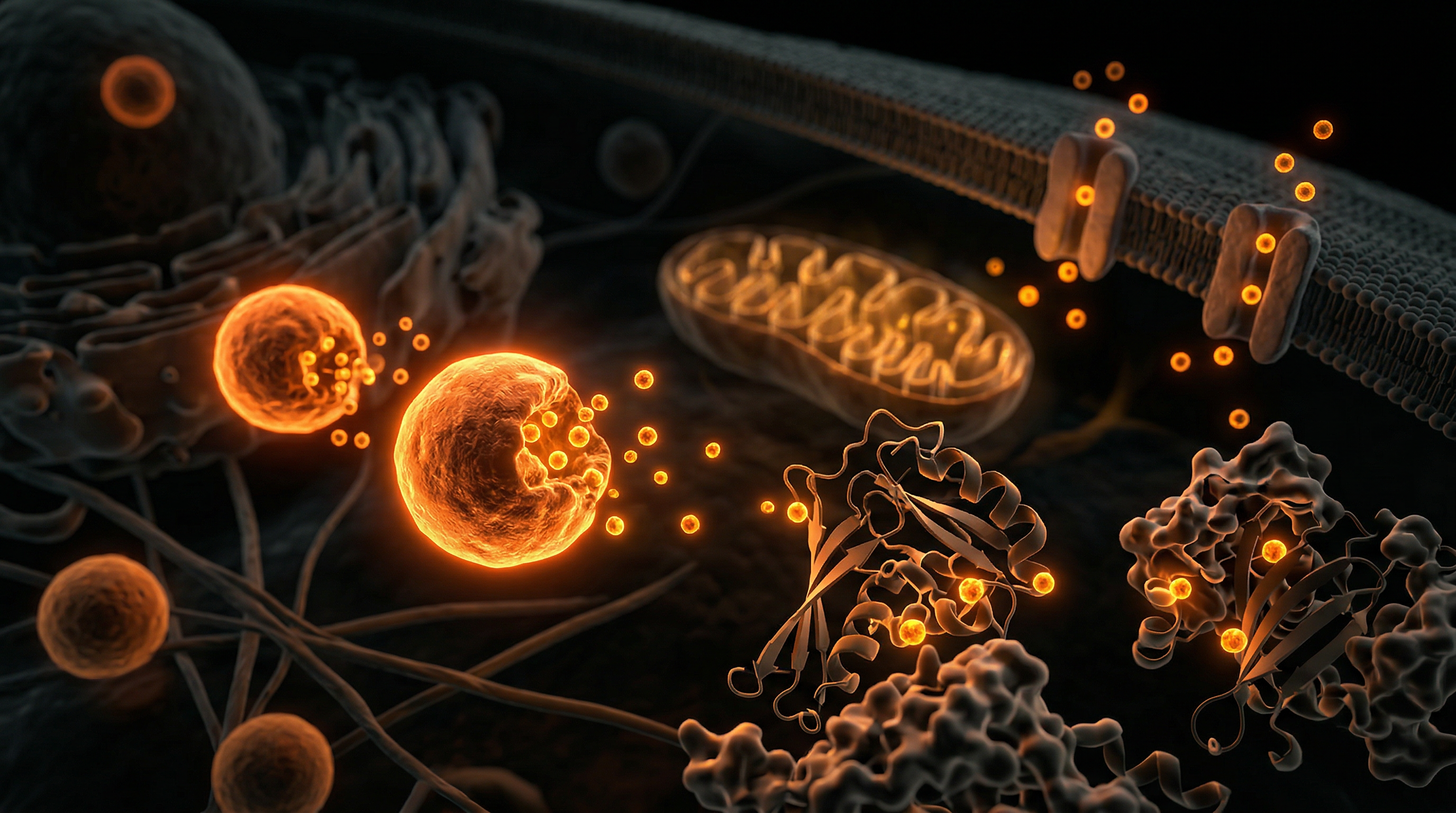
When a cell (such as a macrophage) takes up a quantum dot via endocytosis, the particle is transported into a lysosome. The lysosome is an acidic organelle (pH ~4.5 to 5.0) designed to break down cellular waste using enzymes and acid.
This acidic environment is the "Achilles heel" of the quantum dot. The acid begins to corrode the Zinc Sulphide shell. Once the shell is breached, the Cadmium Selenide core is exposed to the aqueous environment of the cell. This results in the oxidation of the core and the release of free Cd2+ ions.
Oxidative Stress: The ROS Cascade
The release of cadmium ions triggers a massive production of Reactive Oxygen Species (ROS). This occurs through several pathways:
- Mitochondrial Disruption: Cadmium ions have a high affinity for the thiol groups in mitochondrial proteins. They disrupt the electron transport chain, leading to the "leakage" of electrons and the formation of superoxide radicals.
- Glutathione Depletion: The body's master antioxidant, Glutathione (GSH), attempts to neutralise the cadmium. However, the sheer volume of ions released from a degrading QD quickly exhausts the cell's GSH reserves.
- Lipid Peroxidation: ROS attack the polyunsaturated fatty acids in the cell membranes, leading to a chain reaction of membrane destruction.
DNA Fragmentation and Genotoxicity
Cadmium is not merely a metabolic poison; it is a genotoxin. Free Cd2+ ions released from leached quantum dots can enter the nucleus. Once there, they inhibit DNA repair enzymes (such as OGG1) and displace essential zinc ions from "zinc finger" proteins that are crucial for gene expression and DNA stability. This leads to:
- Single and double-strand DNA breaks.
- Chromosomal aberrations.
- The activation of proto-oncogenes, potentially leading to cancer decades after the initial exposure.
Warning: Mainstream toxicology often uses "acute" models (high dose, short time). However, QD leaching is a "chronic" phenomenon (low dose, long time), which is far more effective at inducing malignant cellular transformations.
Environmental Threats and Biological Disruptors
The narrative of "green nanotechnology" is a marketing construct. The environmental footprint of quantum dot production and disposal represents a ticking time bomb for global health.
The E-Waste Nightmare
The global market for QLED displays is projected to reach tens of billions of dollars. Unlike traditional LEDs, these screens contain significant quantities of Cadmium and Indium. Currently, there is no standardised, global infrastructure for the safe recovery of quantum dots from consumer electronics.
When a QLED TV ends up in a landfill, the following sequence occurs:
- Mechanical Breakdown: The screen cracks, exposing the QD film.
- Leaching: Rainwater (often slightly acidic due to dissolved CO2) leaches the QDs into the soil.
- Photodegradation: Exposure to sunlight accelerates the breakdown of the polymer coatings, releasing the toxic cores into the local ecosystem.
Bio-Magnification in the Food Chain
Quantum dots are not just a human problem; they are an ecological disaster. In aquatic environments, filter feeders like Daphnia and bivalves ingest these nanoparticles. Because the QDs are difficult to metabolise, they remain in the tissues of these organisms.
As we move up the trophic levels—from small fish to predatory fish to humans—the concentration of cadmium increases. This is Bio-magnification. A human eating a diet rich in "contaminated" seafood may be unknowingly accumulating the components of a thousand decomposed television screens.
Interference with Microbial Life
New research suggests that quantum dots also disrupt soil microbiota. Cadmium leaching inhibits the nitrogen-fixing bacteria essential for agriculture. By poisoning the soil at a nano-level, we are fundamentally altering the biological foundations of our food security.
The Cascade: From Exposure to Disease
The clinical progression of quantum dot-induced heavy metal poisoning is often misdiagnosed because it mimics common chronic conditions. Doctors rarely look for "nanoparticle degradation products" when a patient presents with renal failure or unexplained fatigue.
Phase 1: Hepatic Accumulation and Inflammation
Because the liver is the primary site of QD sequestration, it is the first organ to suffer. Patients may experience "non-alcoholic fatty liver disease" (NAFLD) symptoms, which are actually manifestations of nanotoxicity. The chronic presence of degrading QDs triggers Kupffer cell activation, leading to a permanent state of low-grade inflammation in the liver.
Phase 2: Nephrotoxicity and Renal Failure
The kidneys are the body's filter, but they are ill-equipped to handle the heavy metal load of leaching cadmium. The cadmium ions target the Proximal Tubule cells.
- Proteinuria: The presence of protein in the urine, indicating the filters are failing.
- Fanconi Syndrome: A specific type of kidney failure where the organ stops reabsorbing essential nutrients (glucose, amino acids) and flushes them out in the urine.
- Chronic Kidney Disease (CKD): A slow, irreversible decline in function that eventually requires dialysis.
Phase 3: Skeletal Fragility (Itai-itai Disease)
One of the most harrowing effects of long-term cadmium exposure from QD leaching is its impact on bone health. Cadmium interferes with calcium metabolism and Vitamin D activation in the kidneys. This leads to Osteomalacia (softening of the bones) and Osteoporosis. In Japan, this was famously known as Itai-itai disease ("it hurts-it hurts"), characterised by bones that break under the weight of the patient's own body.
Phase 4: Neurological Decline
While the Blood-Brain Barrier (BBB) is designed to protect the brain, nanoparticles are notorious for "Trojan Horse" entry. Certain quantum dots can cross the BBB or enter the brain via the olfactory bulb (inhalation). Once in the brain, the released cadmium contributes to neuroinflammation and the aggregation of amyloid-beta plaques, potentially accelerating the onset of Alzheimer’s and Parkinson’s diseases.
What the Mainstream Narrative Omits
The corporate and academic institutions driving the "Nano-Revolution" have a vested interest in maintaining the perception of safety. There is a "Publish or Perish" culture that rewards the creation of new materials but ignores long-term safety studies.
The Myth of "Cadmium-Free" Quantum Dots
In response to regulatory pressure (such as the EU's RoHS directive), some companies claim to produce "Cadmium-Free" quantum dots, usually using Indium Phosphide (InP). However, INNERSTANDING's position is that this is a lateral move, not a solution. Indium is also highly toxic, and InP quantum dots have been shown to be pro-inflammatory and capable of causing significant lung damage (pulmonary fibrosis) when inhaled. The "safe" alternative is simply a different poison.
Regulatory Lag: The 20-Year Gap
Regulation always lags behind innovation. Our current safety standards for heavy metals are based on "bulk" materials—large chunks of metal. They do not account for the unique kinetics of nanoparticles. A gram of cadmium in a solid block behaves very differently than a gram of cadmium distributed into a trillion nano-spheres that can bypass cellular membranes and the blood-brain barrier.
The Influence of the "Big Tech" Lobby
Large electronics manufacturers exert massive influence over environmental policy. They advocate for "self-regulation" regarding e-waste and the use of hazardous substances. By the time the true extent of quantum dot-related illness is recognised, these companies will have moved on to the next "miracle material," leaving the public and the healthcare systems to pick up the bill.
Statistical Reality Check: It is estimated that by 2030, over 500 million devices containing quantum dots will be in circulation globally. If even 1% of the cadmium in these devices leaches into the environment, it would represent an ecological catastrophe equivalent to several major industrial spills.
The UK Context
In the United Kingdom, the situation is particularly acute due to our specific waste management protocols and the high concentration of biotech research in the "Golden Triangle" (London, Oxford, Cambridge).
NHS and Diagnostic Adoption
The NHS has been an early adopter of advanced imaging technologies. While the clinical benefits of using QDs for fluorescence-guided surgery are real, there is no standardised UK protocol for monitoring the long-term heavy metal levels of patients who have received these injections. We are essentially conducting a live experiment on the British population without a "post-market surveillance" programme for nanometal leaching.
BREXIT and Regulatory Divergence
Following BREXIT, the UK transitioned from the EU’s REACH (Registration, Evaluation, Authorisation and Restriction of Chemicals) to UK REACH. There are growing concerns that the UK may soften its stance on hazardous materials to remain "competitive" in the global tech market. This regulatory divergence could make the UK a "dumping ground" for older, cadmium-based quantum dot technologies that are being phased out in the European Union.
The E-Waste Crisis in Britain
The UK is one of the world's largest producers of electronic waste per capita. British households are filled with "Smart" devices, many of which contain quantum dots. The current recycling infrastructure, such as the WEEE (Waste Electrical and Electronic Equipment) directive, is struggling to keep up with the complexity of these devices. Much of our e-waste is still exported to developing nations, where it is dismantled by hand, exposing workers—and eventually the global environment—to the very toxins we seek to avoid.
Protective Measures and Recovery Protocols
If you suspect exposure to quantum dot degradation products or are concerned about the general accumulation of heavy metals, proactive measures are essential. Conventional medicine often ignores these issues until an organ fails.
Environmental Auditing
- Water Filtration: Use high-quality reverse osmosis filters to ensure that cadmium and other heavy metals are removed from your drinking water. Standard "carbon filters" are often insufficient for nano-scale contaminants.
- Air Quality: In urban or industrial areas, use HEPA filters with an activated carbon stage to capture airborne nanoparticles.
- Device Management: Ensure all electronics, especially QLED screens and high-end monitors, are disposed of via certified high-tech recyclers who specialise in hazardous component recovery.
Biological Support and Detoxification
The goal is to enhance the body’s natural ability to chelate (bind) and excrete heavy metals before they cause permanent damage.
- Intracellular Antioxidants: Supplementing with Liposomal Glutathione or its precursor, N-Acetyl Cysteine (NAC), is vital to replenish the stores exhausted by cadmium-induced ROS.
- Chelation Therapy: In cases of confirmed heavy metal burden, medically supervised chelation using agents like EDTA or DMSA may be necessary. These molecules bind to cadmium and allow it to be excreted via the urine.
- Selenium Supplementation: Selenium has a natural affinity for cadmium. It can form a non-toxic complex with cadmium, preventing it from binding to critical cellular structures. Note: Consult a practitioner for appropriate dosages.
- Modified Citrus Pectin (MCP): Research suggests that MCP can bind to heavy metals in the bloodstream and GI tract, facilitating their removal without stripping the body of essential minerals.
Policy Advocacy
The only long-term solution is a moratorium on the use of toxic heavy metals in consumer-facing nanotechnology. Support organisations that demand "Safety-by-Design," where the biological impact is considered before a product reaches the market.
Summary: Key Takeaways
The threat of Quantum Dot Leaching represents the darker side of our technological advancement. As we invite these "brilliant" nanoparticles into our hospitals, our homes, and our bodies, we must be aware of the biological cost.
- The Shell is Not a Shield: The ZnS shell of a quantum dot is temporary. The acidic environment of the human cell will eventually cause it to fail, releasing a core of toxic cadmium.
- Systemic Poisoning: Once released, cadmium ions target the liver and kidneys, causing oxidative stress, DNA damage, and chronic organ failure.
- The Environmental Loop: Improper disposal of QLED technology creates a cycle of contamination that returns to us through the water table and the food chain.
- Regulatory Negligence: Current safety standards are outdated and fail to address the unique "slow-release" toxicity of nanomaterials.
- Proactive Health: Protecting yourself requires a combination of environmental awareness, water purification, and supporting the body's internal antioxidant systems.
At INNERSTANDING, we believe that true progress cannot be built on a foundation of hidden toxicity. The "shimmer" of the quantum dot must not blind us to the very real danger of heavy metal poisoning. We must demand transparency from manufacturers and rigorous, independent safety testing that accounts for the full life cycle of these synthetic biological agents. The health of our species—and our planet—depends on it.
This article is provided for informational and educational purposes only. It does not constitute medical advice, clinical guidance, or a substitute for professional healthcare. Information reflects cited research at time of publication. Always consult a qualified healthcare professional before acting on any health information.
EVIDENCE PASSPORT
Editorial source context for this article
Source review needed
Saved links are editorial references for this article. They may support specific claims rather than every sentence. Open and assess each source in context. This passport does not independently verify them.
Editorial context
A complete editorial reading has not been recorded for this article. Source links remain available for you to open and assess directly.
Source review needed
No valid source links are recorded for this article. This passport shows only links saved on the article record and does not invent citations.
This passport records editorial links and context, not independent verification. Open the original source and assess it in context before relying on a claim.
Medical Disclaimer
The information in this article is for educational purposes only and does not constitute medical advice, diagnosis, or treatment. Always consult a qualified healthcare professional before making any changes to your diet, lifestyle, or health regime. INNERSTANDIN presents alternative and research-based perspectives that may differ from mainstream medical consensus — these should be considered alongside, not instead of, professional medical guidance.
Read Full DisclaimerContinue the thread
Keep this question moving.
Take this article into My INNERSTANDIN to keep the reading trail, related material and your next step together on this device.
Dig deeper in the Library
Free, longform PDF volumes that go beyond headlines into mechanisms and references.