
The Science of Adaptogens: Managing Stress through Phytotherapy
Updated May 2026
An in-depth look at how adaptogenic herbs like Ashwagandha and Rhodiola regulate the body's stress response system through the HPA axis.
Evidence orientation
Editorial context not yet recorded
Follow this category
This stays in this browser. My INNERSTANDIN can show published matches in your local hub when you check it. It does not send email, push, or alert notifications.
Local learning review
A private browser aid for revisiting ideas. It is not an alert or a health recommendation.
Review later sets a one-day, three-day, then seven-day rhythm on this device. Choose it only when you want to revisit this article.
In the contemporary landscape of high-performance living and chronic physiological strain, the term ‘adaptogen’ has transitioned from the fringes of Soviet-era military research to the forefront of modern phytotherapy. However, much of the mainstream discourse remains superficial, reducing these complex bioregulators to mere ‘superfoods’.
To truly grasp the utility of adaptogens is to understand the biological imperative of homeostasis—the body’s ability to maintain internal stability whilst external environments fluctuate. Within the framework of INNERSTANDING, we must expose the reductionist fallacy of modern pharmacology, which seeks to suppress individual symptoms, and instead turn our focus toward the systemic orchestration of the stress response.
The Evolutionary Mismatch: The Anthropocene Stressor
The human organism is currently caught in an evolutionary bottleneck. Our physiological architecture is designed for the intermittent, acute stressors of the Pleistocene—predation and famine—yet we are currently submerged in the unrelenting, low-grade stressors of the Anthropocene.
Environmental disruptors are no longer just physical; they are electromagnetic, chemical, and psychological. The constant bombardment of blue light, endocrine-disrupting plastics, and the hyper-accelerated pace of digital communication has created a state of ‘allostatic load’—the wear and tear on the body which accumulates as an individual is exposed to repeated or chronic stress.
According to the Health and Safety Executive (HSE), in 2022/23, stress, depression, or anxiety accounted for 49% of all work-related ill health cases in Great Britain, resulting in an estimated 17.1 million working days lost.
This systemic failure of the British workforce is not a lack of willpower; it is a failure of biological regulation. Adaptogens represent the phytotherapeutic bridge between our ancient biology and the modern world’s demands.
The Biological Mechanism: Beyond the Adrenal Glands
The common misconception is that adaptogens work solely on the adrenal glands. In reality, their mechanism of action is far more sophisticated, operating at a cellular and systemic level through the Neuroendocrine-Immune (NEI) system.
The HPA Axis and the SAS
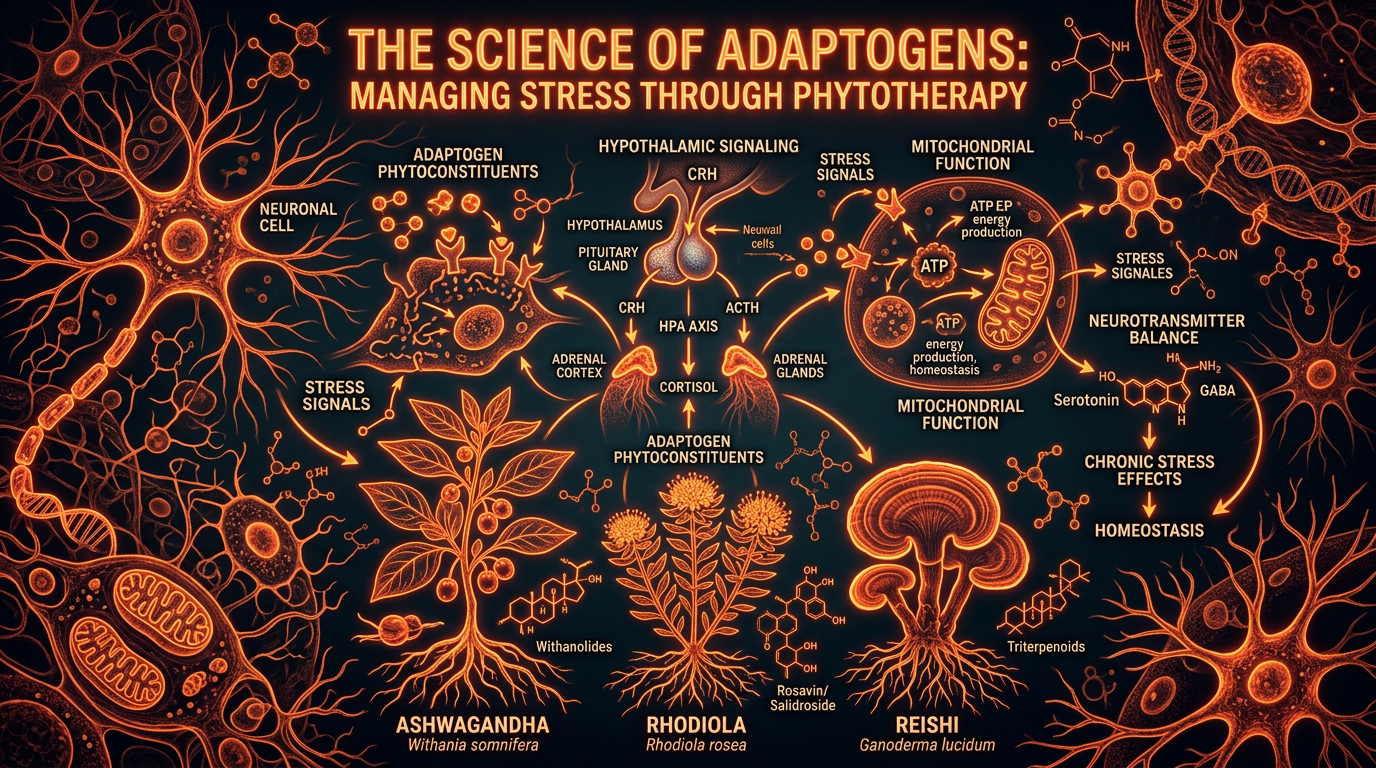
The primary targets of adaptogens are the Hypothalamic-Pituitary-Adrenal (HPA) axis and the Sympathoadrenal System (SAS). When a stressor is perceived, the hypothalamus releases Corticotropin-Releasing Hormone (CRH), triggering a cascade that culminates in the secretion of cortisol from the adrenal cortex.
Whilst cortisol is essential for survival, chronic elevation leads to hippocampal atrophy, insulin resistance, and systemic inflammation. Adaptogens act as ‘thermostats’ for this system. They sensitise cortisol receptors, allowing the body to mount a more efficient response to stress and, crucially, to shut that response down more rapidly once the threat has passed.
Molecular Chaperones and Heat Shock Proteins (HSPs)
At the intracellular level, adaptogens stimulate the production of Heat Shock Proteins, specifically HSP70. These are molecular chaperones that prevent the misfolding of proteins during times of thermal or oxidative stress. By increasing the expression of HSP70, adaptogens protect the cell from apoptosis (programmed cell death) and enhance cellular longevity.
The FoxO Transcription Factor
Recent research suggests that adaptogens like Rhodiola rosea and Withania somnifera influence the FoxO (Forkhead box O) transcription factors. Often referred to as the ‘gatekeepers of longevity’, FoxO factors regulate genes involved in DNA repair, oxidative stress resistance, and metabolism. This exposes a profound truth: adaptogens do not just ‘calm’ us; they structurally reinforce our cells against the ravages of time and environment.
The Phytotherapeutic Heavyweights: A Scientific Deconstruction
Not all herbs marketed as adaptogens meet the rigorous criteria established by Nikolai Lazarev in 1947. To be a true adaptogen, a substance must be non-specific (increasing resistance to a broad range of stressors), non-toxic, and have a normalising effect on physiology.
Rhodiola Rosea (Golden Root)
High-altitude Rhodiola is the premier adaptogen for mental fatigue and cognitive resilience. Its primary bioactives, rosavins and salidroside, inhibit the activity of enzymes like Monoamine Oxidase (MAO), thereby increasing the availability of serotonin and dopamine in the brain.
- Key Benefit: Enhances ATP synthesis in the mitochondria.
- Truth Exposure: Many commercial Rhodiola products are adulterated with cheaper species. Only Rhodiola rosea containing a 3:1 ratio of rosavins to salidrosides provides the documented neuroprotective effects.
Withania Somnifera (Ashwagandha)
Ashwagandha is the ‘calming’ adaptogen. Its withanolides act as GABA-mimetic agents, binding to GABA receptors in the central nervous system to induce anxiolytic effects without the cognitive impairment associated with benzodiazepines.
- Key Benefit: Dramatic reduction in serum cortisol levels (studies show up to a 30% decrease over 60 days).
- Clinical Insight: It is particularly effective for ‘tired but wired’ individuals whose circadian rhythms have been disrupted by nocturnal blue light exposure.
Panax Ginseng (Asian Ginseng)
The most potent metabolic stimulator of the group. Panax contains ginsenosides which directly influence the adrenal cortex and the anterior pituitary.
- Key Benefit: Improves glucose uptake and insulin sensitivity.
- Truth Exposure: Panax is often misused. Due to its ‘yang’ or stimulating nature, it can exacerbate hypertension in those with pre-existing autonomic dysregulation. It is a tool for recovery from depletion, not a stimulant to be stacked with high-dose caffeine.
Cordyceps Sinensis (The Metabolic Catalyst)
Technically a medicinal fungus, Cordyceps is a primary adaptogen for oxygen utilisation. It increases the production of Adenosine Triphosphate (ATP), the body’s fundamental energy currency.
- Key Benefit: Increases VO2 max and reduces lactic acid build-up.
- Environmental Context: In the polluted air of British urban centres, Cordyceps provides a critical respiratory defence by dilating the bronchioles and improving oxygenation.
Environmental Disruptors: The Invisible Drain
To discuss phytotherapy without addressing the environment is to treat the symptom while ignoring the poison. The efficacy of an adaptogen protocol is significantly diminished if the individual remains in an ‘environment of high friction’.
- Blue Light and Melatonin Suppression: Artificial light at night suppresses melatonin, which is not only a sleep hormone but a master antioxidant. Without melatonin, the brain cannot clear metabolic waste (the glymphatic system), leading to neuro-inflammation.
- Endocrine Disruptors (Xenoestrogens): Chemicals found in tap water and plastic packaging mimic oestrogen, disrupting the delicate balance of the endocrine system. This places an additional burden on the liver and the HPA axis to maintain hormonal equilibrium.
- The Dopamine Loop: The ‘infinite scroll’ of modern technology creates a state of tonic dopamine depletion. This leaves the individual feeling demotivated and reliant on exogenous stimulants like caffeine and nicotine, which further exhaust the adrenal reserves.
Research from the Mental Health Foundation indicates that 74% of UK adults have at some point over the past year felt so stressed they felt overwhelmed or unable to cope.
The INNERSTANDING Recovery Protocol: A Systematic Approach
True phytotherapy is not about taking a pill; it is about a strategic intervention in the body's feedback loops. To optimise the use of adaptogens, one must follow a structured protocol.
Phase 1: The Sensitisation Period (Weeks 1–2)
The goal is to lower systemic inflammation to allow adaptogen receptors to function.
- Action: Eliminate ultra-processed foods and seed oils.
- Herb: Start with Withania somnifera (Ashwagandha) in the evening to re-establish the cortisol rhythm.
Phase 2: The Adaptogenic Loading (Weeks 3–8)
Once the baseline inflammation is reduced, introduce specific adaptogens tailored to the stress profile.
- For Cognitive Fatigue: Rhodiola rosea (300-600mg) taken 30 minutes before breakfast.
- For Physical Depletion: Panax ginseng or Cordyceps (standardised to cordycepin).
- Synergy: Combine with Magnesium Bisglycinate to support the nervous system’s relaxation response.
Phase 3: The Pulsing Strategy (Ongoing)
The body is an adaptive system. Constant exposure to any substance leads to habituation and diminished returns.
- The 5:2 Rule: Use adaptogens for five days, then pause for two.
- The Seasonal Cycle: Rotate your adaptogens every 8–12 weeks. Use stimulating adaptogens (Ginseng) in the winter months and calming ones (Ashwagandha, Holy Basil) during high-intensity summer periods.
The Truth Exposed: The Pharmaceutical Conflict
Why is the science of adaptogens not more widely integrated into the UK’s National Health Service (NHS)? The answer lies in the economics of the pharmaceutical industry. Adaptogens are complex, multi-constituent biological agents. They cannot be easily synthesised or patented as a single ‘active ingredient’.
Mainstream medicine prefers ‘silver bullet’ solutions—Selective Serotonin Reuptake Inhibitors (SSRIs) or beta-blockers—which target a single pathway. Adaptogens, by contrast, are ‘shotgun’ solutions; they hit multiple targets simultaneously, harmonising the system rather than forcing it into a specific state.
Furthermore, adaptogens require the patient to take agency over their environment and lifestyle. In a medical model designed for efficiency and symptom management, the slow, systemic work of phytotherapy is often dismissed as ‘anecdotal’, despite the thousands of peer-reviewed studies supporting its efficacy.
Conclusion: Reclaiming Biological Sovereignty
The use of adaptogens is an act of biological defiance. It is an acknowledgment that the modern world is fundamentally misaligned with human physiology and that we must utilise the sophisticated chemistry of the natural world to protect our internal equilibrium.
By understanding the molecular mechanisms—from the HPA axis to Heat Shock Proteins—we move beyond ‘wellness’ and into the realm of applied phytotherapy. We do not use these plants to work harder for a broken system; we use them to build a resilient, sovereign biology that can thrive in any environment.
True INNERSTANDING is the realisation that we are not separate from nature’s pharmacy. The plants that survived the harsh conditions of the Siberian tundra or the Himalayan peaks have encoded that resilience into their chemistry. When we ingest them, we are not just taking a supplement; we are downloading a survival strategy that has been refined over millions of years.
"References & Technical Notes:"
- Panossian, A., & Wikman, G. (2010). Effects of Adaptogens on the Central Nervous System and the Molecular Mechanisms Associated with Their Stress—Protective Activity.
- Lazarov, N.V. (1947). Original definitions of adaptogenic substances.
- HSE UK: Work-related stress, anxiety or depression statistics in Great Britain, 2023.
- Standardisation Note: Ensure all phytotherapeutic agents are HPLC (High-Performance Liquid Chromatography) tested for bioactive purity.
This article is provided for informational and educational purposes only. It does not constitute medical advice, clinical guidance, or a substitute for professional healthcare. Information reflects cited research at time of publication. Always consult a qualified healthcare professional before acting on any health information.
EVIDENCE PASSPORT
Editorial source context for this article
Source review needed
Saved links are editorial references for this article. They may support specific claims rather than every sentence. Open and assess each source in context. This passport does not independently verify them.
Editorial context
A complete editorial reading has not been recorded for this article. Source links remain available for you to open and assess directly.
Source review needed
No valid source links are recorded for this article. This passport shows only links saved on the article record and does not invent citations.
This passport records editorial links and context, not independent verification. Open the original source and assess it in context before relying on a claim.
Medical Disclaimer
The information in this article is for educational purposes only and does not constitute medical advice, diagnosis, or treatment. Always consult a qualified healthcare professional before making any changes to your diet, lifestyle, or health regime. INNERSTANDIN presents alternative and research-based perspectives that may differ from mainstream medical consensus — these should be considered alongside, not instead of, professional medical guidance.
Read Full DisclaimerContinue the thread
Keep this question moving.
Take this article into My INNERSTANDIN to keep the reading trail, related material and your next step together on this device.