
The Biotensegrity Revolution
Updated May 2026
Biotensegrity redefines human movement by viewing the body as a continuous tension network rather than a stack of bones. This article explores how fascial tension maintains structural integrity across the entire biological system.
Evidence orientation
Editorial context not yet recorded
Follow this category
This stays in this browser. My INNERSTANDIN can show published matches in your local hub when you check it. It does not send email, push, or alert notifications.
Local learning review
A private browser aid for revisiting ideas. It is not an alert or a health recommendation.
Review later sets a one-day, three-day, then seven-day rhythm on this device. Choose it only when you want to revisit this article.
Overview
For centuries, the Western medical establishment has viewed the human body through the lens of Newtonian mechanics. In this reductionist framework, we are seen as a collection of parts—a "stack of bones" acting as compression-resistant pillars, with muscles draped over them like pulleys to facilitate movement. This archaic model, however, fails to explain how a gymnast can land a vault without their femur shattering, or how a marathon runner can maintain structural integrity over thousands of repetitive strikes.
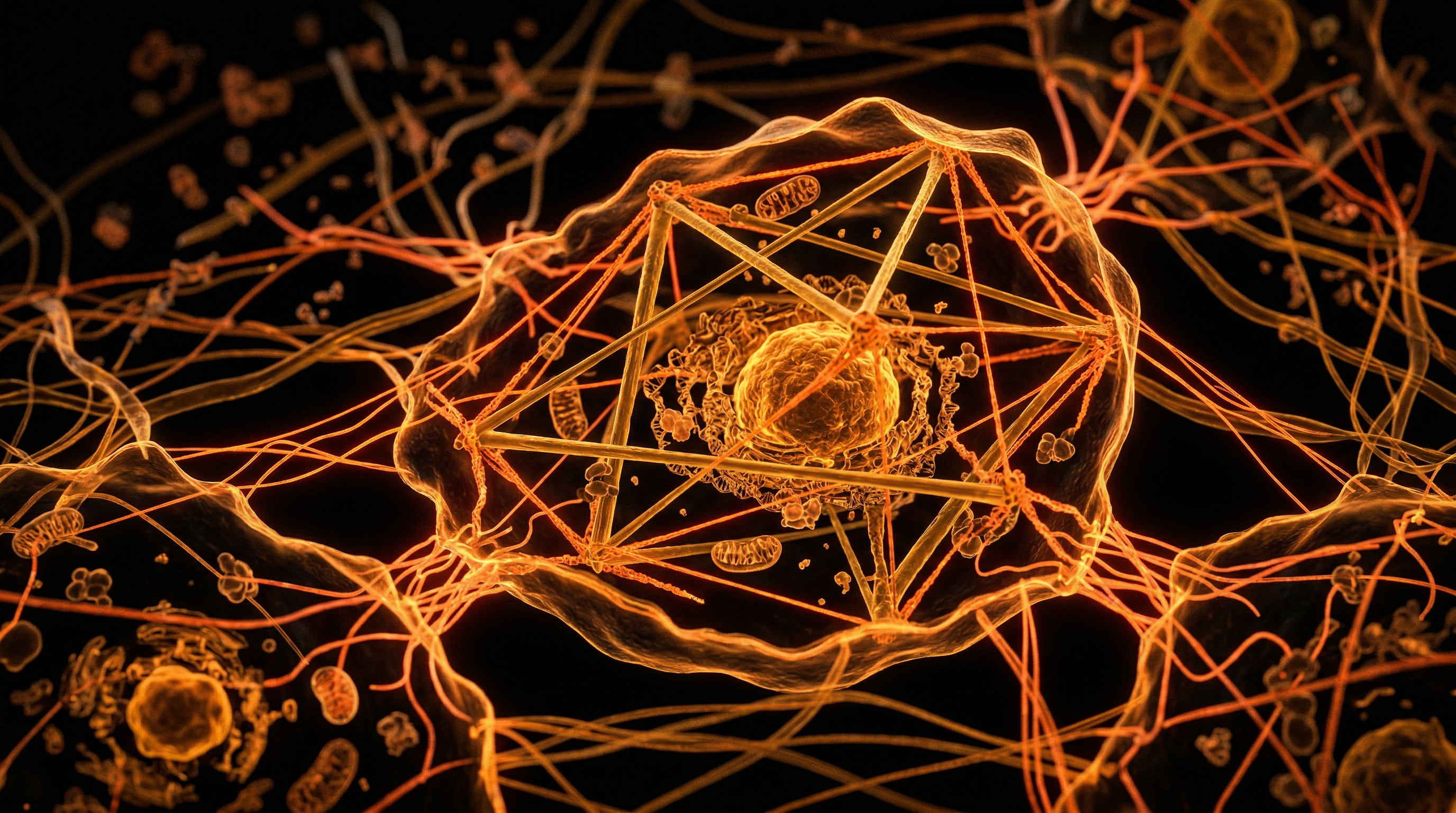
The emergence of Biotensegrity marks a seismic shift in biological understanding. Coined by Dr Stephen Levin, the term fuses "biology" with "tensegrity" (tensional integrity)—a structural principle famously explored by architect Buckminster Fuller and sculptor Kenneth Snelson. In a tensegrity structure, integrity is maintained not by gravity-dependent stacking, but by a continuous network of tension members and discontinuous compression members.
In the human body, this means our bones are not "weight-bearing" in the traditional sense. Instead, they are "spacers" floating within a continuous, ubiquitous sea of tensioned connective tissue known as fascia. This paradigm redefines the body as a holistic, self-organising system where every part is instantaneously aware of the state of the whole.
Fact: In a biotensegrity system, any force applied to a specific point is distributed throughout the entire network, preventing local failure and allowing for maximum efficiency with minimum material.
The implications of this revolution are profound. If the body is a continuous tension network, then the "site of pain" is rarely the "source of the problem." We must move beyond the "broken machine" metaphor and embrace the "living fabric" reality. This article explores the intricate science of biotensegrity, the cellular mechanisms that govern it, and the environmental factors currently threatening our structural health.
The Biology — How It Works
To understand biotensegrity, one must first understand the fascial system. Traditionally discarded in medical dissections as "packing material," fascia is a complex, multi-dimensional web of collagen fibres, elastin, and ground substance (a gel-like matrix) that wraps around every muscle, bone, nerve, and organ.
The Continuous Tension Network
In the biotensegrity model, the Extracellular Matrix (ECM) is the primary structural architect. The bones act as "compression struts" that push outwards, while the fascial network provides the "inward pull" or tension. This state of "pre-stress" ensures that the structure is always stable, regardless of its orientation in space.
Unlike a house, which would collapse if you turned it upside down, a biotensegrity structure—like a cell or a human body—remains intact. This is why humans can move with such fluidity and grace; we are not fighting gravity as much as we are harvesting it through elastic recoil.
The Role of Myofascia
The muscular and fascial systems are inseparable, often referred to as the myofascial unit. Muscles do not attach to bones in isolated "origin and insertion" points as textbooks suggest; instead, they merge into a continuous fascial sheath that spans the entire body.
- Force Transmission: Up to 40% of the force generated by a muscle is transmitted not to the bone it is supposedly attached to, but laterally into the surrounding fascial network.
- Proprioception: Fascia contains roughly six times more sensory nerve endings than muscle, making it our most important organ for "interoception"—the sense of the internal state of the body.
- Hydration and Glide: For the system to function, fascial layers must glide over one another. This is facilitated by hyaluronan, a lubricant that becomes "tacky" and restrictive if movement is absent.
Non-Linearity and Global Response
In a linear system (like a brick wall), if you remove one brick, only that area is affected until the point of collapse. In a non-linear biotensegrity system, a tension change in the foot can immediately alter the structural alignment of the neck. This "global connectivity" explains why chronic headaches can often be traced back to an old ankle injury or pelvic misalignment.
Mechanisms at the Cellular Level
The revolution of biotensegrity does not stop at the gross anatomical level; it extends into the very heart of our cells. Dr Donald Ingber of Harvard University has demonstrated that the cell itself is a tensegrity structure.
Mechanotransduction: The Language of Shape
Cells do not only respond to chemical signals (hormones, drugs, nutrients); they respond to physical forces. This process is known as mechanotransduction. When the fascial network is pulled, that tension is transmitted through the cell membrane via "hook-like" proteins called integrins.
These integrins connect the extracellular matrix to the cytoskeleton—the internal scaffolding of the cell composed of microtubules and microfilaments. This means that the physical "tug" on your skin can literally pull on the nucleus of a cell, changing the way your DNA is expressed.
Key Term: Mechanostat Theory – The concept that biological tissues (bones, tendons, fascia) adapt their growth and density based on the mechanical loads they experience.
The Nuclear Connection
The nucleus is not a loose bag of genetic material floating in cytoplasm. It is physically anchored to the rest of the cell. Under the biotensegrity model:
- Mechanical stress can open or close pores in the nuclear envelope.
- Structural tension can physically pull apart DNA strands, triggering transcription.
- A healthy, tensioned cell is a "happy" cell; a collapsed, compressed cell often becomes a cancerous or senescent cell.
The Liquid Crystalline State
The water within our fascia is not regular "bulk water." It exists in a liquid crystalline state, often referred to as "ordered water" or Exclusion Zone (EZ) water. This structured water acts as a semi-conductor, allowing for near-instantaneous communication across the body. This explains how professional athletes can react to stimuli faster than the speed of nerve conduction—the information is travelling via the "protonic jump" in the fascial water network.
Environmental Threats and Biological Disruptors
In our modern "technosphere," the biotensegrity system is under unprecedented assault. The integrity of our collagen fibres and the fluidity of our fascial matrix are being compromised by factors rarely discussed in general practice.
The Sedentary Crisis and "Fascial Fuzz"
The most immediate threat is lack of varied movement. When we remain in fixed postures (sitting at desks, staring at phones), our fascia begins to "set." Overnight, our bodies grow tiny filaments of collagen between fascial layers—a phenomenon known as "fuzz."
If we don't move through our full range of motion every day, this fuzz thickens and turns into adhesions. Over time, the biotensegrity structure loses its "spring" and becomes brittle. We stop being a "living web" and start becoming a "stiff cage."
Chemical Disruptors: The Glyphosate Problem
The structural integrity of fascia depends on the amino acid glycine. However, the widely used herbicide glyphosate (found in many non-organic food supplies) is a molecular analogue of glycine.
- Molecular Mimicry: There is mounting evidence that the body can mistakenly incorporate glyphosate into collagen chains instead of glycine.
- Structural Failure: This results in "defective" collagen that cannot properly fold or hold tension, potentially leading to the skyrocketing rates of Ehlers-Danlos Syndrome (EDS), joint hypermobility, and chronic fascial pain we see today.
Non-Native EMFs and Water De-Structuring
The liquid crystalline water in our fascia is highly sensitive to electromagnetic fields. Research suggests that non-native EMFs (from Wi-Fi, 5G, and mobile devices) can disrupt the formation of EZ water.
- Dehydration at Scale: Even if you drink three litres of water a day, if your fascia cannot "structure" that water due to EMF interference, your tissues remain functionally dehydrated.
- Loss of Communication: De-structured water cannot conduct information effectively, leading to "biological incoherence" where the parts of the body are no longer in sync.
The Cascade: From Exposure to Disease
When the biotensegrity system fails, the descent into chronic illness is often a "slow-motion cascade" that the mainstream medical system fails to diagnose until it is too late.
Stage 1: Compensatory Patterns
The body is a master of compensation. If the fascia in the right hip becomes "locked" due to an old injury or poor posture, the biotensegrity network redistributes that tension. The left shoulder might tighten to balance the load. At this stage, the patient feels "tight" but is not yet in "pain."
Stage 2: Mechanotransduction Malfunction
As fascial restrictions become chronic, the cells within those tissues are constantly "squeezed" or "over-stretched." This constant mechanical signal tells the cells that they are under attack.
- Inflammatory Signalling: The cells begin to release pro-inflammatory cytokines.
- Metabolic Shift: Compressed cells often switch from efficient aerobic metabolism to anaerobic glycolysis, a hallmark of cancer and chronic fatigue.
Stage 3: Systemic Congestion
The fascial system is the home of the interstitium, a recently "discovered" organ that acts as a highway for lymphatic fluid.
- Waste Accumulation: When fascia is bound and tight, the lymphatic system cannot drain efficiently.
- Toxicity: Metabolic waste and environmental toxins become trapped in the "fascial pockets," leading to localised acidity and further tissue degradation.
Stage 4: Symptomatic Disease
Finally, the "weakest link" in the chain breaks. This might manifest as a herniated disc, fibromyalgia, chronic fatigue syndrome (ME/CFS), or autoimmune disorders. The mainstream narrative treats these as "local" or "chemical" issues, ignoring the underlying structural collapse.
Fact: Chronic pain costs the global economy billions annually, yet less than 5% of medical school curricula are dedicated to the fascial system or biotensegrity principles.
What the Mainstream Narrative Omits
The refusal of the medical establishment to incorporate biotensegrity is not merely an oversight; it is a systemic bias rooted in the history of anatomy.
The "Anatomist's Ghost"
For 400 years, medical students have learned anatomy from cadavers. To see the "important" parts (the organs, the bones, the nerves), the anatomist must use a scalpel to cut away and discard the fascia.
- The Dead Model: A cadaver has no "pre-stress." It has no "liquid crystal" water. By studying the dead, we have built a model of biology that completely ignores the very thing that makes us "alive" and "connected."
- Surgical Blindness: Surgeons are often trained to cut through fascia as if it were mere wrapping paper, unaware that they are severing the body’s primary communication and stability network, leading to "unexplained" post-operative pain and dysfunction.
The Pharmaceutical Bias
Biotensegrity suggests that many health issues can be resolved through structural integration, movement, and environmental changes.
- No Pill for Tensegrity: You cannot "medicate" a fascial adhesion. You cannot "prescribe" a return to proper structural tension.
- The Profit Factor: Because the solutions to fascial dysfunction (movement, manual therapy, grounding, hydration) are low-cost and non-patentable, there is zero incentive for the pharmaceutical-industrial complex to fund research into biotensegrity.
The Myth of "Bone on Bone"
Millions of people are told they have "bone on bone" arthritis and require joint replacements. From a biotensegrity perspective, "bone on bone" is physically impossible in a healthy, tensioned system. The "collapse" of the joint space is not a failure of the bone or cartilage itself, but a failure of the fascial guy-wires that are supposed to hold the joint open. Replacing the joint without addressing the fascial tension ensures that the new joint will also eventually fail or cause pain elsewhere.
The UK Context
In the United Kingdom, the healthcare landscape is at a crossroads. The NHS is buckling under the weight of "musculoskeletal" (MSK) conditions, which are the leading cause of years lived with disability in the UK.
The NHS Stagnation
Despite the cutting-edge research coming out of institutions like the British Fascia Symposium, the NHS remains largely tethered to the "biomedical model."
- Standard Care: A patient with back pain in London or Manchester is typically offered Ibuprofen, an X-ray (which only shows the "bricks," not the "mortar"), and perhaps a few minutes of "stretching" advice.
- The Cost of Ignorance: MSK conditions account for over 25% of all GP consultations in England. Without adopting a biotensegrity-informed approach, the NHS is merely "managing symptoms" while the structural integrity of the population continues to decline.
The Rise of Private Structural Medicine
Because the state-funded system has failed to adapt, there has been a surge in "alternative" practitioners across the UK—Osteopaths, Rolfers (Structural Integrators), and myofascial release therapists. These practitioners are the ones currently holding the line, treating the body as a whole system rather than a collection of parts.
Statistic: In the UK, back pain alone accounts for an estimated £10 billion in lost productivity annually. A biotensegrity-led approach could potentially reduce this by 30-50% through more effective intervention.
Environmental Factors in Britain
The UK’s unique environmental factors also play a role. The high prevalence of mould in British housing and the lack of vitamin D due to northern latitudes both negatively impact collagen synthesis and fascial health. Mould toxins (mycotoxins) are known to "settle" in the fascial matrix, leading to systemic inflammation and "stiffening" of the biotensegrity web.
Protective Measures and Recovery Protocols
Knowing that we are biotensegrity structures, how do we protect and restore ourselves? The following protocols focus on the "Living Fabric" rather than the "Broken Machine."
1. Pandiculation vs. Stretching
Traditional static stretching can actually damage fascia by "over-pulling" specific points. Instead, we should look to the animal kingdom and practice pandiculation.
- The "Cat Stretch": This is a slow, conscious contraction followed by a slow, controlled release. It "resets" the nervous system’s map of the fascial tension, effectively "re-booting" the biotensegrity network.
2. Nutritional Support for the Matrix
The ECM requires specific building blocks to maintain its "spring."
- Glycine and Proline: High-quality collagen peptides or bone broth are essential, particularly in an era of glyphosate exposure.
- Silica and Magnesium: These minerals act as "cross-linkers" for collagen, ensuring the fibres are strong yet flexible.
- Vitamin C: A critical co-factor for collagen synthesis. Without it, the "web" literally falls apart (as seen in scurvy).
3. Restructuring Biological Water
To maintain the "liquid crystalline" state of our fascia:
- Grounding (Earthing): Connecting your skin to the Earth (walking barefoot on grass or sand) allows a flow of electrons into the body. This helps maintain the negative charge required for EZ water formation.
- Infrared Exposure: Sunlight (especially morning sun) provides the infrared frequencies that "charge" the water in our tissues.
- EMF Mitigation: Turning off Wi-Fi at night and keeping mobile phones away from the body reduces the "de-structuring" of fascial water.
4. Myofascial Release and "Load Variation"
The biotensegrity system thrives on variety.
- Self-Myofascial Release (SMR): Using foam rollers or therapy balls to apply "targeted pressure" helps break up adhesions and move stagnant lymphatic fluid.
- Whole-Body Movement: Activities like Yoga, Tai Chi, or "Animal Flow" are superior to gym machines because they load the body in three-dimensional spirals, exactly how the fascial network is designed to move.
5. Conscious Breathing
The diaphragm is the "central hub" of the body’s biotensegrity. Deep, diaphragmatic breathing creates an internal "pressure wave" that massages the organs and tension-loads the fascia from the inside out. Shallow "chest breathing" leads to a collapse of the thoracic tensegrity, causing neck pain and digestive issues.
Summary: Key Takeaways
The biotensegrity revolution is not just a change in how we view the body; it is a change in how we inhabit it. By moving away from the "bone-stack" model and toward the "tension-web" model, we unlock new potentials for healing and performance.
- The Body is a Whole: There is no such thing as an isolated injury. Every part of the system is connected through the fascial network.
- Tension is Life: Proper "pre-stress" is what keeps us upright and vital. When we lose our tension, we lose our health.
- Cells Listen to Shape: Our physical environment and movement patterns dictate our genetic expression through mechanotransduction.
- The Matrix is Threatened: Modern chemicals (glyphosate), radiation (EMFs), and stasis (sitting) are the primary enemies of our structural integrity.
- Recovery is Possible: Through mindful movement, proper nutrition, and environmental awareness, we can restore the "spring" to our step and the "fluidity" to our lives.
The transition from a Newtonian, mechanical view of the body to a Biotensegrity-based, holistic view is the "Great Shift" in modern biology. As we continue to expose the limitations of the mainstream narrative, the importance of the Fascial Revolution becomes undeniable. We are not machines; we are living, breathing, tensioned masterpieces of biological architecture. It is time we started treating ourselves accordingly.
This article is provided for informational and educational purposes only. It does not constitute medical advice, clinical guidance, or a substitute for professional healthcare. Information reflects cited research at time of publication. Always consult a qualified healthcare professional before acting on any health information.
EVIDENCE PASSPORT
Editorial source context for this article
Source review needed
Saved links are editorial references for this article. They may support specific claims rather than every sentence. Open and assess each source in context. This passport does not independently verify them.
Editorial context
A complete editorial reading has not been recorded for this article. Source links remain available for you to open and assess directly.
Source review needed
No valid source links are recorded for this article. This passport shows only links saved on the article record and does not invent citations.
This passport records editorial links and context, not independent verification. Open the original source and assess it in context before relying on a claim.
Medical Disclaimer
The information in this article is for educational purposes only and does not constitute medical advice, diagnosis, or treatment. Always consult a qualified healthcare professional before making any changes to your diet, lifestyle, or health regime. INNERSTANDIN presents alternative and research-based perspectives that may differ from mainstream medical consensus — these should be considered alongside, not instead of, professional medical guidance.
Read Full DisclaimerContinue the thread
Keep this question moving.
Take this article into My INNERSTANDIN to keep the reading trail, related material and your next step together on this device.