
The Metabolic Switch: Fueling the Transition from Dormancy to Action
Updated May 2026
Stem cells must rapidly shift their metabolism to begin the process of tissue repair. This study explains how nutrient availability dictates whether a stem cell stays dormant or activates.
Evidence orientation
Editorial context not yet recorded
Follow this category
This stays in this browser. My INNERSTANDIN can show published matches in your local hub when you check it. It does not send email, push, or alert notifications.
Local learning review
A private browser aid for revisiting ideas. It is not an alert or a health recommendation.
Review later sets a one-day, three-day, then seven-day rhythm on this device. Choose it only when you want to revisit this article.
Overview
In the silent, microscopic corridors of our tissues, a profound drama unfolds every moment of our lives. This is the drama of the stem cell, the biological progenitor charged with the gargantuan task of maintaining human architecture against the relentless tide of entropy. For decades, the scientific establishment viewed these cells through a purely genetic lens, assuming that a pre-programmed "master script" in the DNA dictated when a stem cell should remain dormant and when it should awaken to repair a damaged organ. However, we are now uncovering a deeper, more visceral truth: the master regulator of regenerative medicine is not the gene, but metabolism.
The "Metabolic Switch" represents a paradigm shift in our understanding of longevity and healing. It is the mechanism by which a stem cell senses its environment, evaluates nutrient availability, and decides whether to remain in quiescence (a state of protective dormancy) or to undergo activation and proliferation. This transition is the "on/off" switch for tissue regeneration.
When this switch is calibrated correctly, the body heals wounds, replaces worn-out lining in the gut, and replenishes blood cells with effortless precision. When the switch is jammed—by environmental toxins, nutrient deficiencies, or metabolic dysfunction—the result is a catastrophic failure of the body’s self-healing mechanisms, leading to the chronic degenerative diseases that now plague modern society.
Fact: Stem cells spend up to 99% of their lifespan in a state of quiescence, a metabolic "low-power mode" that protects them from DNA damage and oxidative stress.
This article explores the intricate dance between nutrients and cellular fate. We will examine how specific molecules like glucose, fatty acids, and amino acids act as signalling ligands that tell a stem cell to wake up. Furthermore, we will expose how our modern environment, particularly in the United Kingdom, has been engineered in a way that disrupts this delicate metabolic sensing, effectively "locking" our regenerative potential in a state of permanent slumber or, conversely, driving it into a state of malignant exhaustion.
The Biology — How It Works
To understand the metabolic switch, one must first understand the two primary modes of cellular energy production: Glycolysis and Oxidative Phosphorylation (OXPHOS).
The Quiescent State: Glycolytic Protection
In their dormant state, stem cells are remarkably frugal. They reside in specialised "niches"—microenvironments often characterised by low oxygen (hypoxia). To survive here, they do not rely on the high-energy output of mitochondria. Instead, they utilise anaerobic glycolysis, a process that breaks down glucose without oxygen.
This is not an accident of geography; it is a sophisticated survival strategy. By avoiding the heavy use of mitochondria, the stem cell limits the production of Reactive Oxygen Species (ROS)—unstable molecules that can mutate DNA. For a cell that must last a lifetime to serve as a genetic blueprint, avoiding ROS is paramount. In this state, the "switch" is firmly in the OFF position.
The Activation Phase: Mitochondrial Ignition
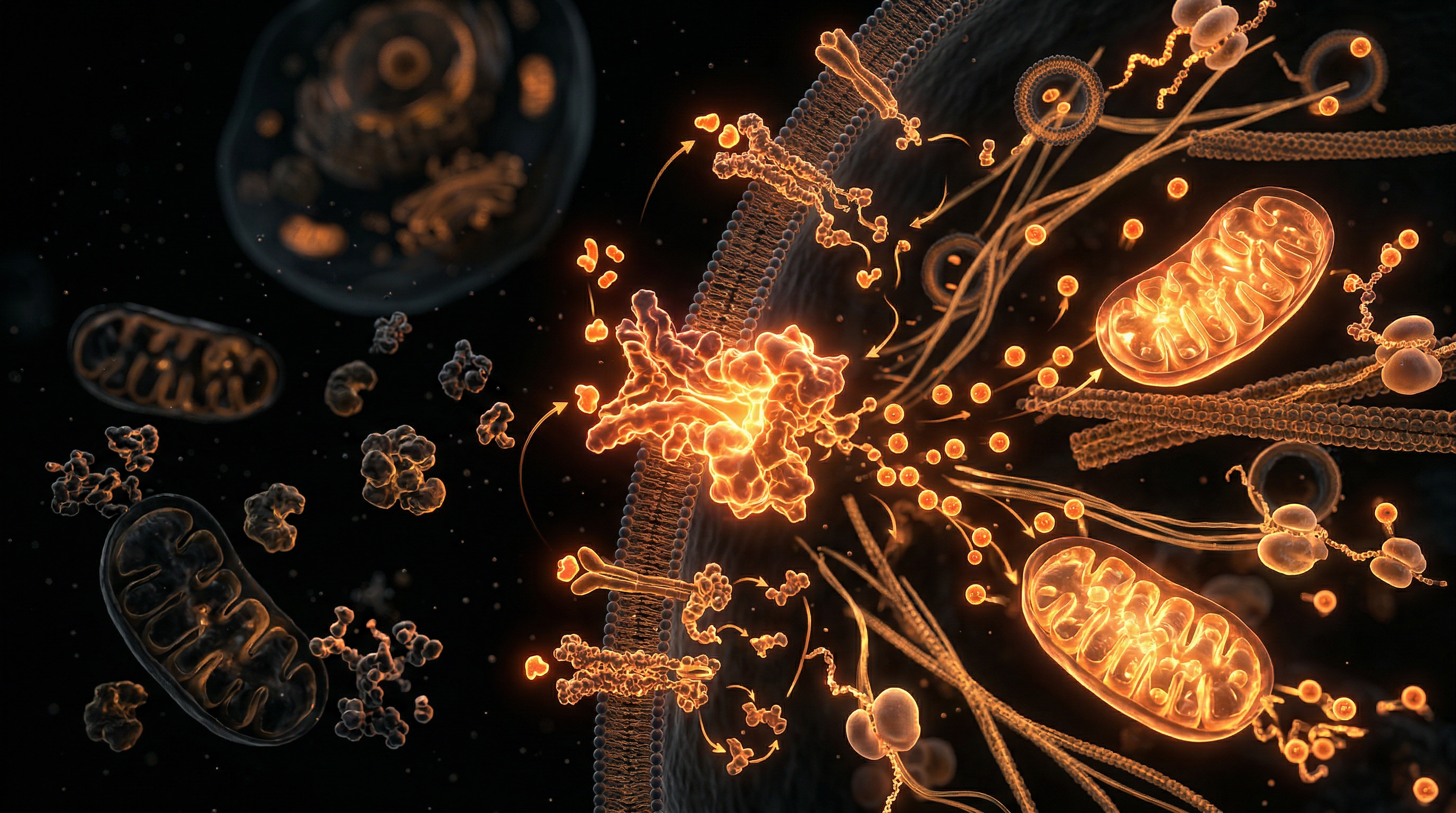
When the body signals a need for repair—perhaps due to a muscle tear or a skin graze—the stem cell must rapidly transition. It needs a massive influx of energy to divide and differentiate. This is where the switch flips. The cell moves from glycolysis to Oxidative Phosphorylation, igniting its mitochondria to produce up to 15 times more ATP (adenosine triphosphate) than it did in the dormant state.
This transition is facilitated by the Metabolic Checkpoint. If the cell senses that it lacks the necessary raw materials (amino acids for proteins, lipids for membranes), it will abort the activation. It is a biological "fail-safe" designed to prevent the creation of half-finished, dysfunctional daughter cells.
Nutrient Sensing: The Primary Inputs
The stem cell monitors three primary nutrient-sensing pathways to determine its fate:
- mTOR (mammalian Target of Rapamycin): The "Growth Controller." When amino acids (especially leucine) and insulin are high, mTOR activates, pushing the stem cell toward division.
- AMPK (AMP-activated Protein Kinase): The "Fuel Gauge." When energy is low, AMPK turns off growth and turns on energy-saving recycling processes (autophagy).
- Sirtuins (SIRT1-7): The "Longevity Guardians." These proteins sense levels of NAD+, a coenzyme central to metabolism, and link nutrient status directly to gene expression.
Mechanisms at the Cellular Level
The "switch" is not merely a metaphorical concept; it is a physical reality involving the remodelling of the cell's internal architecture.
Mitochondrial Remodelling and Dynamics
When a stem cell activates, its mitochondria undergo fusion and fission. In the quiescent state, mitochondria are often sparse and fragmented. Upon activation, they fuse into elongated, highly efficient networks that wrap around the nucleus to provide the energy required for DNA replication. This process is governed by proteins such as Mitofusin 1 and 2.
Failure of these proteins leads to "metabolic stalling," where a cell tries to wake up but lacks the internal "power grid" to do so. This is a hallmark of stem cell exhaustion, a primary driver of the ageing process.
Epigenetic Regulation via Metabolites
Perhaps the most stunning discovery in recent years is that metabolites—the byproducts of the food we eat—act as direct messengers to our DNA. This is known as metabolo-epigenetics.
- Acetyl-CoA: Produced from the breakdown of fats and sugars, this molecule is used to "acetylate" histones, the spools around which DNA is wound. This "opens" the DNA, allowing the genes responsible for regeneration to be read.
- Alpha-Ketoglutarate (α-KG): A key player in the Krebs cycle, α-KG is a necessary cofactor for enzymes that remove "methyl groups" from DNA, effectively "rebooting" the stem cell's genetic programme to a more youthful state.
Stat: Research indicates that supplementing with α-KG can extend the healthspan of model organisms by up to 50% by maintaining the "youthful" metabolic state of stem cell pools.
The Role of the Pentose Phosphate Pathway (PPP)
As a stem cell transitions, it doesn't just need energy (ATP); it needs building blocks. The Pentose Phosphate Pathway is a branch of metabolism that uses glucose to create ribose (for DNA/RNA) and NADPH (for antioxidant protection). Without a functional PPP, an activated stem cell will succumb to the very oxidative stress it is trying to create, leading to premature cell death or "senescence."
Environmental Threats and Biological Disruptors
In an ideal world, the metabolic switch functions with the precision of a Swiss watch. However, we do not live in an ideal world. We live in a world saturated with Xenohormetic disruptors and metabolic poisons that jam the switch in either the "always on" or "always off" position.
Endocrine Disruptors and Insulin Resistance
The most pervasive threat is the epidemic of hyperinsulinaemia. The modern diet, rich in refined carbohydrates and fructose, keeps insulin levels chronically elevated. Since insulin is a primary signal for the mTOR pathway, this keeps stem cells in a state of constant, low-level activation.
When stem cells are never allowed to return to their quiescent "home," they burn out. This is particularly evident in the bone marrow, where chronic metabolic stress leads to the depletion of Haematopoietic Stem Cells, resulting in a weakened immune system and anaemia.
Glyphosate and Mitochondrial Interference
The herbicide glyphosate, ubiquitous in the modern food supply, has been shown to interfere with the cytochrome P450 enzymes and potentially disrupt the mitochondrial electron transport chain. By damaging the very engines required for stem cell activation, glyphosate acts as a "metabolic anchor," preventing tissues from repairing themselves after injury.
Heavy Metals and the Displacement of Cofactors
Metabolic enzymes require specific mineral cofactors to function. Magnesium, Zinc, and Copper are essential for the energy-producing reactions in the stem cell. Toxic heavy metals like Aluminium, Lead, and Cadmium (often found in polluted air and water) can displace these essential minerals. When a heavy metal takes the place of a mineral in a metabolic enzyme, the enzyme becomes "zombified"—it exists, but it cannot perform its chemical duty. The metabolic switch is effectively broken at the hardware level.
Warning: Modern "ultra-processed" foods are often fortified with inorganic iron, which can lead to iron overload in the stem cell niche, triggering a violent form of cell death known as ferroptosis.
The Cascade: From Exposure to Disease
What happens when the metabolic switch fails? The result is not a single disease, but a cascade of systemic failures that manifest differently depending on the individual's genetic predispositions.
Regenerative Failure and Chronic Wounds
In the skin and vascular system, a "jammed" switch means that wounds do not heal. This is most tragically seen in diabetic ulcers. The high-glucose environment confuses the stem cell’s nutrient sensors; the cell "thinks" it should activate, but the internal oxidative stress is so high that it enters senescence—a "zombie" state where it refuses to divide but secretes inflammatory chemicals that damage surrounding tissue.
Neurodegeneration: The Starving Brain
In the brain, Neural Stem Cells (NSCs) are responsible for neuroplasticity and memory. These cells are highly sensitive to the availability of ketone bodies and BDNF (Brain-Derived Neurotrophic Factor). A diet that lacks metabolic flexibility—the ability to switch between burning sugar and burning fat—starves these NSCs of their preferred signals. Over time, this leads to the shrinking of the hippocampus, the hallmark of Alzheimer’s and other dementias.
Cancer: The Switch That Won't Turn Off
Cancer can be viewed as a stem cell activation gone rogue. A Cancer Stem Cell (CSC) is a cell that has locked its metabolic switch in the "growth" position, regardless of the environmental signals. It utilizes a distorted version of the quiescent glycolytic metabolism (the Warburg Effect) to fuel rapid growth while remaining immune to the oxidative stresses that would normally kill a rapidly dividing cell. The mainstream focus on genetic mutations often ignores this fundamental metabolic derangement.
Immunosenescence: The Ageing Defence
The immune system is entirely dependent on the rapid activation of stem cells in the bone marrow and thymus. When the metabolic switch is impaired by chronic inflammation (often called "inflammaging"), the body loses its ability to produce "naive" T-cells. This makes the elderly particularly vulnerable to new viral threats, as their "metabolic library" of immune responses can no longer be updated.
What the Mainstream Narrative Omits
The current medical orthodoxy remains fixated on a "one-disease, one-drug" model. This narrative purposefully omits the foundational role of metabolism in stem cell health for several reasons—chief among them the lack of profitability in metabolic interventions.
The Suppression of Metabolic Therapies
There is a profound silence regarding the efficacy of Metabolic Flexibility in regenerative medicine. If the body can be taught to repair itself by simply manipulating nutrient timing and quality, the trillion-dollar market for synthetic biologics and "stem cell injections" (which often fail because they are injected into a toxic metabolic environment) would collapse.
The Myth of "Genetic Destiny"
Mainstream science often portrays our health as a roll of the genetic dice. By focusing on "defective genes," the responsibility for health is shifted away from the environment and the individual, and toward pharmaceutical companies who promise to "edit" those genes. In reality, Epigenetics—governed by metabolism—controls which genes are expressed. You cannot fix a broken house by just looking at the blueprint if the builders (the stem cells) are on strike due to a lack of supplies.
The Fructose Fallacy
The narrative around sugar often focuses on "calories" rather than "signalling." Fructose, specifically, is a metabolic toxin that bypasses the normal energy-regulation systems in the liver. It directly impairs mitochondrial function and "fools" stem cells into a state of premature senescence. Yet, the mainstream continues to allow the fortification of "health foods" with high-fructose syrups, ignoring the catastrophic impact on the nation’s regenerative capacity.
Key Fact: Unlike glucose, fructose does not require insulin to enter cells, allowing it to "flood" the metabolic pathways and cause immediate oxidative damage to the stem cell niche.
The UK Context
The United Kingdom presents a unique and challenging landscape for stem cell health. From the quality of our soil to the structure of the NHS, the British public faces specific hurdles in maintaining a functional metabolic switch.
The "Ultra-Processed" Nation
The UK has the highest consumption of ultra-processed foods (UPFs) in Europe, with some estimates suggesting they make up over 50% of the national diet. UPFs are engineered to be metabolically disruptive; they are stripped of the "metabolic cofactors" (vitamins and minerals) needed for stem cell activation and loaded with "metabolic noise" (emulsifiers and artificial sweeteners) that confuse cellular signalling.
Soil Depletion and the Mineral Gap
The British Geological Survey and other bodies have noted a significant decline in the mineral content of UK soils over the last century. Selenium, Magnesium, and Iodine—all crucial for the metabolic pathways that govern stem cells—are significantly lower in British-grown produce than in decades past. This means that even a "healthy" UK diet may be metabolically insufficient to support optimal tissue repair.
The NHS: Reactive vs. Proactive
The National Health Service is a "sickness service," designed to intervene only when the metabolic switch has already failed and a disease has manifested. There is currently no framework within the NHS for assessing metabolic health at the cellular level. Standard blood tests for "fasting glucose" are woefully inadequate; they catch problems years, or even decades, after the stem cells have already begun to fail.
Environmental Pollutants in the UK
The UK's industrial legacy has left many urban areas with high levels of particulate matter and heavy metal contamination. Furthermore, the "hard water" in many parts of the UK is often treated with high levels of fluoride and chlorine, both of which can interfere with mitochondrial function and thyroid health, further dampening the body’s metabolic "fire."
Protective Measures and Recovery Protocols
While the threats are significant, the beauty of the metabolic switch is its plasticity. It can be recalibrated. By changing the nutrient inputs and environmental signals, we can "reset" our stem cells and regain our regenerative potential.
1. Controlled Metabolic Stress (Hormesis)
Stem cells respond positively to brief periods of stress. This is known as hormesis.
- Intermittent Fasting: By periodically lowering insulin and increasing AMPK, fasting "cleans" the stem cell niche through autophagy and forces the cells to return to a deep, protective quiescence.
- Cold Thermogenesis: Exposure to cold (e.g., cold showers or ice baths) activates "brown fat" and triggers a metabolic surge that has been shown to stimulate the activation of mesenchymal stem cells.
2. Specific Micronutrient Support
To ensure the switch can flip when needed, the body must have an abundance of specific cofactors:
- NAD+ Precursors: Molecules like Nicotinamide Riboside (NR) or NMN help maintain the levels of NAD+ required for Sirtuin activity and mitochondrial energy production.
- Polyphenols: Compounds like Resveratrol (found in grapes) and Quercetin (found in onions) act as "mimetics" of calorie restriction, helping to keep the metabolic switch sensitive.
- Magnesium Bisglycinate: Essential for all ATP-related reactions, magnesium is the "master mineral" for the metabolic switch.
3. Eliminating "Metabolic Noise"
Recovery requires the removal of disruptors:
- Filter Your Water: Use high-quality filtration (Reverse Osmosis or Distillation with re-mineralisation) to remove fluoride and heavy metals.
- Avoid Seed Oils: Industrial seed oils (sunflower, rapeseed, corn) are high in Linoleic Acid, which can accumulate in the mitochondrial membranes and make them more susceptible to oxidative "leakage."
- Prioritise "Ancestral" Fats: Favour stable fats like tallow, butter, and coconut oil, which provide a clean burning fuel for stem cell mitochondria.
4. Circadian Synchronisation
The metabolic switch is also governed by the "body clock." Stem cells have their own internal circadian rhythms. Exposure to Blue Light at night disrupts melatonin production, which is not only a sleep hormone but a powerful mitochondrial antioxidant.
- Protocol: Get 15 minutes of direct sunlight in the morning to "set" the metabolic clock and use blue-light-blocking glasses after sunset to protect the nocturnal quiescent phase of your stem cells.
Actionable Stat: Studies show that a single night of sleep deprivation can induce temporary insulin resistance in stem cells, effectively "jamming" the switch for up to 24 hours.
Summary: Key Takeaways
The transition from dormancy to action is the most critical event in the life of a stem cell, and by extension, in the health of the human body. As we have explored, this transition is not dictated by chance, but by the metabolic environment we create through our diet, lifestyle, and environmental exposures.
- The Switch is Metabolic: The choice between repair (activation) and protection (quiescence) is governed by how the cell processes energy.
- Nutrients are Signals: Glucose, amino acids, and fats are not just fuel; they are "data" that tells the stem cell what to do.
- Modern Life is a Disruptor: Hyperinsulinaemia, glyphosate, and heavy metals "jam" the switch, leading to either stem cell exhaustion or malignant growth.
- The UK Faces Unique Challenges: Soil depletion and high UPF consumption make the British population particularly vulnerable to "metabolic stalling."
- Recovery is Possible: Through hormetic stressors like fasting, targeted supplementation of NAD+ precursors, and the elimination of environmental toxins, we can restore our innate regenerative capacity.
The "Metabolic Switch" is the frontier of 21st-century medicine. By looking beyond the mainstream narrative and addressing the fundamental energetic requirements of our stem cells, we move from a state of managed decline to one of vibrant, self-sustaining health. The power to heal is already within you; it is simply waiting for the right metabolic signal to awaken.
Author: Senior Biological Researcher, INNERSTANDING Date: May 2024 Subject: Regenerative Medicine / Metabolic Biology Location: London, UK
This article is provided for informational and educational purposes only. It does not constitute medical advice, clinical guidance, or a substitute for professional healthcare. Information reflects cited research at time of publication. Always consult a qualified healthcare professional before acting on any health information.
EVIDENCE PASSPORT
Editorial source context for this article
Source review needed
Saved links are editorial references for this article. They may support specific claims rather than every sentence. Open and assess each source in context. This passport does not independently verify them.
Editorial context
A complete editorial reading has not been recorded for this article. Source links remain available for you to open and assess directly.
Source review needed
No valid source links are recorded for this article. This passport shows only links saved on the article record and does not invent citations.
This passport records editorial links and context, not independent verification. Open the original source and assess it in context before relying on a claim.
Medical Disclaimer
The information in this article is for educational purposes only and does not constitute medical advice, diagnosis, or treatment. Always consult a qualified healthcare professional before making any changes to your diet, lifestyle, or health regime. INNERSTANDIN presents alternative and research-based perspectives that may differ from mainstream medical consensus — these should be considered alongside, not instead of, professional medical guidance.
Read Full DisclaimerContinue the thread
Keep this question moving.
Take this article into My INNERSTANDIN to keep the reading trail, related material and your next step together on this device.
Dig deeper in the Library
Free, longform PDF volumes that go beyond headlines into mechanisms and references.