
The Myopia Epidemic: Modern Strategies for Childhood Vision Control
Updated May 2026
Exploring the rising rates of nearsightedness in children and the latest clinical interventions like orthokeratology and atropine drops.
Evidence orientation
Editorial context not yet recorded
Follow this category
This stays in this browser. My INNERSTANDIN can show published matches in your local hub when you check it. It does not send email, push, or alert notifications.
Local learning review
A private browser aid for revisiting ideas. It is not an alert or a health recommendation.
Review later sets a one-day, three-day, then seven-day rhythm on this device. Choose it only when you want to revisit this article.
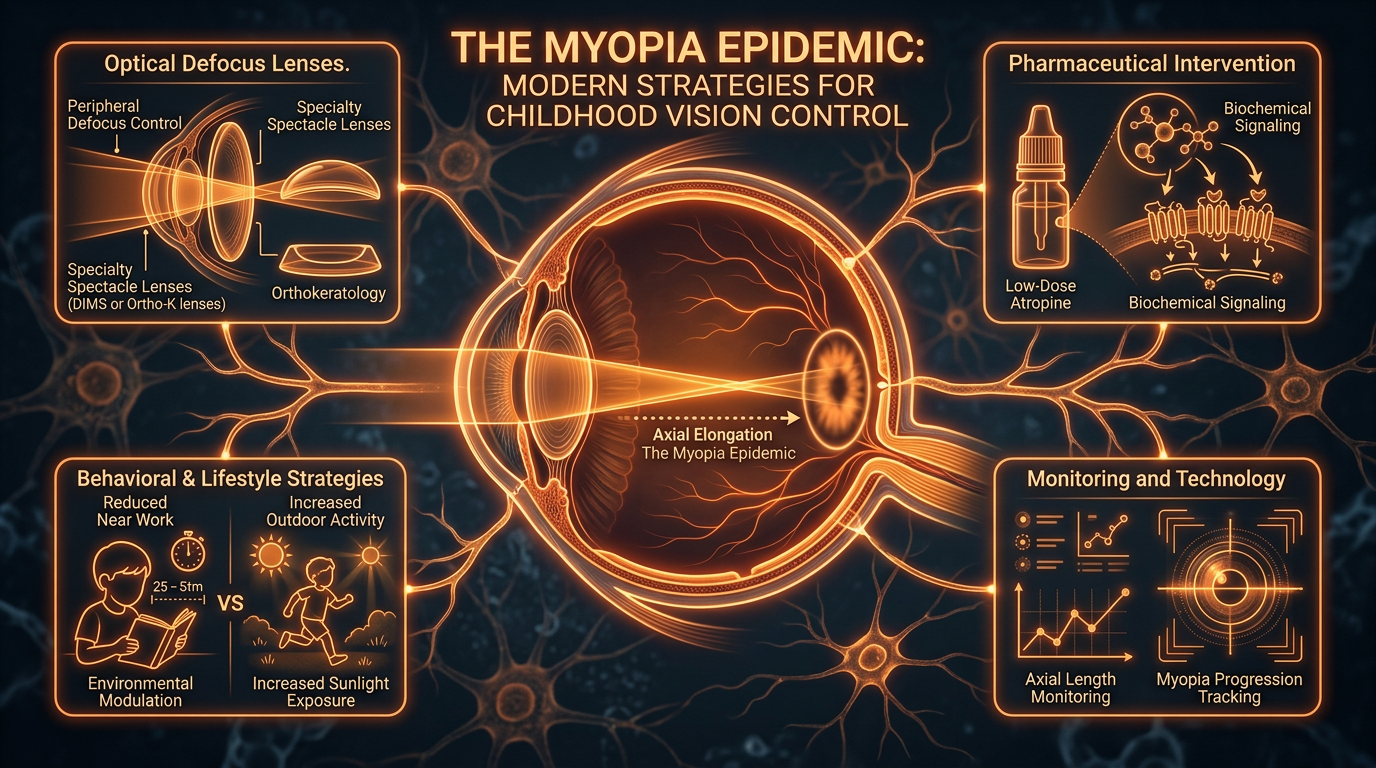
The human eye, a product of millions of years of evolutionary refinement, is currently undergoing a rapid and pathological transformation. Within the span of a single generation, the prevalence of myopia—short-sightedness—has escalated from a manageable refractive error to a global public health crisis. We are witnessing a systemic biological misalignment between our ancestral physiology and the artificial constraints of the modern world.
At INNERSTANDING, we seek to peel back the layers of conventional optometry to reveal the underlying mechanisms of this epidemic. This is not merely a matter of "needing glasses"; it is a structural elongation of the globe that increases the lifetime risk of retinal detachment, glaucoma, and myopic macular degeneration. To understand the cure, we must first expose the environmental and biological disruptors that have turned our children’s eyes into casualties of the digital age.
The Biological Mechanism: The Runaway Sclera
To the layperson, myopia is simply blurry distance vision. To the visual scientist, it is a failure of emmetropisation—the process by which the eye matches its focal length to its axial length. In a myopic eye, the globe grows too long (axial elongation). Light, instead of landing precisely on the retina, falls short, resulting in a blurred image.
The Role of Dopamine and Retinal Signalling
The eye is not a static camera; it is a dynamic organ that grows in response to chemical signals. Research now confirms that retinal dopamine, a neurotransmitter released in response to high-intensity light (specifically sunlight), acts as a "brake" on axial growth.
When a child is deprived of full-spectrum light, dopamine levels drop. The sclera—the white, structural outer layer of the eye—loses its rigidity. This allows the internal pressure of the eye to physically stretch the globe. This is the fundamental "truth" often omitted in standard consultations: myopia is as much a neurochemical disorder as it is an optical one.
Hyperopic Defocus: The Lens-Induced Trap
For decades, the standard treatment for myopia was "single-vision" lenses. However, emerging evidence suggests that these lenses may actually accelerate the condition. While they clear central vision, they often create "peripheral hyperopic defocus"—where light in the periphery lands behind the retina. The eye, in its infinite biological wisdom, attempts to grow toward that light, further elongating the globe. This creates a feedback loop where the correction becomes the catalyst for further degradation.
UK Statistical Insight: The Silent Shift
According to data from the College of Optometrists and recent longitudinal studies, the prevalence of myopia in British children has doubled over the last 50 years.
- Approximately 26% of UK children are now myopic.
- Children of South Asian and East Asian descent living in urban UK environments show rates as high as 35-40%.
- The age of onset has shifted earlier, with a significant rise in "early-onset myopia" (ages 6-9), which carries a higher risk of developing "high myopia" (over -6.00D) in adulthood.
Environmental Disruptors: The "Indoor Generation"
The narrative that myopia is purely genetic is a convenient fallacy. While genetics may load the gun, the environment pulls the trigger. The rapid rise in myopia rates mirrors the transition from outdoor-centric lifestyles to a sedentary, "near-work" dominated existence.
1. The Lux Deficit
The intensity of light is measured in lux. On a bright day, outdoor light can reach 100,000 lux. Even on a grey, overcast London morning, it sits around 10,000 lux. In contrast, a well-lit modern classroom or home office rarely exceeds 500 lux. We are raising a generation in a state of chronic light malnutrition. Without the high-intensity stimulus required to trigger retinal dopamine, the eye remains in a "growth" state, unable to signal the sclera to stop elongating.
2. The Near-Work Paradox and Peripheral Deprivation
Human vision evolved for the horizon. Modern life demands "near-work"—tablets, smartphones, and books. This requires constant accommodation (focusing of the internal lens). More critically, when we stare at a screen, our peripheral vision is effectively "switched off" or blurred. The peripheral retina is highly sensitive to motion and spatial cues; when these are absent, the eye loses its spatial grounding, further contributing to abnormal growth patterns.
3. The Blue Light Myth vs. Circadian Disruption
While much is made of "blue light" causing retinal damage, the more profound impact is on the circadian rhythm. Artificial light exposure after sunset suppresses melatonin and disrupts the diurnal rhythms of eye growth. The eye actually undergoes a slight change in length throughout the day; when these rhythms are fractured by late-night screen use, the regulatory mechanisms of the eye are compromised.
Recovery and Control: Modern Clinical Strategies
We have moved beyond the era of "just stronger glasses." Modern optometry now possesses the tools to slow the progression of myopia by 40% to 70%. These are not "cures" in the sense of reversing the damage already done, but they are vital interventions to prevent "pathological myopia."
Low-Dose Atropine Drops
Atropine, an antagonist of muscarinic receptors, has been used for centuries to dilate the pupil. However, in micro-doses (0.01% to 0.05%), it has been shown to significantly slow axial elongation. Interestingly, it doesn't work by relaxing the eye's focusing muscles, but likely by acting directly on the biochemical signalling in the retina or sclera. It is a pharmaceutical intervention that buys time for the child’s eye to stabilise.
Orthokeratology (Ortho-K)
Ortho-K involves the use of specially designed gas-permeable contact lenses worn only during sleep. These lenses gently reshape the cornea overnight. When the child wakes and removes the lenses, they can see clearly throughout the day without glasses. Beyond the convenience, Ortho-K creates "peripheral myopic defocus"—essentially tricking the eye into thinking it has already grown too long, thereby signalling the growth to stop.
DIMS and HALT Technology Lenses
For children who cannot tolerate contact lenses, new spectacle lens technologies like DIMS (Defocus Incorporated Multiple Segments) and HALT (Highly Aspherical Lenslet Target) have revolutionised myopia control. These lenses feature a central "clear zone" for distance vision, surrounded by a honeycomb of "treatment zones" that create myopic defocus in the periphery. Recent clinical trials have shown these to be nearly as effective as Ortho-K in slowing progression.
The INNERSTANDING Protocol: Natural Mitigation Strategies
While clinical interventions are necessary for many, they must be underpinned by a return to biological fundamentals. We advocate for a "visual hygiene" protocol that addresses the environmental root causes.
The 20-20-2 Rule
Standard advice suggests the 20-20-20 rule (every 20 minutes, look 20 feet away for 20 seconds). At INNERSTANDING, we propose a more robust version:
- 20 Minutes of Near Work: Followed by a break.
- 20 Seconds of Far Viewing: Actively looking at the furthest possible horizon to relax the ciliary muscle.
- 2 Hours of Outdoor Light: This is the non-negotiable threshold. Research suggests that 120 minutes of outdoor exposure daily, regardless of activity, is the primary preventative measure against the onset of myopia.
Peripheral Activation Exercises
Encourage activities that require "global" vision rather than "focal" vision. Ball sports (football, tennis, cricket) are excellent as they require the eye to track objects across three-dimensional space while maintaining awareness of the periphery. This provides the complex visual input the brain and eye require for healthy development.
Full-Spectrum Lighting Environments
Where outdoor time is impossible, we must improve the indoor "light diet."
- Remove "Flicker": Low-quality LED lighting has a high-frequency flicker that, while invisible to the naked eye, causes significant visual stress and strain.
- High-CRI Lighting: Use bulbs with a high Colour Rendering Index (90+) to mimic the solar spectrum as closely as possible.
- Window Proximity: Position study desks directly against windows. Even through glass, the lux levels are significantly higher than in the centre of a room.
The Truth About "Weak Eyes" and Genetics
There is a pervasive myth that myopia is simply an inherited "weakness" of the eyes. This is a dangerous oversimplification. While there are genetic markers that make an individual more susceptible to environmental triggers, the "myopia genes" have not changed in 50 years—our environment has.
Labeling myopia as "genetic" removes agency from the parent and the practitioner. It suggests that the thick spectacles and the eventual risk of blindness are inevitable. They are not. By understanding the axial growth mechanism, we can intervene. We can change the light, change the visual habit, and change the lens technology to steer the eye back toward its intended biological path.
The Looming Crisis of High Myopia
The goal of myopia control is not just to reduce the thickness of a child's glasses. The true mission is the prevention of "High Myopia" (defined as a refractive error greater than -6.00D or an axial length greater than 26mm). As the eye stretches, the retina—the delicate neural tissue responsible for vision—is pulled thin. This creates:
- Lattice Degeneration: Thinned areas of the retina prone to tearing.
- Myopic Maculopathy: Damage to the central vision that cannot be corrected with glasses or surgery.
- Early-Onset Cataracts and Glaucoma: Resulting from the structural stresses on the elongated globe.
Every dioptre of myopia saved reduces the risk of permanent vision loss in later life by approximately 40%. This is why "watch and wait" is no longer an acceptable clinical stance.
Reclaiming Visual Sovereignty
The myopia epidemic is a symptom of our "domestication." We have moved from the wide-open savannah to the glowing rectangle, and our biology is protesting. To protect the vision of the next generation, we must bridge the gap between high-tech clinical interventions and ancestral environmental wisdom.
We must demand that schools prioritise outdoor time. We must insist that optometrists provide myopia control options as the standard of care, rather than an optional extra. And most importantly, we must reconnect our children with the horizon.
The "truth" is that myopia is a modern adaptation to an unnatural environment. By controlling the light, the focal stimulus, and the duration of near-work, we can halt the runaway elongation of the eye. We have the science; we now require the collective will to implement it.
"Conclusion: A Call to Action"
If you are a parent or educator, the mandate is clear. The eye requires the sun. It requires the distance. It requires the dark of night. By integrating low-dose atropine, Ortho-K, or DIMS lenses with a rigorous outdoor protocol, we can effectively "short-circuit" the myopia epidemic. We are not just correcting vision; we are preserving the structural integrity of the human eye for a lifetime.
The era of passive correction is over. The era of active vision control has begun.
This article is provided for informational and educational purposes only. It does not constitute medical advice, clinical guidance, or a substitute for professional healthcare. Information reflects cited research at time of publication. Always consult a qualified healthcare professional before acting on any health information.
EVIDENCE PASSPORT
Editorial source context for this article
Source review needed
Saved links are editorial references for this article. They may support specific claims rather than every sentence. Open and assess each source in context. This passport does not independently verify them.
Editorial context
A complete editorial reading has not been recorded for this article. Source links remain available for you to open and assess directly.
Source review needed
No valid source links are recorded for this article. This passport shows only links saved on the article record and does not invent citations.
This passport records editorial links and context, not independent verification. Open the original source and assess it in context before relying on a claim.
Medical Disclaimer
The information in this article is for educational purposes only and does not constitute medical advice, diagnosis, or treatment. Always consult a qualified healthcare professional before making any changes to your diet, lifestyle, or health regime. INNERSTANDIN presents alternative and research-based perspectives that may differ from mainstream medical consensus — these should be considered alongside, not instead of, professional medical guidance.
Read Full DisclaimerContinue the thread
Keep this question moving.
Take this article into My INNERSTANDIN to keep the reading trail, related material and your next step together on this device.
Explore this in the Body Map
See where this hits your biology. Interactive anatomy, threats, and protective protocols.