
The Thymic Microenvironment: Architecture of Lifetime Immunity
Updated May 2026
The structural integrity of the thymic stroma is paramount for effective T-cell education. This paper examines how changes in the microenvironment dictate the quality of our immune response throughout life.
Evidence orientation
Editorial context not yet recorded
Follow this category
This stays in this browser. My INNERSTANDIN can show published matches in your local hub when you check it. It does not send email, push, or alert notifications.
Local learning review
A private browser aid for revisiting ideas. It is not an alert or a health recommendation.
Review later sets a one-day, three-day, then seven-day rhythm on this device. Choose it only when you want to revisit this article.
Category: Thymus Gland & Immune Ageing Tags: Histology, Stroma, Education, Biology
Overview
In the hierarchy of biological importance, the thymus gland occupies a position of overlooked supremacy. Nestled in the upper anterior thorax, just behind the sternum and in front of the heart, this bi-lobed organ serves as the primary lymphoid site where T-lymphocytes (T-cells) are "educated" to distinguish between the self and the non-self. While mainstream medicine often treats the thymus as a vestigial curiosity that fades after puberty, the reality is far more sinister and significant. The structural integrity of the thymic stroma—the non-lymphoid framework of the organ—is the ultimate architect of our lifetime immunity.
The thymus is not merely a factory; it is a rigorous military academy. Here, progenitor cells arriving from the bone marrow undergo a brutal selection process. Only about 2% to 5% of these recruits survive to graduate as mature, functional T-cells. The rest are liquidated through apoptosis (programmed cell death) because they are either incompetent or, more dangerously, prone to attacking the host's own tissues.
However, we are currently facing a silent crisis: thymic involution. This is the process by which the functional thymic tissue is replaced by adipose (fatty) tissue as we age. For decades, this has been accepted as a "natural" part of ageing. But as a senior researcher for INNERSTANDING, I must posit that this "natural" decline is being accelerated by environmental factors, nutritional deficiencies, and medical paradigms that ignore the regenerative potential of the thymic microenvironment. If the architecture of the thymus fails, the entire immune system collapses into a state of immunosenescence—a state of premature ageing where the body is simultaneously vulnerable to infections and prone to chronic inflammation.
Key Fact: By the age of 50, most individuals have lost over 80% of their functional thymic epithelial space, significantly reducing the diversity of the "T-cell receptor" (TCR) repertoire available to fight new pathogens.
The Biology — How It Works
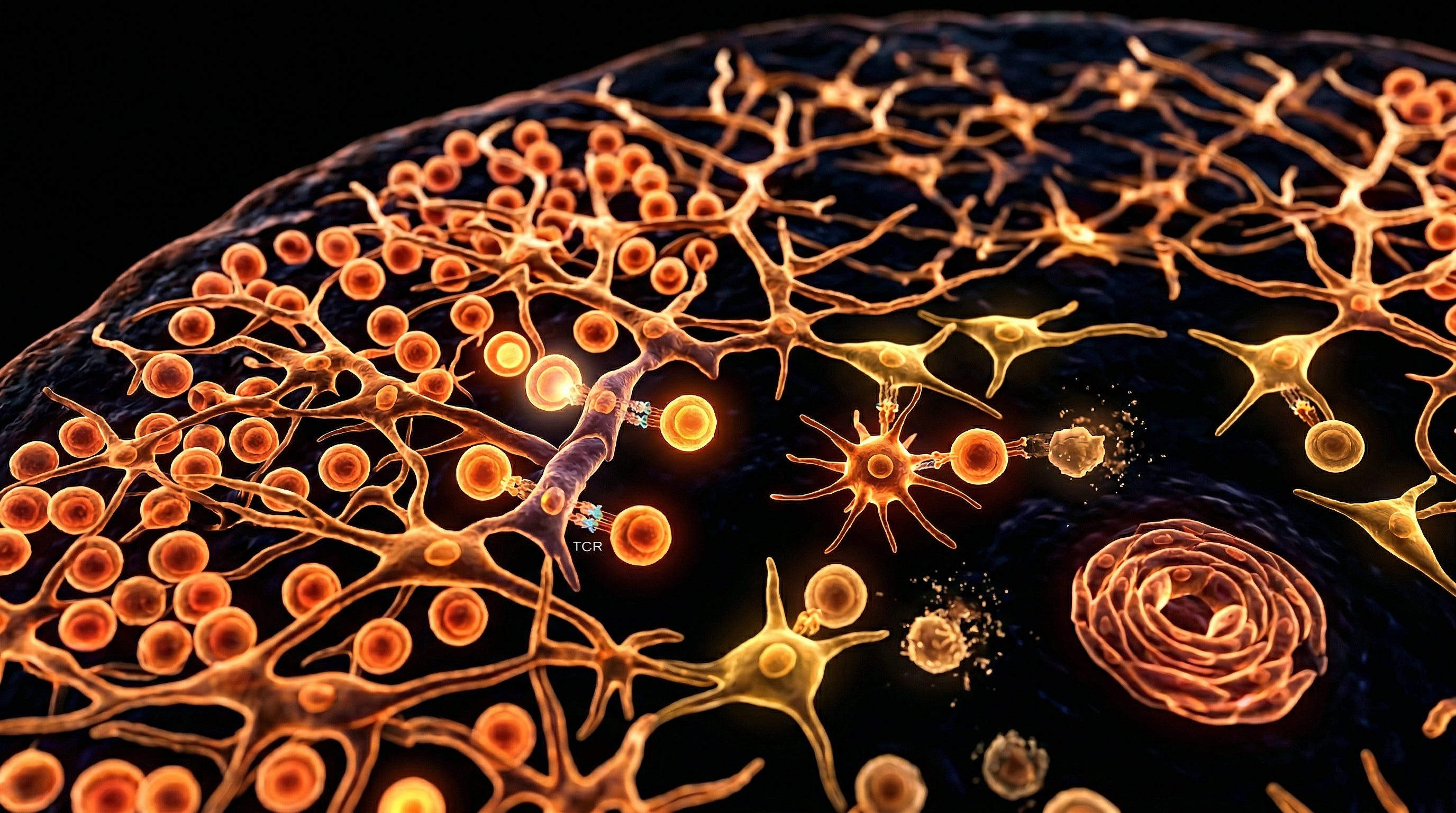
To understand why the thymus is so vital, one must first master the geography of its microenvironment. The gland is divided into an outer cortex and an inner medulla, each providing a distinct "classroom" for developing T-cells, known as thymocytes.
The Cortical Labyrinth
The journey begins in the cortex. Progenitor cells enter via the corticomedullary junction and migrate toward the outer capsule. In this densely packed region, they encounter Cortical Thymic Epithelial Cells (cTECs). The cTECs are essential for Positive Selection. They present bits of proteins (antigens) on Major Histocompatibility Complex (MHC) molecules. If a developing T-cell can recognise these MHC molecules, it receives a "survival signal." If it fails to recognise them, it is left to die. This ensures that every T-cell in your blood is capable of interacting with your body’s signalling system.
The Medullary Filter
Those that pass the cortical test move into the medulla. Here, they encounter Medullary Thymic Epithelial Cells (mTECs) and dendritic cells. This is the stage of Negative Selection. The mTECs are unique in the biological world because they express a gene called AIRE (Autoimmune Regulator). This gene allows mTECs to express proteins from almost every other organ in the body—insulin from the pancreas, myelin from the brain, surfactants from the lungs. It is a "molecular mirror" of the entire self. If a T-cell reacts too strongly to these "self" proteins, it is eliminated. This process prevents the immune system from turning on its host.
The Blood-Thymus Barrier (BTB)
A critical, yet often ignored, component of thymic architecture is the Blood-Thymus Barrier. Formed by continuous capillaries, a thick basal lamina, and a sheath of epithelial cell processes, the BTB ensures that developing T-cells in the cortex are not exposed to "unfiltered" antigens from the general circulation. If this barrier is breached by toxins or systemic inflammation, the education process is corrupted, leading to the release of "uneducated" or "hyper-reactive" cells into the periphery.
- Stroma: The supportive framework of the organ, consisting of epithelial cells, fibroblasts, and extracellular matrix.
- Involution: The shrinking of the thymus, starting as early as the first year of life and accelerating after puberty.
- TCR Repertoire: The vast library of different T-cells, each designed to recognise a specific unique threat.
Mechanisms at the Cellular Level
At the granular level, the thymic microenvironment is a masterpiece of cytokine signalling and extracellular matrix (ECM) dynamics. The stroma is not just a static scaffold; it is a living, breathing instructor.
The Role of Notch Signalling
The commitment of a multipotent stem cell to the T-cell lineage is dictated by Notch signalling. The thymic stroma expresses Notch ligands (specifically Delta-like 4). When a progenitor cell's Notch receptors are triggered, it switches off its ability to become a B-cell or a myeloid cell and "commits" to the T-cell path. Without the precise architecture of the stroma to deliver these Notch signals, T-cell production ceases entirely.
Cytokine Gradients: IL-7 and CCL25
The movement of cells through the thymus is not random; it is directed by chemical breadcrumbs. Interleukin-7 (IL-7) is the "fuel" for thymocyte proliferation. Produced by the epithelial stroma, IL-7 levels dictate how many T-cells the thymus can produce. Meanwhile, chemokines like CCL25 and CCL19/21 act as GPS coordinates, pulling cells through the cortex and into the medulla. As the stroma degrades, these gradients flatten, and T-cells become "lost" within the organ, failing to complete their training.
Hassall’s Corpuscles: The Mystery Solved?
For over a century, Hassall’s corpuscles—concentric whorls of epithelial cells in the medulla—were dismissed as "cell graveyards." We now know they are critical signalling hubs. They produce Thymic Stromal Lymphopoietin (TSLP), which instructs dendritic cells to induce the development of Regulatory T-cells (Tregs). These Tregs are the "peacekeepers" of the immune system; they travel through the body to suppress unnecessary inflammation. A loss of Hassall’s corpuscles directly correlates with an inability to control inflammation.
Callout: Modern histology reveals that the density of Hassall’s corpuscles is a primary marker for "biological age" vs "chronological age."
Environmental Threats and Biological Disruptors
The fragility of the thymic stroma makes it a primary target for environmental insults. While the bone marrow is shielded within the skeletal system, the thymus is relatively exposed and highly sensitive to metabolic and chemical shifts.
Endocrine Disruptors and Sex Hormones
It is no coincidence that thymic involution accelerates at puberty. Sex steroids (oestrogen and testosterone) are potent suppressors of thymic epithelial function. High levels of these hormones lead to the shrinking of the cortical space. However, in our modern world, we are inundated with Xenoestrogens—synthetic chemicals like Bisphenol A (BPA) and Phthalates found in plastics. These "endocrine disruptors" mimic oestrogen and can trigger premature thymic atrophy in children, long before puberty begins.
The Cortisol Axe
Chronic stress is a "thymic killer." The thymus is incredibly rich in glucocorticoid receptors. High levels of cortisol (the stress hormone) induce rapid apoptosis of thymocytes and cause the epithelial network to collapse. This is why periods of extreme grief or professional burnout are often followed by severe illness; the "instructional architecture" of the immune system has been physically degraded by stress hormones.
Dietary Toxins and Glycation
The extracellular matrix of the thymus is susceptible to Advanced Glycation End-products (AGEs). In a high-sugar, high-processed-food environment, proteins in the thymic stroma become "cross-linked" and stiff. This physical stiffening prevents the migration of T-cells. If the T-cell cannot move through the stroma, it cannot be educated.
- Fluoride: Accumulates in calcified structures and has been implicated in disrupting the enzymatic pathways required for thymic hormone production.
- Glyphosate: This ubiquitous herbicide disrupts the gut microbiome, which in turn signals the thymus through the "gut-thymus axis," promoting a pro-inflammatory medullary environment.
The Cascade: From Exposure to Disease
When the thymic microenvironment is compromised, the results are not immediate but cumulative. It creates a "cascade of failure" that defines the modern chronic disease epidemic.
Step 1: Reduced T-Cell Output (Lymphopenia)
As the stroma shrinks, the number of new ("naïve") T-cells entering the blood drops. The body compensates by "cloning" existing T-cells. This leads to a skewed immune system filled with "exhausted" memory cells and very few "fresh" cells capable of fighting new viruses or mutations.
Step 2: Leaky Negative Selection
A damaged medulla fails to express the full range of self-antigens via the AIRE gene. This means T-cells that are "self-reactive" escape into the body. This is the root cause of the explosion in autoimmune diseases such as Rheumatoid Arthritis, Multiple Sclerosis, and Type 1 Diabetes. The "security guards" have been trained with an incomplete database of "friendly" faces.
Step 3: Chronic Inflammageing
In the absence of a healthy thymus, the body enters a state of Inflammageing—a low-grade, systemic inflammation. Without enough Regulatory T-cells (Tregs) produced in the Hassall’s corpuscles, the immune system remains in a permanent state of "high alert," damaging healthy tissues and promoting the growth of cancer cells.
Step 4: The Cancer Gap
The "Immune Surveillance" theory states that the immune system identifies and kills cancer cells daily. T-cells are the primary executioners in this process. A shrinking thymus means fewer T-cells capable of "seeing" neo-antigens on tumour cells. This is why cancer risk increases exponentially as thymic volume decreases.
What the Mainstream Narrative Omits
The mainstream medical establishment views thymic involution as an unavoidable, programmed biological event. This "planned obsolescence" theory is convenient because it justifies the massive pharmaceutical market for autoimmune drugs and cancer treatments in later life. At INNERSTANDING, we challenge this narrative.
The Suppression of Thymic Regeneration Research
There is significant evidence that the thymus can be regenerated. Experiments involving Zinc supplementation, Growth Hormone, and certain Thymic Peptides have shown that the adipose tissue in the thymus can be replaced by functional epithelial cells. Why is this not common knowledge? Because a population with a robust, self-educating immune system requires fewer biological interventions from external sources.
The Impact of Early Childhood Vaccinations
A highly controversial and suppressed area of research involves the impact of intensive early-life "immune challenges" on the developing thymus. The thymus is at its most active in infancy. Flooding the system with multiple synthetic antigens and adjuvants (like aluminium) simultaneously may "overcrowd" the thymic education system, potentially leading to the premature exhaustion of the thymic niche. This "overloading" of the microenvironment is rarely discussed in clinical paediatric settings.
The Fat-Replacement Fallacy
Mainstream textbooks state that the thymus "turns into fat." They omit the fact that this fat (ectopic lipids) is actively inflammatory. It isn't just "filler"; it is metabolically active white adipose tissue that secretes IL-6 and other cytokines that further degrade the remaining epithelial cells. It is a feedback loop of destruction that can be halted through metabolic intervention.
Important Callout: The medical industry focuses on "managing" immune failure rather than "restoring" the thymic architecture. Restoration is the only true path to longevity.
The UK Context
In the United Kingdom, several specific factors exacerbate the "Thymic Crisis."
The Vitamin D Deficiency Epidemic
The UK’s lack of sunlight for much of the year leads to chronic Vitamin D3 deficiency. Vitamin D is not just a vitamin; it is a secosteroid hormone that is essential for thymic function. The thymic stroma has high concentrations of Vitamin D receptors. Without it, mTECs cannot effectively express the AIRE gene. The high rates of autoimmunity in the UK (particularly in the North) are directly linked to this environmental lack of "thymic fuel."
Urban Pollution and the Blood-Thymus Barrier
UK cities like London, Manchester, and Birmingham have struggled with high levels of Particulate Matter (PM2.5) and Nitrogen Dioxide. These ultra-fine particles have been shown to cross the Blood-Thymus Barrier. Once inside the thymic microenvironment, they trigger oxidative stress in the cTECs, leading to the "mis-education" of T-cells and increasing the prevalence of asthma and allergies in urban populations.
The NHS Model of "Sick Care"
The UK’s National Health Service is structured around the treatment of symptoms. There is currently no routine "thymic health check" or "T-cell diversity panel" available to the general public. We monitor cholesterol and blood pressure, but we ignore the very organ that dictates our ability to survive a viral pandemic or avoid a terminal cancer diagnosis.
Protective Measures and Recovery Protocols
Preserving and potentially regenerating the thymic microenvironment is the most effective strategy for ensuring long-term health. The following protocols are designed to support the architecture of the stroma and the education of the T-cells.
Nutritional Foundations
- Zinc: This is the most critical mineral for the thymus. Zinc is a cofactor for Thymulin, a hormone produced by thymic epithelial cells. Deficiency leads to immediate thymic atrophy. (Suggested: 25-50mg of Zinc Picolinate daily with food).
- Vitamin D3 + K2: Aim for blood levels between 100-150 nmol/L. Vitamin D3 supports the medullary selection process, while K2 prevents the calcification of Hassall’s corpuscles.
- Selenium: Protects the epithelial cells from oxidative damage and supports the conversion of thyroid hormones, which are pro-thymic.
Peptide Therapy and Bioregulators
- Thymic Protein A: A biologically active protein that can help signal the maturation of T-cells even when the thymus is shrinking.
- Thymalin/Thymogen: These are "bioregulator" peptides developed in Eastern Europe. They work at the epigenetic level to "wake up" the thymic stroma and encourage the repair of the epithelial network.
Lifestyle and Metabolic Interventions
- Intermittent Fasting: Autophagy (the body’s "self-cleaning" mode) triggered by fasting helps clear out the fatty infiltrates in the thymus. Studies in mice have shown that prolonged fasting cycles can "reboot" the entire immune system by forcing the thymus to regenerate.
- Temperature Stress: Both saunas (heat shock proteins) and cold plunges have been shown to modulate the cortisol response and reduce systemic inflammation, thereby protecting the thymic cortex.
- Grounding (Earthing): Reducing the "body voltage" and inflammatory load through contact with the Earth’s surface may help preserve the Blood-Thymus Barrier’s integrity.
Avoiding "Thymic Killers"
- Eliminate processed sugars (to prevent glycation of the stroma).
- Filter tap water to remove fluoride and chlorine.
- Minimise exposure to plastics and synthetic fragrances (xenoestrogens).
- Practice rigorous stress management (meditation, breathwork) to lower chronic cortisol.
Summary: Key Takeaways
The thymic microenvironment is the silent governor of our biological destiny. Its architecture—from the cortical labyrinth to the medullary mirror—is the only thing standing between us and the chaos of autoimmunity and cancer.
- The Stroma is Key: The health of the immune system is determined not by the number of white blood cells, but by the structural integrity of the thymic epithelial cells.
- Involution is Not Inevitable: While some decline occurs, the rate of decline is heavily influenced by environmental toxins, stress, and nutrition.
- Education Matters: Autoimmunity is the result of "leaky" education in the medulla due to a lack of AIRE gene expression and stromal degradation.
- Regeneration is Possible: Through fasting, targeted peptides, and specific minerals (Zinc/Vitamin D), the thymic microenvironment can be supported and potentially restored.
We must shift our focus from "fighting disease" to "cultivating education." A well-educated immune system, nurtured within a robust thymic microenvironment, is the most powerful medicine in existence. At INNERSTANDING, we advocate for a return to this biological truth. Protect your thymus; your life depends on it.
This article is provided for informational and educational purposes only. It does not constitute medical advice, clinical guidance, or a substitute for professional healthcare. Information reflects cited research at time of publication. Always consult a qualified healthcare professional before acting on any health information.
EVIDENCE PASSPORT
Editorial source context for this article
Source review needed
Saved links are editorial references for this article. They may support specific claims rather than every sentence. Open and assess each source in context. This passport does not independently verify them.
Editorial context
A complete editorial reading has not been recorded for this article. Source links remain available for you to open and assess directly.
Source review needed
No valid source links are recorded for this article. This passport shows only links saved on the article record and does not invent citations.
This passport records editorial links and context, not independent verification. Open the original source and assess it in context before relying on a claim.
Medical Disclaimer
The information in this article is for educational purposes only and does not constitute medical advice, diagnosis, or treatment. Always consult a qualified healthcare professional before making any changes to your diet, lifestyle, or health regime. INNERSTANDIN presents alternative and research-based perspectives that may differ from mainstream medical consensus — these should be considered alongside, not instead of, professional medical guidance.
Read Full DisclaimerContinue the thread
Keep this question moving.
Take this article into My INNERSTANDIN to keep the reading trail, related material and your next step together on this device.
Explore this in the Body Map
See where this hits your biology. Interactive anatomy, threats, and protective protocols.
Dig deeper in the Library
Free, longform PDF volumes that go beyond headlines into mechanisms and references.