
The Toxic Legacy: Mercury and Lead Persistence in the UK Population
Updated May 2026
Analysis of the long-term biological retention of heavy metals from UK industrial history and dental amalgams. We explain how these cations displace essential minerals like zinc and selenium at the enzyme binding sites.
Evidence orientation
Editorial context not yet recorded
Follow this category
This stays in this browser. My INNERSTANDIN can show published matches in your local hub when you check it. It does not send email, push, or alert notifications.
Local learning review
A private browser aid for revisiting ideas. It is not an alert or a health recommendation.
Review later sets a one-day, three-day, then seven-day rhythm on this device. Choose it only when you want to revisit this article.
Overview
The history of the United Kingdom is etched not only in its literature and architecture but in the very marrow of its citizens. As the cradle of the Industrial Revolution, Britain spearheaded a global transformation that brought unparalleled technological advancement, yet this progress arrived with a silent, heavy price. For over two centuries, the British Isles have been saturated with divalent cations—specifically mercury (Hg) and lead (Pb)—substances that do not degrade, do not disappear, and do not belong within the delicate architecture of human biochemistry.
While acute poisoning cases occasionally make headlines, the true crisis lies in "chronic, low-level bioaccumulation." This is the "Toxic Legacy": a generational inheritance of heavy metal burdens passed from mother to child in utero, further compounded by archaic dental practices, industrial emissions, and a crumbling Victorian water infrastructure. In the UK today, we are witnessing a public health phenomenon where the baseline of "normal" health has been lowered to accommodate a population systemically inhibited by metallic interference.
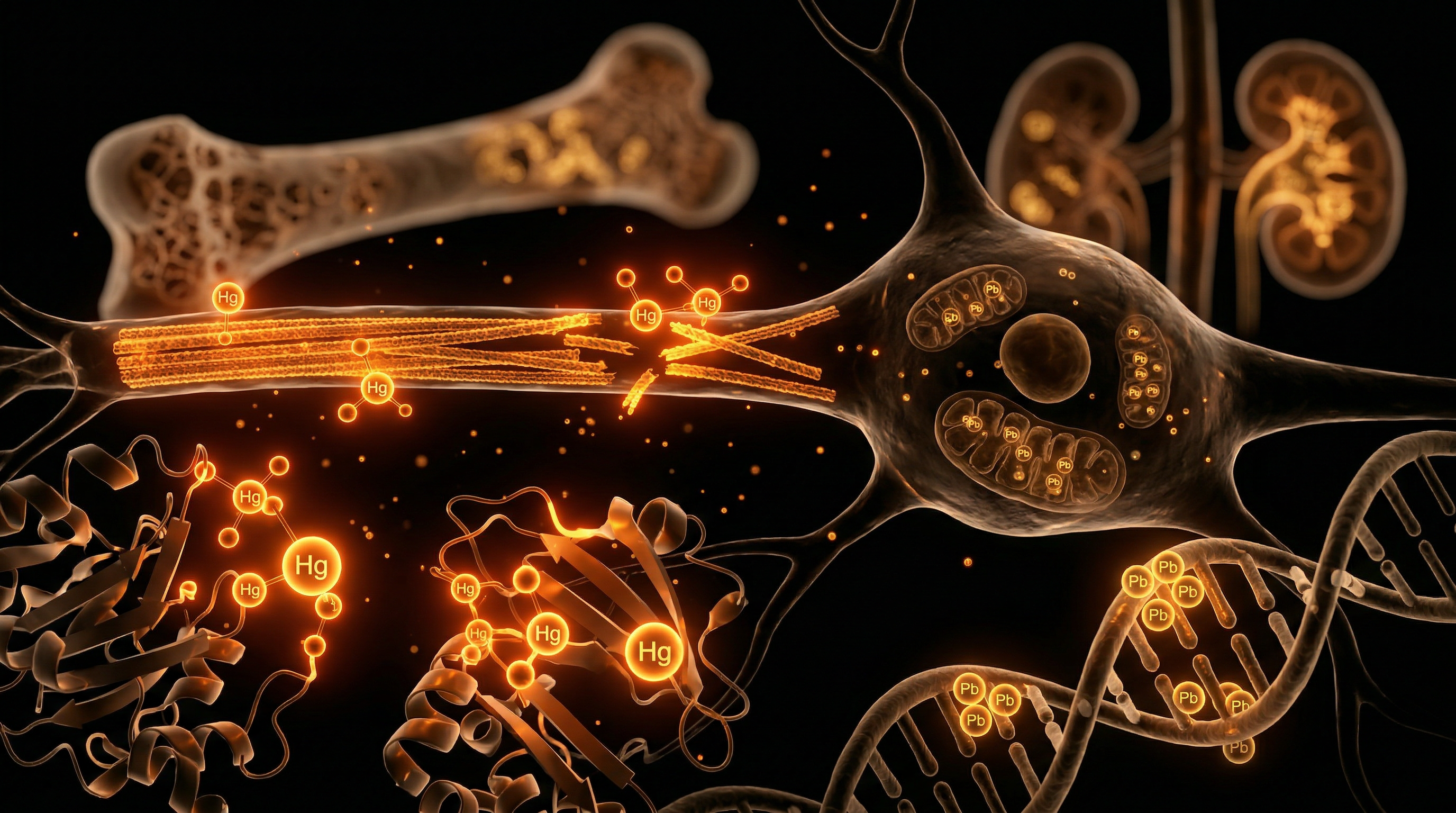
The mainstream medical consensus often operates on the "threshold model," assuming that toxicity only occurs after a specific, high-dose exposure. However, modern molecular biology reveals a more insidious reality. These metals are "metabolic mimics." They do not merely sit in the tissues; they actively displace essential minerals, hijack transport proteins, and derail enzymatic pathways. When mercury replaces selenium in a glutathione peroxidase enzyme, or lead displaces zinc in a heme-synthesizing protein, the biological engine of the human body begins to misfire. This article serves as a deep-dive analysis into the persistence of these toxins within the UK population and the biological mechanisms that allow them to dismantle our health from the inside out.
##
The Biology — How It Works
To understand why mercury and lead are so devastating, one must first understand the concept of Bioaccumulation versus Biomagnification. While biomagnification describes the increasing concentration of toxins up the food chain (e.g., methylmercury in predatory fish), bioaccumulation refers to the process by which an individual organism absorbs these substances at a rate faster than they can be excreted.
The Half-Life Fallacy
A common misconception in clinical toxicology is that the body can "clear" heavy metals within a few weeks. While this may be true for the blood compartment, the blood is merely a transit system. Heavy metals are "chameleons" that seek refuge in deep tissues to escape the body's primary filtration systems.
- Lead (Pb): Lead mimics calcium. Because of this, the body mistakenly incorporates lead into the hydroxyapatite matrix of the bones. In the blood, the half-life of lead is approximately 30 days. However, in the skeletal system, its half-life can exceed 20 to 30 years.
- Mercury (Hg): Elemental mercury vapour from dental amalgams is highly lipophilic (fat-soluble). It crosses the blood-brain barrier (BBB) with ease. Once inside the brain, it is oxidised into an ionic form ($Hg^{2+}$) which is trapped. The estimated half-life of mercury in the human brain is believed to be several decades, potentially lasting a lifetime.
Molecular Mimicry and Sequestration
The primary biological strategy for dealing with toxins is neutralisation via the liver and excretion via the kidneys or bile. However, lead and mercury have evolved (chemically speaking) to exploit the very pathways used by essential nutrients. Lead enters cells through the same channels as calcium, while mercury has an extraordinary affinity for sulphur, which is a foundational element in almost all functional proteins and enzymes.
Callout Fact: The "Body Burden" is a cumulative measurement of these metals. Research indicates that modern humans carry a lead burden 500 to 1,000 times greater than our pre-industrial ancestors.
##
Mechanisms at the Cellular Level
At the cellular level, the "Toxic Legacy" is not a blunt trauma but a sophisticated sabotage of the cell’s electronic and enzymatic machinery. The primary targets are the mitochondria and metalloenzymes.
The Displacement of Essential Cations
The most profound damage occurs through a process known as cationic substitution. Enzymes are proteins that require specific mineral co-factors to function. These minerals (zinc, selenium, magnesium, copper) fit into the enzyme like a key into a lock. Heavy metals act as "skeleton keys"—they fit into the lock but refuse to turn, effectively "plugging" the enzyme and rendering it useless.
- Lead and Zinc Displacement: Lead has a high affinity for the zinc-binding sites on proteins. One of the most critical enzymes affected is delta-aminolevulinate dehydratase (ALAD), which is essential for the synthesis of heme (the part of red blood cells that carries oxygen). When lead replaces zinc in ALAD, heme synthesis is inhibited, leading to microcytic anaemia and systemic hypoxia.
- Mercury and Selenium Antagonism: This is perhaps the most critical mechanism in modern pathology. Mercury has an affinity for selenium that is approximately one million times greater than its affinity for sulphur. Selenium is the core component of selenoproteins, such as glutathione peroxidase (GPx) and thioredoxin reductase. These enzymes are the body’s primary defence against oxidative stress. When mercury binds to selenium, it creates a "suicide complex," permanently deactivating the enzyme. This leaves the brain and other high-oxygen organs completely vulnerable to oxidative firestorms.
Mitochondrial Dysfunction
Mitochondria, the "powerhouses" of the cell, are highly sensitive to heavy metals. Mercury, in particular, binds to the inner mitochondrial membrane, disrupting the electron transport chain (ETC). By interfering with the flow of electrons, mercury causes a "leak" of reactive oxygen species (ROS). This results in a double-blow:
- Decreased ATP (energy) production, leading to chronic fatigue.
- Increased cellular damage through lipid peroxidation of the mitochondrial membrane.
The Sulfhydryl Attack
Both lead and mercury have a "thiol-seeking" nature. They bind to sulfhydryl (-SH) groups on proteins. Since sulfhydryl groups are responsible for the tertiary structure (the 3D shape) of proteins, this binding causes proteins to "misfold." In the brain, misfolded proteins are a hallmark of neurodegenerative diseases, including Alzheimer’s and Parkinson’s.
##
Environmental Threats and Biological Disruptors
The UK population faces a unique "cocktail" of exposures that stems from both historical neglect and modern industrial oversights.
The Dental Amalgam Crisis
In the UK, "silver" fillings have been the standard of care for the NHS for decades. These fillings are actually 50% elemental mercury.
- Vapour Emission: These fillings are not stable; they off-gas mercury vapour ($Hg^0$) continuously, accelerated by chewing, brushing, or consuming hot liquids.
- The British Legacy: While countries like Sweden, Norway, and Denmark have banned amalgams, the UK has been slow to move, primarily due to the astronomical cost of replacing the population's existing fillings. Millions of British citizens are walking around with "mercury pumps" in their mouths, providing a direct route for mercury vapour to enter the lungs and subsequently the brain.
Victorian Infrastructure: The Lead Pipe Problem
Despite the ban on lead piping in 1970, a significant portion of the UK’s 25 million homes still contains lead plumbing or lead solder. In soft water areas (like parts of Scotland, Wales, and Northern England), the water is more corrosive, leading to higher rates of lead leaching. While the water leaving the treatment plant may be safe, the "last mile" through domestic pipes often introduces a neurotoxic load to the household.
The Coal Legacy and the North Sea
The UK's history of coal-fired power plants has deposited tonnes of inorganic mercury into the soil and surrounding seas. Once in the aquatic environment, bacteria convert this into methylmercury, the most toxic organic form. For an island nation with a high seafood consumption rate, this remains a primary source of ongoing exposure.
Callout Fact: A study of the British "ALSPAC" cohort (Children of the 90s) found that even "low" maternal blood mercury levels, primarily from fish consumption and dental amalgams, were associated with measurable changes in the child's neurodevelopmental trajectory.
##
The Cascade: From Exposure to Disease
The clinical manifestation of heavy metal toxicity is rarely a single "disease." Instead, it is a multi-systemic cascade of dysfunction. Because these metals interfere with foundational biochemistry, they can produce symptoms in every organ system.
Neurological Decline
Mercury and lead are both potent neurotoxins, but they attack in different ways.
- Mercury inhibits the "tubulin" protein, which is essential for the structure of neurons. This causes the "neurite growth cones" to collapse, effectively stripping the brain's wiring.
- Lead interferes with NMDA receptors and neurotransmitter release (specifically glutamate and dopamine), which correlates directly with reduced IQ, increased impulsivity, and "behavioural issues" often mislabelled as ADHD in British schools.
Cardiovascular Implications
Lead is a primary driver of hypertension. By displacing calcium and magnesium in the smooth muscle cells of the blood vessels, lead causes chronic vasoconstriction. Furthermore, heavy metals induce systemic inflammation and "oxidised LDL," which accelerates the development of atherosclerosis.
Endocrine and Reproductive Disruption
The endocrine system is highly sensitive to metallic interference. Mercury is known to accumulate in the pituitary gland and the thyroid.
- In the thyroid, mercury can mimic the structure of iodine or damage the enzymes that convert T4 to the active T3 hormone.
- In reproductive health, lead and mercury are linked to reduced sperm count and motility in men, and increased miscarriage rates and "unexplained" infertility in women.
##
What the Mainstream Narrative Omits
The refusal of public health bodies to address the heavy metal burden is one of the greatest "omissions" in modern medicine. Why is this reality suppressed?
The Synergistic Toxicity Fallacy
Regulatory bodies test the safety of chemicals and metals in isolation. However, we do not live in isolation. Research (notably by Schubert et al.) has shown that while a "low" dose of mercury might kill 1% of rats, and a "low" dose of lead might kill 1%, when combined, they kill 100% of the test subjects. The UK population is exposed to a "toxic soup" of lead, mercury, aluminium, and cadmium, yet safety guidelines only account for them individually.
The Economics of Liability
If the NHS or the UK government were to admit that dental amalgams or current lead levels in water were a primary cause of chronic disease (autism, Alzheimer's, chronic fatigue), the financial liability would be trillions of pounds. It is far more "economically viable" to treat the symptoms of these diseases with pharmaceuticals than to address the source through systemic detoxification and infrastructure overhaul.
The "Reference Range" Trap
When a British GP orders a heavy metal blood test, they compare the result to a "reference range." This range is based on the average of the population—a population that is already heavily burdened. Furthermore, blood tests only show recent exposure. They do not reflect the "Body Burden" hidden in the bones, brain, or liver. A patient can have "normal" blood lead levels while their bones are saturated with it.
##
The UK Context
The UK represents a "perfect storm" for heavy metal persistence. Our geography, industrial history, and social habits create specific risk profiles.
The "Black Country" and Industrial Heartland
Regions like the West Midlands (the Black Country), South Yorkshire (Sheffield), and the North West have soil profiles heavily contaminated by 19th-century smelting and manufacturing. In these areas, the "legacy dust" in older homes and gardens is a significant source of lead exposure for toddlers.
Soft Water vs. Hard Water
There is a fascinating correlation in the UK between water hardness and cardiovascular disease. "Hard water" (found in the South East) is rich in magnesium and calcium, which act as competitive inhibitors, preventing the body from absorbing lead. "Soft water" (North and West) lacks these protective minerals, making the populations there more susceptible to the lead leaching from their own pipes.
The British Dental Tradition
The UK’s "Sugar Tax" and focus on dental health often ignore the fact that for decades, the standard response to a cavity was to drill it out and fill it with a neurotoxic material. Many older Britons have 8, 10, or even 12 amalgam fillings, representing a massive reservoir of mercury that is slowly being released into their systems every time they chew.
##
Protective Measures and Recovery Protocols
Recovery from a "Toxic Legacy" is not a quick process. It requires a strategic, scientifically-sound approach to mobilise metals from deep tissues and ensure they are safely excreted without being "re-distributed" to the brain.
Step 1: Source Removal
You cannot dry a floor while the tap is still running.
- Safe Amalgam Removal: This must be done by a "SMART" certified dentist who uses high-volume suction, rubber dams, and oxygen masks to prevent the patient from inhaling the massive burst of mercury vapour released during the drilling process.
- Water Filtration: Using high-quality "Reverse Osmosis" or specialised heavy metal filters (like Berkey with fluoride/arsenic/lead filters) is essential for every UK household.
Step 2: Mineral Repletion (The Competitive Inhibition Strategy)
Because metals displace minerals, the first line of defence is to "crowd out" the toxins.
- Selenium: Essential for neutralising mercury and restoring the function of glutathione peroxidase.
- Zinc: Competes with lead and cadmium for binding sites.
- Magnesium: Protects the calcium channels from lead entry and is vital for over 300 enzymatic reactions.
Step 3: Targeted Chelation and Binding
"Chelation" comes from the Greek word chele, meaning "claw."
- Natural Binders: Chlorella and Cilantro (coriander) are often used, but they must be used cautiously. Cilantro can mobilise mercury from the brain, but if there isn't enough chlorella in the gut to "bind" it, the mercury will simply settle elsewhere.
- Glutathione Support: Supplementing with Liposomal Glutathione or its precursor, N-Acetyl Cysteine (NAC), provides the body with the raw materials needed for the liver's Phase II detoxification.
- Sweat as an Exit Route: Infrared saunas are one of the most effective ways to excrete lead and cadmium, which are often found in higher concentrations in sweat than in urine.
Callout Fact: In the UK, the use of intravenous (IV) chelation (like EDTA or DMPS) is highly regulated and often dismissed by the mainstream, yet it remains one of the only ways to significantly reduce the skeletal lead burden.
##
Summary: Key Takeaways
The "Toxic Legacy" of mercury and lead in the UK is a silent architect of our modern health crisis. By understanding the biology of these metals, we can begin to reclaim our health.
- Persistence: Lead and mercury are not temporary visitors; they are permanent residents in the bone and brain, with half-lives spanning decades.
- Displacement: These metals do not just "sit" in the body; they displace essential zinc and selenium, effectively "turning off" the body's antioxidant and metabolic enzymes.
- Historical Burden: The UK's industrial past and continued use of dental amalgams mean that British citizens often carry a higher "Body Burden" than those in other developed nations.
- Regulatory Failure: Mainstream "safe limits" fail to account for synergistic toxicity or the long-term effects of low-level bioaccumulation.
- Recovery is Possible: Through source removal, mineral repletion, and careful detoxification, the body can be supported in unloading its toxic inheritance.
The mission of INNERSTANDING is to bring these suppressed biological truths to light. We are not merely "getting older" or "succumbing to genetics"; in many cases, we are simply struggling under the weight of a heavy metal burden that was never meant to be there. Recognising this legacy is the first step toward a cleaner, more vibrant future for the British people.
This article is provided for informational and educational purposes only. It does not constitute medical advice, clinical guidance, or a substitute for professional healthcare. Information reflects cited research at time of publication. Always consult a qualified healthcare professional before acting on any health information.
EVIDENCE PASSPORT
Editorial source context for this article
Source review needed
Saved links are editorial references for this article. They may support specific claims rather than every sentence. Open and assess each source in context. This passport does not independently verify them.
Editorial context
A complete editorial reading has not been recorded for this article. Source links remain available for you to open and assess directly.
Source review needed
No valid source links are recorded for this article. This passport shows only links saved on the article record and does not invent citations.
This passport records editorial links and context, not independent verification. Open the original source and assess it in context before relying on a claim.
Medical Disclaimer
The information in this article is for educational purposes only and does not constitute medical advice, diagnosis, or treatment. Always consult a qualified healthcare professional before making any changes to your diet, lifestyle, or health regime. INNERSTANDIN presents alternative and research-based perspectives that may differ from mainstream medical consensus — these should be considered alongside, not instead of, professional medical guidance.
Read Full DisclaimerContinue the thread
Keep this question moving.
Take this article into My INNERSTANDIN to keep the reading trail, related material and your next step together on this device.
Explore this in the Body Map
See where this hits your biology. Interactive anatomy, threats, and protective protocols.
Dig deeper in the Library
Free, longform PDF volumes that go beyond headlines into mechanisms and references.