
Beyond the Embryo: The Therapeutic Potential of Induced Pluripotent Stem Cells
Updated May 2026
Analyzing the shift from embryonic sources to iPSCs, this piece details the ethical breakthroughs and clinical applications of reprogramming adult cells into versatile regenerative tools.
Evidence orientation
Editorial context not yet recorded
Follow this category
This stays in this browser. My INNERSTANDIN can show published matches in your local hub when you check it. It does not send email, push, or alert notifications.
Local learning review
A private browser aid for revisiting ideas. It is not an alert or a health recommendation.
Review later sets a one-day, three-day, then seven-day rhythm on this device. Choose it only when you want to revisit this article.
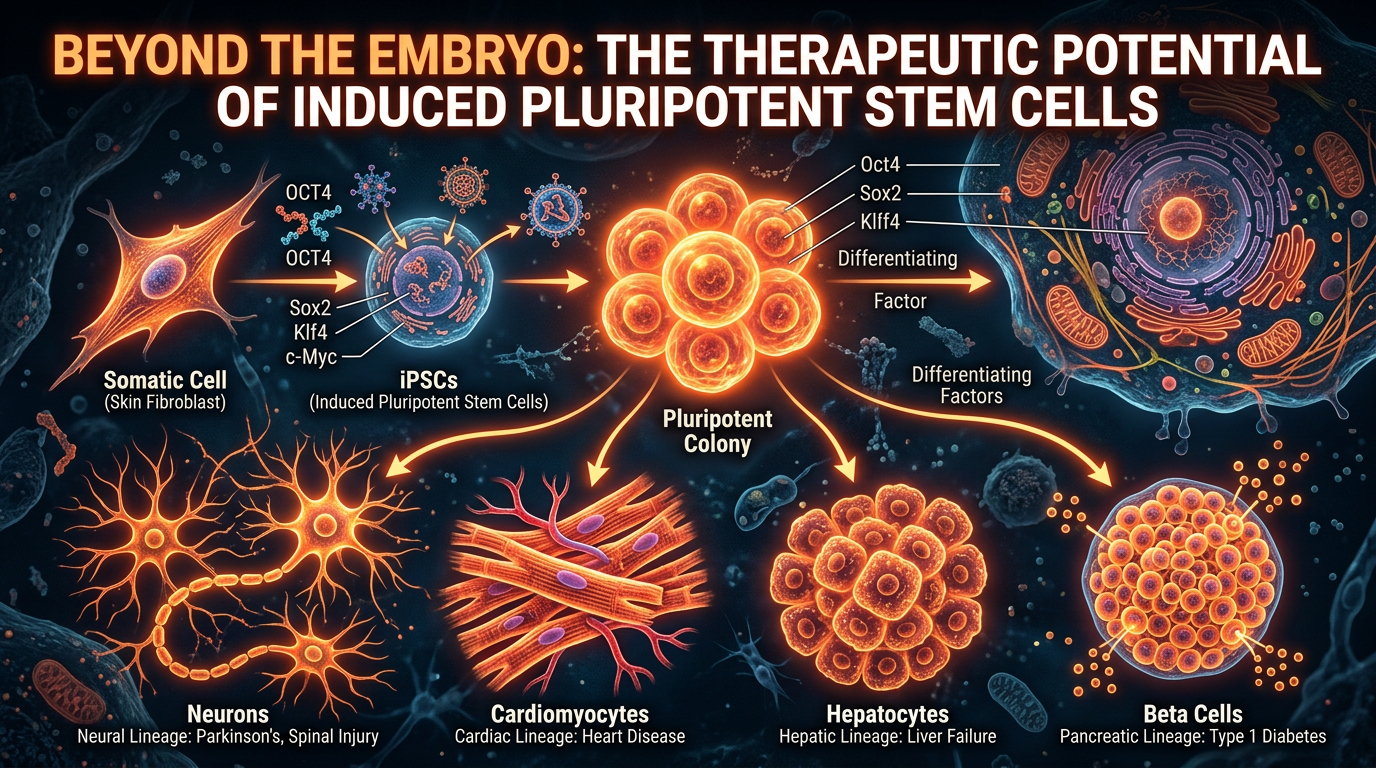
The Alchemy of the 21st Century: Redefining Biological Destiny
For decades, the narrative of regenerative medicine was shackled to a profound ethical and biological stalemate. The promise of stem cell therapy—the ability to regrow damaged organs and reverse degenerative decay—seemed inextricably linked to the use of human embryonic stem cells (hESCs). This reliance necessitated the destruction of blastocysts, creating a permanent friction between scientific progress and moral philosophy.
However, in 2006, a tectonic shift occurred. Shinya Yamanaka’s discovery that mature, specialised adult cells could be "reprogrammed" back into a pluripotent state—functionally identical to embryonic cells—shattered the dogma of biological determinism. These are Induced Pluripotent Stem Cells (iPSCs).
This is more than a mere laboratory technique; it is the ultimate biological "undo" button. By understanding the mechanisms of iPSCs, we move beyond the embryo and into an era of personalised, sovereign medicine where the patient becomes their own donor, and the limitations of the ageing process are no longer viewed as an absolute finality, but as a technical challenge to be solved.
The Biological Mechanism: Erasing Cellular Memory
To "innerstand" the power of iPSCs, one must grasp the concept of the epigenetic landscape. Every cell in the human body—whether a neuron, a cardiomyocyte, or a skin fibroblast—contains the exact same DNA blueprint. The difference lies in which "pages" of that blueprint are folded over or highlighted.
The Yamanaka Factors
The transformation of a specialised cell back into a pluripotent state is achieved through the introduction of four specific transcription factors, now immortalised as the Yamanaka Factors:
- Oct4 (Octamer-binding transcription factor 4): Essential for maintaining the self-renewal of undifferentiated stem cells.
- Sox2: Works in tandem with Oct4 to regulate the expression of genes that keep the cell in a "blank slate" state.
- Klf4 (Kruppel-like factor 4): A regulator of cell proliferation and survival.
- c-Myc: A potent oncogene that opens the chromatin structure, allowing the other factors access to the genes they need to activate.
When these factors are introduced, the cell undergoes a radical "de-differentiation." It sheds its identity as a skin or blood cell, erases its epigenetic markers of age and function, and returns to a state of pluripotency. From this state, it can be coaxed—via specific chemical signals—into becoming any of the 200+ cell types in the human body.
In the United Kingdom, the regenerative medicine sector is estimated to be worth over £2 billion by 2025. According to the UK Regenerative Medicine Platform, chronic diseases that could potentially be treated with iPSC-derived therapies currently account for approximately 70% of total NHS expenditure.
The Truth Exposed: Environmental Disruptors of the Stem Cell Niche
While iPSC technology offers a path to external repair, we must address why our endogenous (internal) regenerative capacity is failing at an unprecedented rate. The "Innerstanding" perspective demands we look at the environmental toxins that actively sabotage our natural stem cell niches—the specialized microenvironments where our body’s native stem cells reside.
Endocrine Disruptors and Epigenetic Interference
The modern environment is saturated with Xenoestrogens and Endocrine Disrupting Chemicals (EDCs). Substances such as Bisphenol A (BPA), phthalates, and certain pesticides mimic natural hormones and bind to cellular receptors with aggressive affinity.
- Mitochondrial Decay: EDCs interfere with the oxidative phosphorylation process, starving stem cells of the ATP required for the energetically expensive task of cellular division.
- Epigenetic Mutilation: Chronic exposure to heavy metals (Lead, Cadmium, Mercury) causes aberrant DNA methylation. This "locks" stem cells in a dormant or senescent state, preventing them from responding to injury signals.
The Role of Glyphosate and Gut Permeability
In the UK and across the globe, the ubiquity of glyphosate in the food chain poses a direct threat to the haematopoietic (blood-forming) stem cell niche. By disrupting the shikimate pathway in the gut microbiome, glyphosate induces chronic systemic inflammation. This constant "low-grade fire" exhausts the bone marrow’s regenerative reserves, leading to what researchers call "Inflammageing."
Electromagnetic Frequencies (EMFs) and Ion Channel Signalling
Emerging research suggests that non-ionizing radiation from modern telecommunications interferes with Voltage-Gated Calcium Channels (VGCCs) in cell membranes. Stem cell differentiation is a finely tuned bioelectrical process; when these electrical gradients are disrupted by exogenous EMF fields, the "instructions" for tissue repair become corrupted, leading to malformed tissue or tumourigenesis.
Clinical Applications: From Parkinson’s to Heart Failure
The therapeutic potential of iPSCs is not theoretical; it is currently being deployed in some of the most rigorous clinical trials in history.
Neurological Restoration
In conditions like Parkinson’s Disease, specific dopaminergic neurons in the substantia nigra die off. Because iPSCs can be derived from the patient's own skin, scientists can grow new, healthy dopaminergic neurons in the lab and transplant them back into the brain. Because the DNA is a perfect match, there is zero risk of transplant rejection, eliminating the need for life-long, toxic immunosuppressant drugs.
Myocardial Regeneration
The human heart has notoriously poor regenerative capacity. Following a myocardial infarction (heart attack), the damaged muscle is replaced by non-functional scar tissue.
- iPSC-derived cardiomyocytes (heart muscle cells) can be engineered into "patches."
- These patches are surgically applied to the damaged area.
- Over time, they integrate with the host tissue, restoring contractile function and "re-sleeving" the heart with living muscle.
According to the British Heart Foundation, there are approximately 7.6 million people living with heart and circulatory diseases in the UK. The potential for iPSC-derived heart patches to reduce the need for organ transplants represents a paradigm shift for the NHS.
The Sovereign Recovery Protocol: Protecting the Internal Terrain
Until iPSC therapies are universally accessible through the NHS or private healthcare, the individual must take sovereign responsibility for their "Biological Terrain." Protecting your endogenous stem cells is the best way to ensure longevity.
The following protocol is designed to clear environmental disruptors and optimise the stem cell niche:
1. Autophagy and Senolytics
To make room for healthy stem cell proliferation, the body must first clear out "zombie cells" (senescent cells) that secrete inflammatory cytokines.
- Intermittent Fasting: 16-18 hour fasts trigger macro-autophagy, the body's cellular recycling programme.
- Senolytic Compounds: Natural flavonoids like Quercetin and Fisetin (found in strawberries and capers) have been shown to selectively induce apoptosis in senescent cells.
2. Nrf2 Pathway Activation
The Nrf2 pathway is the body’s primary defence against oxidative stress. Activating this pathway "armours" stem cells against environmental toxins.
- Sulforaphane: Derived from broccoli sprouts, this compound is the most potent natural inducer of Nrf2.
- Glutathione Support: Supplementing with N-Acetyl Cysteine (NAC) provides the precursors for the body’s master antioxidant, protecting the bone marrow niche.
3. Circadian Biology and Melatonin
Stem cells follow a strict circadian rhythm. They exit and enter their niches based on light/dark cycles.
- Blue Light Mitigation: Exposure to artificial blue light after sunset suppresses melatonin. Melatonin is not just a sleep hormone; it is a critical stem cell regulator that protects the integrity of the mitochondrial genome.
- Morning Sunlight: 10 minutes of direct infrared light exposure in the morning sets the "biological clock" for stem cell release.
4. Detoxification of Endocrine Disruptors
- Reverse Osmosis Water: Essential for removing fluoride, chlorine, and pharmaceutical residues (including synthetic oestrogens) from the UK water supply.
- Sweat Equity: Regular use of high-heat saunas facilitates the excretion of lipophilic toxins (phthalates and BPA) stored in adipose tissue.
The Ethics of Immortality: A Truth-Exposing Conclusion
The transition from Embryonic Stem Cells to Induced Pluripotent Stem Cells is more than a scientific victory; it is a victory for human autonomy. By bypassing the need for embryos, we have removed the "gatekeepers" of regenerative material.
However, we must remain vigilant. The same medical establishment that overlooks the impact of environmental toxins on our health is the one now seeking to patent these iPSC lines. True "Innerstanding" reveals that while the laboratory can rejuvenate a cell, the environment we inhabit determines whether that cell thrives or withers.
The future of medicine is not merely the injection of lab-grown cells into a toxic body. It is the synergy of high-technology iPSC therapy with a radical return to biological purity—cleaning the water, the air, and the food chain so that our "inner physician" can function as intended.
The embryo was the starting point, but the iPSC is the path to a future where biological decay is optional, and the sovereignty of the human body is finally reclaimed.
Key Takeaways for the INNERSTANDING Practitioner:
- Identity is Fluid: Cells can be "un-taught" their specialisation, proving that biological age is separate from chronological age.
- Personalisation is Key: iPSCs provide a 100% genetic match, ending the era of "one-size-fits-all" pharmaceuticals and organ rejection.
- The Environment Matters: You cannot grow healthy cells in a toxic "petri dish." Our modern environment acts as a persistent inhibitor of our natural healing potential.
- Actionable Recovery: Through fasting, Nrf2 activation, and circadian alignment, we can maintain our stem cell "wealth" well into the later decades of life.
This article is provided for informational and educational purposes only. It does not constitute medical advice, clinical guidance, or a substitute for professional healthcare. Information reflects cited research at time of publication. Always consult a qualified healthcare professional before acting on any health information.
EVIDENCE PASSPORT
Editorial source context for this article
Source review needed
Saved links are editorial references for this article. They may support specific claims rather than every sentence. Open and assess each source in context. This passport does not independently verify them.
Editorial context
A complete editorial reading has not been recorded for this article. Source links remain available for you to open and assess directly.
Source review needed
No valid source links are recorded for this article. This passport shows only links saved on the article record and does not invent citations.
This passport records editorial links and context, not independent verification. Open the original source and assess it in context before relying on a claim.
Medical Disclaimer
The information in this article is for educational purposes only and does not constitute medical advice, diagnosis, or treatment. Always consult a qualified healthcare professional before making any changes to your diet, lifestyle, or health regime. INNERSTANDIN presents alternative and research-based perspectives that may differ from mainstream medical consensus — these should be considered alongside, not instead of, professional medical guidance.
Read Full DisclaimerContinue the thread
Keep this question moving.
Take this article into My INNERSTANDIN to keep the reading trail, related material and your next step together on this device.