
UK Sunlight Deficit: Why Red Light Therapy is a Biological Mandate
Updated May 2026
Living in high-latitude regions like the UK creates a chronic deficit of near-infrared exposure necessary for cellular repair. We examine why supplemental photobiomodulation is essential for those deprived of natural solar spectra.
Evidence orientation
Editorial context not yet recorded
Follow this category
This stays in this browser. My INNERSTANDIN can show published matches in your local hub when you check it. It does not send email, push, or alert notifications.
Local learning review
A private browser aid for revisiting ideas. It is not an alert or a health recommendation.
Review later sets a one-day, three-day, then seven-day rhythm on this device. Choose it only when you want to revisit this article.
Overview
The British Isles are currently in the midst of a silent, invisible public health crisis. It is not a viral pathogen, nor is it a nutritional deficiency in the traditional sense of caloric intake. It is a chronic state of spectroscopic deprivation. As a senior researcher for INNERSTANDING, I have spent decades observing the decoupling of human biology from the environmental signals that forged our species. In the United Kingdom, this decoupling is exacerbated by a unique confluence of high-latitude geography, persistent cloud cover, and an architectural transition to "light-starved" indoor living.
We have long known about the "Vitamin D Winter"—those months between October and April where the zenith angle of the sun is too low for UVB photons to penetrate the atmosphere and trigger cholecalciferol synthesis in the skin. However, the mainstream medical establishment has focused myopically on Vitamin D while ignoring a far more pervasive and arguably more critical deficit: the lack of Near-Infrared (NIR) and Red Light exposure.
Living in the UK is not merely a matter of enduring "grey weather." It is a state of chronic cellular malnutrition. The human organism is not a closed system; it is a photo-biological transducer. We require specific wavelengths of light to power the most fundamental regenerative processes within our mitochondria. Without these wavelengths—specifically those in the "Optical Window" (600nm to 1100nm)—the human body enters a state of metabolic "low-power mode," characterized by systemic inflammation, mitochondrial decay, and a failure of protein folding.
In this comprehensive analysis, we will explore why Red Light Therapy (RLT) and Photobiomodulation (PBM) are no longer "alternative" luxuries for the health-conscious. For those residing in the UK, they are a biological mandate—a necessary technological intervention to bridge the gap between our evolutionary requirements and our modern, light-depleted reality.
Fact: The UK receives an average of only 1,400 to 1,500 hours of sunshine per year, compared to 2,500–3,000 in Mediterranean or equatorial regions. This represents a 40-50% deficit in the total photonic energy available for biological repair.
The Biology — How It Works
To understand why red light is essential, we must first understand the solar spectrum. The sun provides a broad range of radiation, but for human health, we are primarily concerned with the balance between Ultraviolet (UV), Visible Light, and Infrared (IR).
While UV light (290nm–400nm) acts as a powerful hormonal trigger and mutagenic stressor (forcing the body to adapt and produce Vitamin D and melanin), Near-Infrared (NIR) (700nm–1400nm) acts as the body's primary restorative signal. NIR makes up over 50% of the total solar radiation that reaches the Earth's surface. Crucially, while UV is easily blocked by clouds, clothing, and glass, NIR has evolved to be the most penetrating part of the spectrum.
The Evolutionary Context
Our ancestors spent the vast majority of their daylight hours outdoors. Even in the northern latitudes, they were bathed in a constant stream of NIR from the sun, and importantly, from reflected NIR off green foliage (the "Red Edge" effect). In the evening, the primary light source was wood fire—a massive emitter of red and near-infrared wavelengths.
Modern British life has inverted this. We spend 90% of our time indoors under non-thermal artificial lighting (LEDs and Fluorescents), which are devoid of NIR. We have effectively removed the "biological buffer" that red light provides against the stressors of life.
The Optical Window
Biology has a "sweet spot" for light penetration. Wavelengths shorter than 600nm (Blue, Green, UV) are largely absorbed by melanin and haemoglobin in the upper layers of the dermis. Wavelengths longer than 1200nm are absorbed by water in the skin's surface. However, the range between 600nm and 1150nm—the Red and Near-Infrared bands—can penetrate several centimetres deep into the body, reaching muscles, nerves, and even bone. This allows these photons to interact directly with the mitochondria of deep tissues.
Mechanisms at the Cellular Level
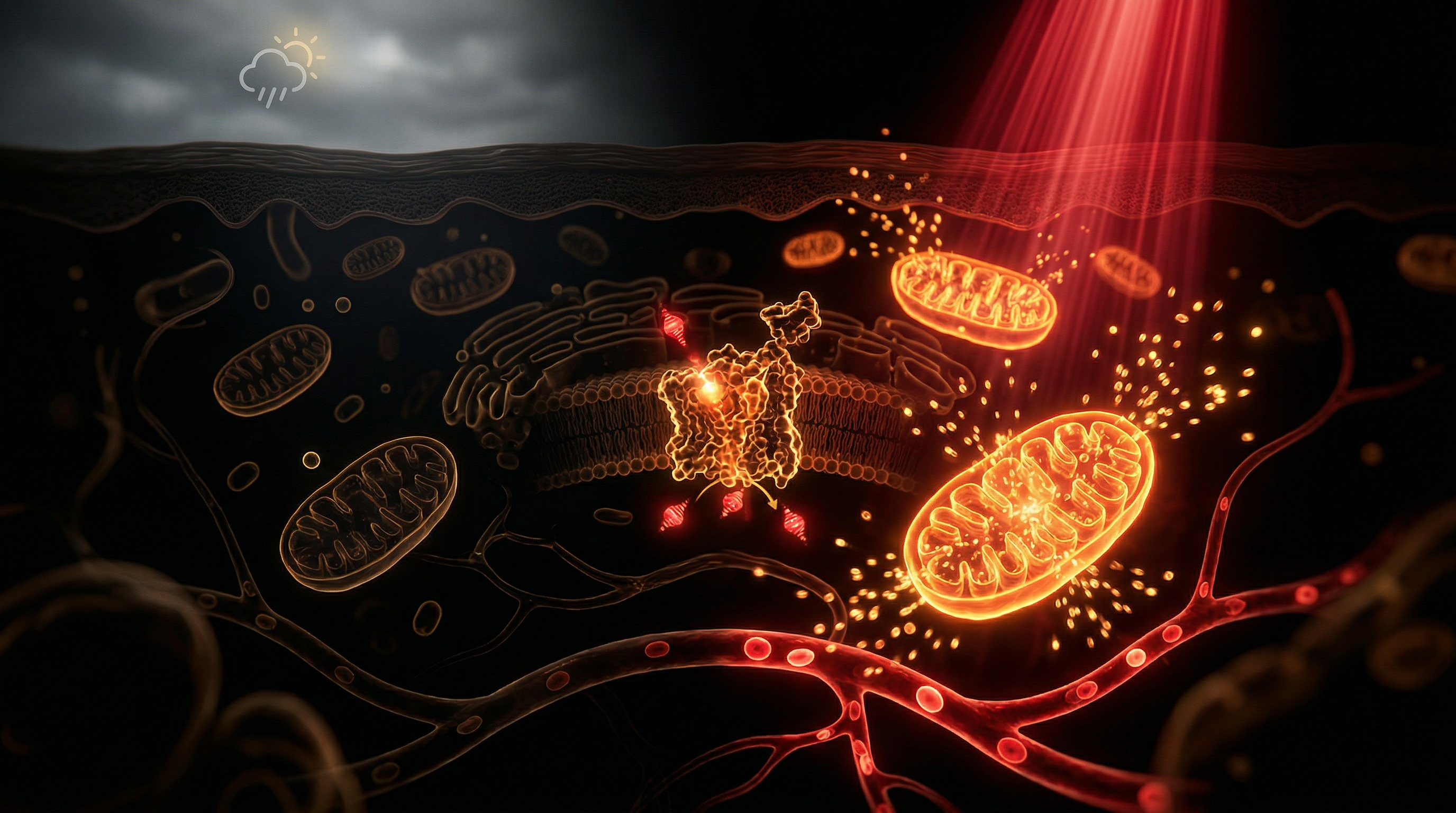
The primary target of Red Light Therapy is the Mitochondrion, specifically a protein complex called Cytochrome c Oxidase (CCO). This is the terminal enzyme in the electron transport chain, the process by which our cells convert food and oxygen into Adenosine Triphosphate (ATP), the universal energy currency of life.
The Dissociation of Nitric Oxide
When a cell is stressed—due to age, toxins, or lack of sunlight—Nitric Oxide (NO) can bind to Cytochrome c Oxidase. When NO is bound to CCO, it displaces oxygen and effectively "clogs" the respiratory chain. This slows down ATP production and increases the production of Reactive Oxygen Species (ROS), leading to oxidative stress.
When red or near-infrared photons strike the CCO enzyme, they cause the photodissociation of Nitric Oxide. This allows oxygen to return to its rightful place, restoring the flow of electrons and dramatically increasing ATP synthesis.
Important Callout: Red Light Therapy does not just "add" energy; it removes the molecular "brakes" on cellular respiration.
Structured Water and Interfacial Viscosity
Recent research, spearheaded by figures like Dr. Gerald Pollack, suggests a second, perhaps more profound mechanism. The water inside our cells is not "bulk water"; it is structured water (Exclusion Zone or EZ water). This water acts like a biological battery.
NIR light is absorbed by the water molecules surrounding the ATP synthase motor (the "rotary engine" of the mitochondrion). This absorption reduces the viscosity of the water, making it "thinner." This reduction in friction allows the ATP synthase motor to spin faster and more efficiently, increasing energy output with less effort.
Subcellular Melatonin
One of the most significant breakthroughs in photobiology is the discovery that the majority of our Melatonin is not produced in the pineal gland, but inside the mitochondria of every cell. This is "subcellular melatonin." While pineal melatonin regulates sleep-wake cycles, mitochondrial melatonin acts as the ultimate antioxidant, neutralising the oxidative damage produced during energy metabolism.
The trigger for the production of mitochondrial melatonin? Near-Infrared light. Without daily NIR exposure, our cells are unable to produce the very antioxidant they need to protect themselves from internal decay. In the grey, NIR-depleted environment of the UK, our mitochondria are effectively "naked" against oxidative stress.
Environmental Threats and Biological Disruptors
The "Sunlight Deficit" is not merely a lack of sun; it is the presence of biological junk light. Modern technology has created an environment that is profoundly toxic to our photo-biological health.
The LED Trap
Most homes and offices in the UK have transitioned to LED (Light Emitting Diode) lighting to meet energy efficiency standards. However, these bulbs are a biological disaster. Standard white LEDs are actually Blue LEDs coated with a phosphor that creates a spike in the blue spectrum to mimic white light. They contain almost zero red or near-infrared energy.
From an evolutionary perspective, blue light is always accompanied by high amounts of red/NIR in sunlight. When we isolate blue light, it becomes a "high-energy" signal to the body without the "repair" signal of red. This results in retinal damage, sleep disruption, and chronic mitochondrial strain.
The Glass Barrier
Even when the sun does shine in the UK, we are often behind windows. Modern architectural glass (Low-E glass) is designed to be thermally efficient. It specifically filters out the infrared spectrum to keep buildings cool in summer and warm in winter. While this is good for the "green" agenda, it is catastrophic for biology.
- Sunlight through glass provides the damaging effects of UVA (which penetrates glass) without the healing, reparative effects of NIR (which is blocked).
- This creates a photo-biological mismatch where the skin receives signals to age and degrade, but is denied the signals to repair and regenerate.
Screen Culture
The average UK adult spends upwards of 6 hours a day staring at digital screens. These screens emit a concentrated spike of 450nm blue light. This specific wavelength suppresses melatonin and stimulates the production of cortisol. In a country already deprived of the "resetting" signal of bright morning sunlight, this evening "blue light bombardment" locks the population into a state of permanent circadian mismatch.
The Cascade: From Exposure to Disease
What happens when a population is deprived of its primary biological fuel (NIR) for decades? We see a cascade of "diseases of civilization" that are particularly prevalent in high-latitude regions like the UK.
The Metabolic Winter
Without NIR to optimize ATP production and manage ROS, the metabolism slows down. This is not just about weight gain; it is about cellular winter. The body enters a state of conservation. This manifests as:
- Chronic Fatigue Syndrome (CFS): Mitochondria that cannot produce enough ATP to meet the demands of the central nervous system.
- Fibromyalgia: A state of chronic low-level inflammation in the fascia and muscle tissues due to poor NIR-mediated repair.
- Insulin Resistance: Mitochondrial dysfunction is the "canary in the coal mine" for Type 2 Diabetes. When mitochondria fail to process electrons efficiently, the cell begins to reject glucose.
The Neuro-Degenerative Link
The brain is the most energy-intensive organ in the body, containing thousands of mitochondria per neuron. The lack of NIR penetration through the skull (yes, NIR can penetrate the cranium) means the brain lacks its primary protective signal.
- Alzheimer’s and Parkinson’s: These are increasingly viewed as "Type 3 Diabetes" or "Mitochondrial Failure" diseases. RLT has been shown in clinical trials to reduce amyloid-beta plaques and protect dopaminergic neurons.
- SAD (Seasonal Affective Disorder): While often attributed to Vitamin D, SAD is more closely linked to the lack of bright-light-mediated serotonin production and NIR-mediated mitochondrial energy in the brain.
The "Sun-Phobia" Paradox
The UK mainstream narrative has pushed a "Stay out of the sun" message for decades to prevent skin cancer. However, by avoiding the sun entirely, the population has become more vulnerable.
Scientific Truth: Near-infrared light pre-conditions the skin (a process called photoprevention), making it more resilient to UV damage. By avoiding NIR, we have made our skin more susceptible to burning when we do finally get exposed to the sun during a rare summer day or a Mediterranean holiday.
What the Mainstream Narrative Omits
The medical-industrial complex in the UK is focused on "pharmaceutical management" rather than "environmental optimization." There are several "suppressed" or overlooked truths regarding light:
1. The Inverse Square Law of Health
Mainstream advice suggests that a 15-minute walk is enough for "Vitamin D." It fails to mention that the intensity (irradiance) of the light determines the biological response. In the UK, the solar irradiance is often so low that the "dose" of photons is below the threshold required to trigger CCO dissociation. We are "snacking" on light when our bodies require a "feast."
2. The Sunscreen Scam
Chemical sunscreens are designed to block UVB (to prevent burning). However, most do not provide full-spectrum protection, and more importantly, they discourage the very behaviour that would lead to NIR exposure. Furthermore, many chemical filters are endocrine disruptors that become more toxic when exposed to heat—ironically, the very thing they are used for.
3. The "Mitochondrial Eve" of Light
Mainstream biology textbooks still treat mitochondria as simple "batteries." They omit the fact that mitochondria are environmental sensors. They are the link between the cosmos (the sun) and our internal physiology. When the light signal is wrong, the "operating system" of the human body begins to throw errors.
The UK Context
The United Kingdom occupies a latitude of approximately 50°N to 60°N. This geographical positioning is a fundamental determinant of the "UK Health Profile."
The Rayleigh Scattering Effect
Because the sun’s rays must travel through a much thicker layer of the atmosphere to reach the UK (compared to the equator), shorter wavelengths (Blue and UV) are scattered more easily. While this makes our skies blue, it also means that for much of the year, the "biological potency" of the sun is severely diminished. However, Infrared travels through the atmosphere with less scattering. This means that even on a cloudy day in Manchester, there is NIR available—but we are rarely outside to get it, and our modern buildings block what little remains.
The "Indoor Generation" Statistics
Statistics from the UK government suggest that people spend significantly more time indoors than previous generations. The combination of:
- The UK Climate: Encourages indoor "cosiness."
- Work Culture: High density of office-based jobs in London and major hubs.
- Digital Infrastructure: One of the most "connected" (digitally) populations, leading to high screen time.
This has created a "Perfect Storm" where the British population is the most light-depleted in its history. We are living in a biological dark age.
Statistic: Over 60% of the UK population is estimated to be Vitamin D deficient in the winter. If we are that deficient in a nutrient we can test for, imagine the deficiency in Near-Infrared—a nutrient for which we have no standard blood test, but which our mitochondria require every single day.
Protective Measures and Recovery Protocols
Given the "Biological Mandate" for red light, how does the UK resident rectify this deficit? We cannot move the islands closer to the equator, but we can engage in Photobiomodulation Technology and lifestyle shifts.
1. High-Irradiance Red Light Therapy (RLT)
For those in the UK, a high-quality RLT device is not a "wellness gadget"; it is an essential prosthetic for the sun.
- Wavelength Selection: Ensure the device provides both 660nm (Red) for skin and superficial repair, and 850nm (Near-Infrared) for deep tissue, joint, and brain health.
- Irradiance Matters: A device must have a high power output (measured in mW/cm²) to ensure photons actually reach the mitochondria. Lower-power masks or "glow-lights" are often insufficient for systemic health.
- Dosing: 10–20 minutes per day, ideally in the morning to "prime" the mitochondria for the day's stressors.
2. Morning Sunlight "Banking"
Even in the UK, the morning sun (within 1 hour of sunrise) has a very high ratio of Red/NIR to Blue/UV.
- Viewing the sunrise, even on a cloudy day, sends a signal to the Suprachiasmatic Nucleus (SCN) to set the circadian clock.
- This "banks" NIR energy in the tissues, providing a protective layer against the blue light of office screens later in the day.
3. Indoor Lighting Overhaul
- Replace LEDs: Swap out "Cool White" LEDs for "Warm" versions, or better yet, use incandescent or halogen bulbs where possible. Halogen bulbs are essentially "Red Light Therapy" devices that happen to provide light, as they emit significant amounts of NIR.
- Amber Lighting: Use amber or red-tinted lighting in the evening to protect the "Circadian Window" and allow pineal melatonin to rise.
4. Nutritional Cofactors
Photobiomodulation is more effective when the body has the right building blocks.
- Chlorophyll: There is emerging evidence that humans can utilize chlorophyll metabolites to "capture" light energy, similar to plants. A diet high in dark leafy greens provides the porphyrins needed for this process.
- DHA (Omega-3): DHA, found in cold-water fish (abundant in the UK’s coastal waters), is essential for turning light into electrical signals in the brain and retina.
5. Skin Exposure
British "decency" and the cold weather mean we are often covered from head to toe. This limits light absorption to just the face and hands.
- When the temperature allows, exposing larger surface areas of skin (the torso and back) to RLT or natural sunlight is crucial. The skin is a giant solar panel; the more of it you expose, the greater the systemic "ATP boost."
Summary: Key Takeaways
The "UK Sunlight Deficit" is a profound biological mismatch that underpins much of the nation's chronic disease burden. By understanding that light is information and fuel, rather than just a way to see, we can begin to take corrective action.
- The Problem: Geography and modern living have deprived the UK population of the Red and Near-Infrared wavelengths required for mitochondrial health.
- The Mechanism: Red light dissociates Nitric Oxide from Cytochrome c Oxidase, increases ATP, reduces "EZ water" viscosity, and triggers subcellular melatonin.
- The Threat: Modern LED lighting and glass "filter" out the healing spectra, leaving us with "junk light" that causes oxidative stress and systemic inflammation.
- The Mandate: Supplemental Red Light Therapy (PBM) is a necessary biological intervention for anyone living at a high latitude.
- The Protocol: Use high-irradiance devices (660nm/850nm), maximize morning sun exposure, and replace "biological junk light" with thermal, NIR-rich sources.
We are creatures of the sun, living in a land of clouds. To thrive in the United Kingdom, we must embrace the science of photobiomodulation to reclaim our mitochondrial sovereignty. The "Grey" does not have to be our destiny; it is merely a signal that we must be more intentional about the light we choose to inhabit.
"References & Further Reading:"
- Hamblin, M. R. (2017). "Mechanisms and applications of the anti-inflammatory effects of photobiomodulation." AIMS Biophysics.
- Pollack, G. H. (2013). "The Fourth Phase of Water: Beyond Solid, Liquid, and Vapor."
- Zimmerman, S. & Reiter, R. J. (2019). "Melatonin and the Optics of the Human Body." Journal of Photochemistry and Photobiology.
- Wunsch, A. (2016). "The Blue Light Hazard and the Importance of Near-Infrared Light." Independent Research Report.
This article is provided for informational and educational purposes only. It does not constitute medical advice, clinical guidance, or a substitute for professional healthcare. Information reflects cited research at time of publication. Always consult a qualified healthcare professional before acting on any health information.
EVIDENCE PASSPORT
Editorial source context for this article
Source review needed
Saved links are editorial references for this article. They may support specific claims rather than every sentence. Open and assess each source in context. This passport does not independently verify them.
Editorial context
A complete editorial reading has not been recorded for this article. Source links remain available for you to open and assess directly.
Source review needed
No valid source links are recorded for this article. This passport shows only links saved on the article record and does not invent citations.
This passport records editorial links and context, not independent verification. Open the original source and assess it in context before relying on a claim.
Medical Disclaimer
The information in this article is for educational purposes only and does not constitute medical advice, diagnosis, or treatment. Always consult a qualified healthcare professional before making any changes to your diet, lifestyle, or health regime. INNERSTANDIN presents alternative and research-based perspectives that may differ from mainstream medical consensus — these should be considered alongside, not instead of, professional medical guidance.
Read Full DisclaimerContinue the thread
Keep this question moving.
Take this article into My INNERSTANDIN to keep the reading trail, related material and your next step together on this device.