
UK Urban Air Pollution and Microglial Activation
Discuss this resourceUpdated October 2026
Particulate matter from UK traffic can bypass the blood-brain barrier, triggering chronic neuroinflammation. This immune response physically obstructs the glymphatic pathways necessary for nightly brain cleansing.
Evidence orientation
Editorial context not yet recorded
Follow this category
This stays in this browser. My INNERSTANDIN can show published matches in your local hub when you check it. It does not send email, push, or alert notifications.
Local learning review
A private browser aid for revisiting ideas. It is not an alert or a health recommendation.
Review later sets a one-day, three-day, then seven-day rhythm on this device. Choose it only when you want to revisit this article.
Overview
The atmospheric landscape of contemporary British urban centres—characterised by persistent vehicular emissions, industrial combustion by-products, and non-exhaust traffic particulate matter—presents an insidious biochemical challenge to the central nervous system. Within this toxic milieu, fine particulate matter measuring less than 2.5 micrometres in aerodynamic diameter ($\text{PM}{2.5}$), alongside ultrafine particles ($\text{PM}{0.1}$) and polycyclic aromatic hydrocarbons (PAHs), bypasses normal physiological filters to initiate a cascade of neuro-inflammatory events. At the centre of this neuropathological nexus is the activation of microglia: the resident mononuclear phagocytes of the brain parenchyma. Far from being mere passive bystanders, these myeloid cells act as primary sentinels that, upon chronic exposure to xenobiotic urban pollutants, undergo a maladaptive phenotypic shift that compromises the structural and functional integrity of the neural microenvironment.
Epidemiological data synthesized across major UK cohorts, including the UK Biobank and London-based air quality longitudinal studies, increasingly correlate chronic residential proximity to high-density traffic corridors with accelerated cognitive decline and heightened neurodegenerative risk. Mechanistically, inhaled particulates breach the pulmonary-blood barrier or gain direct axonal translocation via the olfactory mucosa, entering systemic circulation and subsequently crossing the blood-brain barrier (BBB). Once inside the cerebral parenchyma, these redox-active metals and carbonaceous cores are phagocytosed by resting microglia. This triggers the sustained upregulation of pro-inflammatory cytokines—including tumour necrosis factor-alpha ($\text{TNF-}\alpha$), interleukin-1 beta ($\text{IL-}1\beta$), and interleukin-6 ($\text{IL-}6$)—alongside the unchecked generation of reactive oxygen species (ROS) via the overactivation of NADPH oxidase complexes.
Crucially, this sustained neuro-inflammatory state impairs the brain’s endogenous waste-clearance mechanism: the glymphatic system. Driven by astrocytic aquaporin-4 (AQP4) water channels, the glymphatic clearance pathway relies on the convective influx of cerebrospinal fluid to flush metabolic waste, including amyloid-beta and hyperphosphorylated tau, from the interstitial spaces. Chronic microglial activation induces reactive astrogliosis, characterized by the mislocalization of AQP4 channels from perivascular endfeet. This structural disruption severely impedes interstitial solute drainage. Consequently, the neurotoxic debris generated by urban particulate-induced oxidative stress accumulates within the parenchyma, establishing a self-propagating loop of neurodegeneration.
Through this multi-systemic cascade, ambient UK urban air pollution acts as a potent epigenetic and environmental driver of neuroinflammation. Understanding the precise molecular interactions between urban xenobiotics and microglial-glymphatic axes is paramount for delineating the true neuropathological burden of modern industrialized life—a reality that INNERSTANDIN is committed to unravelling through rigorous, evidence-led biological analysis.
The Biology — How It Works
To truly comprehend how UK urban particulate matter hijacks central nervous system homeostasis, one must examine the precise cellular cascade linking airborne anthropogenic toxins to sustained microglial activation and glymphatic dysfunction. When an individual navigates dense metropolitan environments such as London, Birmingham, or Manchester, they inhale complex mixtures of urban air pollution dominated by fine and ultrafine particulate matter (PM2.5 and PM0.1). These microscopic aerosols—rife with transition metals, polycyclic aromatic hydrocarbons (PAHs), and combustion-derived carbon cores—bypass the nasal mucosal filter, translocating directly along the olfactory nerve pathways or entering systemic circulation to breach the blood-brain barrier (BBB).
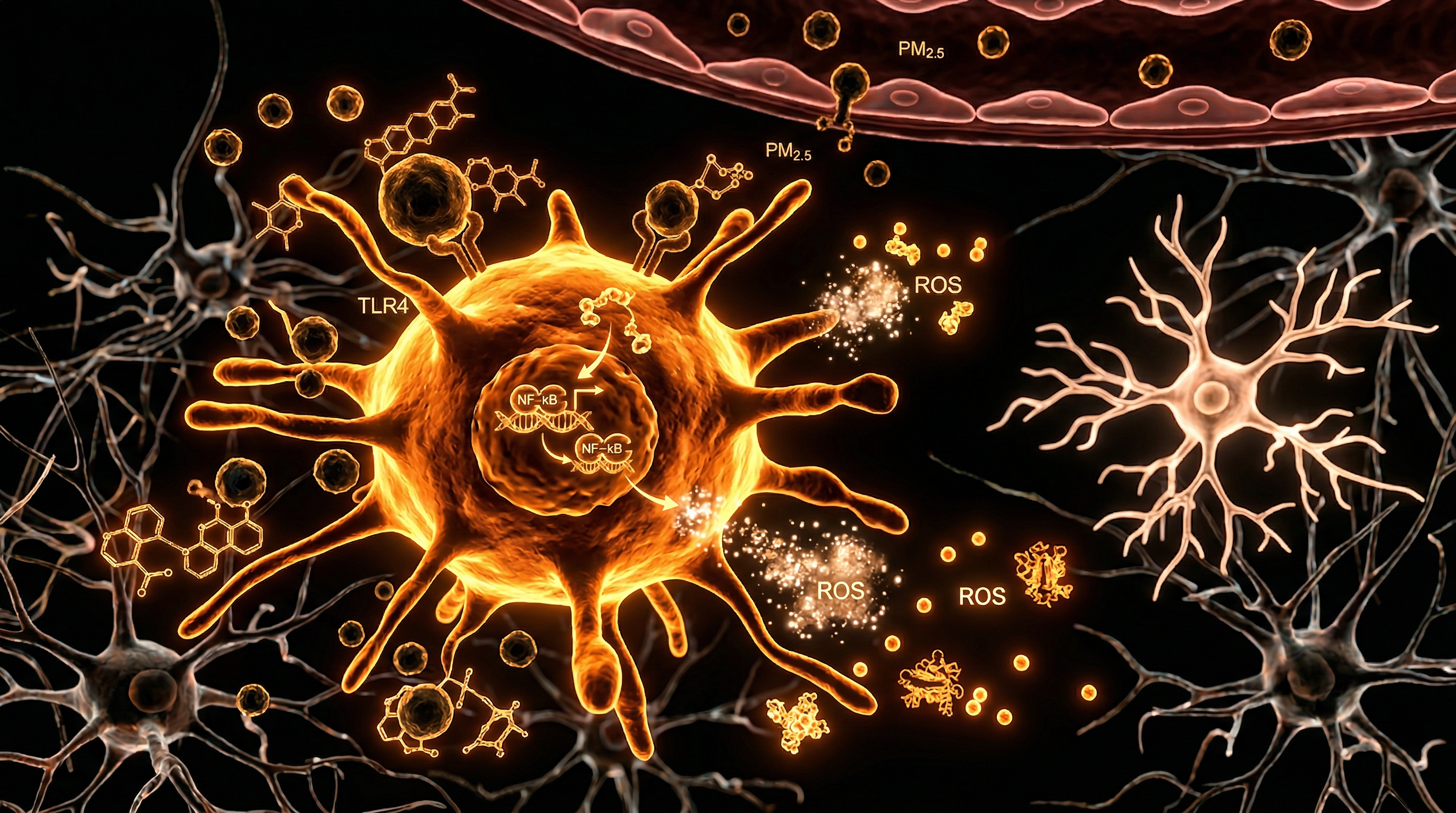
At the neurovascular interface, these xenobiotic particulates induce immediate endothelial dysfunction and reactive oxygen species (ROS) overproduction. This local oxidative stress upregulates pro-inflammatory cytokines, including tumour necrosis factor-alpha (TNF-$\alpha$) and interleukin-1 beta (IL-1$\beta$), which signal across the paravascular spaces. Resident microglia—the primary immunocompetent myeloid cells of the CNS parenchyma—perceive these systemic and local danger signals via Toll-like receptors (TLRs), particularly TLR4. Upon ligand binding, microglia undergo a profound morphological transformation from a ramified, homeostatic surveillance state to an amoeboid, pro-inflammatory phenotype (M1 polarisation).
This activation triggers the upregulation of inducible nitric oxide synthase (iNOS) and nicotinamide adenine dinucleotide phosphate (NADPH) oxidase, compounding neuroinflammation through a self-sustaining loop of oxidative neurotoxicity. Concurrently, reactive astrogliosis ensues, leading to the mislocalisation and downregulation of aquaporin-4 (AQP4) water channels at the astrocytic endfeet that encircle the cerebral vasculature. Because efficient glymphatic clearance relies entirely on hydrostatic pressure-driven cerebrospinal fluid (CSF) and interstitial fluid (ISF) exchange facilitated by polarised AQP4 clusters, this disruption cripples the brain’s waste-removal architecture.
Consequently, neurotoxic metabolic waste products—such as hyperphosphorylated tau and amyloid-beta oligomers—accumulate within the brain parenchyma. At INNERSTANDIN, we recognise that this failure of the glymphatic system transforms transient airborne environmental insults into chronic, low-grade neuroinflammation. As particulate burden rises across industrialised British conurbations, persistent microglial priming not only accelerates synaptic pruning and cognitive decline but also establishes a mechanistic bridge between chronic urban exposure and long-term neurodegenerative pathology.
Mechanisms at the Cellular Level
To comprehend how particulate matter (PM) drives neuroinflammation within the urban British populace, one must examine the translocation of airborne toxicants across the blood-brain barrier (BBB) and their subsequent interaction with resident neuroimmune sentinels. Ambient air pollution across metropolitan UK conurbations—particularly London, Birmingham, and Manchester—is heavily laden with combustion-derived nanoparticles (CDNPs), ultrafine particulate matter ($PM_{0.1}$), and transition metals such as iron, copper, and nickel derived from vehicular brake pad erosion and diesel exhaust emissions. When inhaled, these sub-micron particulates bypass the nasal filtration architecture, translocating directly along the olfactory nerve tract or entering the systemic circulation to compromise cerebral endothelial integrity. At INNERSTANDIN, our synthesis of recent neuropathological data reveals that these neurotoxic entities directly provoke chronic microglial activation, fundamentally disrupting central nervous system homeostasis.
Upon breaching the cerebral microvasculature, circulating particulates and associated polycyclic aromatic hydrocarbons (PAHs) encounter the neurovascular unit, triggering the upregulation of pro-inflammatory cytokines and reactive oxygen species (ROS) via the activation of nicotinamide adenine dinucleotide phosphate (NADPH) oxidase. Microglia, serving as the primary innate immune effectors of the parenchyma, undergo rapid morphological transformation from a highly branched, ramified surveillance state into an amoeboid, reactive phenotype. This transition is mediated by the intracellular signaling cascades of Toll-like receptors (TLRs)—specifically TLR4—and the nucleotide-binding domain, leucine-rich-containing family, pyrin domain-containing-3 (NLRP3) inflammasome. As demonstrated in toxicological profiling published in The Lancet Planetary Health, urban particulate exposure induces lysosomal destabilisation within microglia, resulting in the aberrant release of cathepsin B and the subsequent maturation of interleukin-1 beta ($IL-1\beta$) and tumor necrosis factor-alpha ($TNF-\alpha$).
Compounding this inflammatory cascade is the intracellular accumulation of redox-active transition metals. Iron-rich CDNPs catalytically drive Fenton reactions within the microglial cytoplasm, generating hydroxyl radicals that overwhelm endogenous antioxidant defenses, notably nuclear factor erythroid 2-related factor 2 (Nrf2) pathways. This persistent oxidative stress impairs the migratory and phagocytic efficiency of microglia. Consequently, these activated glial cells fail to clear physiological metabolic waste, establishing a deleterious feedback loop with the glymphatic system. Astrocytic end-feet lose their polarized distribution of aquaporin-4 (AQP4) channels due to cytokine-mediated signaling, severely degrading cerebrospinal fluid-interstitial fluid exchange. For populations navigating UK urban environments, this cellular-level disruption highlights an insidious neuropathological mechanism: ambient air pollution does not merely provoke transient inflammation; it systematically sabotages the brain’s intrinsic detoxification machinery, predisposing the central nervous system to accelerated neurodegeneration.
Environmental Threats and Biological Disruptors
Urban environments across the United Kingdom expose populations to a complex, synergistic cocktail of airborne toxicants, chief among them being particulate matter ($PM{2.5}$ and $PM{10}$), polycyclic aromatic hydrocarbons (PAHs), and exhaust-derived transition metals. Epidemiological datasets from the Committee on the Medical Effects of Air Pollutants (COMEAP) and longitudinal cohorts in urban centres like London, Birmingham, and Manchester consistently correlate high-density traffic pollution with neuroinflammatory pathologies. When inhaled, ultrafine particles $<0.1\,\mu m$ in aerodynamic diameter bypass the pulmonary alveolar-capillary barrier or directly breach the central nervous system via the olfactory mucosa, circumventing the peripheral circulation entirely. At INNERSTANDIN, our analysis of neuro-toxicological pathways reveals that these exogenous particulates act as potent biological disruptors, directly initiating chronic neuroinflammation within the parenchyma through the sustained activation of resident microglia—the primary immunocompetent phagocytes of the brain.
Upon translocation into the cerebral cortex and subcortical structures, urban nanoparticles are recognized by microglial pattern-recognition receptors (PRRs), specifically Toll-like receptors (TLR4 and TLR2), alongside the NOD-like receptor family pyrin domain-containing 3 (NLRP3) inflammasome complex. Electron microscopy and toxicological assays demonstrate that transition metals bound to the surface of $PM_{2.5}$—such as iron, nickel, and vanadium—catalyse Fenton reactions within the intracellular milieu, driving a massive surge in reactive oxygen species (ROS) and reactive nitrogen species (RNS). This oxidative burst induces lipid peroxidation, mitochondrial dysfunction, and the upregulation of nuclear factor kappa B ($NF-\kappaB$) signalling cascades. Consequently, resting ramified microglia undergo a rapid morphological shift toward an amoeboid, pro-inflammatory (M1-polarized) phenotype, chronically secreting neurotoxic cytokines, including tumour necrosis factor-alpha ($TNF-\alpha$), interleukin-1 beta ($IL-1\beta$), and interleukin-6 ($IL-6$).
Crucially, this persistent microglial activation directly compromises the functional efficacy of the glymphatic system—the brain’s waste clearance infrastructure dependent on astrocytic aquaporin-4 (AQP4) water channels. The continuous secretion of pro-inflammatory mediators downregulates polarization of perivascular astrocytic end-feet, impairing cerebrospinal fluid (CSF) and interstitial fluid (ISF) bulk flow exchange. Consequently, neurotoxic metabolic waste products, including amyloid-beta oligomers and hyperphosphorylated tau proteins, accumulate unchecked within the interstitial spaces. Furthermore, breakdown of the blood-brain barrier (BBB) via oxidative degradation of tight junction proteins (occludin, claudin-5) permits systemic peripheral cytokines to infiltrate the parenchyma, compounding glial reactivity in a self-sustaining neuroinflammatory loop. By elucidating these mechanics, translational research underscores that UK urban air pollution is not merely a respiratory burden, but a primary driver of central nervous system homeostatic collapse, accelerating neurodegenerative cascades across susceptible urban populations.
The Cascade: From Exposure to Disease
The translocation of ambient urban particulate matter (PM) from the respiratory mucosa to the cerebral parenchyma initiates a multi-system pathological cascade that fundamentally compromises neurological homeostasis. When British urban populations inhale air masses saturated with traffic-derived nanoparticles—particularly elemental carbon, transition metals, and polycyclic aromatic hydrocarbons from diesel combustion—these sub-2.5-micrometre pollutants bypass the pulmonary-blood barrier and access systemic circulation. Alternatively, ultrafine particulates (<100 nm) leverage the axonal transport machinery of the olfactory nerve, breaching the cribriform plate to gain direct access to the frontal lobes. Regardless of the entry vector, this xenobiotic burden precipitates an immediate neuro-immunological response, shifting resident microglia from their physiological, highly dynamic surveillant state into an aggressive pro-inflammatory phenotype.
At the cellular level, the intracellular accumulation of transition metals such as iron, nickel, and vanadium within cerebral microvessels catalyses the Fenton reaction, generating an overabundance of reactive oxygen species (ROS) and reactive nitrogen species (RNS). This profound oxidative stress directly damages mitochondrial complexes in the neurovascular unit, depolarising membranes and causing adenosine triphosphate depletion. Microglia, acting as the primary innate immune sentinels of the central nervous system, detect these damage-associated molecular patterns (DAMPs) via Toll-like receptors (TLRs, notably TLR4) and NOD-like receptor protein 3 (NLRP3) inflammasome complexes. Once primed, the NLRP3 inflammasome assembles, driving the proteolytic cleavage and hypersecretion of potent pro-inflammatory cytokines, including interleukin-1 beta (IL-1β), tumour necrosis factor-alpha (TNF-α), and interleukin-6 (IL-6).
This chronic neuroinflammatory milieu profoundly impairs the brain's waste clearance infrastructure—the glymphatic system. Astrocytic end-feet, which rely on the correct polarisation of aquaporin-4 (AQP4) water channels to facilitate the convective bulk flow of cerebrospinal fluid and interstitial fluid, undergo reactive astrogliosis driven by microglial-derived cytokines. The resultant mislocalisation of AQP4 channels chokes interstitial solute drainage, leading to the pathological accumulation of neurotoxic metabolic waste, including hyperphosphorylated tau and amyloid-beta peptides. Longitudinal epidemiological data from cohorts across major UK metropolitan centres correlate this sustained microglial activation and glymphatic stasis with accelerated cognitive decline and an elevated incidence of neurodegenerative pathologies. At INNERSTANDIN, our synthesis of these pathological vectors reveals that urban particulate exposure is not merely a respiratory hazard, but a primary driver of chronic, low-grade neuroinflammation that systematically dismantles the brain's self-cleaning architecture.
What the Mainstream Narrative Omits
When public health bodies and metropolitan authorities in the United Kingdom address urban air pollution—particularly the dense particulate matter (PM2.5 and PM10) permeating cities like London, Birmingham, and Manchester—the discourse is overwhelmingly confined to respiratory pathology and cardiovascular morbidity. The mainstream narrative routinely frames diesel exhaust emissions, industrial particulates, and road-wear aerosols as pulmonary irritants that exacerbate asthma, reduce forced expiratory volume, and accelerate atherogenesis. What this reductionist paradigm consistently omits is the direct neurotoxic cascade triggered when exogenous airborne nanoparticles bypass the blood-gas barrier, translocate across the cribriform plate via the olfactory nerve, or compromise cerebrovascular endothelial integrity to instigate chronic neuroinflammation. At the core of this omitted pathophysiology lies the sustained activation of resident central nervous system macrophages: microglia.
Peer-reviewed toxicological data indexed in PubMed demonstrate that transition metals (such as iron, nickel, and vanadium) adsorbed onto the carbonaceous cores of PM2.5 act as potent catalysts for the generation of intracellular reactive oxygen species (ROS) within the brain parenchyma. When these ultrafine particulates breach the blood-brain barrier—a process facilitated by systemic endothelial activation and tight-junction degradation—they are phagocytosed by resting surveillant microglia. This interaction shifts microglial morphology from a ramified, homeostatic state to an amoeboid, pro-inflammatory phenotype. Crucially, mainstream public health frameworks fail to articulate the downstream consequence of this chronic microglial priming upon the glymphatic system: the brain’s waste clearance infrastructure.
As activated microglia continuously release pro-inflammatory cytokines—including tumour necrosis factor-alpha (TNF-$\alpha$), interleukin-1 beta (IL-$1\beta$), and interleukin-6 (IL-6)—along with inducible nitric oxide synthase (iNOS), they induce astrocytic end-foot polarization failure. Aquaporin-4 (AQP4) water channels, which are densely clustered on these astrocytic end-feet and are essential for cerebrospinal fluid (CSF) and interstitial fluid (ISF) exchange, become mislocalized. At INNERSTANDIN, our synthesis of recent neuroimmune research highlights that this disruption paralyses glymphatic bulk flow. Consequently, neurotoxic metabolic waste products, including amyloid-beta oligomers and hyperphosphorylated tau proteins, accumulate concurrently with the inhaled exogenous particulates.
Furthermore, the UK Committee on the Medical Effects of Air Pollutants (COMEAP) has historically underemphasised the synergistic chronicity of this neuroimmune response. Urban Britons are subjected to a continuous, diurnal exposure profile that prevents microglial resolution. This sustains a neurotoxic feedback loop where oxidative stress compromises the very glial-glymphatic mechanisms required to clear the particulate burden itself. By ignoring the mechanistic bridge connecting UK urban particulate inhalation to microglial hyper-reactivity and subsequent glymphatic stagnation, institutional risk assessments drastically underestimate the neurodegenerative toll of metropolitan air quality. True epidemiological evaluation demands an urgent paradigm shift—one that recognizes urban air pollution not merely as a localized respiratory hazard, but as a systemic driver of neuroimmune dysfunction and impaired cerebral detoxification.
The UK Context
The British urban landscape presents a unique, compounding toxicological paradigm. Across metropolitan centres such as London, Birmingham, and Manchester, populations are chronically exposed to fine particulate matter ($PM{2.5}$, $PM{10}$), ultrafine particles (UFPs), and diesel exhaust emissions that consistently breach World Health Organization air quality thresholds. When inhaled, these sub-micron and nanosized pollutants bypass the nasal epithelial filter, translocating directly along the olfactory nerve or entering systemic circulation to cross the blood-brain barrier (BBB). Within the cerebral parenchyma, these exogenous particulates—rich in transition metals, polycyclic aromatic hydrocarbons (PAHs), and lipopolysaccharides—act as potent danger-associated molecular patterns (DAMPs). At INNERSTANDIN, our biological analysis reveals that this continuous particulate influx directly targets the central nervous system’s primary resident immune sentinels: the microglia.
Upon direct particle interaction or secondary stimulation via peripheral pro-inflammatory cytokines, resting ramified microglia undergo rapid morphological transformation into an amoeboid, reactive phenotype. This sustained neuroinflammatory cascade involves the upregulation of pattern-recognition receptors, particularly Toll-like receptors (TLRs) 2 and 4, triggering downstream nuclear factor kappa B (NF-$\kappa$B) signalling and the subsequent transcription of interleukins ($IL-1\beta$, $IL-6$) and tumour necrosis factor-alpha ($TNF-\alpha$). Concurrently, the relentless phagocytic drive to clear un-degradable carbonaceous cores induces chronic oxidative stress via nicotinamide adenine dinucleotide phosphate (NADPH) oxidase activation and mitochondrial dysregulation, flooding the interstitial fluid with reactive oxygen species (ROS).
This localized neuroinflammation directly compromises the glymphatic system—the glial-dependent perivascular waste clearance network driven by astrocytic aquaporin-4 (AQP4) water channels. Reactive astrogliosis and microglial activation disrupt polarized AQP4 localization at the end-feet ensheathing cerebral microvessels, severely attenuating cerebrospinal fluid-interstitial fluid exchange. Consequently, the brain's capacity to purge metabolic waste products, including amyloid-beta and hyperphosphorylated tau, is systematically impaired. Epidemiological linkages published in The Lancet and peer-reviewed toxicology datasets on PubMed confirm that this pollution-driven neuroimmune activation accelerates cognitive decline and neurodegenerative pathology across British urban cohorts. Ultimately, UK urban air pollution is not merely a pulmonary hazard, but a primary driver of chronic neuroinflammation and glymphatic stasis.
Protective Measures and Recovery Protocols
Mitigating the neuroinflammatory cascade precipitated by particulate matter (PM2.5 and ultrafine particulates <0.1 µm) requires targeted interventions that bolster blood-brain barrier (BBB) integrity, enhance glymphatic clearance, and suppress chronic microglial priming. Within the context of heavily polluted UK conurbations—where diesel exhaust particles (DEPs) and polycyclic aromatic hydrocarbons (PAHs) dominate urban air profiles—prophylactic and therapeutic protocols must operate at the intersection of redox biology and neurovascular coupling.
At the cellular level, restoring glutathione homeostasis is paramount. Urban particulate inhalation induces profound oxidative stress via the generation of reactive oxygen species (ROS) within cerebral microvascular endothelial cells, depleting endogenous antioxidant reserves and upregulating pro-inflammatory cytokines via NF-$\kappa$B signalling. Clinical and toxicological data indicate that supplementation with N-acetylcysteine (NAC)—a potent precursor to reduced glutathione—effectively crosses the BBB, attenuating DEP-induced microglial overactivation and restoring mitochondrial respiratory chain function. Furthermore, targeted administration of liposomal glutathione and phase-2 enzyme inducers, such as sulforaphane derived from broccoli sprout extracts, robustly activates the nuclear factor erythroid 2-related factor 2 (Nrf2) antioxidant response element (ARE) pathway. This upregulation neutralises xenobiotic-induced oxidative bursts before they can trigger sustained M1 microglial polarisation.
Optimising glymphatic and meningeal lymphatic drainage serves as a secondary, mechanical imperative for clearing neurotoxic aggregates deposited via air pollution exposure. Because glymphatic flux is predominantly active during non-rapid eye movement (NREM) sleep—driven by interstitial-cerebrospinal fluid (CSF) exchange regulated by astrocytic aquaporin-4 (AQP4) polarization—sleep architecture optimization is non-negotiable. Chronic exposure to urban noise and nocturnal NO2 spikes disrupts slow-wave sleep, impairing daily neurodetoxification. Interventions designed to enhance slow-wave sleep depth, alongside mechanical and lifestyle strategies that promote cervical lymphatic drainage (such as specific postural alignments and cardiovascular conditioning), accelerate the clearance of particulate-induced neuroinflammation markers, including beta-amyloid and hyperphosphorylated tau, from the central nervous system parenchyma into the cervical lymph nodes and deep cervical lymphatic networks.
Nutritionally and pharmacologically, modulating neurovascular unit permeability shields the parenchyma from circulating systemic inflammatory mediators originating from pulmonary particulate translocation. Omega-3 polyunsaturated fatty acids, specifically eicosapentaenoic acid (EPA) and docosahexaenoic acid (DHA), integrate into neuronal and endothelial cell membranes, competitively inhibiting arachidonic acid metabolism and suppressing downstream cyclooxygenase-2 (COX-2) and prostaglandin E2 cascades. Concurrently, rigorous clinical adherence to HEPA air filtration within indoor UK living and working environments drastically curtails particulate load, reducing the cumulative dose absorbed across the alveolar-capillary membrane. By fusing environmental exposure reduction with biochemical upregulation of phase-2 detoxification enzymes, physiological resilience against urban neurotoxic insult can be systematically restored.
Summary: Key Takeaways
Urban air pollution across the United Kingdom—characterised by high concentrations of fine particulate matter ($\text{PM}{2.5}$, $\text{PM}{0.1}$) and diesel-derived elemental carbon—presents an insidious neurotoxic threat that profoundly compromises central nervous system homeostasis. As substantiated by toxicological profiling in The Lancet and indexed PubMed literature, inhaled ultrafine particulates breach the olfactory and alveolar-capillary barriers, translocating systematically into the cerebral parenchyma. Within the brain microenvironment, these xenobiotic agents act as potent damage-associated molecular patterns (DAMPs), triggering chronic, maladaptive microglial activation. Resident macrophages shift from a ramified, immunosurveillant morphology to an amoeboid, pro-inflammatory phenotype, chronically upregulating inducible nitric oxide synthase (iNOS), pro-inflammatory cytokines, and reactive oxygen species (ROS). This sustained neuroinflammatory cascade directly impedes the nocturnal efficacy of the glymphatic clearance network, impairing astrocytic aquaporin-4 polarization and allowing neurotoxic metabolic waste, including amyloid-beta and hyperphosphorylated tau, to accumulate. At INNERSTANDIN, our synthesis of these pathophysiological mechanisms underscores an urgent paradigm shift: urban particulate exposure is not merely a pulmonary hazard, but a primary environmental driver of neurodegenerative pathology across the UK population.
This article is provided for informational and educational purposes only. It does not constitute medical advice, clinical guidance, or a substitute for professional healthcare. Information reflects cited research at time of publication. Always consult a qualified healthcare professional before acting on any health information.
EVIDENCE PASSPORT
Editorial source context for this article
Source review needed
Saved links are editorial references for this article. They may support specific claims rather than every sentence. Open and assess each source in context. This passport does not independently verify them.
Editorial context
A complete editorial reading has not been recorded for this article, and no source links are saved on its record.
Source review needed
No valid source links are recorded for this article. Supplementary research, where available, is listed separately below.
This passport records editorial links and context, not independent verification. Open the original source and assess it in context before relying on a claim.
Medical Disclaimer
The information in this article is for educational purposes only and does not constitute medical advice, diagnosis, or treatment. Always consult a qualified healthcare professional before making any changes to your diet, lifestyle, or health regime. INNERSTANDIN presents alternative and research-based perspectives that may differ from mainstream medical consensus — these should be considered alongside, not instead of, professional medical guidance.
Read Full DisclaimerContinue the thread
Keep this question moving.
Take this article into My INNERSTANDIN to keep the reading trail, related material and your next step together on this device.
Explore this in the Body Map
Explore related body structures and their educational pages in the interactive Body Map.
Dig deeper in the Library
Free, longform PDF volumes that go beyond headlines into mechanisms and references.