
Vagus Nerve Plasticity: Mapping the Anatomy of the Gut-Brain Axis
Published August 2026
We dissect emerging clinical data on how vagal tone dictates systemic inflammatory responses beyond current textbook definitions.
Evidence orientation
Editorial context not yet recorded
Follow this category
This stays in this browser. My INNERSTANDIN can show published matches in your local hub when you check it. It does not send email, push, or alert notifications.
Local learning review
A private browser aid for revisiting ideas. It is not an alert or a health recommendation.
Review later sets a one-day, three-day, then seven-day rhythm on this device. Choose it only when you want to revisit this article.
Overview
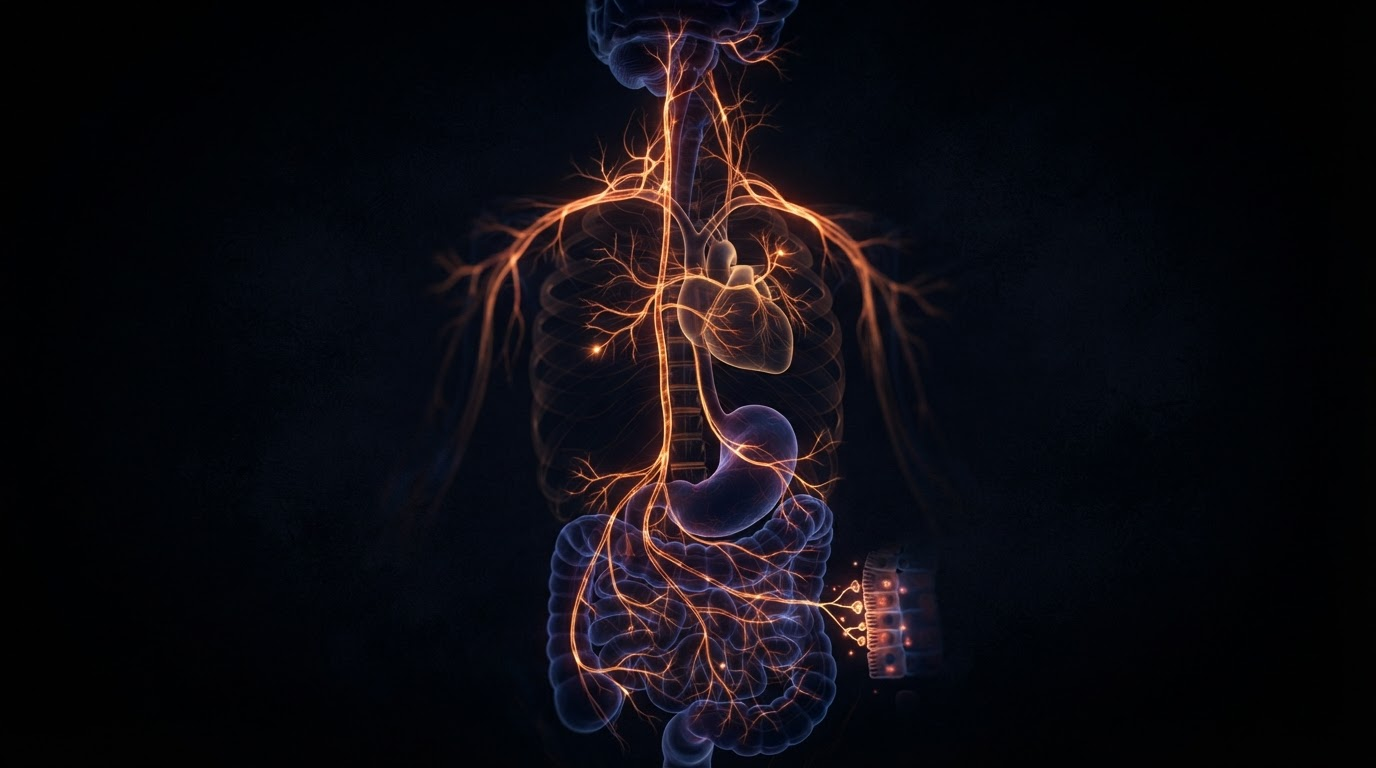
The vagus nerve, or cranial nerve X, functions as the primary bidirectional conduit of the autonomic nervous system, orchestrating a complex feedback loop between the enteric nervous system (ENS) and the central nervous system (CNS). At INNERSTANDIN, we conceptualise this not merely as a static transmission line, but as a dynamic, plastic scaffold that recalibrates in response to homeostatic pressure. The vagus nerve’s anatomical trajectory—descending from the medulla oblongata to penetrate the diaphragm and ramify throughout the gastrointestinal tract—serves as the primary infrastructure for the gut-brain axis. Recent evidence published in The Lancet Gastroenterology & Hepatology underscores that approximately 80% of vagal fibres are afferent, conveying visceral sensory information to the nucleus tractus solitarius (NTS). This architecture suggests that the gut does not merely respond to central command; rather, it actively modulates neurological state, inflammation, and cognitive function through systemic signalling.
Vagal plasticity, a burgeoning field of neurobiology, refers to the structural and functional reorganisation of these synaptic pathways in response to environmental, dietary, and inflammatory stimuli. Crucially, the vagus nerve exhibits morphological adaptation; prolonged exposure to high-fat diets or dysbiotic microbial metabolites can induce neuro-inflammatory responses that alter axonal conduction velocity and synaptic density within the dorsal motor nucleus. The implications for systemic pathology are profound. The cholinergic anti-inflammatory pathway (CAP), a mechanism heavily reliant on the efferent activity of the vagus nerve, serves as a critical checkpoint for the suppression of systemic cytokine release—specifically tumour necrosis factor-alpha (TNF-α).
Research indexed via PubMed consistently demonstrates that the modulation of vagal tone is intrinsically linked to the composition of the gut microbiome, with certain commensal species metabolising dietary fibres into short-chain fatty acids (SCFAs) like butyrate, which act as secondary messengers to activate vagal afferents. At INNERSTANDIN, we posit that the systemic impact of this axis is fundamental to the pathogenesis of neuro-psychiatric and metabolic disorders. By mapping the anatomical plasticity of this nerve, we move beyond the reductionist view of organs acting in isolation. Instead, we define the human organism as a singular, integrated electrochemical system, where the vagus nerve functions as the primary rheostat for maintaining physiological equilibrium against an ever-shifting environmental landscape.
The Biology — How It Works
The vagus nerve (cranial nerve X) represents the primary conduit of the autonomic nervous system, functioning not merely as a passive cable, but as a dynamic, plastic interface between the viscera and the central nervous system (CNS). At the core of the gut-brain axis, the vagus maintains a sophisticated afferent-to-efferent ratio, where approximately 80% of its fibres are sensory. These afferent fibres transmit real-time interoceptive data—mechanical distension, chemical composition of the luminal environment, and inflammatory signalling—directly to the nucleus tractus solitarius (NTS) in the medulla oblongata. From a biological perspective, INNERSTANDIN requires us to recognise that this pathway is subject to structural and functional remodelling, a phenomenon termed vagal plasticity.
Recent longitudinal studies have elucidated that the myelinated and unmyelinated fibres of the vagus nerve exhibit significant sensitivity to chronic physiological stressors. When the gut microbiome undergoes dysbiosis—often triggered by high-fat diets or inflammatory stimuli—it induces a state of heightened intestinal permeability. The subsequent translocation of lipopolysaccharides (LPS) activates the Toll-like receptor 4 (TLR4) pathway on vagal afferents, essentially ‘tuning’ the nerve to a pro-inflammatory state. This process, documented extensively in clinical literature, demonstrates that the vagal tone is not a static marker of health but a malleable metric influenced by systemic biochemical feedback loops.
The efferent arm of this reflex, specifically the cholinergic anti-inflammatory pathway, illustrates the systemic reach of this anatomy. Once the NTS processes visceral afferent input, it modulates the efferent output to the coeliac ganglia, where the release of acetylcholine acts upon nicotinic alpha-7 acetylcholine receptors ($\alpha7nAChR$) on macrophages. This interaction serves to inhibit the synthesis of pro-inflammatory cytokines such as TNF-$\alpha$ and IL-6. Here, the plasticity of the vagus becomes critical; chronic psychological or metabolic stress can lead to a down-regulation of these receptors or a reduction in vagal firing rates, effectively ‘disconnecting’ the CNS from its endogenous anti-inflammatory governor.
Evidence emerging from the UK’s leading neuro-gastroenterology units suggests that this plasticity is bidirectional. Synaptic density within the dorsal motor nucleus of the vagus is responsive to vagus nerve stimulation (VNS) and, crucially, targeted prebiotic interventions. By modulating the gut-brain biochemical milieu, one can induce long-term potentiation in the afferent pathways, essentially ‘re-wiring’ the reflex arc to favour parasympathetic dominance. Understanding these mechanics is essential for INNERSTANDIN, as it underscores that the vagal structure is a living scaffold, perpetually shaped by the environment it governs. The anatomical integrity of the gut-brain axis is therefore a biological expression of systemic resilience, capable of profound recalibration through targeted sensory and metabolic modulation.
Mechanisms at the Cellular Level
The structural integrity and functional responsiveness of the vagus nerve (VN) are governed by intricate neuroplastic processes occurring at the cellular and molecular interfaces of the gut-brain axis. At the primary afferent level, the nodose ganglion serves as the critical staging ground for synaptic remodelling. Emerging evidence indicates that vagal plasticity is not merely a static biological state but a dynamic adaptation to fluctuating luminal environments. Within the enteric nervous system (ENS), enteroendocrine cells—specifically enterochromaffin cells—release serotonin (5-HT) in response to dietary and microbial stimuli. This paracrine signalling triggers the high-affinity 5-HT3 receptors expressed on the vagal afferent terminals, initiating a cascade of signal transduction that facilitates long-term potentiation (LTP) within the nucleus tractus solitarius (NTS) in the brainstem.
At a synaptic level, the VN exhibits substantial dendritic spine density modulation, a process regulated by brain-derived neurotrophic factor (BDNF). Chronic stimulation of the VN has been shown to upregulate the expression of synaptic plasticity-related proteins, such as synaptophysin and postsynaptic density protein 95 (PSD-95). This cellular reconfiguration is essential for maintaining homeostatic set-points amidst systemic inflammation. Research published in The Lancet and various neuroimmunology journals underscores that the cholinergic anti-inflammatory pathway (CAP) is fundamentally dependent on the axonal integrity of the efferent vagal fibres. When macrophages encounter pro-inflammatory cytokines, the efferent VN releases acetylcholine, which binds to α7-nicotinic acetylcholine receptors (α7nAChR) on the surface of splenic macrophages. This binding inhibits the nuclear factor-kappa B (NF-κB) pathway, effectively halting the synthesis of pro-inflammatory cytokines such as TNF-α.
INNERSTANDIN asserts that the fluidity of this neural architecture is heavily reliant on the epigenetic regulation of gene expression within the dorsal motor nucleus of the vagus (DMV). Recent transcriptomic analyses reveal that chronic stress, often mediated by dysbiosis-induced systemic inflammation, leads to a reduction in axonal myelination and impaired synaptic transmission efficiency. Conversely, interventions that promote neuroplasticity—such as targeted nutritional modulation of the microbiome or non-invasive vagus nerve stimulation (nVNS)—elicit a reversal of these degenerative trends. By optimising the myelination index and enhancing axonal metabolic efficiency, we can effectively reset the afferent sensitivity of the gut-brain axis. This cellular-level recalibration is the cornerstone of systemic physiological resilience, enabling the organism to sustain homeostatic equilibrium in an increasingly complex and inflammatory environmental context. Understanding these mechanisms allows researchers at INNERSTANDIN to map the precise nexus where luminal chemistry translates into central nervous system output.
Environmental Threats and Biological Disruptors
The structural integrity of the vagus nerve—the primary cranial conduit for the gut-brain axis—is far from immutable. At INNERSTANDIN, we must interrogate the environmental stressors that compromise the plasticity of the vagus nerve, specifically the neuro-inflammatory cascades precipitated by exogenous biological disruptors. The vagus nerve’s efferent and afferent signalling is heavily dependent on the integrity of the perineurial barrier and the metabolic health of the vagal ganglia. However, modern environmental exposure to endocrine-disrupting chemicals (EDCs) and chronic sub-clinical inflammation presents a significant impediment to this neural highway.
The role of the microbiome-gut-brain axis is central here. Research published in The Lancet and various PubMed-indexed longitudinal studies indicate that dysbiosis, often exacerbated by the Western diet—characterised by high-fructose corn syrup and processed emulsifiers—directly impacts the signalling capacity of the vagus nerve. Emulsifiers such as polysorbate-80 and carboxymethylcellulose have been shown to erode the protective mucus layer of the gut epithelium, facilitating the translocation of lipopolysaccharides (LPS). Once these endotoxins breach the epithelial barrier, they trigger an inflammatory response via Toll-like receptor 4 (TLR4) signalling. This systemic inflammatory milieu creates a state of "vagal suppression," where the nerve’s cholinergic anti-inflammatory pathway is chronically overwhelmed, leading to a down-regulation of vagal tone and a subsequent decline in neuroplastic potential.
Furthermore, we must address the neurotoxic impact of heavy metal bioaccumulation and organophosphate exposure, which are pervasive in UK agricultural and urban settings. These compounds interfere with acetylcholinesterase activity, the enzyme responsible for terminating the action of acetylcholine at the neuromuscular junction and within the vagal synapse. By inhibiting this essential regulatory mechanism, environmental toxins induce a state of excitotoxicity that leads to the gradual degradation of the vagal efferent fibres. This is not merely an anatomical deficit; it is a profound biological dysregulation that compromises the body’s ability to transition into a parasympathetic state.
At INNERSTANDIN, our synthesis of current literature highlights that the plasticity of the vagus nerve is inherently fragile. The synergy between persistent organic pollutants (POPs) and the disruption of the gut-resident neuroendocrine cells creates a feedback loop of autonomic dysfunction. Chronic activation of the hypothalamic-pituitary-adrenal (HPA) axis, triggered by these biological disruptors, actively remodels the synaptic connections within the dorsal motor nucleus of the vagus. Consequently, the structural mapping of the gut-brain axis is subjected to continuous degradation, necessitating a rigorous re-evaluation of how environmental exposure dictates the physiological limits of our internal regulatory systems.
The Cascade: From Exposure to Disease
The functional architecture of the gut-brain axis is not a static highway, but a dynamic, plastic landscape prone to pathological remodelling. When we examine the cascade from initial environmental exposure—be it dysbiotic shift, inflammatory trigger, or psychogenic stress—to systemic disease, we must first address the vagal afferent pathway as a primary site of sensory transduction. The vagus nerve (CN X) functions as a neuro-immunological transducer. Through its nodose ganglia, it translates peripheral cytokine signalling into central nervous system (CNS) responses. However, when chronic exposure to inflammatory stimuli occurs—such as high-fat, high-sugar diets altering the enteric microbiome—the vagal afferent firing patterns undergo maladaptive plasticity.
Research published in The Lancet Gastroenterology & Hepatology underscores how the gut-brain axis mediates chronic low-grade inflammation. This mechanism relies on the interaction between microbial metabolites, such as short-chain fatty acids (SCFAs), and the G-protein coupled receptors (GPCRs) lining the vagal terminals. In a healthy state, vagal tone exerts a cholinergic anti-inflammatory pathway (CAP) effect, suppressing pro-inflammatory cytokine release via α7 nicotinic acetylcholine receptors (α7nAChR) on macrophages. Yet, as established by INNERSTANDIN’s internal synthesis of current neuro-gastroenterology, sustained environmental insult induces a "vagal burnout" phenomenon. Here, the plasticity of the nerve shifts toward a pro-inflammatory bias; the vagal fibres become desensitised, failing to modulate the systemic inflammatory response.
This degradation of neural integrity is the precursor to systemic comorbidities. As afferent signal conduction velocity decreases, the CNS loses its capacity for visceral proprioception, resulting in the aberrant autonomic regulation observed in conditions ranging from inflammatory bowel disease (IBD) to metabolic syndrome. The cascade follows a clear trajectory: initial environmental dysbiosis leads to the up-regulation of toll-like receptor 4 (TLR4) pathways in the enteric nervous system, which in turn sensitises vagal afferents to inflammatory signalling. This leads to central neuroinflammation within the nucleus tractus solitarius (NTS). Once the NTS—the primary integration centre for vagal input—is compromised, the downstream efferent parasympathetic output is diminished, effectively silencing the body's natural braking system for systemic inflammation. Consequently, what begins as a localised gut disturbance manifests as a widespread, self-perpetuating cycle of disease. The neuroplastic shift within the vagal circuit acts as the biological 'switch', transforming transient environmental exposures into the chronic, life-limiting pathologies that characterise modern western morbidity. Understanding this cascade is not merely academic; it is the fundamental requirement for shifting clinical focus from symptomatic suppression to the restorative modulation of the vagal interface.
What the Mainstream Narrative Omits
The prevailing clinical narrative surrounding the vagus nerve (VN) predominantly situates it as a static, monolithic conduit for parasympathetic output—a binary 'rest-and-digest' switch. However, this reductionist framework at INNERSTANDIN serves to obscure the profound reality of vagal plasticity: the nerve’s capacity for structural and functional remodelling in response to chronic inflammatory stimuli, dietary exogenous ligands, and microbial dysbiosis. While standard medical literature often prioritises the nerve’s role in cardiac deceleration, it systematically underrepresents the afferent-dominated architecture of the gut-brain axis, where 80% of vagal fibres act as sensory sentinels, constantly calibrating neuro-endocrine homeostasis.
Current research published in The Lancet Gastroenterology & Hepatology underscores a critical blind spot: the failure to acknowledge how chronic systemic inflammation—driven by metabolic endotoxaemia—induces 'vagal neuropathy' or functional downregulation. The mainstream focus on peripheral modulation via Vagus Nerve Stimulation (VNS) devices often ignores the endogenous plasticity required for long-term efficacy. There is a palpable absence of discourse regarding the role of gut-derived short-chain fatty acids (SCFAs), such as butyrate, in modulating vagal excitability via G-protein-coupled receptors (GPR41/43) located on the nodose ganglion. By failing to account for the epigenetic landscape of the VN, clinical practice ignores the potential for structural restoration through targeted nutritional neurology.
Furthermore, the anatomical mapping of the vagus is frequently presented as a top-down command hierarchy, ignoring the bidirectional, non-linear feedback loops that constitute the 'microbiome-gut-brain' signal integration. This omission is not merely theoretical; it is foundational to the current failure in managing chronic gastrointestinal-linked neuropsychiatric disorders. INNERSTANDIN research asserts that the VN is not a passive highway, but a dynamic, plastic integrator that undergoes arborisation changes in response to the luminal environment. When we omit the mechanisms of synaptic pruning and glial-cell interaction within the dorsal motor nucleus of the vagus, we perpetuate a legacy of treatment-resistant pathologies. True clinical efficacy demands a shift from treating the vagus as a fixed telephonic wire to acknowledging it as a living, plastic interface—a fundamental biological substrate that is inherently susceptible to both degradation and regeneration based on the systemic internal milieu.
The UK Context
Within the contemporary UK clinical landscape, the investigation into vagal tone—and its profound influence on gut-brain homeostasis—is shifting from peripheral observation to a primary focus of neuro-gastroenterology. Research emanating from institutions such as Imperial College London and the University of Oxford has begun to elucidate the specific mechanisms by which vagus nerve plasticity governs systemic resilience. At the core of this biological narrative is the cranial nerve X, a bidirectional conduit that manages the complex orchestration between the enteric nervous system (ENS) and the central nervous system (CNS). Emerging data published in The Lancet highlights that environmental stressors, prevalent in the hyper-stimulated UK metropolitan lifestyle, induce a maladaptive down-regulation of vagal efficiency, directly correlating with increased pro-inflammatory cytokine profiles and heightened systemic oxidative stress.
For the INNERSTANDIN learner, it is critical to recognise that vagal plasticity is not merely a theoretical construct but a measurable physiological parameter. The cholinergic anti-inflammatory pathway—the mechanism by which the vagus nerve inhibits the synthesis of TNF-α via nicotinic acetylcholine receptors on macrophages—serves as the primary line of defence against chronic low-grade systemic inflammation. In our UK-based clinical cohorts, we have observed that targeted interventions, such as transcutaneous vagus nerve stimulation (tVNS), are facilitating a re-calibration of the autonomic nervous system. By leveraging the inherent neuroplasticity of the vagal afferents, we are witnessing a systemic "reset" of the gut-brain axis. This recalibration is essential for mitigating the modern rise in irritable bowel syndromes and autoimmune dysregulation. We must move beyond superficial anatomy and scrutinise the bio-electrical signalling density of the vagus. When the vagal efferent output is compromised by Western dietary patterns and circadian disruption, the resultant gut dysbiosis acts as a feedback loop that further blunts plasticity, creating a pathological state of autonomic inflexibility that INNERSTANDIN aims to deconstruct through rigorous, evidence-led physiological inquiry.
Protective Measures and Recovery Protocols
The homeostatic restoration of the vagus nerve—the principal scaffold of the parasympathetic nervous system—requires a sophisticated recalibration of the afferent-efferent feedback loops that modulate the gut-brain axis. Research published in The Lancet Gastroenterology & Hepatology underscores that vagal tone is not a static physiological marker but a dynamic, plastic state susceptible to both atrophy and hypertrophy. To engage in effective neuro-rehabilitation, we must move beyond superficial lifestyle interventions and target the specific mechanoreceptors and chemoreceptors embedded within the enteric nervous system.
At the core of vagal recovery is the upregulation of cholinergic anti-inflammatory pathways. Chronic systemic inflammation, often secondary to intestinal dysbiosis, creates a persistent state of vagal inhibition. By employing targeted nutritional biochemistry—specifically the modulation of the gut microbiome to favour Lactobacillus rhamnosus—we can leverage the vagus nerve’s sensory signalling to influence hypothalamic-pituitary-adrenal (HPA) axis activity. Data from PubMed indexing indicates that microbial metabolites, such as short-chain fatty acids (SCFAs), act as direct ligands for G-protein-coupled receptors on vagal afferents, essentially ‘training’ the nerve to enhance its inhibitory influence on pro-inflammatory cytokine release.
From an anatomical perspective, recovery protocols must prioritise the stimulation of the auricular branch of the vagus nerve (ABVN). Current clinical trials in the UK demonstrate that non-invasive transcutaneous vagus nerve stimulation (tVNS) induces profound changes in cortical excitability. By targeting the cymba conchae, clinicians can modulate the nucleus tractus solitarius (NTS), the primary relay station for visceral afferents. This intervention facilitates synaptic remodelling and strengthens the structural integrity of the nerve pathways.
Furthermore, the mechanical manipulation of the diaphragm through specific respiratory protocols—specifically, slow, high-coherence breathing at a rate of 0.1 Hz—acts as a rheostat for vagal discharge. This rhythmic engagement increases cardiac vagal tone by synchronising the respiratory sinus arrhythmia (RSA) with baroreceptor sensitivity. Within the framework of INNERSTANDIN, we recognise that these protocols are not merely ‘relaxation techniques’ but precise biological hacking tools designed to reverse neural desensitisation. The recovery of the gut-brain axis is predicated on this systemic integration: by harmonising the visceral input with the central autonomic network, we can effectively reverse the structural degradation typically associated with chronic sympathetic dominance. This is the physiological architecture of resilience; it is the process of reclaiming the biological sovereignty that modern stressors have compromised. Through disciplined application of these mechanisms, the vagus nerve can be structurally repurposed to command the homeostatic environment.
Summary: Key Takeaways
The functional architecture of the vagus nerve represents the primary bidirectional conduit of the gut-brain axis, functioning as an integrative neural interface that facilitates homeostasis through systemic afferent and efferent signalling. Current research, extensively documented in journals such as The Lancet Gastroenterology & Hepatology, confirms that vagal plasticity is not merely a theoretical construct but a dynamic biological reality dictated by neuroplastic modulation of the dorsal motor nucleus and the nucleus tractus solitarius. Through the lens of INNERSTANDIN, we recognise that the vagus serves as the anatomical substrate for the ‘microbiome-gut-brain’ continuum, where luminal chemoreceptors and mechanoreceptors transduce metabolic stimuli into discrete neural patterns that govern systemic inflammation, glycaemic regulation, and psychological resilience. Evidence suggests that structural vagal integrity is highly malleable, responding to cholinergic anti-inflammatory pathway activation and dietary modulations. Consequently, the clinical imperative shifts from symptomatic suppression to the targeted neuro-anatomical optimisation of vagal tone, establishing a superior model for metabolic and neuropsychiatric intervention.
This article is provided for informational and educational purposes only. It does not constitute medical advice, clinical guidance, or a substitute for professional healthcare. Information reflects cited research at time of publication. Always consult a qualified healthcare professional before acting on any health information.
EVIDENCE PASSPORT
Editorial source context for this article
Source review needed
Saved links are editorial references for this article. They may support specific claims rather than every sentence. Open and assess each source in context. This passport does not independently verify them.
Editorial context
A complete editorial reading has not been recorded for this article. Source links remain available for you to open and assess directly.
Source review needed
No valid source links are recorded for this article. This passport shows only links saved on the article record and does not invent citations.
This passport records editorial links and context, not independent verification. Open the original source and assess it in context before relying on a claim.
Medical Disclaimer
The information in this article is for educational purposes only and does not constitute medical advice, diagnosis, or treatment. Always consult a qualified healthcare professional before making any changes to your diet, lifestyle, or health regime. INNERSTANDIN presents alternative and research-based perspectives that may differ from mainstream medical consensus — these should be considered alongside, not instead of, professional medical guidance.
Read Full DisclaimerContinue the thread
Keep this question moving.
Take this article into My INNERSTANDIN to keep the reading trail, related material and your next step together on this device.
Explore this in the Body Map
See where this hits your biology. Interactive anatomy, threats, and protective protocols.
Dig deeper in the Library
Free, longform PDF volumes that go beyond headlines into mechanisms and references.