
Vagus Nerve Tone: The Biological Key to Deactivating the Pain Response
Updated May 2026
A low vagal tone is associated with an inability to exit the sympathetic 'fight or flight' state, keeping pain signals active. Enhancing this parasympathetic pathway offers a biological route to systemic pain reduction without pharmaceuticals.
Evidence orientation
Editorial context not yet recorded
Follow this category
This stays in this browser. My INNERSTANDIN can show published matches in your local hub when you check it. It does not send email, push, or alert notifications.
Local learning review
A private browser aid for revisiting ideas. It is not an alert or a health recommendation.
Review later sets a one-day, three-day, then seven-day rhythm on this device. Choose it only when you want to revisit this article.
Overview
In the realm of modern clinical biology, few structures command as much systemic influence yet remain as misunderstood as the tenth cranial nerve: the Vagus Nerve. Derived from the Latin vagus, meaning "wandering," this expansive neural architecture serves as the primary conduit of the parasympathetic nervous system (PNS). It is the biological superhighway that facilitates bi-directional communication between the brainstem and the visceral organs, including the heart, lungs, and the entire digestive tract. However, its most profound—and often suppressed—function lies in its role as the master regulator of the pain response and the systemic inflammatory threshold.
For decades, the mainstream medical establishment has treated chronic pain as a localised issue or a purely psychological phenomenon. This reductionist approach has led to an over-reliance on pharmacological interventions, primarily opioids and Non-Steroidal Anti-Inflammatory Drugs (NSAIDs), which often exacerbate the underlying biological dysfunction. At INNERSTANDING, we recognise that chronic pain is frequently not a failure of the tissues, but a failure of the Vagal Tone.
Vagal tone refers to the internal biological activity of the vagus nerve. High vagal tone is synonymous with physiological resilience, emotional regulation, and the rapid deactivation of the inflammatory response. Conversely, low vagal tone—a state of "vagal withdrawal"—locks the human organism into a persistent sympathetic (fight or flight) state. In this state, the body’s "off-switch" for pain is effectively broken. This article serves as a deep-dive investigation into how the vagus nerve functions as the biological key to deactivating the pain response, and how modern environmental factors are systematically degrading this vital neural pathway.
According to data from the British Pain Society, approximately 28 million adults in the UK are living with chronic pain, a figure that represents nearly 43% of the population. This "silent epidemic" suggests a widespread failure of systemic neurological regulation across the British Isles.
##
The Biology — How It Works
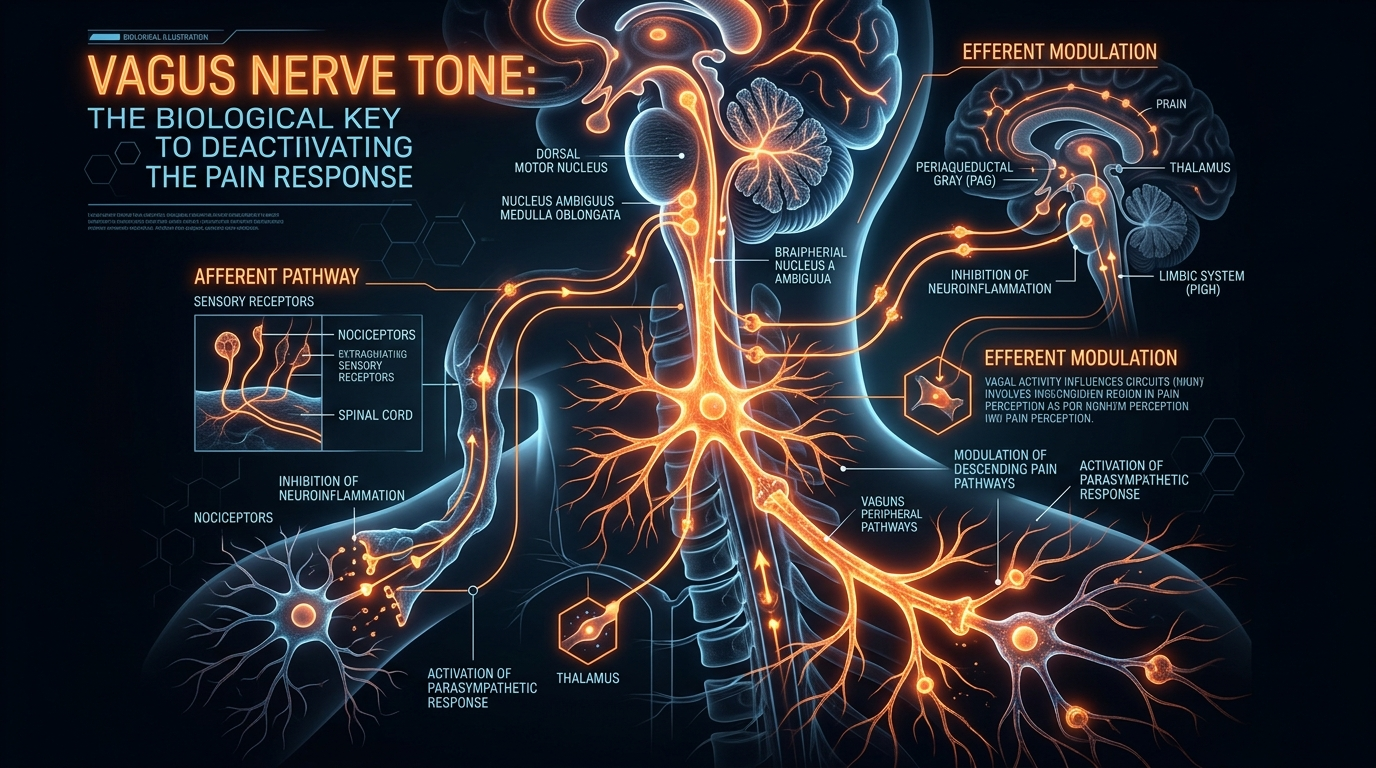
To understand how the vagus nerve modulates pain, one must first grasp its complex anatomical landscape. The vagus nerve is not a single wire but a bundle of thousands of fibres, roughly 80% of which are afferent (sensory) and 20% of which are efferent (motor). This means that the vast majority of vagal activity is dedicated to sensing the internal state of the body and reporting it back to the brain, specifically to the Nucleus Tractus Solitarius (NTS) in the medulla oblongata.
The Two Branches: Polyvagal Theory
The work of Dr. Stephen Porges and the "Polyvagal Theory" provides a critical framework for understanding how the vagus nerve dictates our survival state. The vagus is divided into two distinct circuits:
- The Ventral Vagal Complex (VVC): The myelinated "smart" vagus, unique to mammals. It facilitates social engagement, calm, and the active inhibition of the sympathetic nervous system. It is the primary driver of the "rest and digest" and "tend and befriend" responses.
- The Dorsal Vagal Complex (DVC): The unmyelinated, evolutionary ancient branch. When overwhelmed, this branch triggers "freeze" states or metabolic shutdown.
Chronic pain is often a result of a "stuck" nervous system. When the Ventral Vagal Complex loses its "brake" on the sympathetic system, the body remains in a state of high alert. This causes the HPA (Hypothalamic-Pituitary-Adrenal) axis to pump out cortisol and adrenaline continuously. While these hormones are beneficial in short bursts (escaping a predator), their chronic presence lowers the pain threshold by sensitising peripheral nociceptors (pain-sensing nerves).
The Cholinergic Anti-Inflammatory Pathway
The most significant biological mechanism linking the vagus to pain reduction is the Cholinergic Anti-Inflammatory Pathway (CAP). When the vagus nerve is stimulated, it releases the neurotransmitter acetylcholine. This is not merely a signal for the heart to slow down; it is a potent chemical signal that tells the immune system to cease the production of pro-inflammatory cytokines. In essence, the vagus nerve acts as a physical wire that allows the brain to "dial down" inflammation in real-time. Without sufficient vagal tone, the fire of inflammation burns unchecked, resulting in the systemic hyperalgesia (increased sensitivity to pain) that characterises conditions like fibromyalgia, rheumatoid arthritis, and chronic back pain.
##
Mechanisms at the Cellular Level
To truly appreciate the vagus nerve’s power, we must look beyond organ systems and into the microscopic world of cellular signaling. The interaction between the vagus nerve and the immune system occurs at a specific molecular junction: the alpha-7 nicotinic acetylcholine receptor ($\alpha$7nAChR) located on the surface of macrophages.
Macrophage Modulation
Macrophages are the "sentinels" of the immune system. When they detect tissue damage or pathogens, they release a cascade of pro-inflammatory messengers such as Tumour Necrosis Factor-alpha (TNF-$\alpha$), Interleukin-1 beta (IL-1$\beta$), and Interleukin-6 (IL-6). These molecules are the primary drivers of the pain response; they irritate nerve endings and cause the swelling and heat associated with injury.
When the vagus nerve fires, the acetylcholine it releases binds to the $\alpha$7nAChR on these macrophages. This binding triggers an intracellular signal that inhibits the translocation of NF-$\kappa$B (nuclear factor kappa-light-chain-enhancer of activated B cells) into the cell nucleus. Since NF-$\kappa$B is the "master switch" for inflammation, blocking its entry effectively prevents the cell from producing more inflammatory cytokines. This is Bio-Electronic Medicine in its purest form: a neural signal overriding a biochemical catastrophe.
Glial Cell Regulation and Central Sensitisation
In chronic pain states, the problem often migrates from the site of injury to the Central Nervous System (CNS)—a process known as Central Sensitisation. This is driven by the activation of Microglia, the resident immune cells of the brain and spinal cord.
Once activated, microglia enter a "pro-inflammatory" state, releasing substances that make the spinal cord’s pain-processing neurons hypersensitive. In this state, even a light touch can be perceived as excruciating (allodynia). High vagal tone has been shown to exert a "calming" effect on these glial cells through the same cholinergic mechanisms, effectively "resetting" the sensitivity of the spinal cord and dampening the central pain response.
Mitochondrial Efficiency
Emerging research suggests that vagal tone also influences mitochondrial function. Mitochondria are not just power plants; they are the arbiters of cell survival and death. Low vagal tone is associated with increased oxidative stress and mitochondrial dysfunction. By promoting a parasympathetic state, the vagus nerve facilitates an environment where mitochondria can produce ATP (energy) without the excessive byproduct of Reactive Oxygen Species (ROS), which further damage tissues and trigger pain signals.
##
Environmental Threats and Biological Disruptors
The modern environment is, by design or negligence, hostile to the vagus nerve. We are currently living through a period of "Vagal Erosion," where multiple environmental stressors combine to degrade our parasympathetic capacity.
Electromagnetic Fields (EMFs) and Calcium Signalling
One of the most overlooked disruptors of vagal tone is the prevalence of non-ionising radiation from 5G, Wi-Fi, and smart devices. Research into Voltage-Gated Calcium Channels (VGCCs) suggests that EMF exposure can lead to an excessive influx of calcium into cells. This intracellular calcium overload triggers a cascade of oxidative stress (peroxynitrite formation) and keeps the nervous system in a state of "perceived" threat. The vagus nerve, which relies on precise electrical signalling, becomes "noisy" and less efficient in this high-EMF environment.
The Circadian Disruption: Blue Light and Sleep
The vagus nerve operates on a circadian rhythm. It is naturally more active during the night to facilitate repair and detoxification. However, the modern obsession with artificial blue light after sunset—emitted by LED bulbs and screens—suppresses melatonin production and signals "daytime" to the brain. This keeps the sympathetic nervous system dominant 24/7, preventing the vagal "night-shift" from performing its essential duties of clearing inflammatory debris and resetting pain thresholds.
Dietary Neurotoxins and the Gut-Brain Axis
Since 80% of the vagus nerve’s fibres are afferent (sensing the gut), the state of the microbiome is perhaps the single greatest influencer of vagal tone. The consumption of ultra-processed foods, glyphosate-treated grains, and artificial sweeteners induces Intestinal Permeability (leaky gut). When the gut barrier is breached, bacterial endotoxins like Lipopolysaccharides (LPS) enter the bloodstream. The vagus nerve senses this LPS and immediately triggers a systemic inflammatory response. If the gut is perpetually inflamed, the vagus is perpetually sending "danger" signals to the brain, maintaining a state of chronic pain.
Studies indicate that the UK has the highest consumption of ultra-processed foods in Europe, with UPFs accounting for over 50% of the average British diet. This dietary landscape provides a direct biological explanation for the UK's soaring rates of chronic inflammatory pain.
##
The Cascade: From Exposure to Disease
The journey from a healthy, resilient organism to one riddled with chronic pain is a predictable biological cascade driven by the degradation of vagal tone.
- Phase 1: Vagal Withdrawal: Initial environmental or emotional stress causes a temporary drop in vagal tone. The "parasympathetic brake" is lifted, and the heart rate variability (HRV) decreases.
- Phase 2: Sympathetic Dominance: The body enters a state of chronic "high alert." Cortisol levels rise, but over time, the body becomes "cortisol resistant." The inhibitory effect of the HPA axis on inflammation fails.
- Phase 3: The Cytokine Storm: Without the Vagus Nerve's "Cholinergic Anti-Inflammatory Pathway" to regulate them, macrophages and mast cells begin overproducing TNF-$\alpha$ and IL-6. Systemic inflammation begins to rise.
- Phase 4: Peripheral Sensitisation: Pro-inflammatory cytokines bathe the peripheral nerves. The threshold for firing pain signals drops. Normal movements begin to feel "tight" or "sore."
- Phase 5: Central Sensitisation and Glial Activation: The inflammation crosses the blood-brain barrier. Microglia in the spinal cord and brain become chronically activated. The brain’s "pain map" expands. At this stage, the pain is no longer about the original injury; it is a self-sustaining loop of neurological dysfunction.
- Phase 6: Disease Manifestation: The body manifests diagnosed conditions such as Fibromyalgia, Chronic Fatigue Syndrome (ME/CFS), Complex Regional Pain Syndrome (CRPS), or chronic migraines.
##
What the Mainstream Narrative Omits
The mainstream medical narrative regarding pain is fundamentally flawed because it views the body as a collection of isolated parts rather than an integrated bio-electrical system. This omission is not merely accidental; it is a structural necessity for the current pharmaceutical model.
The Profitability of "Management" vs. "Regulation"
There is no "Vagus Nerve Pill." Because the vagus nerve is a biological system that can be modulated through breath, cold, movement, and lifestyle, it offers very little in the way of patentable revenue. The pharmaceutical industry thrives on Symptom Management—selling drugs that block pain receptors (like opioids) or inhibit enzymes (like NSAIDs)—rather than Endogenous Regulation, which empowers the body to heal itself.
The Suppression of Bio-Electronic Medicine
The field of bio-electronic medicine, which uses small electrical impulses to stimulate the vagus nerve, has shown miraculous results in treating drug-resistant depression, epilepsy, and rheumatoid arthritis. However, these treatments are often relegated to "last resort" status or are prohibitively expensive. The fact that the same results can often be achieved through manual vagal stimulation techniques is rarely discussed in GP surgeries.
The Myth of the "Psychosomatic" Label
When mainstream medicine cannot find a structural cause for pain (like a broken bone or a tumour), they frequently label the patient as "psychosomatic" or suggest it is "all in their head." This is a profound misunderstanding of the vagus nerve. While the pain is indeed being processed in the brain, it is rooted in the biological reality of low vagal tone and neuroinflammation. It is not "imaginary"; it is a systemic regulatory failure.
##
The UK Context
The United Kingdom presents a unique and troubling case study in vagal dysfunction. The combination of a high-stress economic environment, a diet rich in ultra-processed foods, and a healthcare system (the NHS) that is buckling under the weight of chronic disease has created a "perfect storm" for chronic pain.
The Opioid Legacy in the North
In regions like the North East of England and parts of Scotland, opioid prescription rates are among the highest in Europe. This has created a secondary crisis of dependency and "opioid-induced hyperalgesia," where the very drugs meant to kill pain actually make the nervous system more sensitive over time. This is a direct result of failing to address the vagal-inflammatory link.
Public Health England reported that in 2017-2018, 1 in 4 adults in England were prescribed potentially addictive medicines, including opioid pain medications and benzodiazepines. Many of these prescriptions are for chronic pain conditions that lack a structural "fix."
The Economic Burden
Chronic pain costs the UK economy an estimated £10 billion per year in lost productivity and healthcare costs. Despite this, the funding for "Pain Clinics" is often the first to be cut. Furthermore, the British weather—characterised by low sunlight levels for much of the year—contributes to widespread Vitamin D deficiency, which is a known co-factor in low vagal tone and chronic inflammation.
##
Protective Measures and Recovery Protocols
The beauty of the vagus nerve is its plasticity. Vagal tone is not a fixed trait; it is a biological "muscle" that can be strengthened. To deactivate the pain response, one must move from a state of sympathetic dominance to parasympathetic sovereignty.
1. Resonance Frequency Breathing
The most immediate way to stimulate the vagus nerve is through the breath. By slowing the breath to approximately 5.5 to 6 breaths per minute (specifically a long, slow exhalation), you activate the baroreceptors in the carotid sinus. This sends an immediate signal to the brainstem to increase vagal outflow.
- Protocol: Inhale for 4 seconds, exhale for 6 seconds. Repeat for 10 minutes, twice daily. This "coherence" breathing has been shown to increase HRV and lower systemic inflammation.
2. Cold Thermogenesis
Exposure to cold is a potent vagal stimulator. When the body is plunged into cold water, the sympathetic system initially spikes, but the subsequent "recovery" phase forces the vagus nerve to work harder to bring the heart rate back down.
- Protocol: End your morning shower with 60–90 seconds of pure cold water. Focus on the back of the neck and the chest, where vagal density is high. This "shocks" the system into a higher state of vagal tone.
3. Vagal Nerve Stimulation (VNS) Manual Techniques
- The Valsalva Manoeuvre: Moderately forceful attempted exhalation against a closed airway.
- Gargling and Singing: The vagus nerve passes through the vocal cords. Vigorous gargling with water or loud, percussive singing/chanting (like the "Om" chant) physically stimulates the nerve fibres.
- Auricular Stimulation: The cymba conchae (the hollow part of the ear just above the ear canal) is one of the few places where the vagus nerve comes close to the surface of the skin. Massaging this area or using a TENS machine with a dedicated ear clip can stimulate the auricular branch of the vagus nerve.
4. Anti-Inflammatory Nutrition and Microbiome Support
To stop the afferent "danger" signals, one must heal the gut.
- Elimination: Remove glyphosate-laden grains, seed oils (omega-6 overload), and refined sugars.
- Addition: High-quality Omega-3 fatty acids (EPA/DHA) are essential for vagal signalling. Fermented foods (sauerkraut, kefir) provide the "good" bacteria that communicate with the brain via the vagus.
- Polyphenols: Compounds found in dark berries, green tea, and cacao have been shown to enhance the cholinergic anti-inflammatory pathway.
5. Circadian Alignment and EMF Mitigation
- Darkness: Use "blue light blocking" glasses after sunset and ensure the bedroom is pitch black to allow for nocturnal vagal repair.
- Grounding: Walking barefoot on the earth (Earthing) allows for the transfer of electrons from the ground to the body, which has been shown to reduce inflammation and improve HRV.
##
Summary: Key Takeaways
The path out of chronic pain is not found in the pharmacy, but in the biological restoration of the Vagus Nerve. By understanding and applying the principles of vagal tone, we can reclaim control over our internal environment.
- The Vagus Nerve is the Body’s Off-Switch: It is the primary biological mechanism for deactivating the sympathetic "fight or flight" response and the accompanying pain signals.
- The Cholinergic Pathway: Through the release of acetylcholine, the vagus nerve directly inhibits the production of pro-inflammatory cytokines like TNF-$\alpha$, acting as a natural anti-inflammatory.
- Pain is Systemic, Not Local: Chronic pain is often a result of "Central Sensitisation," where the brain and spinal cord become hypersensitive due to low vagal tone and glial cell activation.
- Modern Life is Anti-Vagal: EMFs, blue light, ultra-processed foods, and chronic stress are systematically eroding our vagal tone, leading to the UK's chronic pain epidemic.
- Vagal Tone is Trainable: Through resonance breathing, cold exposure, auricular stimulation, and gut health, anyone can enhance their vagal tone and biologically downregulate their pain response.
In the pursuit of INNERSTANDING, we must recognise that our health is not at the mercy of "random" pain or "incurable" conditions. We are bio-electrical beings, and the vagus nerve is the master conductor of our internal symphony. To master the vagus is to master the pain response, and ultimately, to master one's own biological destiny.
This article is provided for informational and educational purposes only. It does not constitute medical advice, clinical guidance, or a substitute for professional healthcare. Information reflects cited research at time of publication. Always consult a qualified healthcare professional before acting on any health information.
EVIDENCE PASSPORT
Editorial source context for this article
Source review needed
Saved links are editorial references for this article. They may support specific claims rather than every sentence. Open and assess each source in context. This passport does not independently verify them.
Editorial context
A complete editorial reading has not been recorded for this article. Source links remain available for you to open and assess directly.
Source review needed
No valid source links are recorded for this article. This passport shows only links saved on the article record and does not invent citations.
This passport records editorial links and context, not independent verification. Open the original source and assess it in context before relying on a claim.
Medical Disclaimer
The information in this article is for educational purposes only and does not constitute medical advice, diagnosis, or treatment. Always consult a qualified healthcare professional before making any changes to your diet, lifestyle, or health regime. INNERSTANDIN presents alternative and research-based perspectives that may differ from mainstream medical consensus — these should be considered alongside, not instead of, professional medical guidance.
Read Full DisclaimerContinue the thread
Keep this question moving.
Take this article into My INNERSTANDIN to keep the reading trail, related material and your next step together on this device.
Explore this in the Body Map
See where this hits your biology. Interactive anatomy, threats, and protective protocols.
Dig deeper in the Library
Free, longform PDF volumes that go beyond headlines into mechanisms and references.