
Understanding Volatile Organic Compounds in Common Cleaners
Updated May 2026
An in-depth look at how household cleaners release VOCs into the air and their long-term health effects on indoor environments.
Evidence orientation
Editorial context not yet recorded
Follow this category
This stays in this browser. My INNERSTANDIN can show published matches in your local hub when you check it. It does not send email, push, or alert notifications.
Local learning review
A private browser aid for revisiting ideas. It is not an alert or a health recommendation.
Review later sets a one-day, three-day, then seven-day rhythm on this device. Choose it only when you want to revisit this article.
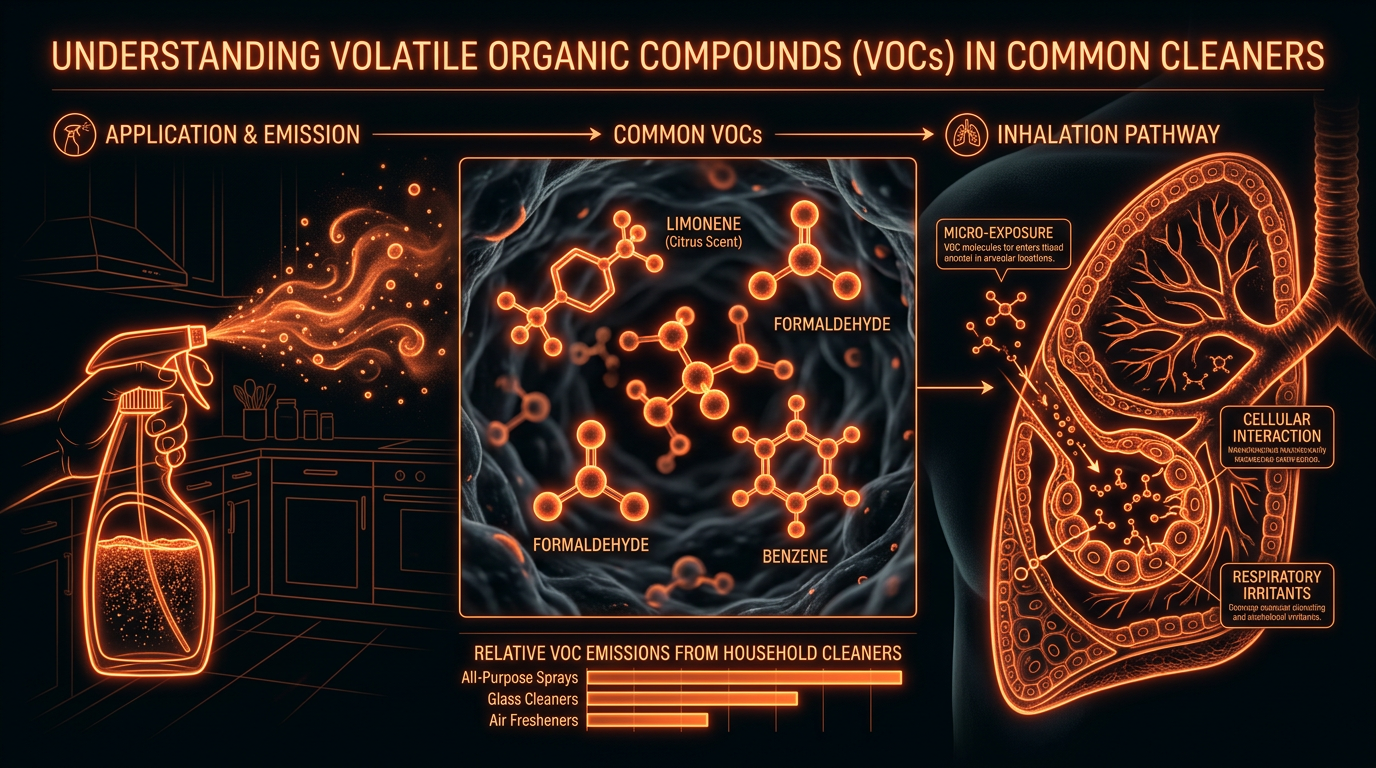
The modern obsession with sterility has birthed a paradoxical crisis. In our quest to eradicate visible pathogens and "freshen" our domestic sanctuaries, we have inadvertently transformed our homes into chemical laboratories. The primary culprits in this silent assault are Volatile Organic Compounds (VOCs)—a diverse group of carbon-based chemicals that evaporate at room temperature, permeating the air we breathe and the surfaces we touch.
For the discerning seeker of truth at INNERSTANDING, it is not enough to simply acknowledge that "chemicals are bad." We must dissect the molecular treachery at play, understand the biological pathways of degradation, and reclaim our physiological sovereignty.
The Chemistry of Deception: Defining the Invisible Threat
Volatile Organic Compounds are defined by their high vapour pressure and low water solubility. In the context of household cleaners, they are the structural backbone of solvents, degreasers, and the ubiquitous "fragrance" profiles that dominate the market.
While the industry maintains that these substances are safe in "trace amounts," the cumulative bio-burden and the synergistic effects of these chemicals tell a different story.
Common VOC Offenders in the British Household
- Formaldehyde: Often found in disinfectants and surfactants. It is a known Group 1 carcinogen that acts as a potent protein cross-linker.
- Benzene: A constituent of many solvent-based cleaners, linked to haematological malignancies and bone marrow suppression.
- Toluene: Frequently present in polish and stain removers; a notorious neurotoxin that disrupts the myelin sheath.
- Limonene and Pinene: Often marketed as "natural" citrus or pine extracts. While seemingly benign, these terpenes react with ambient ozone to produce secondary pollutants, including ultra-fine particulate matter and formaldehyde.
According to the Royal College of Physicians, indoor air pollution—of which VOCs from household products are a primary driver—is linked to approximately 9,000 deaths per year in the UK, contributing to a wider crisis of respiratory and cardiovascular disease.
Biological Mechanisms: The Molecular Siege
To understand the danger of VOCs, one must understand how they bypass the body's primary defences. Unlike larger particulates, VOCs are insidious due to their lipophilicity (fat-solubility) and their ability to enter the systemic circulation via three main routes: inhalation, dermal absorption, and ingestion of residues.
1. The Olfactory Bypass and Neurotoxicity
The olfactory system provides a direct conduit from the external environment to the brain. VOCs inhaled through the nose can bypass the Blood-Brain Barrier (BBB) via the olfactory nerve. Once inside the central nervous system, compounds like xylene and toluene disrupt the lipid bilayer of neuronal membranes. This leads to:
- Altered Signalling: Interference with GABAergic and glutamatergic neurotransmission.
- Neuroinflammation: Activation of microglia, the brain's resident immune cells, leading to chronic low-grade inflammation and cognitive "fog."
2. Mitochondrial Dysfunction and Oxidative Stress
At the cellular level, VOCs act as potent oxidants. Many of these compounds interfere with the Electron Transport Chain (ETC) within the mitochondria—the cell's power plants. When VOCs like benzene or formaldehyde are metabolised, they generate Reactive Oxygen Species (ROS).
- DNA Adducts: ROS can cause structural damage to DNA, leading to mutations.
- ATP Depletion: As mitochondrial efficiency drops, cellular repair mechanisms fail, leading to premature ageing and chronic fatigue syndromes.
3. The Endocrine Disruption Matrix
Many VOCs, particularly those used as "fixatives" in fragrances (such as phthalates), function as endocrine-disrupting chemicals (EDCs). They possess a molecular structure that mimics endogenous hormones like oestrogen.
- Receptor Competitive Inhibition: They occupy hormone receptors, sending "false signals" to the endocrine system.
- Hormonal Imbalance: This is linked to declining fertility rates in the UK, thyroid dysfunction, and the proliferation of hormone-dependent cancers.
Environmental Disruptors: The "Clean" Air Fallacy
The industry markets cleaners as a means of improving "hygiene," yet the environmental reality within the four walls of a modern British home is often more toxic than a busy London intersection.
The Secondary Pollutant Phenomenon
The most significant "truth-exposed" fact regarding VOCs is their capacity for atmospheric chemistry within the home. When you use a "lemon-scented" cleaner, you are releasing limonene. If your home has even moderate levels of ozone (which enters from outdoors), a chemical reaction occurs.
- Limonene + Ozone = Formaldehyde + Hydroxyl Radicals.
In essence, the very act of "cleaning" creates a more hazardous chemical environment than the one it sought to remediate.
Data from the UK Government’s Clean Air Strategy (2019) indicates that VOC emissions from domestic products now exceed those from vehicular exhausts in several urban categories, marking a fundamental shift in our primary sources of chemical exposure.
The Indoor Air Quality (IAQ) Trap
Modern UK building regulations prioritise "airtightness" for energy efficiency. While excellent for carbon footprints, this "sealing" effect traps VOCs inside. Without adequate Air Exchange Rates (AER), the concentration of VOCs can reach levels ten times higher than those found outdoors, creating a persistent "toxic soup."
The Regulatory Gap: Corporate Interest vs. Public Health
In the United Kingdom, the regulation of household chemicals falls under several frameworks, including REACH (Registration, Evaluation, Authorisation and Restriction of Chemicals). However, there remains a glaring loophole: the "Fragrance" exemption.
The "Parfum" Mystery
Under current labelling laws, companies are not required to disclose the specific ingredients that constitute a "fragrance" or "parfum." A single "fragrance" listing can mask a cocktail of over 200 undisclosed VOCs, many of which have never been tested for long-term human inhalation safety. This lack of transparency is a direct violation of the consumer's right to informed consent.
Recovery Protocols: Restoring Biological and Domestic Sanctity
Innerstanding requires action. To mitigate the damage of VOC exposure and restore the body's homeostatic balance, a two-pronged approach is required: environmental remediation and biological detoxification.
I. Environmental Remediation (The "Source Removal" Strategy)
The most effective way to reduce VOC load is to eliminate the source.
- The Audit: Remove all synthetic air fresheners, "plug-ins," and conventional cleaning sprays.
- Substitution: Transition to "biophilic" cleaning agents. Acetic acid (white vinegar), sodium bicarbonate, and high-quality castile soaps provide effective sanitation without the volatile load.
- Mechanical Filtration: Utilise high-efficiency particulate air (HEPA) filters combined with substantial activated carbon stages. While HEPA captures dust, only activated carbon or zeolite can adsorb molecular-level VOC gases.
- Ventilation Protocols: Implement "purge ventilation." Open windows at opposite ends of the dwelling for 15 minutes daily to flush the internal atmosphere, regardless of the season.
II. Biological Recovery (Supporting Detoxification Pathways)
If you have been exposed to high levels of VOCs, your liver's Phase I and Phase II detoxification pathways may be overburdened.
#### 1. Upregulating Glutathione Glutathione is the body’s master antioxidant and the primary conjugate for many VOCs.
- N-Acetyl Cysteine (NAC): A precursor to glutathione that helps the liver neutralise lipid-soluble toxins.
- Sulforaphane: Found in cruciferous vegetables (broccoli sprouts), this compound activates the Nrf2 pathway, enhancing the body’s natural antioxidant response.
#### 2. Supporting the Glymphatic System To clear neurotoxic VOCs from the brain, the glymphatic system (the brain's waste clearance system) must function optimally.
- Sleep Hygiene: The glymphatic system is primarily active during deep sleep.
- Hydration and Electrolytes: Adequate mineral balance is essential for the movement of cerebrospinal fluid.
#### 3. Targeted Nutrients
- Vitamin B12 and Folate: Essential for methylation, a process critical for the breakdown of chemicals like formaldehyde.
- Magnesium: Protects NMDA receptors in the brain from VOC-induced overstimulation (excitotoxicity).
The Path to Innerstanding
The presence of Volatile Organic Compounds in our homes is a symptom of a wider systemic issue: the prioritisation of convenience and profit over biological integrity. By stripping away the "fresh" scents of the chemical industry, we reveal a harsher truth—we have been breathing poison under the guise of purity.
True cleanliness is not the absence of bacteria, nor is it the presence of a synthetic floral odour. True cleanliness is an environment that supports the fundamental processes of life. It is an environment where the mitochondria can respire, the DNA can remain intact, and the nervous system can exist in a state of calm rather than chemical agitation.
Summary of Actionable Truths:
- Label Literacy: If a product contains "Parfum" or "Fragrance," it is a VOC delivery system.
- Natural Isn't Always Safe: Be wary of concentrated essential oils (terpenes) in ozone-rich environments.
- The Solution is Dilution: Increased airflow is the simplest and most effective VOC mitigator.
- Body Burden: VOCs accumulate in adipose (fat) tissue; detoxification is a marathon, not a sprint.
We must look beyond the glossy marketing of the household chemical industry. We must demand transparency. But most importantly, we must take the sovereignty of our internal and external environments back into our own hands. This is the essence of INNERSTANDING.
This article is provided for informational and educational purposes only. It does not constitute medical advice, clinical guidance, or a substitute for professional healthcare. Information reflects cited research at time of publication. Always consult a qualified healthcare professional before acting on any health information.
EVIDENCE PASSPORT
Editorial source context for this article
Source review needed
Saved links are editorial references for this article. They may support specific claims rather than every sentence. Open and assess each source in context. This passport does not independently verify them.
Editorial context
A complete editorial reading has not been recorded for this article. Source links remain available for you to open and assess directly.
Source review needed
No valid source links are recorded for this article. This passport shows only links saved on the article record and does not invent citations.
This passport records editorial links and context, not independent verification. Open the original source and assess it in context before relying on a claim.
Medical Disclaimer
The information in this article is for educational purposes only and does not constitute medical advice, diagnosis, or treatment. Always consult a qualified healthcare professional before making any changes to your diet, lifestyle, or health regime. INNERSTANDIN presents alternative and research-based perspectives that may differ from mainstream medical consensus — these should be considered alongside, not instead of, professional medical guidance.
Read Full DisclaimerContinue the thread
Keep this question moving.
Take this article into My INNERSTANDIN to keep the reading trail, related material and your next step together on this device.
Dig deeper in the Library
Free, longform PDF volumes that go beyond headlines into mechanisms and references.