
Adaptogens and HPA Axis Regulation in Modern Environments
Updated May 2026
Examine how Ayurvedic and TCM herbs modulate the cortisol response in the high-stress UK corporate landscape. This study highlights the biological pathways of herbal resilience versus synthetic stimulants.
Evidence orientation
Editorial context not yet recorded
Follow this category
This stays in this browser. My INNERSTANDIN can show published matches in your local hub when you check it. It does not send email, push, or alert notifications.
Local learning review
A private browser aid for revisiting ideas. It is not an alert or a health recommendation.
Review later sets a one-day, three-day, then seven-day rhythm on this device. Choose it only when you want to revisit this article.
Overview
In the hyper-accelerated epoch of the twenty-first century, the human biological blueprint is facing an unprecedented existential challenge. Our physiological systems, honed over millennia for acute survival—the "fight or flight" response—are now being bombarded by a relentless, non-linear stream of digital, chemical, and psychological stimuli. This is nowhere more apparent than in the high-pressure corporate environments of the United Kingdom, where "hustle culture" and the "always-on" digital leash have pushed the Hypothalamic-Pituitary-Adrenal (HPA) Axis to its breaking point.
As a senior researcher at INNERSTANDING, my objective is to dissect the bridge between ancient botanical intelligence and modern endocrinology. For centuries, the systems of Ayurveda and Traditional Chinese Medicine (TCM) have utilised a unique class of pharmacological agents known as Adaptogens. These are not merely "herbs"; they are sophisticated metabolic regulators that increase the state of non-specific resistance in the face of stress.
While mainstream Western medicine often seeks to suppress symptoms through synthetic blockade—using beta-blockers or SSRIs to manage the fallout of chronic stress—the adaptogenic paradigm focuses on the biochemical recalibration of the stress response itself. This article explores how these ancient remedies interact with our modern biology to provide a shield against the corrosive effects of chronic cortisol elevation, offering a path toward resilience that synthetic stimulants can never replicate.
Key Fact: The term "Adaptogen" was first coined in 1947 by Soviet toxicologist Nikolai Lazarev to describe substances that could increase resistance to stressors without disturbing normal physiological functions.
The Biology — How It Works
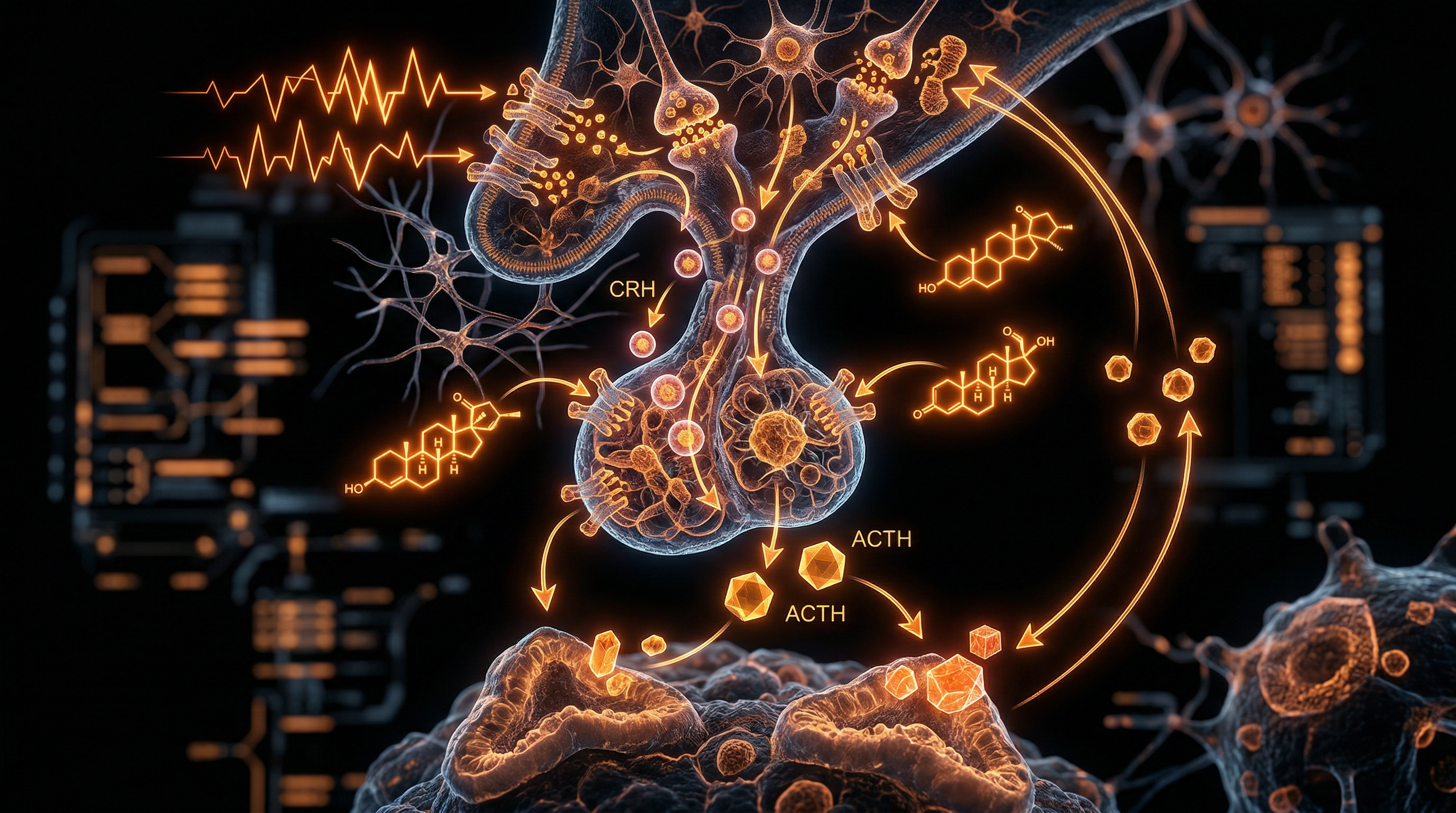
To understand the efficacy of adaptogens, one must first comprehend the architecture of the human stress response. The HPA axis is our central command centre for adaptation. When the brain perceives a threat—be it a predatory animal or an urgent 11:00 PM email from a supervisor—the Hypothalamus secretes Corticotropin-Releasing Hormone (CRH).
The Neuroendocrine Relay
This hormone signals the Anterior Pituitary Gland to release Adrenocorticotropic Hormone (ACTH) into the bloodstream. ACTH then migrates to the adrenal cortex, triggering the synthesis and secretion of Glucocorticoids, primarily Cortisol.
In a healthy, ancestral environment, this cascade is self-limiting. High levels of circulating cortisol provide negative feedback to the hypothalamus and pituitary, effectively "turning off" the stress response once the threat has passed. However, in the modern landscape, the "off switch" has become jammed.
The Allostatic Load
The cumulative wear and tear on the body due to chronic over-activation of these systems is known as Allostatic Load. When the HPA axis is perpetually engaged, the body enters a state of cortisol resistance. Similar to insulin resistance, the cellular receptors for cortisol become desensitised. The brain, sensing a lack of response, pumps out even more CRH and ACTH, creating a toxic loop of neuro-inflammation and metabolic exhaustion.
Adaptogens function as eustressors—mild stressors that prime the system. They act as "thermostats" for the HPA axis. If cortisol is too high, adaptogens work to down-regulate the adrenal output; if cortisol is too low (as seen in advanced stages of burnout), they provide a gentle upward titration, ensuring the body remains in the "Goldilocks zone" of optimal arousal.
Mechanisms at the Cellular Level
The sophistication of adaptogens lies in their multi-target approach. Unlike pharmaceutical drugs, which typically operate via "lock and key" single-receptor inhibition, adaptogens like Withania somnifera (Ashwagandha) and Rhodiola rosea influence the body at the molecular and epigenetic levels.
Molecular Chaperones and HSP70
One of the most profound mechanisms identified in recent research is the induction of Heat Shock Proteins (HSP70). These are molecular chaperones that prevent the misfolding of proteins during cellular stress. Adaptogens significantly increase the expression of HSP70, which protects cells from thermal, oxidative, and chemical damage. By enhancing the cell’s internal repair machinery, adaptogens allow the organism to survive higher levels of stress without incurring permanent cellular "scars."
The FoxO Transcription Factors
Adaptogens have been shown to modulate FoxO transcription factors, which play a critical role in longevity and stress resistance. These factors regulate genes involved in DNA repair, cell cycle control, and apoptosis (programmed cell death). By activating FoxO, adaptogens essentially "instruct" the cell to prioritise maintenance and repair over rapid growth—a survival strategy that is essential during periods of chronic environmental pressure.
Mitochondrial Bioenergetics
Modern fatigue is often a manifestation of mitochondrial dysfunction. The high cortisol levels associated with the London corporate lifestyle inhibit the efficiency of the Electron Transport Chain.
- Cordyceps militaris, an adaptogen used in TCM, has been shown to increase Adenosine Triphosphate (ATP) production by up to 30%.
- It achieves this by improving the efficiency of oxygen utilisation and enhancing the activity of enzymes like citrate synthase.
Callout: Unlike caffeine, which provides a temporary spike in energy by blocking adenosine receptors (effectively "borrowing" energy from the future), adaptogens like Cordyceps and Ginseng increase the actual energy currency available to the cell.
Environmental Threats and Biological Disruptors
The modern UK environment is a minefield of biological disruptors that exacerbate HPA dysfunction. We are the first generation of humans to live in a state of perpetual "pseudo-emergency."
The Digital Panopticon and Blue Light
The human eye contains melanopsin-containing retinal ganglion cells that are hypersensitive to blue light. In the corporate landscape, the exposure to LED screens well into the evening suppresses Melatonin and stimulates the hypothalamus to keep CRH levels high. This creates a state of circadian misalignment, where the body is biologically "awake" while the brain is desperately trying to rest.
Electromagnetic Frequencies (EMF) and Calcium Signalling
Emerging research suggests that the dense EMR environments of modern cities may interfere with Voltage-Gated Calcium Channels (VGCCs) in our cell membranes. Excessive calcium influx can lead to the production of Peroxynitrite, a potent oxidant that damages DNA and proteins. This "unseen" environmental stress adds to the total allostatic load, requiring the HPA axis to work even harder to maintain homeostasis.
Ultra-Processed Foods (UPFs)
The British diet, increasingly reliant on UPFs, introduces chemical additives and inflammatory seed oils that trigger the gut's immune system. Since 70% of the immune system resides in the gut, this constant irritation sends inflammatory signals (Cytokines) to the brain, which in turn activates the HPA axis. This is known as Systemic Inflammation-Induced Stress.
The Cascade: From Exposure to Disease
The progression from "feeling stressed" to clinical pathology is a predictable biological cascade. When the HPA axis remains dysregulated, the protective mechanisms of the body begin to fail.
Stage 1: The Alarm Phase
Characterised by high cortisol and high adrenaline. The individual feels "wired but tired." Sleep is disrupted, and there is an increased reliance on stimulants.
Stage 2: Resistance and Metabolic Shift
The body attempts to compensate. Cortisol remains high, but thyroid function begins to slow (the body’s way of conserving energy). This leads to the "middle-age spread" or central adiposity, as cortisol directs glucose to be stored as fat around the visceral organs.
Stage 3: The Exhaustion Phase (Burnout)
The HPA axis finally "blunts." Morning cortisol levels fail to rise, leading to profound lethargy. This is the stage where Inflammaging takes hold. Without the anti-inflammatory effects of cortisol, the body becomes a tinderbox for:
- Autoimmune disorders (Hashimoto’s, Rheumatoid Arthritis)
- Neurodegenerative diseases (Alzheimer's, Parkinson's)
- Cardiovascular disease (Hypertension, Atherosclerosis)
Important Statistic: According to the Health and Safety Executive (HSE) in the UK, stress, depression, or anxiety accounted for 50% of all work-related ill health in 2022/23.
What the Mainstream Narrative Omits
The mainstream medical and corporate narrative regarding stress is fundamentally flawed. It is often framed as a "mental health" issue that can be solved with resilience training, mindfulness apps, or, in more severe cases, pharmaceutical intervention. This perspective ignores the biological reality of systemic depletion.
The Caffeine Trap
In the UK corporate sector, caffeine is the most widely used "performance enhancer." However, caffeine is a sympathomimetic. It triggers the release of adrenaline and cortisol from the adrenals. For an individual already suffering from HPA axis over-activity, caffeine is like whipping a tired horse. It masks the symptoms of exhaustion while accelerating the underlying biological decay.
The Myth of the "Chemical Imbalance"
The narrative that depression and anxiety are simply "serotonin deficiencies" is being increasingly debunked. Modern science shows that these states are often the result of Neuro-inflammation caused by a dysregulated HPA axis. By focusing solely on neurotransmitters in the synaptic cleft, mainstream medicine fails to address the "upstream" hormonal dysregulation that is actually driving the pathology.
The Suppression of Traditional Knowledge
There is a systemic bias against botanical medicine because complex plant extracts cannot be patented in the same way as synthetic molecules. Adaptogens contain hundreds of bioactive compounds (withanolides, ginsenosides, eleutherosides) that work synergistically. The pharmaceutical model demands a "silver bullet" (single active ingredient), which inherently misses the "shotgun effect" of adaptogens that makes them so effective at modulating complex systems like the HPA axis.
The UK Context
The United Kingdom presents a unique "perfect storm" for HPA axis dysfunction. The combination of geographic, cultural, and economic factors creates a baseline of stress that is arguably higher than in many other European nations.
The "Stiff Upper Lip" and Cortisol
Culturally, the British "stiff upper lip" encourages the suppression of emotional expression. Biologically, suppressing emotion is an active process that requires significant energy and keeps the amygdala—the brain's fear centre—in a state of high arousal. This internalised stress is a silent driver of chronic cortisol elevation.
Vitamin D and the Seasonal Slump
The UK’s lack of sunlight for six months of the year leads to widespread Vitamin D deficiency. Vitamin D is actually a pro-hormone that plays a vital role in modulating the HPA axis and the immune system. Without sufficient Vitamin D, the body is less able to regulate the inflammatory response, making the UK workforce more vulnerable to the physical effects of stress.
The London Finance and Tech Pressure Cooker
In the Square Mile and Canary Wharf, the culture of "Presenteeism" remains dominant. Long hours, combined with high-stakes decision-making and the "Commuter Grind," creates a state of chronic sympathetic dominance. This is where we see the highest rates of HPA Axis Dysregulation, often masked by high-functioning alcoholism or the abuse of stimulant medications like Ritalin or Modafinil.
Protective Measures and Recovery Protocols
Recovery from chronic HPA dysregulation requires a multi-pronged approach that integrates ancient botanical wisdom with modern lifestyle adjustments.
The Adaptogen Protocol
For those embedded in the UK corporate landscape, I recommend a tiered approach to adaptogen supplementation:
- For the "Wired and Anxious" (High Cortisol):
- *Ashwagandha (Withania somnifera):* Focus on KSM-66 or Shoden extracts. Ashwagandha is perhaps the most potent adaptogen for lowering serum cortisol. Studies have shown reductions of up to 30% in chronically stressed individuals.
- Holy Basil (Tulsi): Excellent for clearing "brain fog" and modulating the metabolic effects of stress (blood sugar regulation).
- For the "Fatigued and Depleted" (Low/Blunted Cortisol):
- Rhodiola rosea: Known as the "Arctic Root," it is exceptional for improving cognitive function under stress and reducing fatigue. It should be taken in the morning as it can be mildly stimulating.
- Panax Ginseng: A powerful metabolic restorer. It enhances the HPA axis's sensitivity to feedback, helping to "reset" the system.
- For Immune Support and Longevity:
- Astragalus membranaceus: Traditionally used in TCM to "tonify the Wei Qi" (the protective energy), it helps prevent the immune suppression that typically follows a period of high stress.
Cycling and Bioavailability
Adaptogens should not be taken indefinitely without breaks. I recommend a "5-days on, 2-days off" cycle, or a "3-weeks on, 1-week off" rotation. This prevents the body from becoming habituated and maintains the "eustress" signal. Furthermore, many adaptogens are fat-soluble or require specific enzymes for absorption. Taking them with a healthy fat source (like grass-fed butter or coconut oil) is essential for maximum efficacy.
Circadian Entrainment
No amount of Ashwagandha can override the damage of poor sleep.
- Morning Sunlight: 10 minutes of direct sunlight before 9:00 AM to set the circadian clock.
- Digital Sunset: No blue light exposure after 9:00 PM. Use blue-light-blocking glasses if screens are unavoidable.
- Temperature Control: Keeping the bedroom at 18°C mimics the natural drop in core body temperature required for deep, restorative sleep.
Summary: Key Takeaways
The modern UK landscape is a biological anomaly, forcing our ancient HPA axis to operate in a state of perpetual overdrive. The result is a silent epidemic of burnout, metabolic dysfunction, and chronic disease. However, the solution does not lie in more synthetic blockade, but in the intelligent application of Adaptogenic Medicine.
- Adaptogens are not stimulants; they are metabolic regulators that enhance the body's non-specific resistance to stress.
- The HPA Axis is the command centre; its dysregulation leads to a cascade of disease, starting with cortisol resistance and ending in systemic exhaustion.
- Molecular mechanisms like HSP70 induction and FoxO activation provide a cellular "shield" against the environmental toxins and psychological pressures of modern life.
- The UK context demands specific attention to Vitamin D levels, circadian hygiene, and the cultural tendency to suppress the stress response.
- A disciplined protocol of Ashwagandha, Rhodiola, and Cordyceps, combined with circadian alignment, offers the most robust defence against the "London Grind."
In the final analysis, we must recognise that our biology is not "broken"; it is simply mismatched with our environment. By reclaiming the botanical wisdom of Ayurveda and TCM, we can bridge this gap, transforming from a state of fragile survival to one of resilient, enduring vitality. The path to innerstanding our stress is the path to overcoming it.
This article is provided for informational and educational purposes only. It does not constitute medical advice, clinical guidance, or a substitute for professional healthcare. Information reflects cited research at time of publication. Always consult a qualified healthcare professional before acting on any health information.
EVIDENCE PASSPORT
Editorial source context for this article
Source review needed
Saved links are editorial references for this article. They may support specific claims rather than every sentence. Open and assess each source in context. This passport does not independently verify them.
Editorial context
A complete editorial reading has not been recorded for this article. Source links remain available for you to open and assess directly.
Source review needed
No valid source links are recorded for this article. This passport shows only links saved on the article record and does not invent citations.
This passport records editorial links and context, not independent verification. Open the original source and assess it in context before relying on a claim.
Medical Disclaimer
The information in this article is for educational purposes only and does not constitute medical advice, diagnosis, or treatment. Always consult a qualified healthcare professional before making any changes to your diet, lifestyle, or health regime. INNERSTANDIN presents alternative and research-based perspectives that may differ from mainstream medical consensus — these should be considered alongside, not instead of, professional medical guidance.
Read Full DisclaimerContinue the thread
Keep this question moving.
Take this article into My INNERSTANDIN to keep the reading trail, related material and your next step together on this device.