
Chrononutrition: Sun-Syncing vs Modern Late-Night Metabolism
Updated May 2026
Traditional eating windows are compared to the UK's late-night snacking culture and its effect on insulin sensitivity. Discover how ancient dietary timing prevents modern metabolic syndrome.
Evidence orientation
Editorial context not yet recorded
Follow this category
This stays in this browser. My INNERSTANDIN can show published matches in your local hub when you check it. It does not send email, push, or alert notifications.
Local learning review
A private browser aid for revisiting ideas. It is not an alert or a health recommendation.
Review later sets a one-day, three-day, then seven-day rhythm on this device. Choose it only when you want to revisit this article.
Overview
In the grand tapestry of human evolution, the most profound constant has not been our tools, our languages, or our shelters, but the unwavering cycle of the sun. For over two million years, the hominid lineage evolved under a binary paradigm: the golden clarity of day and the impenetrable obsidian of night. This environmental oscillation dictated not merely our sleep, but the very foundation of our metabolic architecture.
Today, we find ourselves in the midst of a silent, biological insurrection. We have decoupled our internal clocks from the celestial movements that once governed them. The term Chrononutrition—the study of how the timing of food intake affects the body’s internal circadian rhythms—has emerged as the most critical frontier in biological research. It posits a truth that modern industrial society has spent decades attempting to ignore: when you eat is just as important, if not more important, than what you eat.
As a senior researcher at INNERSTANDING, I have observed the catastrophic divergence between our ancient genetic programming and the modern "24/7" paradigm. While mainstream dietetics remains obsessed with the reductionist "calories in, calories out" (CICO) model, we are witnessing a systemic collapse of metabolic health across the Western world, with the United Kingdom standing at the precipice. This article serves as an expose of the biological mechanisms being dismantled by late-night snacking and a manifesto for returning to Sun-Syncing—the practice of aligning nutritional intake with the solar cycle to prevent the modern plague of Metabolic Syndrome.
"The human body is not a static furnace that burns fuel at a constant rate; it is a rhythmic biological engine that requires specific windows of activity and recovery to maintain cellular integrity."
The Biology — How It Works
To understand chrononutrition, one must first understand the Circadian Timing System (CTS). This is not a single clock, but a hierarchical network of oscillators that coordinate every physiological process, from hormone secretion to core body temperature.
The Master Clock: The Suprachiasmatic Nucleus
At the apex of this hierarchy sits the Suprachiasmatic Nucleus (SCN), located in the hypothalamus of the brain. The SCN is the master conductor, receiving direct input from the retina regarding light exposure. Its primary role is to synchronise the body’s internal state with the external environment. When photons hit the retina, the SCN signals the suppression of Melatonin and the release of Cortisol, preparing the body for the metabolic demands of the day.
Peripheral Clocks and Metabolic Tissues
Perhaps the most revolutionary discovery in recent chronobiology is that every organ—the liver, the pancreas, the gut, and even adipose tissue (fat)—possesses its own peripheral clock. These clocks are controlled by "Clock Genes" (such as CLOCK, BMAL1, and PER).
While the SCN is primarily entrained by light, the peripheral clocks in our metabolic organs are primarily entrained by food intake. In a healthy, sun-synced individual, the SCN and the peripheral clocks are in perfect alignment. However, when we eat late at night—a time when the SCN is signaling "rest and repair"—we create a state of Circadian Misalignment. The brain thinks it is night, but the liver and pancreas are forced into "daytime" metabolic activity.
The Insulin-Melatonin Conflict
The biological "clash" of late-night eating centres on the relationship between melatonin and insulin. Melatonin, the hormone of darkness, prepares the body for sleep and cellular autophagy. Crucially, melatonin receptors are found on the beta cells of the pancreas. When melatonin levels rise in the evening, they act as a signal to the pancreas to downregulate insulin secretion.
Scientific Fact: Eating a high-carbohydrate meal at 10:00 PM results in a significantly higher and more prolonged blood glucose spike compared to eating the exact same meal at 10:00 AM, because the pancreas is biologically "asleep."
Mechanisms at the Cellular Level
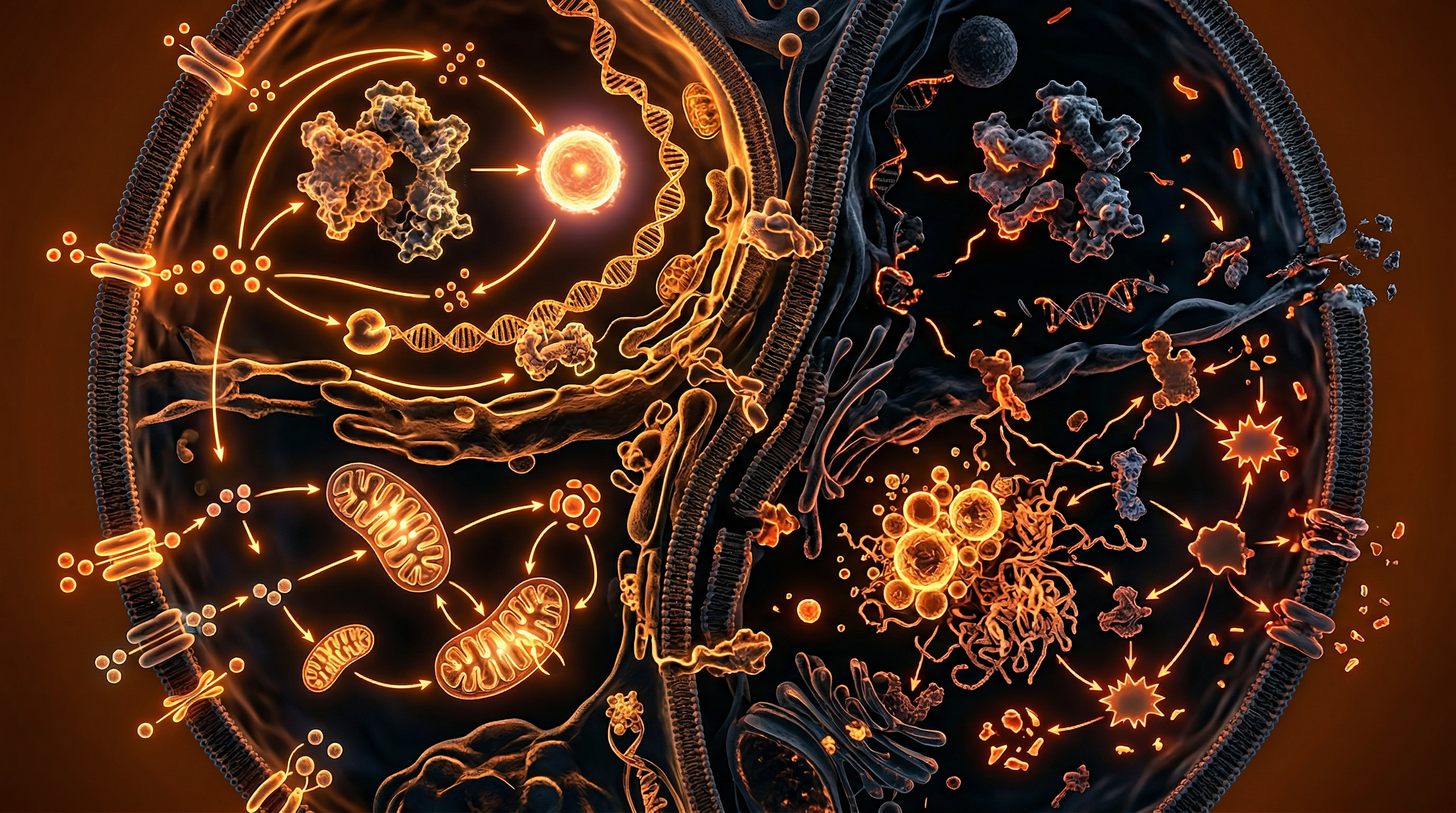
At the microscopic level, the disruption caused by late-night metabolism is an exercise in cellular chaos. To appreciate the gravity of the "late-night snack," we must look at how our cells process energy.
The Role of GLUT4 and Insulin Sensitivity
During the daylight hours, our cells are highly sensitive to insulin. Insulin sensitivity refers to how effectively our cells use insulin to take up glucose from the bloodstream. This process involves the translocation of GLUT4 (glucose transporter type 4) to the cell membrane. In a sun-synced state, GLUT4 expression is maximal during the day. When we eat at night, the "machinery" for glucose uptake is retracted, leading to postprandial hyperglycaemia—a state where sugar lingers in the blood, damaging the lining of the arteries and causing systemic inflammation.
Mitochondrial Dynamics and Autophagy
Mitochondria, the powerhouses of our cells, also follow a circadian rhythm. During the day, they focus on oxidative phosphorylation (energy production). At night, in the absence of food, they undergo mitophagy (the clearing out of damaged mitochondria).
By consuming calories late into the evening, we inhibit the process of Autophagy—the body's natural "housekeeping" mechanism. Autophagy is regulated by the nutrient-sensing pathway mTOR (mammalian target of rapamycin). When we eat, mTOR is activated, and autophagy is suppressed. Constant late-night eating means mTOR is perpetually "on," and the cellular debris that should be cleared away instead accumulates, leading to rapid cellular ageing and oncogenic (cancer-promoting) environments.
The Hepatic Clock and Lipid Metabolism
The liver is the central hub of metabolism. Under ancestral conditions, the liver would spend the night performing Gluconeogenesis (producing its own glucose) and breaking down fats. When we flood the liver with nutrients (especially fructose and refined starches) late at night, we disrupt the PPAR-alpha pathway, which governs fat oxidation. This shift forces the liver into De Novo Lipogenesis—the creation of new fat—which is directly linked to the development of Non-Alcoholic Fatty Liver Disease (NAFLD).
- Daytime: High fat-burning (beta-oxidation), high insulin sensitivity, high autophagy.
- Night-time: Low glucose tolerance, high fat storage, low cellular repair.
Environmental Threats and Biological Disruptors
The modern world is a hostile environment for the human circadian system. We are besieged by "Zeitgebers" (time-givers) that are fundamentally artificial.
Artificial Light at Night (ALAN)
The invention of the lightbulb was the first shot fired in the war against our metabolism. Specifically, the Blue Light emitted by LED screens and smartphones mimics the short-wavelength light of the midday sun. This suppresses melatonin production for hours, tricking the SCN into thinking it is still daytime. This light pollution not only prevents sleep but extends the "metabolic window" far beyond its natural limits, inducing hunger signals at times when the body should be fasting.
The Ultra-Processed Food (UPF) Trap
Modern food is engineered to be hyper-palatable and rapidly absorbable. Unlike the fibrous, complex foods of our ancestors, UPFs cause an immediate and violent spike in blood glucose. When these foods are consumed late at night, their impact is magnified. The UK, in particular, has one of the highest consumptions of UPFs in Europe, creating a "perfect storm" of metabolic disruption.
Social Jetlag
This phenomenon occurs when our biological clock and our social clock are out of sync. For example, a worker who wakes up at 6:00 AM during the week but sleeps until 11:00 AM on weekends experiences "jetlag" without ever leaving their time zone. This constant shifting of eating and sleeping times prevents the peripheral clocks from ever reaching a state of equilibrium, leading to chronic metabolic fragmentation.
"Exposure to blue light for just two hours before bed can delay the peak of melatonin by up to 90 minutes, effectively shifting the body into a state of 'nocturnal diabetes'."
The Cascade: From Exposure to Disease
The transition from a healthy sun-syncer to a victim of metabolic syndrome is not instantaneous; it is a slow, multi-stage cascade of biological failure.
Stage 1: The Loss of Metabolic Flexibility
The first sign of circadian disruption is the loss of Metabolic Flexibility—the ability of the body to switch efficiently between burning carbohydrates and burning fat. A sun-synced individual burns carbs during the day and fats at night. A late-night eater remains "locked" into carbohydrate metabolism, leading to constant hunger, "hangry" episodes, and an inability to go more than four hours without food.
Stage 2: Hyperinsulinaemia and Resistance
As late-night eating continues, the pancreas is forced to pump out more and more insulin to deal with elevated nighttime glucose. Eventually, the cells become "numb" to the signal. This is Insulin Resistance. The body now requires five to ten times more insulin to do the same job. High levels of circulating insulin (Hyperinsulinaemia) are a primary driver of systemic inflammation.
Stage 3: The Metabolic Syndrome Cluster
The cascade eventually manifests in the clinical symptoms of Metabolic Syndrome:
- Abdominal Obesity: Insulin is a fat-storage hormone; high levels at night specifically promote visceral fat (fat around the organs).
- Hypertension: High insulin causes the kidneys to retain sodium and the blood vessels to constrict.
- Dyslipidaemia: Elevated triglycerides and low "good" HDL cholesterol as the liver's fat metabolism breaks down.
Stage 4: Chronic Disease State
The final stage is the manifestation of overt Type 2 Diabetes, Cardiovascular Disease, and even neurodegenerative conditions like Alzheimer’s (now often referred to by researchers as "Type 3 Diabetes" due to its link to brain insulin resistance).
What the Mainstream Narrative Omits
The current medical and dietary establishment is largely silent on the issue of chrononutrition. This silence is not accidental; it is a byproduct of a system that benefits from chronic consumption.
The CICO Myth
The "Calories In, Calories Out" model is the most pervasive lie in modern nutrition. It treats the human body like a simple thermodynamic machine. However, the biological response to 500 calories of cookies at 8:00 AM is radically different from the response at 11:00 PM. By focusing only on the "amount" of calories, the mainstream narrative ignores the hormonal environment in which those calories are processed.
The "Snacking" Industry
Food corporations have spent billions of pounds convincing the public that "grazing" or eating "six small meals a day" is healthy for metabolism. In reality, this constant stimulation of insulin prevents the body from ever entering the fasting state required for autophagy. The UK high street is a testament to this, with "meal deals" and late-night convenience stores ensuring that no Briton is ever more than ten metres away from a glucose spike.
The Pharmaceutical Focus
The mainstream medical paradigm is designed to treat the symptoms of metabolic syndrome rather than the cause. It is far more profitable to prescribe Metformin for blood sugar, Statins for cholesterol, and ACE inhibitors for blood pressure than it is to instruct a patient to stop eating after 6:00 PM. Chrononutrition is a "free" intervention, and therefore, it has no marketing budget.
Exposing the Truth: Clinical trials have shown that Time-Restricted Feeding (TRF) can be more effective than standard caloric restriction for weight loss and insulin sensitivity, yet it is rarely mentioned in standard GP consultations.
The UK Context
The United Kingdom faces a unique set of challenges regarding chrononutrition. We are a nation currently trapped in a "Metabolic Twilight Zone."
The "Late Tea" and Takeaway Culture
Traditional British culture often revolved around a substantial midday meal and a lighter "high tea." However, modern work patterns and the rise of "Gig Economy" delivery apps (Deliveroo, UberEats) have shifted the main caloric load of the day to late in the evening. In major UK cities, the peak time for takeaway orders is between 7:30 PM and 9:30 PM. This means millions of people are flooding their systems with high-fat, high-carb "hyper-palatable" foods just as their melatonin is beginning to rise.
The NHS Crisis and Metabolic Burden
The National Health Service (NHS) is currently buckling under the weight of preventable metabolic diseases. Type 2 Diabetes alone costs the NHS approximately £10 billion a year. A significant portion of this could be mitigated by a national shift toward Time-Restricted Feeding (TRF). Yet, the dietary guidelines provided by public health bodies still focus heavily on the outdated "Eatwell Guide," which emphasizes frequent carbohydrate intake and fails to mention the timing of meals.
The Northern Latitude Factor
The UK’s northern latitude means that in winter, the sun sets as early as 3:30 PM. For an ancient Briton, this would have been the signal to stop eating. For the modern Briton, the period between 4:00 PM and 11:00 PM is spent under bright artificial lights, consuming calories. This creates a massive seasonal "Circadian Gap" that contributes to the high rates of Seasonal Affective Disorder (SAD) and winter weight gain seen across the British Isles.
Protective Measures and Recovery Protocols
Reversing the damage of modern late-night metabolism requires a disciplined return to sun-synced living. As a biological researcher, I recommend the following "Chrononutrition Protocol."
1. Establish a Consistent Eating Window
The most powerful tool for metabolic recovery is Time-Restricted Feeding (TRF). Aim for a 10-hour or 8-hour eating window.
- The Golden Rule: Finish your last calorie at least three hours before bed. If you go to sleep at 10:00 PM, your kitchen must be "closed" by 7:00 PM.
- Front-Loading: Consume the majority of your calories and carbohydrates during the period of maximum insulin sensitivity (between 10:00 AM and 2:00 PM).
2. Light Hygiene and Melatonin Protection
Protect the SCN to ensure the pancreas functions correctly.
- Morning Sunlight: Get 10–30 minutes of natural light as soon as you wake up. This "sets" your master clock for the day.
- Evening Blackout: Use blue-light blocking glasses after 7:00 PM. Switch to warm, dim, amber lighting in the house.
- No Screens in Bed: The proximity of a smartphone screen to the eyes is enough to delay metabolic rest for hours.
3. Food Composition for the Sunset
If you must eat later in the day, the composition of the meal is vital.
- Avoid Fructose and Refined Carbs at Night: These require the highest insulin response.
- Prioritise Protein and Healthy Fats: Proteins and fats have a lower glycaemic index and are less disruptive to the nocturnal metabolic state.
- The Role of Fibre: Fibre slows the absorption of glucose, mitigating the damage of a later meal.
4. Supplements to Aid Transition
While not a substitute for timing, certain compounds can help re-sensitise the body:
- Magnesium Bisglycinate: Supports the SCN and aids in muscle relaxation and glucose metabolism.
- Berberine: Often called "Nature's Metformin," it can help lower blood glucose if taken before the final meal of the day.
- Apple Cider Vinegar (ACV): Taking ACV before a meal has been shown to improve postprandial insulin sensitivity.
5. The "Sun-Sync" Exercise Rule
Exercise is a potent Zeitgeber. Physical activity in the morning or early afternoon enhances insulin sensitivity. However, intense "HIIT" workouts late at night can spike cortisol and disrupt the transition to the melatonin-dominant state.
- Morning: Strength training or high-intensity work.
- Evening: Gentle walking or restorative yoga.
Summary: Key Takeaways
The path to metabolic health is not found in a new pharmaceutical drug or a fad diet; it is found in the ancient rhythm of the sun. By ignoring our internal clocks, we have invited a host of modern "civilisation diseases" into our lives.
- Chrononutrition is the science of eating in alignment with our biological clocks.
- Insulin sensitivity is highest during the day and lowest at night; eating late forces the body to process sugar in a "diabetic" state.
- Melatonin and insulin are mutually inhibitory; you cannot effectively digest a heavy meal while your body is trying to sleep.
- Modern light pollution and the "snacking culture" are engineered disruptors of our metabolic health.
- The UK context shows a dangerous trend toward late-night, processed calorie consumption that is crippling the national health infrastructure.
- Recovery is possible through Time-Restricted Feeding, front-loading calories, and strict light hygiene.
We must stop viewing ourselves as machines that can be refuelled at any hour. We are rhythmic, biological beings, inseparable from the cycles of the earth. To reclaim our health, we must reclaim the night and return to the wisdom of the sun. The "Late-Night Metabolism" is a modern construct; "Sun-Syncing" is our biological heritage. Choose wisely, for your cells are always keeping time.
This article is provided for informational and educational purposes only. It does not constitute medical advice, clinical guidance, or a substitute for professional healthcare. Information reflects cited research at time of publication. Always consult a qualified healthcare professional before acting on any health information.
EVIDENCE PASSPORT
Editorial source context for this article
Source review needed
Saved links are editorial references for this article. They may support specific claims rather than every sentence. Open and assess each source in context. This passport does not independently verify them.
Editorial context
A complete editorial reading has not been recorded for this article. Source links remain available for you to open and assess directly.
Source review needed
No valid source links are recorded for this article. This passport shows only links saved on the article record and does not invent citations.
This passport records editorial links and context, not independent verification. Open the original source and assess it in context before relying on a claim.
Medical Disclaimer
The information in this article is for educational purposes only and does not constitute medical advice, diagnosis, or treatment. Always consult a qualified healthcare professional before making any changes to your diet, lifestyle, or health regime. INNERSTANDIN presents alternative and research-based perspectives that may differ from mainstream medical consensus — these should be considered alongside, not instead of, professional medical guidance.
Read Full DisclaimerContinue the thread
Keep this question moving.
Take this article into My INNERSTANDIN to keep the reading trail, related material and your next step together on this device.
Explore this in the Body Map
See where this hits your biology. Interactive anatomy, threats, and protective protocols.
Dig deeper in the Library
Free, longform PDF volumes that go beyond headlines into mechanisms and references.