
Circadian Chaos: Light Pollution in British Cities
Updated May 2026
Artificial blue light exposure in UK urban centers is decoupling the SCN from ancestral solar rhythms. This hormonal disruption is linked to rising rates of metabolic syndrome and sleep disorders across the population.
Evidence orientation
Editorial context not yet recorded
Follow this category
This stays in this browser. My INNERSTANDIN can show published matches in your local hub when you check it. It does not send email, push, or alert notifications.
Local learning review
A private browser aid for revisiting ideas. It is not an alert or a health recommendation.
Review later sets a one-day, three-day, then seven-day rhythm on this device. Choose it only when you want to revisit this article.
Overview
For three billion years, life on Earth evolved under a singular, immutable rhythm: the cycle of the sun. From the earliest cyanobacteria to the complex hominids that roamed the British Isles during the Neolithic, biological survival was predicated on a precise synchronization with the spectral shifts of the solar day. Our ancestors lived in a world where the day was defined by the full-spectrum brilliance of the sun and the night was characterized by the profound darkness of a moonlit landscape, occasionally punctuated by the long-wavelength embers of a wood fire.
Today, this ancestral heritage has been shattered. We are currently living through the most significant biological experiment in human history, one conducted without a control group and without informed consent. In the urban sprawls of London, Manchester, Birmingham, and Glasgow, the "natural night" has been effectively eradicated. The advent of Artificial Light at Night (ALAN), specifically the aggressive rollout of high-intensity, blue-enriched Light Emitting Diodes (LEDs), has decoupled the human organism from its evolutionary environmental cues.
This phenomenon, which we term Circadian Chaos, is not merely a matter of "bad sleep." It is a systemic biological failure. By flooding our retinas with high-frequency blue light after sunset, we are signaling to our master internal clock—the Suprachiasmatic Nucleus (SCN)—that it is perpetual noon. The result is a profound state of chronodisruption, a condition where our internal physiological processes are no longer in sync with the external environment or, more importantly, with each other.
Key Statistic: Since the widespread adoption of LED streetlighting in the UK, urban skyglow has increased by approximately 2% per year, yet the biological impact of this "spectral shift" is estimated to be orders of magnitude more damaging than the old sodium-vapour lamps.
In this article, we will explore the mechanisms by which light pollution is dismantling British public health. We will go beyond the superficial advice of "avoiding phones before bed" to examine the cellular and hormonal destruction occurring at the heart of our urban environments. This is a story of evolutionary mismatch, metabolic collapse, and the silent war being waged against our ancient biological rhythms.
The Biology — How It Works
To understand why a streetlight outside a bedroom window in Leeds can cause insulin resistance, we must first understand the architecture of the human eye—not as an organ of sight, but as an organ of time-keeping.
The Non-Visual Pathway
For decades, science believed the eye's only function was vision via rods and cones. It wasn't until the turn of the 21st century that researchers identified a third type of photoreceptor: the Intrinsically Photosensitive Retinal Ganglion Cells (ipRGCs). These cells contain a photopigment called melanopsin, which is exquisitely sensitive to short-wavelength blue light (approximately 460–480 nm).
Unlike rods and cones, which send signals to the visual cortex for image processing, ipRGCs send signals directly to the Suprachiasmatic Nucleus (SCN), located in the hypothalamus. The SCN is the master pacemaker of the body. Its job is to translate the message of light into a hormonal symphony.
The Melatonin-Cortisol Seesaw
The primary mechanism of the SCN is the regulation of two opposing hormones: Melatonin and Cortisol.
- Melatonin: Often erroneously called the "sleep hormone," melatonin is actually the body’s master antioxidant and mitochondrial regulator. It is produced by the pineal gland in response to darkness.
- Cortisol: The "alertness hormone" should peak in the early morning to wake the body, mobilise glucose, and sharpen focus.
Under ancestral conditions, the absence of blue light at dusk triggered the release of melatonin, preparing the body for cellular repair, autophagy, and immune surveillance. In the modern UK city, the constant bombardment of blue light from streetlights, billboards, and devices keeps melatonin suppressed throughout the night.
The SCN as a Conductor
Think of the SCN as the conductor of an orchestra. Every organ in the body—the liver, the pancreas, the heart, and the gut—contains its own peripheral clock. These clocks rely on the SCN to keep them "in time." When the SCN receives conflicting light signals (e.g., darkness at 10 PM but a 480nm blue spike from a smartphone), the conductor loses the beat. The liver may think it is midnight (storing fat), while the pancreas thinks it is noon (releasing insulin). This internal desynchrony is the definition of Circadian Chaos.
Mechanisms at the Cellular Level
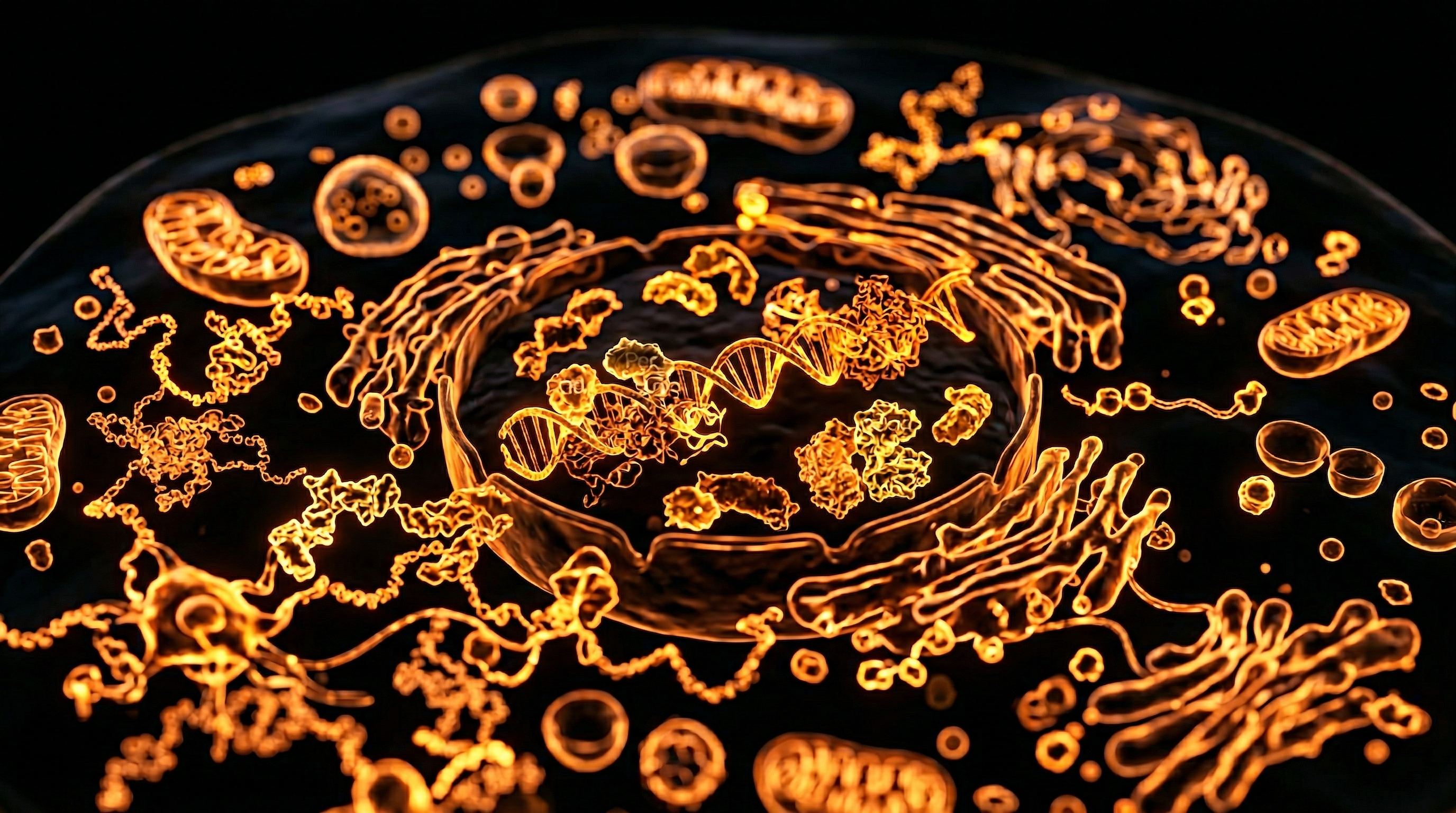
The damage of light pollution is not limited to systemic hormones; it penetrates into the very engine of the cell: the Mitochondria.
Mitochondrial Melatonin
Recent breakthroughs in chronobiology have revealed a shocking truth: while the pineal gland produces melatonin for systemic circulation, the mitochondria produce their own melatonin locally. This "subcellular melatonin" is crucial for neutralizing the Reactive Oxygen Species (ROS) produced during energy production (ATP synthesis).
Blue light exposure at night, particularly in the absence of Near-Infrared (NIR) light—which is abundant in sunlight and firelight but absent in LEDs—causes a collapse in mitochondrial melatonin production. This leaves the mitochondria vulnerable to oxidative stress, leading to:
- Reduced ATP production (fatigue).
- Increased cellular inflammation.
- Premature cellular senescence (aging).
Clock Genes: Per, Cry, and Bmal1
At the genetic level, our circadian rhythms are governed by a complex feedback loop of proteins. The genes CLOCK and BMAL1 drive the expression of Period (PER) and Cryptochrome (CRY) proteins.
- During the day, PER and CRY accumulate.
- At night, they reach a threshold and inhibit the activity of CLOCK and BMAL1.
This molecular oscillation takes roughly 24 hours. However, blue light exposure creates a "phase delay." It tricks the CLOCK/BMAL1 complex into remaining active, preventing the necessary "reset" that occurs during deep, dark sleep. When these clock genes are disrupted, the cell loses its ability to time-gate critical functions like DNA repair and apoptosis (programmed cell death). This is why chronodisruption is so tightly linked to the proliferation of oncogenic (cancerous) cells.
Callout: Every single cell in the human body has a "clock." When you stare at a screen in a London flat at 1 AM, you are effectively telling the DNA in your liver and skin cells to halt their repair protocols.
Environmental Threats and Biological Disruptors
The UK's urban environment has become a minefield of biological disruptors. The shift from incandescent and sodium lighting to LED technology has fundamentally changed the "spectral diet" of the British population.
The LED Revolution: A Poisoned Chalice
In an effort to meet carbon reduction targets, UK councils have aggressively replaced orange-hued High-Pressure Sodium (HPS) streetlights with "energy-efficient" white LEDs. While this saves electricity, it is a biological disaster.
- The Blue Spike: Most "cool white" LEDs have a massive peak in the 450-460nm range—the exact frequency that maximally suppresses melatonin.
- The Absence of Red: Unlike fire or old incandescent bulbs, LEDs provide almost zero Near-Infrared (NIR) or Red light. Red light has been shown to have a protective, healing effect on the retina and the skin, counteracting the oxidative damage caused by blue light. We have traded a balanced spectrum for a biologically aggressive, narrow-spectrum spike.
The "Smart City" and 5G Integration
The UK's push toward "Smart Cities" involves streetlights that are not only LED-based but also integrated with telecommunications hardware. This creates a dual-threat environment:
- Constant Flicker: Many cheap LED drivers produce a high-frequency flicker (often invisible to the naked eye) that contributes to neurological fatigue and headaches.
- Data-Driven Luminance: Digital advertising hoardings in places like Piccadilly Circus or Manchester’s Northern Quarter now use adaptive brightness that can reach thousands of nits, ensuring that even a passerby receives a massive dose of circadian-disrupting light in seconds.
The Indoor Environment
British workers spend an average of 90% of their time indoors. The "biological darkness" of a standard UK office (which is far dimmer than the sun) followed by the "biological brightness" of an LED-lit home at night creates a flat light signal. The body never receives a clear "Day" signal or a clear "Night" signal, leading to a permanent state of low-level circadian mismatch.
The Cascade: From Exposure to Disease
The disruption of the SCN and the suppression of melatonin are not "silent" events; they manifest as a predictable cascade of chronic diseases that are currently reaching epidemic proportions in the UK.
1. Metabolic Syndrome and Type 2 Diabetes
Circadian rhythm is the primary regulator of insulin sensitivity. Under normal conditions, insulin sensitivity is high in the morning (to process breakfast) and low at night.
Fact: Just one night of disrupted sleep or late-night light exposure can induce a state of "pre-diabetes" in a healthy young adult by causing acute peripheral insulin resistance.
When the UK urbanite is exposed to light at night, the body remains in a "daylight" metabolic state, but because it is actually night, the pancreas cannot effectively manage blood glucose. Over years, this results in Metabolic Syndrome: obesity, hypertension, and high blood sugar. The "midnight snack" under a bright kitchen LED is metabolically vastly more damaging than the same snack eaten in daylight.
2. The Mental Health Crisis
There is a direct neural pathway from the ipRGCs to the parts of the brain that regulate mood, such as the amygdala and habenula.
- Chronic blue light exposure at night has been shown to induce depressive-like symptoms in animal models and is strongly correlated with the rising rates of anxiety and depression in British cities.
- Lack of morning sunlight (common in the cloudy UK) prevents the synthesis of serotonin, the precursor to melatonin. This "double hit"—no serotonin in the morning and no melatonin at night—is a recipe for psychiatric collapse.
3. Neurodegenerative Disease
The brain has a waste-clearance system called the Glymphatic System. This system only "turns on" during deep, slow-wave sleep. If light pollution prevents the transition into deep sleep, metabolic waste—including beta-amyloid plaques—builds up in the brain. This is a primary driver of Alzheimer’s and other forms of dementia, which are now the leading cause of death in the UK.
4. Hormonal Cancers
The World Health Organization (WHO) has classified "shift work that involves circadian disruption" as a Group 2A carcinogen. However, we are now seeing that "urban living" is effectively a form of shift work. Low melatonin levels are strongly linked to:
- Breast Cancer: Melatonin naturally inhibits the proliferation of breast cancer cells.
- Prostate Cancer: Studies in major cities have shown higher rates of prostate cancer in neighbourhoods with the highest levels of satellite-detected light pollution.
What the Mainstream Narrative Omits
The mainstream health narrative in the UK, led by the NHS and major health charities, focuses almost exclusively on "diet and exercise." While important, this ignores the environmental control of metabolism. You cannot out-run or out-eat a broken circadian rhythm.
The "Lux" Fallacy
Standard lighting regulations in the UK are based on Lux, a measurement of how bright light appears to the human eye. This is a visual metric. It does not account for Melanopic Lux, which measures how much the light is affecting our internal clock. A light can look "dim" but have enough blue frequency to completely shut down melatonin production. The mainstream narrative fails to inform the public that "warm" looking LEDs often still contain a hidden blue spike.
The Importance of Infrared (IR)
Mainstream science rarely discusses the fact that sunlight is 50% Infrared. We evolved to be "bathed" in IR. Infrared light penetrates deep into our tissues, stimulating mitochondrial repair and pre-conditioning our cells against the stress of UV and blue light. By moving indoors and using LEDs, we have removed the "healing" part of the light spectrum while doubling down on the "stressful" part.
The Flicker Effect
Most modern lighting uses Pulse Width Modulation (PWM) to dim or maintain brightness. This causes the light to turn on and off hundreds of times per second. While we don't "see" it, the brain perceives it. This constant "strobe" effect is a massive sympathetic nervous system stressor, contributing to the "always-on" anxiety felt by many city dwellers.
The UK Context
The United Kingdom faces a unique set of challenges regarding circadian health.
High Latitude and Seasonal Affective Disorder (SAD)
Because the UK is located at a high latitude, the seasonal variation in day length is extreme. In winter, London receives less than 8 hours of daylight, often obscured by cloud cover.
- In this environment, the "contrast" between day and night is very low.
- British citizens often go from a dark morning to a dimly lit office, then home to a bright LED environment.
- This lack of Circadian Amplitude (the difference between the brightest part of the day and the darkest part of the night) is why SAD is so prevalent in the UK.
The Housing Crisis and "Light Poverty"
The UK’s aging housing stock and the rise of high-density "luxury" flats in cities like Salford or the London Docklands often feature floor-to-ceiling glass windows. While aesthetically pleasing, these residents are at the mercy of the city's light environment.
- Many new builds lack proper "blackout" infrastructure.
- Lower-income areas are often subjected to the most aggressive, high-glare "security" lighting, creating a socio-economic divide in circadian health.
The Failure of British Urban Planning
The UK's "National Planning Policy Framework" barely mentions light pollution as a health hazard. It is treated as a "nuisance" (like noise) rather than a systemic biological toxin. Consequently, there is no legislative barrier to installing 5000K (bright blue-white) streetlights directly outside residential bedrooms.
Protective Measures and Recovery Protocols
As a senior researcher for INNERSTANDING, I propose a "Circadian Rescue" protocol specifically designed for those trapped in the UK's urban centers. We must use technology to protect ourselves from technology.
1. Morning Entrainment (The Anchor)
The SCN needs a powerful "START" signal every morning to set the clock for the next 24 hours.
- The 30-Minute Rule: Spend 30 minutes outside within an hour of sunrise. Even on a cloudy day in Birmingham, the lux levels outside are 10-50x higher than inside.
- No Sunglasses: Allow the full-spectrum light to hit the ipRGCs (do not look directly at the sun). This triggers cortisol and sets the "timer" for melatonin release 14-16 hours later.
2. Spectral Hygiene (The Shield)
You must aggressively manage the light in your home after sunset.
- Kill the Overhead Lights: After 8 PM, use only low-level lamps.
- The Red Shift: Replace bulbs in the bedroom and bathroom with dedicated Red LED bulbs or incandescent "warm" bulbs. Red light does not suppress melatonin.
- Blue Blocking Glasses: For those who must use screens, "Blue Blocker" glasses (specifically those with orange or red lenses that block 100% of light below 550nm) are non-negotiable. The clear "computer glasses" marketed by high-street opticians are largely ineffective for circadian protection.
3. Environmental Hardening
Transform your sleeping environment into a "Circadian Vault."
- Blackout Blinds: Use professional-grade blackout curtains or "EZ Blackout" liners to ensure zero light ingress from streetlights.
- Cover the "Vampire Lights": Use black electrical tape to cover every LED standby light on TVs, chargers, and monitors. Even a tiny green light can be sensed through closed eyelids.
- The Eye Mask: A high-quality, contoured silk eye mask is the cheapest and most effective health intervention available to the British public.
4. Strategic Supplementation and Red Light Therapy
Given the UK's lack of sunlight, we must sometimes "biohack" our way to health.
- Vitamin D3/K2: Low Vitamin D levels (endemic in the UK) further weaken the circadian system.
- Photobiomodulation (PBM): Using a Red/Near-Infrared light panel in the morning can mimic the ancestral "sunrise" and provide the mitochondrial support that modern offices lack.
Summary: Key Takeaways
The crisis of Circadian Chaos in British cities is a silent epidemic. Our transition from a solar-governed species to a "Blue Light" species is driving the rise in metabolic, oncogenic, and psychiatric diseases.
- The SCN is the Master Clock: It controls everything from your insulin response to your brain's waste-clearance system.
- Blue Light is the Disruptor: The 480nm spike in modern LEDs tells your body it is always noon, preventing the production of melatonin—the body's most potent internal medicine.
- UK Cities are High-Risk: High-intensity LED streetlights and a lack of morning sun create a "perfect storm" of chronodisruption.
- The Solution is Spectral Control: By maximizing morning sun and ruthlessly eliminating blue light at night, we can re-couple our biology to the ancestral rhythms it requires for health.
The light bulb was once celebrated as the invention that "conquered the night." We now know that in conquering the night, we have begun to destroy the very biological foundations of our health. It is time to reclaim the dark. We must demand that our cities move toward Circadian-Friendly Lighting (2200K or lower, shielded fixtures) and, on an individual level, we must take radical responsibility for our own light environment.
The health of the British nation depends not on the next pharmaceutical breakthrough, but on our ability to return to the rhythms of the sun.
This article is provided for informational and educational purposes only. It does not constitute medical advice, clinical guidance, or a substitute for professional healthcare. Information reflects cited research at time of publication. Always consult a qualified healthcare professional before acting on any health information.
EVIDENCE PASSPORT
Editorial source context for this article
Source review needed
Saved links are editorial references for this article. They may support specific claims rather than every sentence. Open and assess each source in context. This passport does not independently verify them.
Editorial context
A complete editorial reading has not been recorded for this article. Source links remain available for you to open and assess directly.
Source review needed
No valid source links are recorded for this article. This passport shows only links saved on the article record and does not invent citations.
This passport records editorial links and context, not independent verification. Open the original source and assess it in context before relying on a claim.
Medical Disclaimer
The information in this article is for educational purposes only and does not constitute medical advice, diagnosis, or treatment. Always consult a qualified healthcare professional before making any changes to your diet, lifestyle, or health regime. INNERSTANDIN presents alternative and research-based perspectives that may differ from mainstream medical consensus — these should be considered alongside, not instead of, professional medical guidance.
Read Full DisclaimerContinue the thread
Keep this question moving.
Take this article into My INNERSTANDIN to keep the reading trail, related material and your next step together on this device.
Explore this in the Body Map
See where this hits your biology. Interactive anatomy, threats, and protective protocols.
Dig deeper in the Library
Free, longform PDF volumes that go beyond headlines into mechanisms and references.