
Cortisol and the Gut: How the Sympathetic State Paralyzes the MMC
Updated May 2026
Chronic stress keeps the body in a sympathetic state, which inhibits the 'rest and digest' functions necessary for the Migrating Motor Complex. This biological reality makes stress management a physiological requirement for gut healing.
Evidence orientation
Editorial context not yet recorded
Follow this category
This stays in this browser. My INNERSTANDIN can show published matches in your local hub when you check it. It does not send email, push, or alert notifications.
Local learning review
A private browser aid for revisiting ideas. It is not an alert or a health recommendation.
Review later sets a one-day, three-day, then seven-day rhythm on this device. Choose it only when you want to revisit this article.
Overview
In the contemporary landscape of gastroenterology, the conversation has shifted decisively from what we eat to how our bodies process it. For decades, the medical establishment viewed the gut as a mechanical tube—a biological plumbing system that either worked or didn't. However, the rise of Small Intestinal Bacterial Overgrowth (SIBO) and chronic functional dyspepsia has exposed a far more complex reality. At the heart of this reality lies the Migrating Motor Complex (MMC), the "housekeeping" wave of the small intestine. And at the heart of MMC failure lies a single, pervasive physiological state: the Sympathetic Overdrive.
The Migrating Motor Complex is a distinct electromechanical activity observed in the gastrointestinal tract during periods of fasting. It is the silent guardian of the small intestine, sweeping undigested food particles, cellular debris, and—most importantly—excessive bacteria down into the colon. When the MMC is robust, SIBO is virtually impossible. When the MMC is paralysed, SIBO is inevitable.
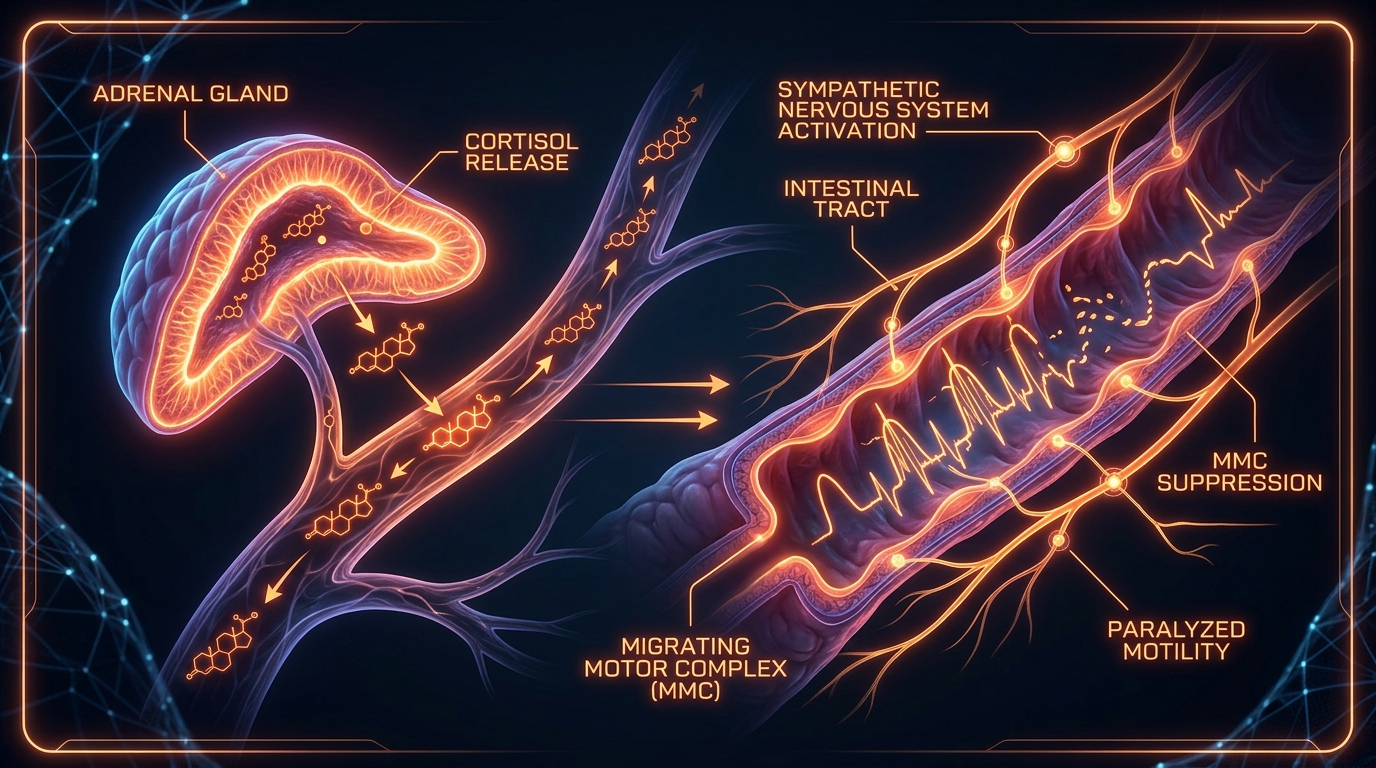
The primary executioner of the MMC is chronic stress, mediated through the hormone cortisol and the broader activation of the Sympathetic Nervous System (SNS). In a biological hierarchy, the "Fight or Flight" response always takes precedence over "Rest and Digest." To the human body, a looming work deadline or a financial crisis triggers the same primitive neurochemical cascade as an apex predator. In this state, the body purposefully diverts blood flow, energy, and neurological signaling away from the digestive tract to the musculoskeletal system and the brain’s survival centres.
UK Health Alert: Recent data suggests that over 74% of UK adults have felt so stressed in the last year that they felt overwhelmed or unable to cope. This chronic state of sympathetic activation is directly correlating with a 20% rise in reported functional gut disorders across the British Isles.
This article serves as a comprehensive exploration of the biological antagonism between cortisol and gut motility. We will dissect how the modern environment has created a state of "perpetual paralysis" for the MMC and why no amount of probiotics or antibiotics can cure a gut that is trapped in a sympathetic cage.
##
The Biology — How It Works
To understand why cortisol halts the gut, we must first understand the Autonomic Nervous System (ANS). The ANS is the control centre for all involuntary bodily functions, divided into two primary branches: the Sympathetic Nervous System (SNS) and the Parasympathetic Nervous System (PNS).
The Parasympathetic Dominance: The Window for Healing
The PNS, often mediated by the Vagus Nerve (Cranial Nerve X), is the biological prerequisite for digestion. The Vagus nerve acts as a bidirectional superhighway, carrying signals between the brainstem and the Enteric Nervous System (ENS). When the body is in a parasympathetic state, the Vagus nerve releases acetylcholine, a neurotransmitter that stimulates smooth muscle contraction and secretions throughout the GI tract.
The MMC occurs almost exclusively in this state. It is a four-phase cycle that begins roughly 90 to 120 minutes after eating.
- Phase I: A period of quiescence with rare contractions.
- Phase II: Irregular electrical activity and contractions.
- Phase III: The "Big Sweep." Intense, rhythmic contractions that move from the stomach through to the end of the ileum.
- Phase IV: A brief transition back to Phase I.
The Sympathetic Interference: The Cortisol Spike
When the brain perceives a threat, the Hypothalamic-Pituitary-Adrenal (HPA) axis is activated. The hypothalamus releases Corticotropin-Releasing Hormone (CRH), which signals the pituitary gland to release Adrenocorticotropic Hormone (ACTH), which finally prompts the adrenal glands to flood the system with cortisol and adrenaline.
This hormonal flood has an immediate, inhibitory effect on the Vagus nerve. Effectively, the brain "mutes" the signal to the gut. Adrenaline binds to alpha and beta-adrenergic receptors in the gut lining, causing the smooth muscles of the intestine to relax (inhibiting movement) while simultaneously causing the sphincters (like the ileocecal valve) to tighten. The result is total stasis. The "housekeeper" is dismissed from duty because the body is too busy "fighting for its life."
The Enteric Nervous System (ENS)
The gut contains its own independent nervous system, often called the "Second Brain." While the ENS can operate independently, it is heavily influenced by the ANS. Cortisol acts as a molecular "jammer" for the ENS. It disrupts the rhythmic firing of the Interstitial Cells of Cajal (ICCs)—the natural pacemakers of the gut. Without the rhythmic electrical pacing of the ICCs, Phase III of the MMC cannot initiate.
##
Mechanisms at the Cellular Level
The paralysis of the MMC is not just a general slowing of the body; it is a precise, molecular shutdown. At the cellular level, several key players are compromised when cortisol levels remain chronically elevated.
1. The Inhibition of Motilin
Motilin is a polypeptide hormone secreted by the M-cells in the duodenum and jejunum. It is the primary chemical trigger for Phase III of the MMC. Under normal conditions, motilin levels rise cyclically during fasting. However, high levels of cortisol and sympathetic activity have been shown to suppress motilin secretion. Without the "motilin surge," the mechanical waves of the MMC simply never start. The undigested contents of the small intestine remain stationary, providing a stagnant breeding ground for bacteria.
2. Blood Flow Shunting (Vasoconstriction)
Digestion is an energy-intensive process requiring significant blood flow to the mesenteric arteries. Cortisol and norepinephrine induce peripheral vasoconstriction. This diverts blood away from the visceral organs toward the skeletal muscles. This "intestinal ischaemia" (even in mild forms) reduces the oxygen and nutrients available to the smooth muscle cells of the gut, rendering them unable to perform the high-energy contractions required for a strong MMC wave.
3. Serotonin (5-HT) Dysregulation
Approximately 95% of the body’s serotonin is located in the gut, where it acts as a critical signaling molecule for peristalsis and secretomotor functions. Chronic stress alters the expression of Serotonin Reuptake Transporters (SERT) in the intestinal lining. When cortisol is high, serotonin signaling becomes chaotic. Instead of orderly waves of contraction, the gut may experience spasms (contributing to IBS-D) or complete lack of tone (contributing to IBS-C and SIBO).
4. The Role of Ghrelin
Ghrelin, known as the "hunger hormone," is also a potent stimulator of the MMC. Stress-induced HPA axis activation disrupts the natural rhythm of ghrelin. In many individuals, chronic stress leads to "stress eating" or constant grazing, which prevents ghrelin from reaching the levels necessary to trigger the MMC. The MMC requires a fasted state; even a small snack "resets" the clock, and cortisol-induced cravings ensure the clock is never allowed to run long enough to reach Phase III.
##
Environmental Threats and Biological Disruptors
The human biological blueprint was forged in an environment where stress was intense but episodic—a chase by a predator followed by long periods of recovery. The modern world has inverted this. We now live in an environment of low-grade, chronic, inescapable stress, which acts as a permanent brake on gut motility.
The "Always-On" Digital Culture
The blue light from screens and the constant dopamine hits from social media notifications keep the brain in a state of hyper-vigilance. This prevents the transition into the deep parasympathetic state required for the MMC to function during sleep. Research indicates that the MMC is most active during the night; however, if sleep is fragmented or the body is metabolising late-night cortisol, the nocturnal "housekeeping" is skipped entirely.
Ultra-Processed Foods (UPFs) and Endotoxemia
The British diet is now heavily reliant on UPFs. These foods often contain emulsifiers and inflammatory oils that irritate the gut lining. This irritation is itself a stressor. When the gut lining is inflamed, it sends "danger" signals back to the brain via the Vagus nerve, further activating the HPA axis. This creates a vicious cycle: stress inhibits the gut, and an inflamed gut increases stress.
Sedentary Lifestyles
Physical movement is a mechanical primer for the gut. The "stiff upper lip" British work culture, involving long hours at a desk, leads to a compressed abdomen and poor diaphragmatic breathing. The diaphragm is a key pump for the Vagus nerve. Shallow, chest-heavy breathing—a hallmark of the sympathetic state—starves the Vagus nerve of the mechanical stimulation it needs to maintain tone.
Biological Fact: The Vagus nerve passes through the diaphragm. Deep, diaphragmatic breathing physically stimulates the Vagus, signaling the brain to lower cortisol and initiate the "rest and digest" protocol.
##
The Cascade: From Exposure to Disease
What happens when the MMC is chronically paralysed? The progression from stress to diagnosed SIBO and systemic disease follows a predictable, destructive cascade.
Step 1: Stasis and Fermentation
Without Phase III contractions, the small intestine (which should be relatively sterile) becomes a stagnant pond. Bacteria from the large intestine—such as E. coli and Klebsiella—begin to migrate upwards through the ileocecal valve, which often fails to close properly in a sympathetic state. These bacteria find a feast of undigested carbohydrates and fibres.
Step 2: Methane and Hydrogen Production
As these bacteria ferment food, they produce gases. Hydrogen and Methane (produced by archaea) build up in the small intestine. Methane, in particular, has been shown to further slow down transit time by acting as a local paralytic to the gut muscles. This creates a "feedback loop of constipation," where the bacterial gases ensure that the MMC remains broken.
Step 3: Increased Intestinal Permeability (Leaky Gut)
The overgrowth of bacteria and the stagnation of waste damage the tight junctions of the intestinal epithelium. Cortisol itself is known to increase gut permeability. Once the barrier is breached, bacterial fragments (Lipopolysaccharides or LPS) enter the bloodstream.
Step 4: Systemic Inflammation and Metabolic Endotoxemia
LPS in the blood triggers a systemic inflammatory response. This is "Metabolic Endotoxemia." The immune system is now on high alert, which—you guessed it—activates the HPA axis further. The patient now feels "brain fog," chronic fatigue, and heightened anxiety, all driven by the gut's inability to clean itself.
##
What the Mainstream Narrative Omits
The current medical approach to SIBO in the UK and elsewhere is fundamentally flawed because it focuses on the invader (the bacteria) rather than the environment (the motility).
The Antibiotic Fallacy
The standard of care is often a course of Rifaximin. While this may kill the bacteria, it does nothing to address the underlying reason the bacteria were there in the first place: a paralyzed MMC. Statistics show that SIBO recurrence rates are as high as 45% within months of antibiotic treatment. Why? Because the patient returns to their high-stress life, their cortisol remains high, their Vagus nerve remains muted, and the MMC remains offline. The "house" is empty, but the "cleaner" still hasn't shown up, so the "squatters" (bacteria) return immediately.
The Misunderstanding of "Fiber"
Patients are often told to eat more fibre to "keep things moving." However, in a state of sympathetic paralysis and SIBO, fibre is often the worst thing possible. It provides more fuel for the overgrowth and adds bulk to a system that lacks the muscular waves to move it. Mainstream advice fails to recognize that motility is an electrical issue, not just a bulk issue.
The Psychological Dismissal
For years, patients were told their gut issues were "all in their head." While this was meant dismissively, there is a biological truth to it: the issues begin in the head, specifically in the amygdala and the HPA axis. However, the resulting SIBO and gut damage are very much physical. The mainstream narrative fails to bridge the gap between "stress management" and "physiological requirement." Stress management isn't a "wellness" luxury; it is a clinical necessity for gut motility.
##
The UK Context
The United Kingdom presents a unique set of challenges regarding gut health and stress-induced motility disorders. The "Great British Grind" and the structural nature of our healthcare system play significant roles.
The NHS Burden
The NHS is currently under unprecedented strain. Primary care physicians (GPs) are often limited to 10-minute consultations. In such a timeframe, it is impossible to address the nuances of the autonomic nervous system or the intricacies of the MMC. Consequently, patients are frequently cycled through Proton Pump Inhibitors (PPIs) for "acid reflux"—which, by lowering stomach acid, actually makes SIBO worse and further slows digestion.
The British "Stiff Upper Lip"
Cultural stoicism in the UK often leads to the suppression of emotional stress. Physiologically, suppression is an active process that requires significant sympathetic effort. The "carry on" attitude means many Britons are living in a state of functional sympathetic dominance, unaware that their inability to "vent" or relax is the direct cause of their bloating and digestive distress.
UK Statistic: Functional GI disorders account for roughly 1 in 10 GP visits in the UK. Yet, less than 5% of these patients are ever assessed for Vagal tone or sympathetic overdrive.
The Urban Environment
UK cities, with their high density, noise pollution, and lack of green space, are "pro-sympathetic" environments. The lack of "Forest Bathing" or natural sunlight exposure—which helps regulate the circadian rhythm and the HPA axis—means the British urbanite is biologically primed for MMC failure.
##
Protective Measures and Recovery Protocols
Healing a gut paralyzed by cortisol requires a two-pronged approach: killing the overgrowth and re-engaging the nervous system. Without the latter, the former is a waste of time.
1. Vagal Nerve Stimulation (The "Manual Override")
To restart the MMC, we must manually signal to the brain that the "threat" has passed.
- Cold Exposure: Splashing the face with ice-cold water or taking cold showers stimulates the Vagus nerve via the "diving reflex."
- Gargling and Humming: The Vagus nerve innervates the vocal cords. Vigorous gargling or humming (like the "Om" chant) can physically stimulate the nerve.
- Diaphragmatic Breathing: 10 minutes of "box breathing" (4 seconds in, 4 hold, 4 out, 4 hold) before and after meals can shift the body from sympathetic to parasympathetic dominance.
2. Meal Spacing and "The Fasting Window"
Since the MMC only occurs in the fasted state, grazing is the enemy.
- The 4-Hour Rule: Leave at least 4 to 5 hours between meals with zero snacks. Only water, black coffee, or plain tea is allowed.
- Overnight Fasting: A minimum of 12 hours (ideally 14) of overnight fasting allows the MMC to perform multiple cycles of deep cleaning.
3. Natural Prokinetics
Prokinetics are substances that encourage gut motility. Unlike laxatives, which simply irritate the colon, prokinetics target the small intestine and the MMC.
- Ginger and Artichoke: Research suggests that a combination of ginger and artichoke extract can significantly increase the frequency of Phase III contractions.
- Low-Dose Naltrexone (LDN): In clinical settings, LDN is often used to reduce inflammation and promote MMC activity by modulating the immune system and ENS.
4. Circadian Alignment
Cortisol should naturally be high in the morning and low at night.
- Morning Sunlight: Exposure to natural light within 30 minutes of waking helps set the cortisol rhythm.
- Digital Sunset: Turning off screens 2 hours before bed allows melatonin to rise and cortisol to drop, opening the nocturnal window for the MMC.
5. Visceral Manipulation
Physical therapy or osteopathic manipulation of the abdomen can help release tension in the mesentery and the ileocecal valve, removing mechanical "blocks" to motility.
##
Summary: Key Takeaways
The connection between the mind and the gut is not metaphorical; it is a hard-wired, biochemical reality. To ignore the role of cortisol in gut health is to ignore the fundamental laws of human biology.
- The MMC is the Housekeeper: Its job is to prevent SIBO by sweeping the small intestine clean. It is the body's primary defense against bacterial overgrowth.
- Cortisol is the Paralytic: Chronic stress and the resulting sympathetic state actively inhibit the MMC through the suppression of motilin, the shunting of blood flow, and the disruption of Vagal signaling.
- SIBO is a Symptom, Not a Cause: Bacterial overgrowth is often the result of a "broken" nervous system. Treating the bacteria without treating the stress response is a recipe for recurrence.
- The Sympathetic State is Selective: The body cannot "Rest and Digest" while it believes it is "Fighting or Fleeing." In the modern world, the "tiger" is our lifestyle, and our guts are paying the price.
- Recovery Requires Strategy: Healing involves more than just supplements; it requires a radical restructuring of our relationship with stress, a commitment to meal spacing, and the active cultivation of Vagal tone.
In the UK, where the "stiff upper lip" and high-pressure work environments are the norm, we must recognize that our cultural habits are in direct conflict with our biological requirements. To heal the gut, we must first calm the mind and lower the cortisol "shield" that is currently paralyzing the most vital functions of our digestive health. The path to SIBO recovery is not found in a pill bottle alone, but in the deliberate transition from a state of survival to a state of safety.
This article is provided for informational and educational purposes only. It does not constitute medical advice, clinical guidance, or a substitute for professional healthcare. Information reflects cited research at time of publication. Always consult a qualified healthcare professional before acting on any health information.
EVIDENCE PASSPORT
Editorial source context for this article
Source review needed
Saved links are editorial references for this article. They may support specific claims rather than every sentence. Open and assess each source in context. This passport does not independently verify them.
Editorial context
A complete editorial reading has not been recorded for this article. Source links remain available for you to open and assess directly.
Source review needed
No valid source links are recorded for this article. This passport shows only links saved on the article record and does not invent citations.
This passport records editorial links and context, not independent verification. Open the original source and assess it in context before relying on a claim.
Medical Disclaimer
The information in this article is for educational purposes only and does not constitute medical advice, diagnosis, or treatment. Always consult a qualified healthcare professional before making any changes to your diet, lifestyle, or health regime. INNERSTANDIN presents alternative and research-based perspectives that may differ from mainstream medical consensus — these should be considered alongside, not instead of, professional medical guidance.
Read Full DisclaimerContinue the thread
Keep this question moving.
Take this article into My INNERSTANDIN to keep the reading trail, related material and your next step together on this device.
Explore this in the Body Map
See where this hits your biology. Interactive anatomy, threats, and protective protocols.
Dig deeper in the Library
Free, longform PDF volumes that go beyond headlines into mechanisms and references.