
Deuterium Depletion: The Science of Metabolic Water
Updated May 2026
Explains the dangers of high deuterium levels in modern food and water sources. Reducing deuterium is critical for maintaining the structural integrity of cellular water.
Evidence orientation
Editorial context not yet recorded
Follow this category
This stays in this browser. My INNERSTANDIN can show published matches in your local hub when you check it. It does not send email, push, or alert notifications.
Local learning review
A private browser aid for revisiting ideas. It is not an alert or a health recommendation.
Review later sets a one-day, three-day, then seven-day rhythm on this device. Choose it only when you want to revisit this article.
Overview
In the realm of modern biochemistry, we have long been taught that the fundamental unit of biological energy is the calorie, and that the primary solvent of life is water. Yet, this reductionist view ignores the sub-atomic reality of the elements that constitute our physical form. For decades, a silent but profound disruptor has been accumulating in our biosphere, our food chain, and our very cells: Deuterium.
Deuterium ($^2$H) is a stable isotope of hydrogen. While a standard hydrogen atom (protium) consists of one proton and one electron, deuterium carries an additional neutron. This seemingly minor addition doubles its atomic mass. In the world of quantum biology, mass is everything. When this "heavy hydrogen" replaces normal hydrogen in biological systems, it acts not merely as a passive variant, but as a kinetic saboteur.
The concept of Deuterium Depletion refers to the biological necessity of maintaining low levels of this isotope within the intracellular environment, particularly within the mitochondria. We are now discovering that the hallmark of chronic disease, ageing, and metabolic collapse is the failure of the body to effectively "filter" deuterium out of its functional machinery. The water we drink and the food we eat today are significantly more "deuterated" than those of our ancestors. We are living in a state of isotopic overload.
This article explores the sophisticated science of metabolic water—the water produced inside our cells through the burning of fats and sugars. This is not the water you drink; it is the water you make. Its purity, specifically its lack of deuterium, determines the structural integrity of your cellular architecture and the efficiency of your mitochondrial nanomotors. As we delve into the mechanisms of isotopic discrimination, it becomes clear that the "hydration" narrative pushed by mainstream science is fundamentally incomplete, failing to account for the isotopic quality of the water that drives the engine of life.
The Biology — How It Works
To understand why deuterium is so destructive, one must first appreciate the scale of the machinery it inhabits. At the sub-atomic level, biology operates via the movement of protons. In the mitochondria, the power plants of our cells, energy is generated by stripping hydrogen atoms from our food and pumping the resulting protons across a membrane to create an electrochemical gradient.
The Isotope Problem
Deuterium is chemically similar to hydrogen, meaning it can participate in the same chemical reactions. However, because it is twice as heavy, it behaves differently in a physical sense. This is known as the Kinetic Isotope Effect (KIE). In chemical reactions involving hydrogen, the bond between hydrogen and another atom is relatively easy to break. If deuterium takes that place, the bond is much stronger and requires significantly more energy to break.
- Protium ($^1$H): 1 Proton, 0 Neutrons. Mass: ~1 amu.
- Deuterium ($^2$H): 1 Proton, 1 Neutron. Mass: ~2 amu.
Fact: Deuterium is the only isotope in nature that has a 100% mass difference from its primary element. No other isotopic variation (such as Carbon-12 vs Carbon-13) presents such a radical physical disparity.
The Quantum Nature of Hydrogen
In biological systems, hydrogen is not just a building block; it is a signal and a fuel. The speed at which protons tunnel through enzymes and move across membranes is calibrated to the mass of a single proton. When a deuterium atom—a "heavy" interloper—enters these pathways, the timing of the quantum tunnelling is disrupted. This is not a minor delay; it is a catastrophic mechanical failure at the molecular level.
Metabolic Water vs. Bulk Water
Mainstream nutrition focuses on "bulk water"—the liquid we consume from the tap or a bottle. However, the most important water for health is metabolic water. When your mitochondria process nutrients, they combine the hydrogen from your food with the oxygen you breathe. The result is H$_2$O.
Crucially, the body has evolved complex mechanisms to ensure that the hydrogen used to create this metabolic water is protium, not deuterium. This internal "distillation" process is what maintains the structured water or liquid crystalline state of the cytoplasm. When these internal depletion mechanisms fail, the metabolic water becomes "heavy," leading to a collapse in cellular order.
Mechanisms at the Cellular Level
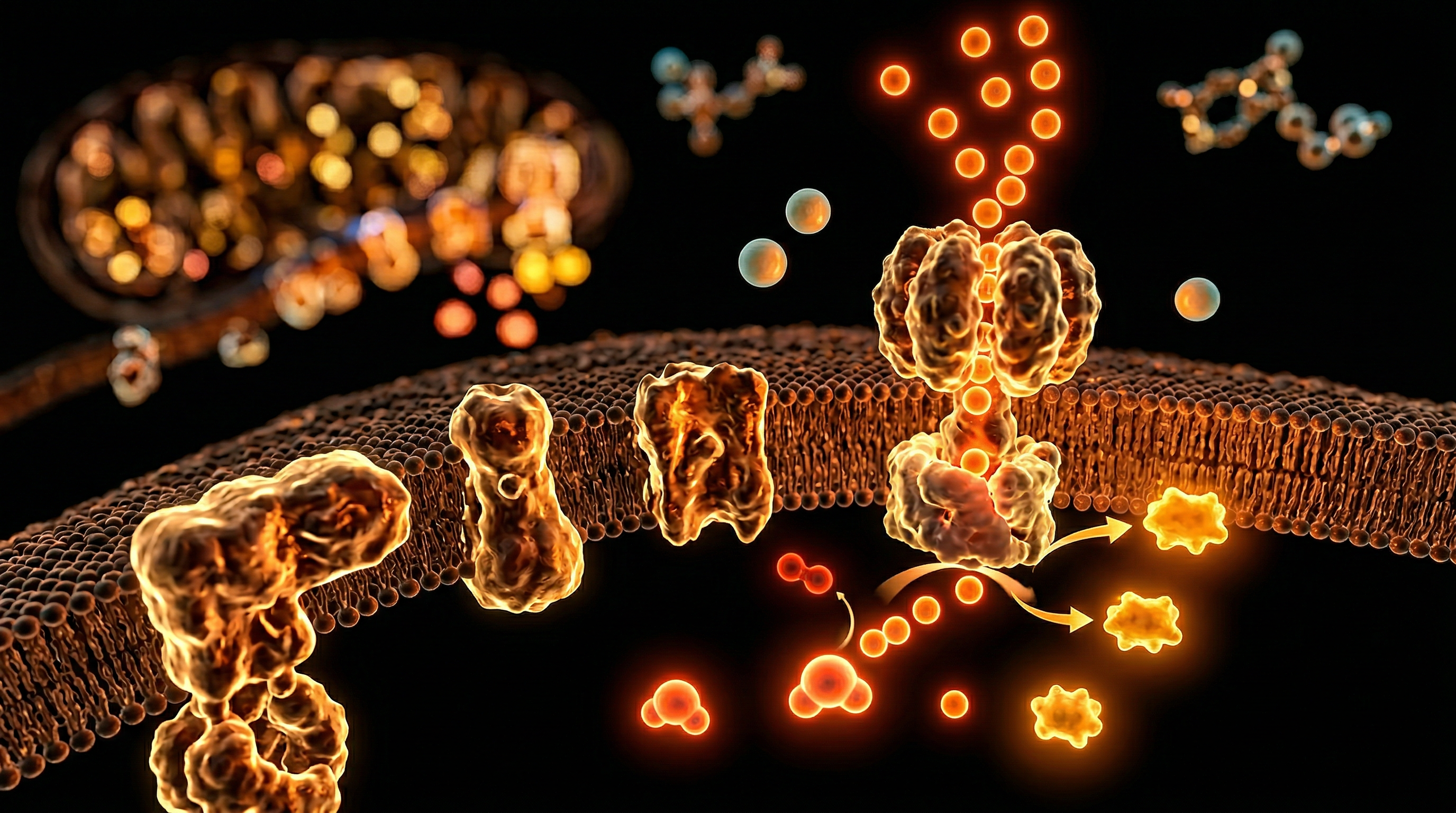
The primary victim of deuterium toxicity is the ATP Synthase nanomotor. These incredible protein complexes are embedded in the inner mitochondrial membrane. They function like microscopic water wheels or revolving doors, spinning at rates of 6,000 to 9,000 revolutions per minute (RPM).
The Destruction of the Nanomotor
The ATP synthase motor is powered by the flow of protons. These protons fit perfectly into the "slots" of the motor's rotor (the c-ring). Because the motor is designed for the precise dimensions of a proton (protium), the introduction of a deuterium ion—which is twice the size and mass—is like throwing a massive boulder into a delicate turbine.
- Mechanical Damage: When deuterium enters the ATP synthase, it strikes the rotor with twice the force of hydrogen. This physical impact can bend or break the nanomotor, leading to immediate "stalling."
- Efficiency Drop: A stalled motor cannot produce ATP (Adenosine Triphosphate), the energy currency of the cell. This leads to a drop in cellular voltage.
- Leaky Membranes: To compensate for the broken motors, the mitochondria may become "leaky," allowing protons to bypass the motor entirely. This generates heat (thermogenesis) but no usable energy, leading to metabolic inefficiency.
The TCA Cycle as a Filter
The Tricarboxylic Acid (TCA) Cycle, also known as the Krebs Cycle, is more than just a way to harvest electrons. It is a sophisticated isotopic filtration system. Various enzymes within the cycle, such as fumarase and aconitase, are highly "stereospecific." They are designed to preferentially select protium and shunt deuterium away from the mitochondrial matrix.
Structured Water and the Exclusion Zone
Dr Gerald Pollack’s research into EZ (Exclusion Zone) water has shown that biological water exists in a fourth phase—a gel-like, liquid crystalline state. This EZ water forms near hydrophilic surfaces (like cellular membranes) and pushes out solutes. Deuterium, due to its mass and its effect on the hydrogen bond angle, disrupts the formation of this crystalline lattice.
High deuterium levels prevent water from "structuring" properly. Without structured water, proteins cannot fold correctly, enzymes cannot find their targets, and the cell’s internal communication system—which relies on proton semiconduction—breaks down.
Fact: The bond between Deuterium and Oxygen is shorter and stronger than the bond between Hydrogen and Oxygen. This alters the geometry of the water molecule, changing the freezing point, boiling point, and the way it interacts with DNA.
Environmental Threats and Biological Disruptors
In the pre-industrial era, the level of deuterium in the environment was relatively stable and lower than it is today. However, several factors in the modern world have led to a "Deuterium Deluge" that our biological systems are struggling to process.
The Modern Diet: C4 Plants and Processed Sugar
One of the greatest sources of deuterium in the modern diet is the shift toward C4 plants. Plants use different photosynthetic pathways to fix carbon and hydrogen.
- C3 Plants: Most vegetables, nuts, and temperate fruits. These plants naturally deplete deuterium from their tissues.
- C4 Plants: Corn, sugar cane, and some grasses. These plants are "deuterium concentrators."
The modern food supply is built on corn-derived ingredients (high fructose corn syrup) and cane sugar. By consuming these, humans are bypassing the natural isotopic filters of the ecosystem. Furthermore, the animals we eat are often "finished" on corn and soy, meaning their fat—which should be a source of deuterium-depleted metabolic water—is instead loaded with heavy hydrogen.
Global Warming and the Hydrological Cycle
Deuterium is heavier than hydrogen, which means it evaporates less easily and condenses more readily. This is known as fractionation. As global temperatures rise, the rate of evaporation increases, but the heavier deuterium-rich water tends to remain in the lower latitudes and in surface waters.
- Surface Water: Lakes and rivers, especially in warmer climates, have higher deuterium levels (approx. 150-155 ppm).
- Glacial Water: Historically, humans drank more water from high-altitude or high-latitude sources, which are naturally depleted (approx. 130-140 ppm).
Pharmaceutical and Chemical Interference
Many modern pharmaceuticals and pesticides (like glyphosate) interfere with the enzymes involved in the TCA cycle. When these enzymes are inhibited, the body’s ability to discriminate between hydrogen and deuterium is compromised. This allows deuterium to leak into the mitochondria even if the dietary intake is relatively low.
The Role of GMOs
Genetically modified crops are often designed to withstand heavy chemical applications. These plants often have altered metabolic pathways that do not discriminate against deuterium as effectively as heirloom varieties. When we consume these "heavy" plants, we are essentially importing biological chaos.
The Cascade: From Exposure to Disease
When the deuterium load exceeds the body's capacity for depletion, a predictable cascade of cellular degradation begins. This is not an acute poisoning, but a slow, progressive "rusting" of the biological machinery.
1. Mitochondrial Dysfunction
The first sign of deuterium overload is a decrease in the Oxygen Consumption Rate (OCR) and a shift toward glycolysis (fermentation). Because the ATP synthase motors are broken, the cell can no longer produce energy via oxidative phosphorylation. It reverts to a more primitive form of energy production—burning sugar in the cytoplasm.
2. Chronic Fatigue and Brain Fog
The brain is the most energy-intensive organ in the body. It relies heavily on mitochondrial efficiency. When deuterium accumulates in the neurons, the "proton wiring" of the brain becomes sluggish. This manifests as cognitive decline, loss of focus, and chronic exhaustion that cannot be solved by sleep alone.
3. Cancer: The Ultimate Isotopic Failure
The "Warburg Effect"—the observation that cancer cells ferment sugar even in the presence of oxygen—is directly linked to deuterium. Research by Dr Gábor Somlyai has shown that high deuterium levels are a prerequisite for rapid cell division (mitosis).
Statistic: Studies have demonstrated that lowering deuterium levels to below 130 ppm can inhibit the growth of various cancer cell lines and induce apoptosis (cell death) in tumour cells without harming healthy tissue.
Cancer cells lack the ability to deplete deuterium. In fact, they seem to thrive on it. The heavy isotope stabilises the DNA in a way that promotes "unzipping" for replication. By removing deuterium, we effectively "starve" the cancer of the isotopic environment it requires to proliferate.
4. Metabolic Syndrome and Obesity
Obesity can be viewed as the body’s attempt to store "dirty fuel" it cannot safely burn. If the fat we consume is high in deuterium (from grain-fed animals or seed oils), the mitochondria struggle to process it. The body, sensing the damage to the nanomotors, shuts down fat burning and stores the lipids instead. This creates a vicious cycle of weight gain and further metabolic slowing.
What the Mainstream Narrative Omits
The silence regarding deuterium in mainstream nutritional science is deafening. While "macro-nutrients" and "micro-nutrients" are discussed ad nauseam, the isotopic composition of those nutrients is entirely ignored. This omission is not accidental; it is a result of a scientific paradigm that refuses to look deeper than the molecular level.
The "Calorie is a Calorie" Fallacy
Mainstream dietetics treats all calories as equal. However, from a deuterium perspective, 100 calories of carbohydrate and 100 calories of fat are radically different.
- Carbohydrates (especially from C4 plants) carry a high deuterium load and are processed in the cytoplasm.
- Fats (especially saturated fats from grass-fed animals) are processed deep within the mitochondria, where the deuterium-filtering enzymes are most active.
By ignoring the isotopic quality of food, the mainstream narrative encourages diets (high-carb, low-fat) that actively flood the body with deuterium, ensuring a lifetime of dependency on metabolic medications.
The Hydration Myth
The "drink 2 litres of water a day" advice fails to distinguish between source and type. If that water is high-deuterium tap water, it may actually be dehydrating the cell at a functional level by disrupting the formation of structured metabolic water. True hydration is about the ability of the mitochondria to create its own water. You cannot "drink" your way out of a mitochondrial water deficit if your nanomotors are broken.
Pharmaceutical Interests
There is little profit in "deuterium depletion." You cannot patent naturally depleted water or the process of fasting. The pharmaceutical industry relies on managing the symptoms of mitochondrial failure—diabetes, heart disease, and depression—rather than addressing the sub-atomic cause. Recognising deuterium as a primary driver of disease would invalidate a significant portion of the current pharmacological catalogue.
The UK Context
In the United Kingdom, the deuterium problem is particularly acute due to a combination of geography, water management, and the "Westernised" British diet.
The Geography of UK Water
The UK’s water supply is varied, but several factors contribute to high deuterium levels:
- Southern England: Much of the water in London and the South East comes from groundwater and rivers in relatively low-lying, warmer areas. These sources often have deuterium levels near the 150-155 ppm range.
- Hard Water Areas: The "hardness" of water in the UK (high calcium and magnesium) often masks the isotopic quality. While minerals are beneficial, they do not mitigate the presence of heavy hydrogen.
- The Gulf Stream: The UK’s climate is heavily influenced by the Gulf Stream, which brings warm, deuterium-rich moisture from the tropics. This moisture precipitates as rain across the British Isles, ensuring that our local produce and water sources are higher in deuterium than those in continental, high-altitude regions like the Alps.
The British Diet and "Hidden" Deuterium
The UK has one of the highest rates of ultra-processed food consumption in Europe.
- Bread and Cereals: Much of the wheat used in British bread is imported or grown with intensive fertilisers that alter the plant’s natural hydrogen handling.
- Vegetable Oils: The UK diet is saturated with "seed oils" (rapeseed, sunflower), which are highly deuterated due to their processing and the types of plants used.
- The Loss of Traditional Fats: The shift away from traditional British fats like suet, tallow, and butter—which are naturally low in deuterium if the animals are pasture-raised—has removed a key protective element from the national diet.
Historical Scientific Legacy
Ironically, the UK was home to one of the pioneers of this field. Peter Mitchell, the British biochemist who won the Nobel Prize in 1978, discovered the chemiosmotic mechanism—the very process by which mitochondria use proton gradients to create ATP. While Mitchell focused on protons, the modern understanding of deuterium depletion is the natural evolution of his work. Unfortunately, the UK scientific establishment has been slow to integrate these sub-atomic insights into clinical practice.
Protective Measures and Recovery Protocols
Reducing your deuterium burden is not about "detoxing" in the traditional sense; it is about changing the isotopic ratio of your body’s fuel and water over time. This process is known as Deuterium Depletion Therapy (DDT).
1. Source Deuterium-Depleted Water (DDW)
The most direct way to lower levels is to consume water that has been mechanically depleted.
- Standard water is ~150 ppm.
- Therapeutic DDW is typically between 25 ppm and 125 ppm.
By drinking DDW, you create a concentration gradient that "pulls" deuterium out of your tissues and replaces it with light hydrogen.
2. The High-Fat, Low-Carb (Keto) Strategy
Fat is the preferred fuel for deuterium depletion.
Fact: For every 100 grams of fat you burn, your body produces approximately 110 grams of deuterium-depleted metabolic water.
By contrast, burning carbohydrates produces less metabolic water and introduces more deuterium into the system. A ketogenic diet, focusing on animal fats (tallow, lard, butter) and C3 plant fats (avocado, olive oil, macadamia), is the most effective dietary intervention for mitochondrial repair.
3. Time-Restricted Feeding and Fasting
When you fast, your body is forced to burn its own stored fat. This fat is processed through the mitochondria, producing pure, depleted metabolic water. Fasting is essentially an internal "distillation" programme that cleanses the nanomotors of isotopic debris.
4. Sunlight and IR Exposure
Infrared light (from the sun or IR saunas) helps build the Exclusion Zone (EZ) water in your cells. This structured water layer naturally excludes deuterium. Sunlight also stimulates the efficiency of the TCA cycle, enhancing your body’s natural ability to filter out heavy hydrogen.
5. Cold Thermogenesis
Exposure to cold forces the body to burn "brown fat" to maintain temperature. This process (non-shivering thermogenesis) is a massive producer of metabolic water and is perhaps the fastest way to "flush" the mitochondrial matrix.
6. Sleep and Melatonin
Melatonin is not just a sleep hormone; it is a powerful mitochondrial antioxidant. It helps repair the membranes that house the ATP synthase motors. Deep sleep in a dark environment is essential for the nightly "maintenance" of your isotopic filters.
Summary: Key Takeaways
The science of Deuterium Depletion represents a paradigm shift in our understanding of health and disease. It moves the conversation beyond mere molecules and into the realm of sub-atomic physics.
- Deuterium is a "Heavy" Saboteur: Its extra neutron doubles its mass, allowing it to physically damage mitochondrial nanomotors and disrupt the quantum flow of protons.
- Metabolic Water is the Key: The water produced inside your mitochondria is the most important fluid in your body. Its purity determines your cellular "voltage."
- The Modern World is Deuterated: From C4 crops (corn/sugar) to warm-source tap water and processed oils, we are being flooded with heavy hydrogen.
- Chronic Disease is Isotopic Failure: Cancer, obesity, and neurodegeneration are all linked to the accumulation of deuterium and the subsequent collapse of mitochondrial function.
- Depletion is Possible: Through the consumption of DDW, a high-fat diet, fasting, and sunlight exposure, we can purge the heavy hydrogen and restore our biological integrity.
In an age of escalating chronic illness, the "Structured Water & Hydration Science" of deuterium depletion offers a path back to fundamental health. It is time we stop looking at the quantity of our hydration and start focusing on its isotopic quality. The integrity of your cellular water is the integrity of your life.
This article is provided for informational and educational purposes only. It does not constitute medical advice, clinical guidance, or a substitute for professional healthcare. Information reflects cited research at time of publication. Always consult a qualified healthcare professional before acting on any health information.
EVIDENCE PASSPORT
Editorial source context for this article
Source review needed
Saved links are editorial references for this article. They may support specific claims rather than every sentence. Open and assess each source in context. This passport does not independently verify them.
Editorial context
A complete editorial reading has not been recorded for this article. Source links remain available for you to open and assess directly.
Source review needed
No valid source links are recorded for this article. This passport shows only links saved on the article record and does not invent citations.
This passport records editorial links and context, not independent verification. Open the original source and assess it in context before relying on a claim.
Medical Disclaimer
The information in this article is for educational purposes only and does not constitute medical advice, diagnosis, or treatment. Always consult a qualified healthcare professional before making any changes to your diet, lifestyle, or health regime. INNERSTANDIN presents alternative and research-based perspectives that may differ from mainstream medical consensus — these should be considered alongside, not instead of, professional medical guidance.
Read Full DisclaimerContinue the thread
Keep this question moving.
Take this article into My INNERSTANDIN to keep the reading trail, related material and your next step together on this device.