
Environmental Endpoints: How Industrial Toxins Damage the Mitochondrial Engine
Updated May 2026
Modern industrial toxins, from heavy metals to common pesticides, specifically target mitochondrial pathways. This article identifies the most common environmental threats and how to shield your cellular energy from these invisible stressors.
Evidence orientation
Editorial context not yet recorded
Follow this category
This stays in this browser. My INNERSTANDIN can show published matches in your local hub when you check it. It does not send email, push, or alert notifications.
Local learning review
A private browser aid for revisiting ideas. It is not an alert or a health recommendation.
Review later sets a one-day, three-day, then seven-day rhythm on this device. Choose it only when you want to revisit this article.
Overview
We exist in a state of biological paradox. While human longevity has technically increased due to the eradication of acute infectious diseases and advancements in emergency medicine, our cellular vitality is in a state of precipitous decline. At the heart of this decline lies a microscopic victim: the mitochondrion. No longer viewed merely as the "powerhouse of the cell" in the simplistic terms of secondary school biology, the mitochondrion is now recognised by leading-edge researchers as the central sensor of environmental safety and the ultimate arbiter of life and death.
The modern industrial landscape is not merely an external environment; it is a pervasive, chemically aggressive reality that permeates our biological barriers. From the organophosphates sprayed across the rolling hills of the British countryside to the heavy metal particulates suspended in the air of our congested urban centres, the "environmental endpoint" of these toxins is the mitochondrial matrix.
This article serves as an exposé on the systematic degradation of the human energy engine. We will move beyond the superficial discussions of "pollution" and "toxins" to examine the precise molecular mechanisms by which industrial byproducts sabotage the Electron Transport Chain (ETC), mutate mitochondrial DNA (mtDNA), and trigger a state of chronic cellular "danger response" that underpins the modern epidemic of fatigue, neurodegeneration, and metabolic collapse. The truth, often obscured by regulatory bodies and industrial interests, is that our environment has become a minefield for the very organelles that allow us to breathe, think, and thrive.
Key Fact: Mitochondria are the only organelles outside the nucleus that possess their own DNA. Unlike nuclear DNA, mitochondrial DNA (mtDNA) lacks the protective shielding of histone proteins, making it up to 15 times more susceptible to environmental oxidative damage.
##
The Biology — How It Works
To understand the scale of the damage, we must first appreciate the staggering complexity of the mitochondrial engine. Each cell in the human body (with the exception of red blood cells) contains hundreds to thousands of these organelles. In high-energy tissues like the myocardium (heart muscle), the substantia nigra (brain), and the retina, mitochondria can account for up to 40% of the total cytoplasmic volume.
The Architecture of Energy
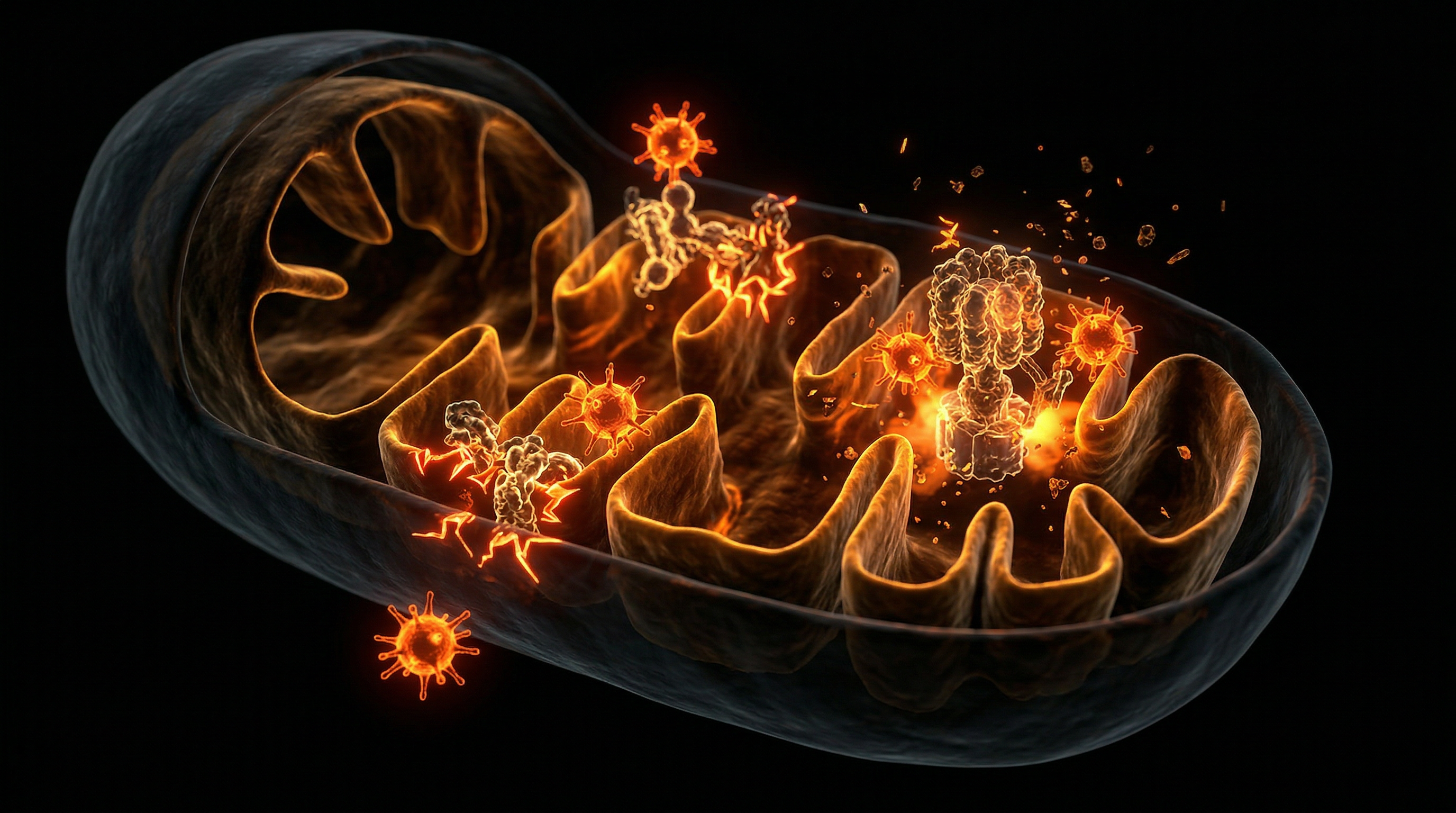
The mitochondrion is defined by its double-membrane structure. The Inner Mitochondrial Membrane (IMM) is the most sophisticated biological border in existence. It is folded into structures called cristae, which vastly increase the surface area available for the primary function of the organelle: Oxidative Phosphorylation (OXPHOS).
The process of energy production involves the movement of electrons through a series of multi-protein complexes (Complexes I through IV). This movement acts as a molecular pump, driving protons (H+ ions) from the mitochondrial matrix into the intermembrane space. This creates an electrochemical gradient—essentially a biological battery. The final stage occurs when these protons flow back through ATP Synthase (Complex V), a literal rotary motor that spins at speeds of up to 150 revolutions per second to manufacture Adenosine Triphosphate (ATP), the universal currency of biological energy.
The Fragility of the Matrix
Within the mitochondrial matrix sits the mtDNA. Because mitochondria are evolutionary descendants of ancient alphaproteobacteria, their DNA is circular and compact. However, this ancient heritage comes with a significant vulnerability. Because the ETC is a constant source of Reactive Oxygen Species (ROS) as a natural byproduct of oxygen metabolism, the mtDNA is perpetually bathed in a corrosive environment.
In a healthy state, the body’s endogenous antioxidant systems—primarily Glutathione Peroxidase and Superoxide Dismutase (SOD)—neutralise these free radicals instantly. However, industrial toxins disrupt this delicate equilibrium, turning the cell’s power plant into a site of internal combustion.
##
Mechanisms at the Cellular Level
Industrial toxins do not "accidentally" harm the body; they target specific mitochondrial pathways with surgical precision. There are four primary mechanisms through which environmental stressors dismantle the energy engine.
1. Competitive Inhibition of the Electron Transport Chain
Many toxins act as "molecular wrenches" thrown into the gears of the ETC. For example, Cyanide and Carbon Monoxide are well-known inhibitors of Cytochrome c Oxidase (Complex IV), effectively suffocating the cell even in the presence of oxygen. However, more insidious are the modern "sub-lethal" toxins like certain pesticides and fungicides that bind to Complex I (NADH:ubiquinone oxidoreductase). This blockage causes electrons to "leak" prematurely, reacting with molecular oxygen to form the superoxide radical, the precursor to systemic oxidative stress.
2. Uncoupling of Oxidative Phosphorylation
Under normal conditions, the "burning" of calories is strictly coupled to the production of ATP. Certain industrial chemicals, specifically halogenated phenols and phthalates found in plastics, act as uncouplers. They punch holes in the electrochemical gradient, allowing protons to leak back into the matrix without passing through the ATP Synthase motor. The result is "wasted" energy that is dissipated as heat, leading to a state of cellular starvation despite high caloric intake—a hallmark of modern metabolic dysfunction.
3. Thiol-Binding and Glutathione Depletion
The mitochondrial defence system relies heavily on thiols (sulphur-containing groups). Heavy metals such as Mercury (Hg) and Arsenic (As) have an incredibly high affinity for these thiol groups. When these metals enter the mitochondria, they bind to and deactivate Glutathione, the "master antioxidant," and enzymes like Thioredoxin Reductase. This leaves the mitochondria utterly defenceless against the ROS generated during energy production, leading to a "meltdown" of the internal membranes.
4. Opening of the Mitochondrial Permeability Transition Pore (mPTP)
The mPTP is the mitochondrion's "self-destruct" button. When the organelle is under extreme stress from toxins or calcium overload, this pore opens, causing the mitochondrion to swell and burst. This releases Cytochrome c into the cytoplasm, which signals the cell to undergo apoptosis (programmed cell death). When this happens on a mass scale in the brain or heart, we see the clinical manifestation of neurodegenerative and cardiovascular diseases.
##
Environmental Threats and Biological Disruptors
The list of mitochondrial toxins is extensive, but four categories stand out as the most pervasive and damaging in our modern industrial landscape.
Heavy Metals: The Silent Conductors of Decay
Heavy metals are perhaps the most potent mitochondrial poisons due to their ability to persist in the body for decades.
- Mercury: Found in "silver" dental amalgams and contaminated seafood, mercury is a potent inhibitor of pyruvate dehydrogenase, the enzyme that links glycolysis to the mitochondrial Krebs cycle. Without this link, the cell cannot efficiently burn glucose for fuel.
- Lead: Even at levels the Environment Agency considers "low," lead displaces calcium in mitochondrial signaling pathways and damages the IMM, leading to cognitive decline and hypertension.
- Cadmium: Ubiquitously found in phosphate fertilisers and cigarette smoke, cadmium accumulates in the mitochondria of the kidneys and liver, where it destroys the integrity of the cristae.
Pesticides and Herbicides: The Agricultural Sabotage
The UK’s agricultural sector remains heavily reliant on chemicals that are direct mitochondrial toxins.
- Glyphosate: While the mainstream narrative focuses on its potential carcinogenicity, glyphosate’s true danger may be its role as a chelator. It binds to essential mitochondrial co-factors like manganese and zinc, rendering them unavailable for the enzymes that protect mtDNA.
- Rotenone and Paraquat: These are used specifically in laboratory settings to induce Parkinson’s disease in animal models because they are so effective at destroying Complex I of the mitochondria. Yet, derivatives of these compounds persist in the global food supply.
Air Pollution: The Invisible Inhalant
Particulate Matter (PM2.5) is small enough to pass directly from the lungs into the bloodstream and across the blood-brain barrier. Research has shown that these particles often carry a "hitchhiker" load of Polycyclic Aromatic Hydrocarbons (PAHs). Once inside the cell, these PAHs are metabolised into quinones that directly interfere with Coenzyme Q10, the vital electron carrier that shuttles energy between Complex II and III.
Persistent Organic Pollutants (POPs) and Plastics
Bisphenol A (BPA) and Phthalates are not just endocrine disruptors; they are "mitogens" in the worst sense. They alter mitochondrial biogenesis—the process by which cells create new mitochondria. Exposure to these chemicals often results in a population of "broken" mitochondria that are smaller, less efficient, and prone to leaking pro-inflammatory signals.
Alarming Statistic: Studies indicate that the average person is now exposed to over 700 synthetic chemicals daily, many of which have never been tested for their synergistic impact on mitochondrial function.
##
The Cascade: From Exposure to Disease
The damage to the "mitochondrial engine" does not remain localised within the cell. It triggers a systemic cascade that mirrors the most common chronic illnesses of the 21st century.
Neurodegeneration: The High-Energy Victim
The brain consumes roughly 20% of the body's total oxygen, despite being only 2% of its weight. This makes it the "canary in the coal mine" for mitochondrial failure. In Alzheimer’s and Parkinson’s, researchers consistently find a "bioenergetic deficit" that precedes the appearance of plaques or tremors by decades. When the mitochondria in neurons cannot produce enough ATP to maintain ion gradients, the neurons become hyper-excitable and eventually die.
Metabolic Syndrome and Type 2 Diabetes
Contrary to the "overeating" narrative, metabolic syndrome can be viewed as a failure of mitochondrial flexibility. When the mitochondria are damaged by industrial toxins, they lose the ability to switch between burning glucose and burning fat. This leads to an accumulation of "metabolic sludge"—lipids and glucose backed up in the bloodstream—because the mitochondrial furnace is essentially broken.
Chronic Fatigue Syndrome (CFS/ME) and Fibromyalgia
For decades, these conditions were dismissed as psychosomatic. We now know better. Patients with CFS consistently show profound abnormalities in mitochondrial function, including reduced maximal oxidative capacity and high levels of nitrative stress. Their "engines" are stuck in a low-power mode as a protective response to a perceived toxic threat—a phenomenon known as the Cell Danger Response (CDR).
The Cancer Connection
The Warburg Effect describes how cancer cells shift from mitochondrial respiration to primitive fermentation (glycolysis). We now recognise that this shift is often a survival mechanism. When the mitochondria are too damaged by environmental toxins to function, the cell must either die or revert to a more primitive, fermentative state of energy production to survive. This "survival at all costs" is the hallmark of malignancy.
##
What the Mainstream Narrative Omits
The current medical and regulatory discourse is dangerously reductive. It operates on the "poison is in the dose" philosophy—a 16th-century concept that is entirely inadequate for 21st-century toxicology.
The Failure of "Safe Limits"
The FSA (Food Standards Agency) and the MHRA (Medicines and Healthcare products Regulatory Agency) set "Acceptable Daily Intakes" (ADIs) for toxins based on isolated, short-term animal studies. These "safe limits" fail to account for:
- Bioaccumulation: Toxins like mercury and lead have half-lives in human bone and tissue measured in decades, not days.
- The Cocktail Effect: We are never exposed to one toxin in isolation. The synergy between aluminium (from cookware or deodorants) and fluoride (from water) can increase the neurotoxicity of both by orders of magnitude.
- Epigenetic Transgenerational Inheritance: Mitochondrial damage in a mother can be passed directly to her offspring through the cytoplasm of the egg, meaning the "environmental endpoint" of one generation becomes the starting point of the next.
The Mitochondrial "Danger Response"
Mainstream medicine views symptoms as the enemy. However, the work of researchers like Dr. Robert Naviaux suggests that many symptoms are actually the result of the Cell Danger Response. When mitochondria sense industrial toxins, they intentionally shut down energy production and stiffen the cell membrane to prevent the spread of "infection" or "threat." If the toxic trigger is never removed, the cell remains stuck in this "wartime metabolism," leading to chronic illness. The mainstream narrative focuses on "managing" the symptoms of the CDR rather than removing the environmental triggers that keep the mitochondria in a state of alarm.
##
The UK Context
In the United Kingdom, the threat to mitochondrial health is shaped by our unique industrial history and current regulatory landscape.
The Legacy of the Industrial Revolution
Britain was the first nation to industrialise, and we carry that burden in our soil and water. Former industrial heartlands in the North and Midlands still show significantly elevated levels of heavy metals in the topsoil. For those living in Victorian-era housing, the presence of lead piping remains a silent contributor to the national toxic load, despite ongoing replacement programmes.
Water Quality and the Environment Agency
The state of UK waterways is currently a matter of national scandal. Beyond the high-profile sewage spills, our water supply contains a "chemical soup" of prescription drug residues (including mitochondrial-toxic antibiotics like fluoroquinolones), microplastics, and agricultural runoff. The Environment Agency has been criticized for its inability to adequately monitor or penalise the discharge of "forever chemicals" (PFAS) which are known to interfere with mitochondrial fatty acid metabolism.
Post-Brexit Regulatory Divergence
Following the UK's departure from the European Union, there are significant concerns regarding the divergence from REACH (Registration, Evaluation, Authorisation and Restriction of Chemicals), the world’s most stringent chemical regulatory framework. As the UK establishes its own "UK REACH," there is a risk that "mitochondrial safety" will be sacrificed on the altar of "regulatory flexibility," allowing chemicals that are restricted in the EU to remain in the British market.
##
Protective Measures and Recovery Protocols
While the environmental situation is dire, the mitochondrion possesses a remarkable capacity for repair and regeneration—a process known as mitophagy (the clearing out of damaged mitochondria) and biogenesis (the creation of new ones).
1. Upregulating the Nrf2 Pathway
The Nrf2 pathway is the body’s "master switch" for antioxidant production. Activating this pathway instructs the cell to produce more endogenous glutathione and SOD.
- Sulforaphane: Found in broccoli sprouts, this is the most potent natural activator of Nrf2.
- Resveratrol and Pterostilbene: These polyphenols activate Sirtuins, enzymes that coordinate mitochondrial repair and longevity.
2. Mitochondrial Nutrient Support
To bypass the "molecular wrenches" of industrial toxins, we can provide the mitochondria with high doses of essential co-factors:
- Coenzyme Q10 (Ubiquinol): Directly supports the transfer of electrons in the ETC, bypassing certain toxic blockages.
- PQQ (Pyrroloquinoline Quinone): One of the few substances known to stimulate mitochondrial biogenesis in aging cells.
- Magnesium (Malate or Bisglycinate): Magnesium is required for every single step of ATP production. Most industrial toxins cause the cell to "dump" magnesium, making supplementation essential.
- N-Acetyl Cysteine (NAC): The rate-limiting precursor to glutathione, crucial for neutralising heavy metals.
3. Hormetic Stressors
The "engine" needs to be challenged to stay efficient.
- Photobiomodulation (Red Light Therapy): Specifically, light in the 660nm to 850nm range penetrates the tissues and is absorbed by Cytochrome c Oxidase, boosting the efficiency of the ETC.
- Thermal Stress: Using a sauna (especially infrared) assists in the excretion of heavy metals and plastics through sweat, while also triggering Heat Shock Proteins that help refold damaged mitochondrial proteins.
- Intermittent Fasting: Triggers mitophagy, allowing the body to "cannibalise" damaged, toxin-laden mitochondria and replace them with healthy ones.
4. Environmental Remediation
- Water Filtration: Utilising high-quality Reverse Osmosis (RO) or multistage carbon filtration is non-negotiable in the UK to remove fluoride, lead, and pharmaceutical residues.
- Air Purification: In urban areas, HEPA filters with activated carbon stages are necessary to capture PM2.5 and volatile organic compounds (VOCs).
- Choosing Organic: Reducing the "Total Toxic Load" by opting for organic produce significantly lowers the intake of mitochondrial-toxic pesticides like glyphosate.
##
Summary: Key Takeaways
The modern health crisis is, at its core, a crisis of bioenergetics. We have built a world that is fundamentally incompatible with the ancient, delicate machinery of our mitochondria.
- The Mitochondrial Engine is the ultimate endpoint for environmental toxins; damage here manifests as systemic disease.
- Industrial Chemicals like heavy metals, pesticides, and plastics do not just "cause inflammation"; they physically dismantle the Electron Transport Chain and mutate mtDNA.
- Regulatory Failures in the UK and globally mean that "safe limits" do not account for the cumulative, synergistic, and transgenerational impact of toxins on cellular energy.
- Neurodegeneration, Cancer, and Chronic Fatigue are all clinical expressions of mitochondrial failure—often the result of the "Cell Danger Response" being perpetually triggered.
- Recovery is Possible through the strategic use of Nrf2 activators, targeted mitochondrial nutrients, hormetic stressors like sauna and red light, and aggressive environmental remediation.
We must stop viewing our health as separate from our environment. Every breath we take and every drop of water we drink is either fuel for our mitochondrial engine or sand in its gears. To reclaim our vitality, we must first recognise the invisible stressors of the modern world and take radical responsibility for the protection of our cellular power plants. The engine of life is under siege; it is time to fortify its defences.
This article is provided for informational and educational purposes only. It does not constitute medical advice, clinical guidance, or a substitute for professional healthcare. Information reflects cited research at time of publication. Always consult a qualified healthcare professional before acting on any health information.
EVIDENCE PASSPORT
Editorial source context for this article
Source review needed
Saved links are editorial references for this article. They may support specific claims rather than every sentence. Open and assess each source in context. This passport does not independently verify them.
Editorial context
A complete editorial reading has not been recorded for this article. Source links remain available for you to open and assess directly.
Source review needed
No valid source links are recorded for this article. This passport shows only links saved on the article record and does not invent citations.
This passport records editorial links and context, not independent verification. Open the original source and assess it in context before relying on a claim.
Medical Disclaimer
The information in this article is for educational purposes only and does not constitute medical advice, diagnosis, or treatment. Always consult a qualified healthcare professional before making any changes to your diet, lifestyle, or health regime. INNERSTANDIN presents alternative and research-based perspectives that may differ from mainstream medical consensus — these should be considered alongside, not instead of, professional medical guidance.
Read Full DisclaimerContinue the thread
Keep this question moving.
Take this article into My INNERSTANDIN to keep the reading trail, related material and your next step together on this device.
Explore this in the Body Map
See where this hits your biology. Interactive anatomy, threats, and protective protocols.
Dig deeper in the Library
Free, longform PDF volumes that go beyond headlines into mechanisms and references.