
Understanding Hashimoto's Disease and Iodine Sensitivity
Updated May 2026
An analytical look at the complex relationship between autoimmune thyroiditis and iodine, providing insights into why sensitivity varies among patients with Hashimoto's.
Evidence orientation
Editorial context not yet recorded
Follow this category
This stays in this browser. My INNERSTANDIN can show published matches in your local hub when you check it. It does not send email, push, or alert notifications.
Local learning review
A private browser aid for revisiting ideas. It is not an alert or a health recommendation.
Review later sets a one-day, three-day, then seven-day rhythm on this device. Choose it only when you want to revisit this article.
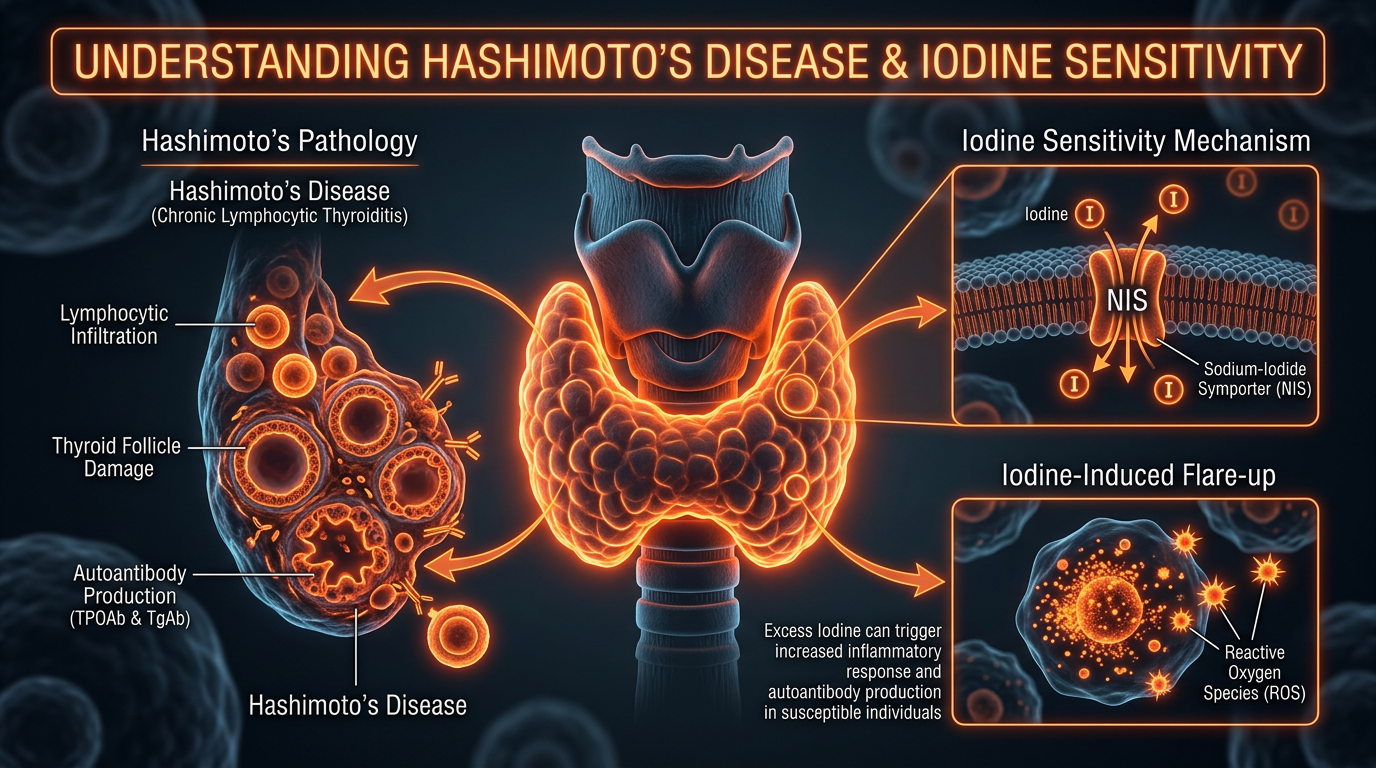
The current landscape of British endocrinology is facing a silent crisis. Despite the widespread prescription of Levothyroxine—the third most prescribed medication in the United Kingdom—the clinical outcomes for millions of patients remain suboptimal. We are witnessing an epidemic of Hashimoto’s Thyroiditis, an autoimmune assault on the thyroid gland that is frequently mismanaged as a simple hormone deficiency.
At the heart of this mismanagement lies a profound misunderstanding of the relationship between the immune system, the thyroid, and the halogen element: Iodine. To truly understand Hashimoto’s is to look beyond the TSH (Thyroid Stimulating Hormone) lab reference range and peer into the cellular mechanisms of molecular mimicry, oxidative stress, and environmental toxicity.
The Biological Battlefield: TPO, TG, and the Mechanism of Self-Destruction
Hashimoto’s Thyroiditis is not a disease of the thyroid; it is a disease of the immune system that manifests in the thyroid. The pathology is characterised by the lymphocytic infiltration of the thyroid gland, primarily by T-cells, leading to the destruction of thyroid follicular cells.
Two primary antibodies drive this destruction:
- Thyroid Peroxidase (TPO) Antibodies: These target the enzyme responsible for the oxidation of iodide—a crucial step in hormone synthesis.
- Thyroglobulin (TG) Antibodies: These target the protein scaffold where thyroid hormones are manufactured.
In the United Kingdom, it is estimated that autoimmune thyroid disease affects approximately 1 in 20 people, with women being ten times more likely to be diagnosed than men. Current NHS data suggests that thyroid disorders account for over 25 million prescriptions annually, yet a significant percentage of patients report persistent fatigue and brain fog despite "normal" lab results.
The "truth" that remains frequently ignored in clinical settings is that the presence of these antibodies precedes the rise in TSH by years, sometimes decades. By the time a patient is diagnosed with hypothyroidism, the thyroid has often sustained irreversible structural damage.
Molecular Mimicry and the Gut-Thyroid Axis
A critical driver of this autoimmune cascade is "molecular mimicry." This occurs when the immune system identifies foreign proteins—most notably gluten and certain bacterial lipopolysaccharides—as threats. Due to structural similarities between the amino acid sequences of these proteins and thyroid tissue, the immune system mistakenly attacks the thyroid.
- The Zonulin Connection: Increased intestinal permeability (leaky gut) allows undigested proteins into the bloodstream.
- The Cross-Reactivity Factor: Gliadin (the protein in wheat) bears a striking resemblance to the enzyme Thyroid Peroxidase.
- The Cytokine Storm: This chronic low-grade inflammation keeps the immune system in a state of hyper-vigilance, making the introduction of any stimulating substance—including iodine—potentially volatile.
The Iodine Paradox: Essential Nutrient or Autoimmune Catalyst?
Iodine is the primary building block of thyroid hormones (T4 and T3). Without it, life is impossible. However, in the context of Hashimoto’s, iodine acts as a "double-edged sword." This is the crux of the Iodine Paradox: how can a nutrient essential for thyroid function also be the primary trigger for its destruction?
The Oxidation Fire
When iodine enters the thyroid, it must be "organised"—converted from iodide to iodine. This process is mediated by the TPO enzyme and requires the production of Hydrogen Peroxide (H2O2).
In a healthy individual, this oxidative process is tightly controlled. However, in those with Hashimoto’s, the "fire" of H2O2 is often unbuffered. When high doses of iodine are introduced, it accelerates TPO activity, producing an excess of H2O2. This causes localized oxidative stress, damaging the thyroid follicles and exposing "hidden" thyroid proteins to the immune system, which then generates more antibodies.
The Wolff-Chaikoff Effect
The human body possesses a fail-safe mechanism known as the Wolff-Chaikoff effect. When the body is flooded with an excess of iodine, the thyroid temporarily shuts down hormone production to prevent thyrotoxicosis.
Statistical analysis from British nutritional surveys indicates that while the UK was once considered "iodine sufficient," certain demographics—particularly pregnant women and vegans—are now showing signs of moderate deficiency. Paradoxically, the reintroduction of iodine in an unbuffered state has been linked to a 15% increase in autoimmune thyroiditis incidence in previously deficient populations.
For a Hashimoto’s patient, the "escape" from the Wolff-Chaikoff effect is often flawed. Instead of resuming normal function, the thyroid may remain suppressed or trigger an aggressive inflammatory flare, leading to the "iodine sensitivity" reported by so many sufferers.
The Halogen Displacement Theory: The Invisible Antagonists
To understand why modern populations are so sensitive to iodine, we must look at the Periodic Table. Iodine is a halogen, sharing the same column as Fluoride, Bromide, and Chlorine.
In the 21st-century British environment, we are saturated with these "competitive inhibitors." Because they share a similar atomic structure, these lighter halogens can "kick" iodine out of its receptor sites in the human body.
- Fluoride: Found in the majority of UK tap water supplies and dental products. It is a known thyroid disruptor that inhibits the sodium-iodide symporter (NIS).
- Bromide: Found in "flame retardants" in furniture, certain medications, and as a "dough conditioner" in commercially baked British breads (potassium bromate).
- Chlorine: Used extensively in the UK water treatment process and swimming pools.
When the body’s receptors are saturated with Bromide and Fluoride, the introduction of Iodine causes a "detoxification reaction." The Iodine begins to displace the toxic halogens, pushing them back into the bloodstream. This displacement often causes symptoms—acne, headaches, irritability, and metallic taste—which are frequently misidentified as "iodine allergy" when they are, in fact, a sign of halogen toxicity.
The Synergistic Blueprint: Selenium as the Essential Buffer
The fatal flaw in both conventional and alternative thyroid protocols is the administration of iodine in isolation. Iodine should never be viewed as a solo player; it is part of a synergistic biological complex.
The most critical partner to Iodine is Selenium.
The Glutathione Connection
If iodine is the match that starts the fire of hormone production, Selenium is the chimney and the fire extinguisher. Selenium is a core component of selenoproteins, specifically glutathione peroxidase. This enzyme neutralises the excess Hydrogen Peroxide (H2O2) produced during iodine metabolism.
- Without Selenium: Iodine causes oxidative damage to the thyroid.
- With Selenium: The thyroid can safely process iodine, and TPO antibody levels have been shown in clinical trials to reduce by up to 40% over six months of supplementation.
Furthermore, Selenium is required for the deiodinase enzymes, which convert the inactive hormone T4 into the active T3. In the UK, soil depletion has led to a significant drop in selenium levels in domestic produce, exacerbating the Hashimoto’s crisis.
Recovery Protocols: Reclaiming the Endocrine Axis
Recovery from Hashimoto’s and the resolution of iodine sensitivity requires a phased, mechanistic approach. One cannot simply "supplement" their way out of an autoimmune crisis without addressing the underlying systemic instability.
Phase I: Extinguishing the Autoimmune Fire
Before introducing iodine, the "biological terrain" must be stabilised. This involves:
- Removal of Triggers: A strict elimination of gluten and dairy is non-negotiable for most Hashimoto’s patients due to the molecular mimicry mentioned earlier.
- Gut Restoration: Addressing intestinal permeability through the use of L-glutamine, collagen, and spore-based probiotics.
- Quenching Inflammation: High-dose Omega-3 fatty acids (EPA/DHA) and Curcumin to dampen the cytokine response.
Phase II: Nutritional Loading (The Buffers)
Before iodine is even considered, the body must be saturated with the co-factors required to handle it safely:
- Selenium: 200mcg daily (preferably as Selenomethionine or from Brazil nuts).
- Magnesium: Essential for the ATP-driven sodium-iodide symporter.
- Vitamin C: Supports the NIS and helps repair oxidative damage.
- Unrefined Sea Salt: Providing the sodium necessary for the transport of iodine into the cells.
Phase III: Micro-Dose Iodine Introduction
Once the patient is "Selenium-sufficient" and inflammation is lowered, iodine can be introduced—not in the milligram doses suggested by some "iodine protocols," but in micro-gram doses.
Starting with kelp or a high-quality Lugol's solution at very low concentrations allows the body to displace toxic halogens slowly, avoiding a "healing crisis" or an autoimmune flare.
The Truth Exposed: Beyond the TSH
The standard of care for Hashimoto’s in the UK is largely a "wait and see" approach. Patients are often told that their antibodies do not matter and that they must wait until their thyroid is sufficiently destroyed to justify Levothyroxine.
This is a failure of preventive medicine.
The "Innerstanding" of Hashimoto’s reveals that this is a manageable, and often reversible, condition. By addressing the "Holy Trinity" of thyroid health—gut integrity, halogen balance, and nutrient synergy—we can move beyond the limitations of pharmaceutical dependency.
Current clinical audits suggest that nearly 30% of patients on T4-only medication (Levothyroxine) continue to experience symptoms of hypothyroidism. This points to a failure of peripheral T4 to T3 conversion—a process heavily dependent on the very nutrients (Selenium, Zinc, Iodine) that are often ignored in a standard NHS consultation.
Conclusion: A New Paradigm of Thyroid Health
Hashimoto’s Disease and Iodine Sensitivity are not random acts of biological misfortune. They are the predictable results of an ancestral biological system clashing with a modern, halogen-saturated environment and a nutrient-depleted diet.
The path to recovery is not found in higher doses of synthetic T4, but in the meticulous restoration of the cellular environment. We must stop viewing the thyroid in isolation and begin treating it as the sensitive environmental sensor it truly is.
Only by acknowledging the "Truth" of the iodine-selenium-halogen relationship can we hope to stem the tide of autoimmune thyroiditis in the British population. It is time to move from "management" to "remission."
Summary of the Recovery Hierarchy
- Test, Don't Guess: Demand a full thyroid panel (TSH, FT4, FT3, Reverse T3, TPOAb, and TGAb).
- Calm the Immune System: Eliminate gluten and address the "Leaky Gut."
- Saturate the Buffers: Optimise Selenium, Magnesium, and Vitamin D levels.
- Displace the Toxins: Reduce exposure to Fluoride and Bromide to open the receptors for Iodine.
- Micro-dose Iodine: Reintroduce iodine under the protection of selenium to restore hormonal production without triggering oxidative stress.
The era of "one pill for one ill" is over. The future of thyroid health lies in the "Innerstanding" of the complex, beautiful, and fragile web of endocrine biochemistry.
This article is provided for informational and educational purposes only. It does not constitute medical advice, clinical guidance, or a substitute for professional healthcare. Information reflects cited research at time of publication. Always consult a qualified healthcare professional before acting on any health information.
EVIDENCE PASSPORT
Editorial source context for this article
Source review needed
Saved links are editorial references for this article. They may support specific claims rather than every sentence. Open and assess each source in context. This passport does not independently verify them.
Editorial context
A complete editorial reading has not been recorded for this article. Source links remain available for you to open and assess directly.
Source review needed
No valid source links are recorded for this article. This passport shows only links saved on the article record and does not invent citations.
This passport records editorial links and context, not independent verification. Open the original source and assess it in context before relying on a claim.
Medical Disclaimer
The information in this article is for educational purposes only and does not constitute medical advice, diagnosis, or treatment. Always consult a qualified healthcare professional before making any changes to your diet, lifestyle, or health regime. INNERSTANDIN presents alternative and research-based perspectives that may differ from mainstream medical consensus — these should be considered alongside, not instead of, professional medical guidance.
Read Full DisclaimerContinue the thread
Keep this question moving.
Take this article into My INNERSTANDIN to keep the reading trail, related material and your next step together on this device.
Explore this in the Body Map
See where this hits your biology. Interactive anatomy, threats, and protective protocols.
Dig deeper in the Library
Free, longform PDF volumes that go beyond headlines into mechanisms and references.