
Hidden in Plain Sight: Common Household Products Containing Phthalates and BPA
Updated May 2026
An investigative look at everyday consumer goods, from plastic containers to thermal receipts, that contain these synthetic chemicals and how to minimize exposure.
Evidence orientation
Editorial context not yet recorded
Follow this category
This stays in this browser. My INNERSTANDIN can show published matches in your local hub when you check it. It does not send email, push, or alert notifications.
Local learning review
A private browser aid for revisiting ideas. It is not an alert or a health recommendation.
Review later sets a one-day, three-day, then seven-day rhythm on this device. Choose it only when you want to revisit this article.
Hidden in Plain Sight: Common Household Products Containing Phthalates and BPA
The modern domestic environment, once considered a sanctuary of safety, has become a silent reservoir for complex synthetic compounds. Amongst the most pervasive are Phthalates and Bisphenol A (BPA). These substances are not merely inert additives; they are bioactive "Endocrine Disrupting Chemicals" (EDCs) that interfere with the fundamental signalling of the human body. To achieve true Innerstanding, one must peel back the veneer of industrial convenience to expose the molecular cost of twenty-first-century living.
This research piece examines the biological mechanisms of these disruptors, identifies their stealthy presence in the British household, and outlines a rigorous protocol for biological recovery and environmental mitigation.
I. The Molecular Saboteurs: Defining the Enemy
To understand the threat, we must first categorise the chemistry. Phthalates and BPA serve distinct but equally problematic roles in manufacturing.
1. Bisphenol A (BPA)
BPA is a structural component in polycarbonate plastics and epoxy resins. It has been used commercially since the 1950s to create hard, clear plastics and protective linings for metal equipment. Its danger lies in its shape; BPA is a xenoestrogen, meaning it mimics the structure of 17β-estradiol, the primary female sex hormone.
2. Phthalates
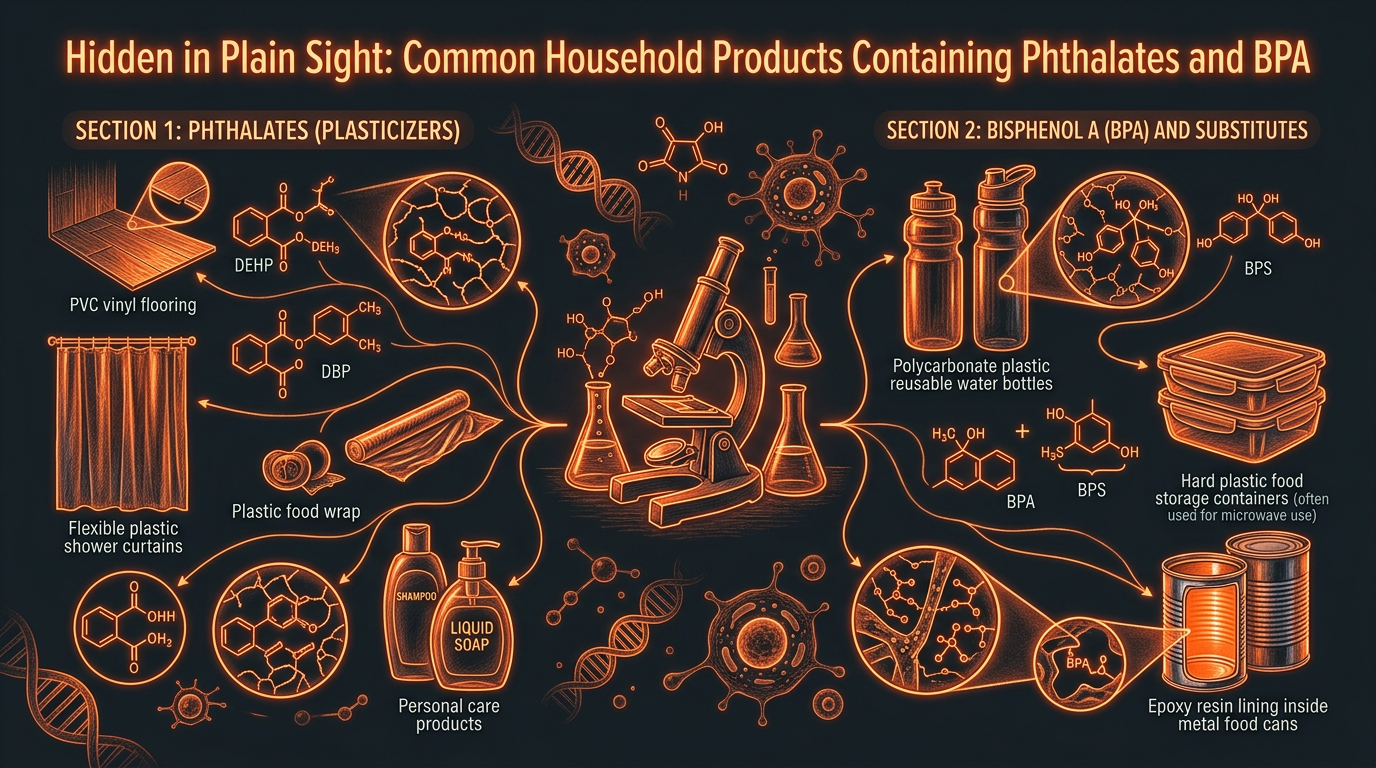
Phthalates are a group of "plasticisers" used to impart flexibility and longevity to polyvinyl chloride (PVC) and other plastics. Unlike BPA, which is chemically bonded to the material, phthalates are physically trapped within the plastic matrix. This means they off-gas and leach continuously throughout the product's lifespan. They are also used as "fixatives" in synthetic fragrances to ensure scents linger on the skin or in the air.
II. Biological Mechanisms: The Endocrine Hijack
The human body operates via a delicate symphony of hormonal signals. EDCs like phthalates and BPA do not merely "poison" the system in a traditional toxicological sense; they subvert it through three primary mechanisms:
1. Receptor Mimicry and Competitive Inhibition
BPA binds to oestrogen receptors (ERα and ERβ) with an affinity that, while lower than natural oestrogen, is sufficient to trigger cellular responses at critical developmental windows. Conversely, phthalates are potent anti-androgens. They interfere with the synthesis of testosterone, particularly during foetal development, leading to what researchers call the "Phthalate Syndrome."
2. Epigenetic Alterations
Emerging research suggests that exposure to these chemicals can alter gene expression without changing the DNA sequence. By influencing DNA methylation and histone modification, these chemicals can "silence" protective genes or "activate" those linked to metabolic dysfunction. These changes are often transgenerational, meaning the chemical exposure of a grandmother can manifest as health issues in the grandchild.
3. The Low-Dose Paradox
Traditional toxicology relies on the adage "the dose makes the poison." However, EDCs follow a non-monotonic dose-response curve. This means that extremely low concentrations—often measured in parts per billion—can have more profound effects on the endocrine system than higher doses, which may trigger the body’s natural defence and excretion mechanisms.
III. The Domestic Landscape: Where They Are Hidden
The ubiquity of these chemicals is a result of a regulatory framework that prioritises industrial utility over the precautionary principle. In the United Kingdom, despite tightening restrictions, these compounds remain "hidden in plain sight."
1. The Receipt in Your Wallet
Perhaps the most overlooked source of BPA is thermal paper. Most supermarket and petrol station receipts are coated with a layer of "free" BPA (not chemically bound) to facilitate the heat-activated printing process.
UK Insight: Research conducted by Breast Cancer UK suggests that BPA can be absorbed through the skin within seconds of handling a receipt, and this absorption is increased significantly if the individual has recently used hand sanitiser or moisturiser, which act as dermal penetrants.
2. The Lining of Tinned Goods
While many UK brands now advertise "BPA-free" cans, the reality is often the substitution of BPA with BPS (Bisphenol S) or BPF (Bisphenol F). These structural analogues are frequently as bioactive, if not more so, than the original compound. The epoxy resins lining tins of tomatoes, beans, and soups leach these chemicals directly into the food, accelerated by the acidity of the contents.
3. The "Fragrance" Loophole
Phthalates, specifically Diethyl Phthalate (DEP), are the primary vehicle for synthetic scents. Under current UK and EU labelling laws, "parfum" or "fragrance" is considered a trade secret. A single product may contain dozens of undisclosed chemicals, including phthalates used to make the scent last longer.
- Laundry Detergents and Fabric Softeners: These saturate clothing fibres, ensuring constant dermal contact and inhalation.
- Air Fresheners and Scented Candles: These aerosolise phthalates, allowing them to bypass the digestive system and enter the bloodstream directly via the lungs.
4. Personal Care and "Soft" Plastics
Phthalates are ubiquitous in "flexible" personal care items.
- Vinyl Shower Curtains: The "new shower curtain smell" is the scent of volatile organic compounds (VOCs) and phthalates off-gassing.
- Plastic Food Wrap and Storage Containers: When heated in a microwave, the molecular motion of the plastic increases, causing phthalates to migrate into fatty foods.
IV. The UK Context: A Growing Crisis
The UK government, through the UK REACH (Registration, Evaluation, Authorisation and Restriction of Chemicals) framework, has mirrored many EU bans on specific phthalates like DEHP in toys. However, the legacy of these chemicals persists in our infrastructure and the "cocktail effect" remains largely unaddressed.
Statistal Reality: A study published in The Lancet Diabetes & Endocrinology estimates that the healthcare costs associated with endocrine-disrupting chemicals in the UK and EU exceed €163 billion (£140 billion) annually, driven by lost IQ, adult obesity, and male infertility.
- Male Fertility: Over the last 40 years, sperm counts in Western nations, including the UK, have declined by over 50%. Phthalate exposure is cited as a primary driver of this "Spermageddon."
- Thyroid Health: BPA is known to interfere with thyroid hormone transport, contributing to the rising incidence of hypothyroidism and Hashimoto’s disease in the British population.
V. Environmental Interconnectivity
We do not live in a vacuum. The phthalates we wash down our drains and the BPA-laden plastics we discard enter the UK water system. Most municipal water treatment plants are not equipped to filter out molecular-level EDCs. Consequently, these chemicals return to us via the tap, creating a closed-loop system of exposure. Furthermore, microplastics found in British coastal waters and agricultural soil serve as "vectors," absorbing EDCs from the environment and concentrating them in the food chain.
VI. Recovery Protocols: Reclaiming Biological Sovereignty
To achieve Innerstanding is to move beyond victimhood into informed action. While it is impossible to avoid these chemicals entirely, one can significantly reduce the "body burden" through strategic lifestyle shifts and biological support.
1. Immediate Environmental Mitigation
- Ditch the "Fragrance": Transition to essential oils or fragrance-free products for laundry and personal care. Look for products labelled "Phthalate-Free."
- Glass and Stainless Steel: Replace all plastic food storage containers with glass or high-quality stainless steel. Never, under any circumstances, microwave food in plastic.
- The Receipt Rule: Refuse receipts when possible or ask for a digital copy. If you must handle them, wash your hands immediately afterward with plain soap (avoiding sanitisers).
- Water Filtration: Invest in a multi-stage water filtration system (Reverse Osmosis or high-quality Activated Carbon) that specifically lists the removal of EDCs and microplastics.
2. Biological Detoxification Support
The body possesses innate systems for processing phenols and phthalates, primarily through the liver's Phase II detoxification pathways.
- Glucuronidation Support: This is the primary pathway for excreting BPA. Support this by consuming calcium-d-glucarate (found in apples, grapefruit, and cruciferous vegetables) and ensuring adequate intake of magnesium.
- Cruciferous Power: Vegetables like broccoli, kale, and Brussels sprouts contain Indole-3-Carbinol (I3C) and Sulforaphane. These compounds help modulate oestrogen receptors and assist the liver in processing xenoestrogens.
- Sweat Therapy: Clinical studies have shown that phthalates and BPA are actively excreted through the skin. Regular use of a sauna (ideally infrared) followed by an immediate cold shower to rinse off the toxins is one of the most effective ways to lower the body burden.
- Fibre Intake: EDCs are often excreted into the bile. If a diet is low in fibre, these toxins can be reabsorbed in the gut (enterohepatic circulation). Aim for 35-40g of fibre daily to "bind" these chemicals and ensure their exit from the body.
3. The Precautionary Mindset
The British consumer must adopt the "Precautionary Principle." If a chemical's safety is not proven beyond doubt, it should be assumed guilty until proven innocent. This involves reading labels with the same scrutiny one would apply to a legal contract.
VII. Conclusion: The Path to Innerstanding
The presence of Phthalates and BPA in our homes is not a trivial matter of "modern pollution." It is a fundamental challenge to our biological integrity. These chemicals operate at the intersection of our health and our environment, acting as invisible architects of our physical and mental states.
Exposing the truth of these "hidden" disruptors is the first step toward reclaiming sovereignty over our biology. By purging these compounds from our immediate environment and supporting our body's natural resilience, we do more than just survive; we begin the process of internal restoration.
True Innerstanding is the realisation that our health is not merely the absence of disease, but the presence of a clean, unadulterated biological signal. In an age of synthetic interference, the most radical act of rebellion is to remain biologically pure.
"References for Further Research:"
- Food Standards Agency (FSA) - Reports on BPA in Food Contact Materials.
- The Endocrine Society - Scientific Statement on Endocrine-Disrupting Chemicals.
- UK REACH - Guidance on Phthalate Restrictions.
- The Lancet Diabetes & Endocrinology - Economic Costs of EDC Exposure.
This article is provided for informational and educational purposes only. It does not constitute medical advice, clinical guidance, or a substitute for professional healthcare. Information reflects cited research at time of publication. Always consult a qualified healthcare professional before acting on any health information.
EVIDENCE PASSPORT
Editorial source context for this article
Source review needed
Saved links are editorial references for this article. They may support specific claims rather than every sentence. Open and assess each source in context. This passport does not independently verify them.
Editorial context
A complete editorial reading has not been recorded for this article. Source links remain available for you to open and assess directly.
Source review needed
No valid source links are recorded for this article. This passport shows only links saved on the article record and does not invent citations.
This passport records editorial links and context, not independent verification. Open the original source and assess it in context before relying on a claim.
Medical Disclaimer
The information in this article is for educational purposes only and does not constitute medical advice, diagnosis, or treatment. Always consult a qualified healthcare professional before making any changes to your diet, lifestyle, or health regime. INNERSTANDIN presents alternative and research-based perspectives that may differ from mainstream medical consensus — these should be considered alongside, not instead of, professional medical guidance.
Read Full DisclaimerContinue the thread
Keep this question moving.
Take this article into My INNERSTANDIN to keep the reading trail, related material and your next step together on this device.
Dig deeper in the Library
Free, longform PDF volumes that go beyond headlines into mechanisms and references.