
Iodine's Crucial Role in Thyroid Hormone Production
Updated May 2026
A comprehensive guide on how iodine serves as the building block for T3 and T4 hormones and the clinical risks associated with both deficiency and excess.
Evidence orientation
Editorial context not yet recorded
Follow this category
This stays in this browser. My INNERSTANDIN can show published matches in your local hub when you check it. It does not send email, push, or alert notifications.
Local learning review
A private browser aid for revisiting ideas. It is not an alert or a health recommendation.
Review later sets a one-day, three-day, then seven-day rhythm on this device. Choose it only when you want to revisit this article.
Iodine’s Crucial Role in Thyroid Hormone Production: The Silent Crisis of British Public Health
The human biological machine is a masterpiece of precision engineering, yet its entire metabolic framework rests upon a single, volatile trace element: Iodine. Within the paradigm of ‘Innerstanding’, we must peel back the layers of conventional dietary advice to reveal a startling reality. While the medical establishment often treats iodine as a footnote in neonatal health, it is, in fact, the master key to cellular energy, neurological integrity, and the very synthesis of life-sustaining hormones.
In the United Kingdom, a nation historically plagued by the ‘Derbyshire Neck’ (goitre), we have succumbed to a dangerous complacency. We have traded ancestral nutrient density for industrial convenience, leading to a silent epidemic of subclinical hypothyroidism and metabolic dysfunction. This piece serves as a definitive examination of iodine’s biochemical necessity, the environmental forces conspiring against its uptake, and the sovereign protocols required for metabolic restoration.
The Biochemistry of Synthesis: From Ion to Hormone
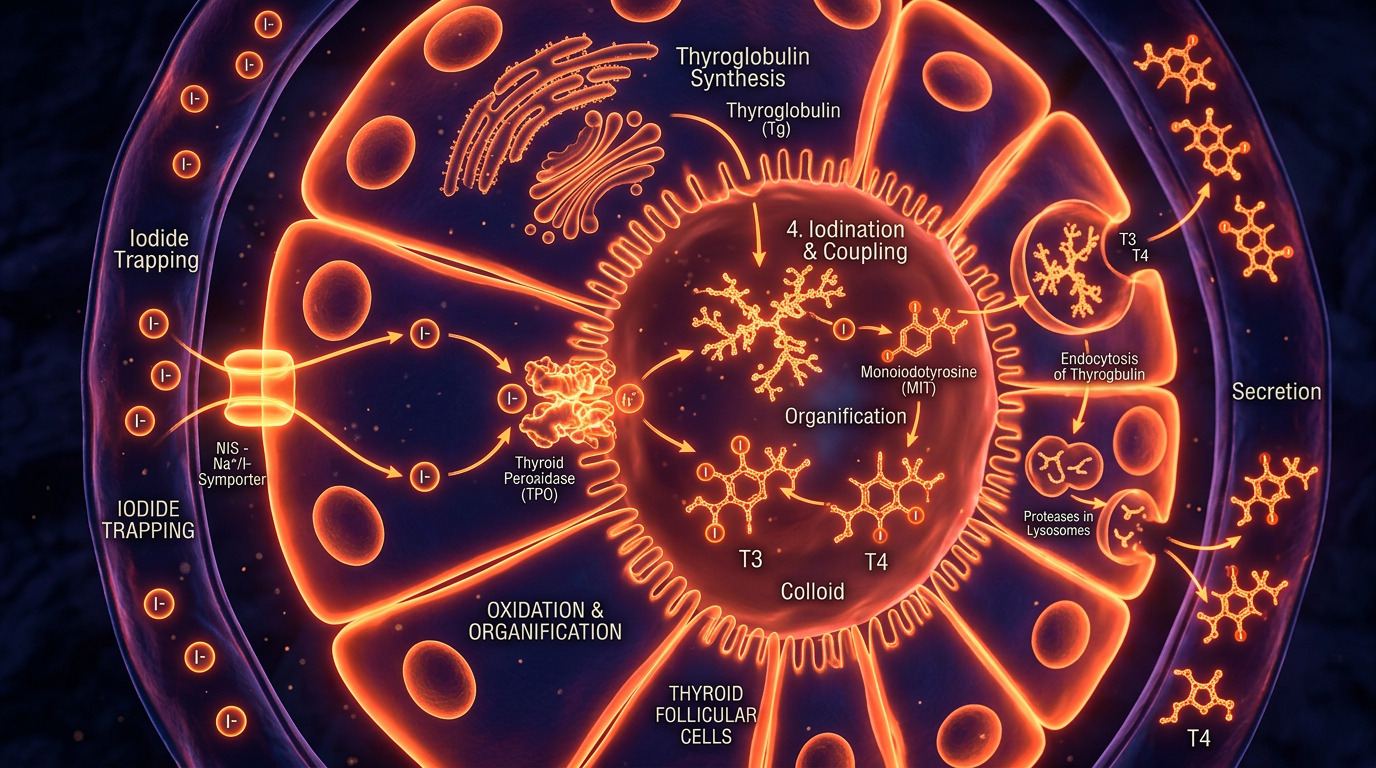
To understand the thyroid, one must first understand the journey of the iodide ion ($I^-$). The thyroid gland, a butterfly-shaped endocrine organ situated in the neck, acts as a biological sponge, sequestering iodine from the bloodstream against a concentration gradient that can be 20 to 50 times higher than plasma levels.
The Sodium-Iodide Symporter (NIS)
The process begins at the basolateral membrane of the thyroid follicular cells. Here, the Sodium-Iodide Symporter (NIS)—a specialised protein—utilises energy to pump iodide into the cell. This is the first ‘gatekeeper’ of metabolic rate. Without sufficient magnesium and ATP (Adenosine Triphosphate), this pump falters, rendering even adequate iodine intake useless.
Organification and the TPO Enzyme
Once inside the follicle, iodide must be oxidised to its active form. This is mediated by Thyroid Peroxidase (TPO) and hydrogen peroxide. This reactive iodine is then attached to tyrosine residues on a large protein called thyroglobulin.
- Monoiodotyrosine (MIT): One iodine atom attached to tyrosine.
- Diiodotyrosine (DIT): Two iodine atoms attached to tyrosine.
The coupling of these molecules creates the hormones we recognise:
- T4 (Thyroxine): DIT + DIT (contains four iodine atoms). This is the 'storage' hormone.
- T3 (Triiodothyronine): MIT + DIT (contains three iodine atoms). This is the 'active' hormone that dictates the speed of every cellular process.
The Peripheral Conversion
While the thyroid produces mostly T4, the body’s tissues—primarily the liver and kidneys—must convert T4 into the biologically active T3. This requires deiodinase enzymes, which are, crucially, selenium-dependent. This synergy between iodine and selenium is a cornerstone of innerstanding thyroid health; one cannot function optimally without the other.
The United Kingdom’s Iodine Deficit: A Statistical Warning
Contrary to popular belief, the UK is not ‘iodine sufficient’. Unlike many other nations, the UK does not have a mandatory salt iodisation programme. We rely almost exclusively on adventitious iodine—the iodine that happens to be in cow’s milk due to teat disinfectants and winter feed supplements.
"The UK is now ranked among the top ten iodine-deficient nations globally. Recent studies of schoolgirls across the UK found that 51% were iodine deficient, with 16% falling into the 'severe' category. This poses a significant risk to the cognitive development of the next generation." — The Lancet Diabetes & Endocrinology
This precarious reliance on the dairy industry means that the rise of plant-based diets, while perhaps ethically motivated, has created a nutritional vacuum. Most milk alternatives contain negligible amounts of iodine, leaving millions in a state of unrecognised deficiency.
The Halogen War: Environmental Disruptors and Competitive Inhibition
In the realm of chemistry, iodine belongs to Group 17 of the periodic table—the Halogens. It shares this column with Fluorine, Chlorine, and Bromine. This chemical kinship is the source of a profound modern health crisis. Because these elements share similar outer electron shells, they compete for the same receptors in the human body.
The Bromine Invasion
Bromine is a persistent environmental toxin found in flame retardants (in UK furniture and carpets), pesticides, and certain medications. When the body is deficient in iodine, the thyroid receptors become ‘promiscuous’, taking up bromine instead. Bromine, however, cannot synthesise thyroid hormones. It occupies the seat but refuses to do the work, leading to ‘toxic’ thyroid nodules and systemic metabolic slowing.
The Fluoride Factor
In many parts of the UK, fluoride is added to the municipal water supply under the guise of dental health. However, fluoride is a more electronegative element than iodine. It effectively displaces iodine from the NIS and the thyroid gland itself. Historically, fluoride was actually used as a medication to suppress thyroid function in patients with hyperthyroidism. Its presence in our daily drinking water is a direct assault on the endocrine system.
Perchlorates and Nitrates
Chlorine by-products and nitrates from industrial runoff further interfere with the NIS. We are living in a ‘Halogen Soup’ that effectively pushes iodine out of our biology, necessitating much higher intake levels than the current Recommended Dietary Allowance (RDA) suggests.
The Wolff-Chaikoff Myth: Deconstructing Iodophobia
The greatest barrier to iodine restoration is ‘Iodophobia’—a pervasive fear within the medical community that high-dose iodine will shut down the thyroid. This fear is rooted in the 1948 Wolff-Chaikoff effect study.
The study suggested that as iodine levels rise, thyroid hormone synthesis stops. However, this effect is transient, typically lasting only 24 to 48 hours, after which the body ‘escapes’ and resumes normal production. In reality, the body uses high levels of iodine as a protective mechanism. The RDA of 150mcg is the bare minimum to prevent a goitre; it is not the amount required for whole-body sufficiency.
Every tissue in the body requires iodine. The breasts, ovaries, and prostate gland concentrate iodine in amounts similar to the thyroid. To suggest that 150mcg is sufficient for the entire human organism is a failure of physiological logic.
The Path to Recovery: A Sovereign Protocol
Restoring iodine levels is not as simple as taking a high-dose supplement. Because of the ‘Halogen War’, displacing toxins too quickly can result in a ‘healing crisis’ or Bromoderma (acne-like rashes caused by bromine excretion). A structured protocol is essential.
1. The Necessity of Co-factors
Iodine must never be taken in isolation. To protect the thyroid gland from oxidative stress during the TPO reaction, the following must be present:
- Selenium (200mcg): Vital for T4 to T3 conversion and for neutralising hydrogen peroxide.
- Magnesium (400-600mg): Required for the ATP-dependent NIS pump.
- Unrefined Sea Salt: The chloride in salt helps the kidneys flush out the displaced bromine.
- Vitamin B2 (Riboflavin) and B3 (Niacin): Necessary for the NADPH oxidase system to produce the energy required for iodine organification.
2. Testing vs. Guessing
The gold standard for assessing iodine status is the 24-hour Urinary Iodine Loading Test. The patient ingests a 50mg dose of iodine; if the body is deficient, it will retain the iodine. If the body is sufficient, it will excrete 90% or more in the urine. Conventional blood tests for iodine are notoriously unreliable as they only reflect recent dietary intake, not cellular stores.
3. Gradual Titration
For those with significant halogen toxicity, starting with 'Lugol’s Iodine' (a combination of molecular iodine and potassium iodide) at low doses and slowly titrating upwards allows the body to detoxify bromine and fluoride safely. This ‘start low, go slow’ approach prevents the ‘brain fog’ and lethargy often associated with rapid detoxification.
- Phase 1: Optimise co-factors for 2–4 weeks.
- Phase 2: Introduce low-dose iodine (e.g., 6.25mg).
- Phase 3: Increase dosage based on symptoms and testing, ensuring salt-loading is used to mitigate detox reactions.
Conclusion: The Sovereign Thyroid
The suppression of iodine knowledge is, in many ways, the suppression of human vitality. A thyroid functioning at peak capacity translates to a sharp mind, a robust metabolism, and a resilient nervous system. By understanding the biological mechanisms of iodine, the environmental threats of the halogens, and the necessity of co-factors, we move from being passive patients to active stewards of our own biology.
Iodine is more than a nutrient; it is an elemental force that allows our internal fire to burn bright. In the pursuit of ‘Innerstanding’, we recognise that the reclamation of our health begins with the restoration of this ancient, misunderstood element. The UK’s iodine crisis is solvable, but only through the education and agency of the individual. It is time to turn the tide on deficiency and reignite the metabolic engine of the nation.
This article is provided for informational and educational purposes only. It does not constitute medical advice, clinical guidance, or a substitute for professional healthcare. Information reflects cited research at time of publication. Always consult a qualified healthcare professional before acting on any health information.
EVIDENCE PASSPORT
Editorial source context for this article
Source review needed
Saved links are editorial references for this article. They may support specific claims rather than every sentence. Open and assess each source in context. This passport does not independently verify them.
Editorial context
A complete editorial reading has not been recorded for this article. Source links remain available for you to open and assess directly.
Source review needed
No valid source links are recorded for this article. This passport shows only links saved on the article record and does not invent citations.
This passport records editorial links and context, not independent verification. Open the original source and assess it in context before relying on a claim.
Medical Disclaimer
The information in this article is for educational purposes only and does not constitute medical advice, diagnosis, or treatment. Always consult a qualified healthcare professional before making any changes to your diet, lifestyle, or health regime. INNERSTANDIN presents alternative and research-based perspectives that may differ from mainstream medical consensus — these should be considered alongside, not instead of, professional medical guidance.
Read Full DisclaimerContinue the thread
Keep this question moving.
Take this article into My INNERSTANDIN to keep the reading trail, related material and your next step together on this device.
Explore this in the Body Map
See where this hits your biology. Interactive anatomy, threats, and protective protocols.
Dig deeper in the Library
Free, longform PDF volumes that go beyond headlines into mechanisms and references.