
Managing Hypothyroidism Through Targeted Nutrition
Updated May 2026
An exploration of dietary strategies to support an underactive thyroid, emphasizing the importance of selenium, zinc, and balanced iodine intake for metabolic health.
Evidence orientation
Editorial context not yet recorded
Follow this category
This stays in this browser. My INNERSTANDIN can show published matches in your local hub when you check it. It does not send email, push, or alert notifications.
Local learning review
A private browser aid for revisiting ideas. It is not an alert or a health recommendation.
Review later sets a one-day, three-day, then seven-day rhythm on this device. Choose it only when you want to revisit this article.
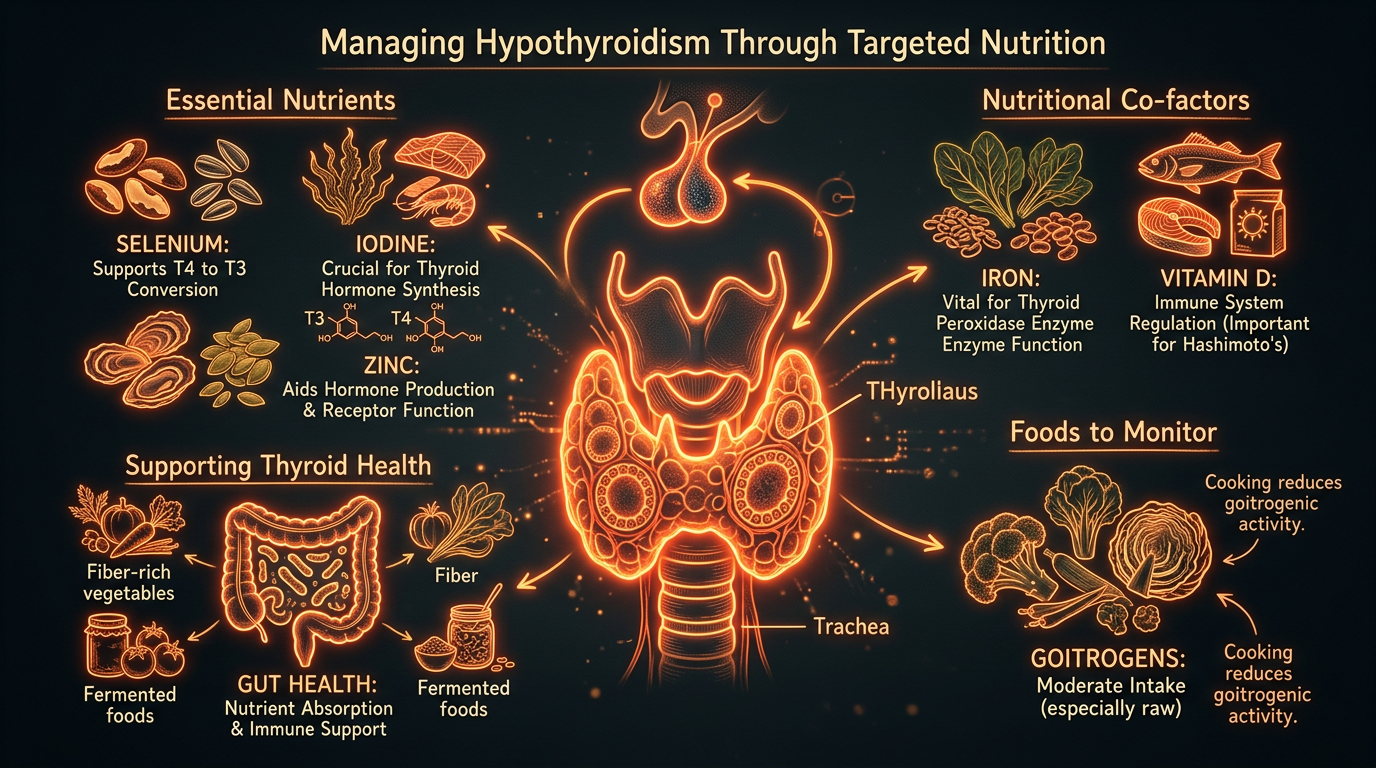
The prevailing clinical approach to thyroid health in the United Kingdom has remained largely static for decades. In the standard medical model, the thyroid is viewed as a solitary gland that either "works" or "fails," with the subsequent treatment being a lifelong dependency on synthetic T4 (Levothyroxine). However, an innerstanding of the endocrine system reveals a far more complex, integrated web of biological feedback loops, nutrient dependencies, and environmental sensitivities.
Hypothyroidism is not merely a deficiency of a hormone; it is a systemic signal that the body’s cellular energy production—its "metabolic fire"—is being suppressed. To manage this condition effectively, we must look beyond the TSH (Thyroid Stimulating Hormone) lab reference ranges and address the underlying biochemical bottlenecks that prevent the conversion and utilisation of thyroid hormones at the cellular level.
The Biological Assembly Line: How Thyroid Hormone Is Formed
To understand how to manage hypothyroidism, one must first appreciate the delicate assembly line of thyroid hormone production. The process begins in the hypothalamus and pituitary, but the actual "manufacturing" occurs within the thyroid gland using two primary raw materials: the amino acid L-tyrosine and the mineral iodine.
- Iodine Trapping: The gland actively pumps iodine from the blood.
- Organification: Iodine is attached to thyroglobulin (a protein).
- Coupling: This creates T4 (four iodine atoms) and T3 (three iodine atoms).
- Peripheral Conversion: The thyroid produces mostly T4, which is pro-hormonal and relatively inactive. The body must convert T4 into T3—the biologically active form—primarily in the liver, kidneys, and gut.
If any stage of this assembly line is compromised—whether by nutrient deficiency or environmental toxicity—the result is a systemic slowdown of every metabolic process, from digestion to cognitive function.
The Conversion Crisis: T4 to T3
Many patients in the UK remain symptomatic despite "normal" TSH levels. This is frequently due to a failure in peripheral conversion. The enzymes responsible for this conversion, known as deiodinases, are selenium-dependent. Without adequate selenium, the body cannot strip an iodine atom from T4 to create active T3. Instead, it may divert T4 into Reverse T3 (rT3)—an inactive mirror image that blocks thyroid receptors, effectively putting the brakes on your metabolism.
Environmental Disruptors: The Halogen Hijack
A significant factor often overlooked in mainstream British endocrinology is the impact of the "Halogen Group" on the periodic table. Iodine is a halogen. Unfortunately, the body’s iodine receptors can be easily "hijacked" by other halogens that are chemically similar but biologically toxic: Fluoride, Bromide, and Chlorine.
The Fluoride Factor
In many regions of the UK, particularly the West Midlands and the North East, water fluoridation is a standard public health measure. Mechanistically, fluoride is more electronegative than iodine. It can displace iodine in the thyroid gland and inhibit the enzymes that facilitate hormone production.
The Bromide Burden
Bromide is a pervasive endocrine disruptor found in flame retardants, certain pesticides, and—crucially—as a "dough conditioner" in many commercial UK bakery products (though less common than in the US, it remains an environmental pollutant). Bromide competes for the same receptors as iodine, leading to what is often termed "Bromide Dominance," where the thyroid is saturated with a useless halogen while starving for iodine.
"According to data from the British Thyroid Foundation, approximately 1 in 20 people in the UK have a thyroid conditioner, with women being five to ten times more likely to be affected than men. Despite high treatment rates, recent surveys suggest that up to 15% of patients on Levothyroxine continue to report persistent symptoms of hypothyroidism."
The Nutritional Recovery Protocol
To restore thyroid function, we must move from a model of "hormone replacement" to one of "nutritional restoration." The following pillars form the basis of a targeted nutritional strategy for hypothyroidism.
1. The Iodine-Selenium Synthesis
Iodine is the fuel, but selenium is the "coolant" that prevents oxidative damage. When the thyroid gland processes iodine, it produces hydrogen peroxide as a byproduct. Selenium-dependent enzymes (glutathione peroxidase) neutralise this peroxide.
- Iodine: Sourced from seaweeds (Kelp, Dulse), wild-caught white fish, and eggs. However, high-dose iodine supplementation should only be undertaken once selenium levels are optimised to prevent triggering an autoimmune (Hashimoto’s) flare.
- Selenium: Found in Brazil nuts (just two to three per day provide the RDA), sardines, and grass-fed beef. Selenium also assists in the conversion of T4 to T3.
2. Liver Support for Metabolic Conversion
As the liver is the primary site for converting T4 into active T3, any degree of "sluggish" liver function or Non-Alcoholic Fatty Liver Disease (NAFLD) will manifest as hypothyroid symptoms.
- Bitters: Utilising dandelion root, artichoke, or milk thistle can stimulate bile flow and improve liver clearance.
- Choline: Found in egg yolks, choline is essential for transporting fats out of the liver, ensuring it has the capacity to process thyroid hormones.
3. The Role of Fat-Soluble Vitamins (A, D, and K2)
Mainstream advice often focuses on Vitamin D, but for thyroid health, Vitamin A (Retinol) is equally critical. Vitamin A is required for the thyroid hormone to actually "enter" the cell and bind to the nuclear receptor. Without enough Retinol, your blood levels of T3 might look perfect, but the hormone cannot deliver its message to the DNA to increase energy production.
- Source: Real Vitamin A (Retinol) is found in cod liver oil, beef liver, and pasture-raised butter. Note that beta-carotene from carrots is a precursor and is often poorly converted in hypothyroid individuals.
4. Correcting the Iron-Thyroid Loop
Iron deficiency (anaemia) and hypothyroidism often exist in a vicious cycle. You need iron for the enzyme thyroid peroxidase (TPO) to produce hormone. Conversely, you need thyroid hormone to properly absorb iron in the gut.
- Testing: One must check Ferritin levels, not just haemoglobin. For optimal thyroid function, Ferritin should be in the mid-range (70-100 ng/mL), rather than merely "not anaemic" by NHS standards.
The Impact of Stress and Cortisol: The "Safety" Mechanism
The thyroid does not operate in a vacuum; it is governed by the HPT axis. When the body perceives chronic stress—whether from caloric restriction, over-exercising, or psychological pressure—the adrenals produce high levels of cortisol.
In a state of "survival mode," the body deliberately downregulates thyroid function to conserve energy. This is a protective mechanism. If you attempt to "force" the thyroid to speed up (via medication or stimulants) without addressing the underlying adrenal stress, you are essentially "whipping a tired horse."
The Caloric Trap
Many hypothyroid sufferers in the UK attempt to lose weight by drastically cutting calories. This is counter-productive. The body interprets low glucose availability as a famine, further suppressing the conversion of T4 to T3 to lower the metabolic rate. Targeted nutrition for the thyroid requires metabolic safety—consistent, nutrient-dense meals that signal to the brain that the environment is safe for energy expenditure.
Truth-Exposing: The Myth of the "Normal" Range
The standard TSH test used by the NHS is often misleading. TSH measures the pituitary’s demand for hormone, not the actual availability of active hormone at a cellular level.
"A study published in the Journal of Clinical Endocrinology & Metabolism suggests that the 'normal' TSH range is far too wide. While the NHS often considers a TSH of 4.0 or 4.5 mU/L as 'normal,' many individuals experience optimal health only when their TSH is between 0.5 and 2.0 mU/L."
Furthermore, the failure to test Free T3 and Reverse T3 leaves a massive blind spot in clinical diagnosis. A patient can have a "perfect" TSH of 1.5, but if their Free T3 is at the bottom of the range, they will remain exhausted, cold, and cognitively impaired.
Targeted Recovery Protocol: A Step-by-Step Approach
To reclaim metabolic health, follow this hierarchical approach to nutritional intervention:
Phase I: Mineral Foundation
Before introducing stimulants or high-dose hormones, ensure the mineral "spark plugs" are present.
- Magnesium: Required for over 300 enzymatic reactions, including the production of TSH.
- Zinc: Essential for the synthesis of TSH and the health of the pituitary.
- Trace Minerals: Use a high-quality Celtic or Himalayan sea salt to provide the full spectrum of trace elements necessary for cellular transport.
Phase II: Eliminate Environmental Inhibitors
- Filter Your Water: Use a filter capable of removing fluoride (e.g., Reverse Osmosis or specific activated alumina filters).
- Iodine-Cleanse: Reduce exposure to bromide by choosing organic, unbromated breads or sourdough.
- Endocrine Disruptors: Swap plastic food containers for glass to reduce phthalate exposure, which can interfere with thyroid hormone receptors.
Phase III: Support Conversion and Sensitivity
- Focus on Selenium: 200mcg daily via food or supplements.
- Optimise Gut Health: Since 20% of T4 to T3 conversion happens in the gut (via the enzyme intestinal sulfatase), a healthy microbiome is non-negotiable. Probiotic-rich foods like kefir or sauerkraut support the "gut-thyroid axis."
- Blood Sugar Stability: Avoid the glucose "rollercoaster." Spikes in insulin can inflame the thyroid gland and worsen autoimmune responses.
The Broda Barnes Method: Tracking the Basal Body Temperature
In the mid-20th century, before the TSH test became the "gold standard," Dr. Broda Barnes found that the most accurate way to assess thyroid function was through Basal Body Temperature (BBT). Since thyroid hormone dictates heat production, a low waking temperature is a direct proxy for low cellular metabolism.
- The Test: Keep a thermometer by your bed. Before getting out of bed in the morning, take your temperature.
- The Indicator: A consistent waking temperature below 36.4°C (97.5°F) strongly suggests hypothyroidism, regardless of what blood tests might indicate.
This "innerstanding" allows the individual to monitor their own recovery. As you implement targeted nutrition—increasing selenium, supporting the liver, and removing halides—you should see a gradual, stable rise in your basal temperature, signalling that the "metabolic fire" has been relit.
Conclusion: Sovereignty Over Metabolism
Managing hypothyroidism in the modern age requires a departure from the "passive patient" model. The UK's reliance on a single-marker blood test (TSH) and a single-hormone replacement (T4) is a reductive approach to a systemic issue.
By viewing the thyroid as a sensitive environmental sensor, we can see that "hypothyroidism" is often the body’s rational response to a nutrient-depleted, toxin-saturated world. Through the targeted application of iodine, selenium, and fat-soluble vitamins—coupled with the removal of halogen disruptors—we can move beyond the management of symptoms and towards the restoration of biological vitality.
True health is not found in the suppression of a lab value; it is found in the innerstanding of the body’s requirements for energy, warmth, and resilience. The tools for recovery are not found in the pharmacy alone, but in the strategic, scientific application of ancestral nutrition.
This article is provided for informational and educational purposes only. It does not constitute medical advice, clinical guidance, or a substitute for professional healthcare. Information reflects cited research at time of publication. Always consult a qualified healthcare professional before acting on any health information.
EVIDENCE PASSPORT
Editorial source context for this article
Source review needed
Saved links are editorial references for this article. They may support specific claims rather than every sentence. Open and assess each source in context. This passport does not independently verify them.
Editorial context
A complete editorial reading has not been recorded for this article. Source links remain available for you to open and assess directly.
Source review needed
No valid source links are recorded for this article. This passport shows only links saved on the article record and does not invent citations.
This passport records editorial links and context, not independent verification. Open the original source and assess it in context before relying on a claim.
Medical Disclaimer
The information in this article is for educational purposes only and does not constitute medical advice, diagnosis, or treatment. Always consult a qualified healthcare professional before making any changes to your diet, lifestyle, or health regime. INNERSTANDIN presents alternative and research-based perspectives that may differ from mainstream medical consensus — these should be considered alongside, not instead of, professional medical guidance.
Read Full DisclaimerContinue the thread
Keep this question moving.
Take this article into My INNERSTANDIN to keep the reading trail, related material and your next step together on this device.
Explore this in the Body Map
See where this hits your biology. Interactive anatomy, threats, and protective protocols.
Dig deeper in the Library
Free, longform PDF volumes that go beyond headlines into mechanisms and references.