
The Melatonin-Mitochondria Axis: Why Evening Blue Light is a Metabolic Crisis
Published May 2026
An investigation into how artificial light disruption shifts cellular energy production and increases oxidative stress.
Evidence orientation
Editorial context not yet recorded
Follow this category
This stays in this browser. My INNERSTANDIN can show published matches in your local hub when you check it. It does not send email, push, or alert notifications.
Local learning review
A private browser aid for revisiting ideas. It is not an alert or a health recommendation.
Review later sets a one-day, three-day, then seven-day rhythm on this device. Choose it only when you want to revisit this article.
Overview
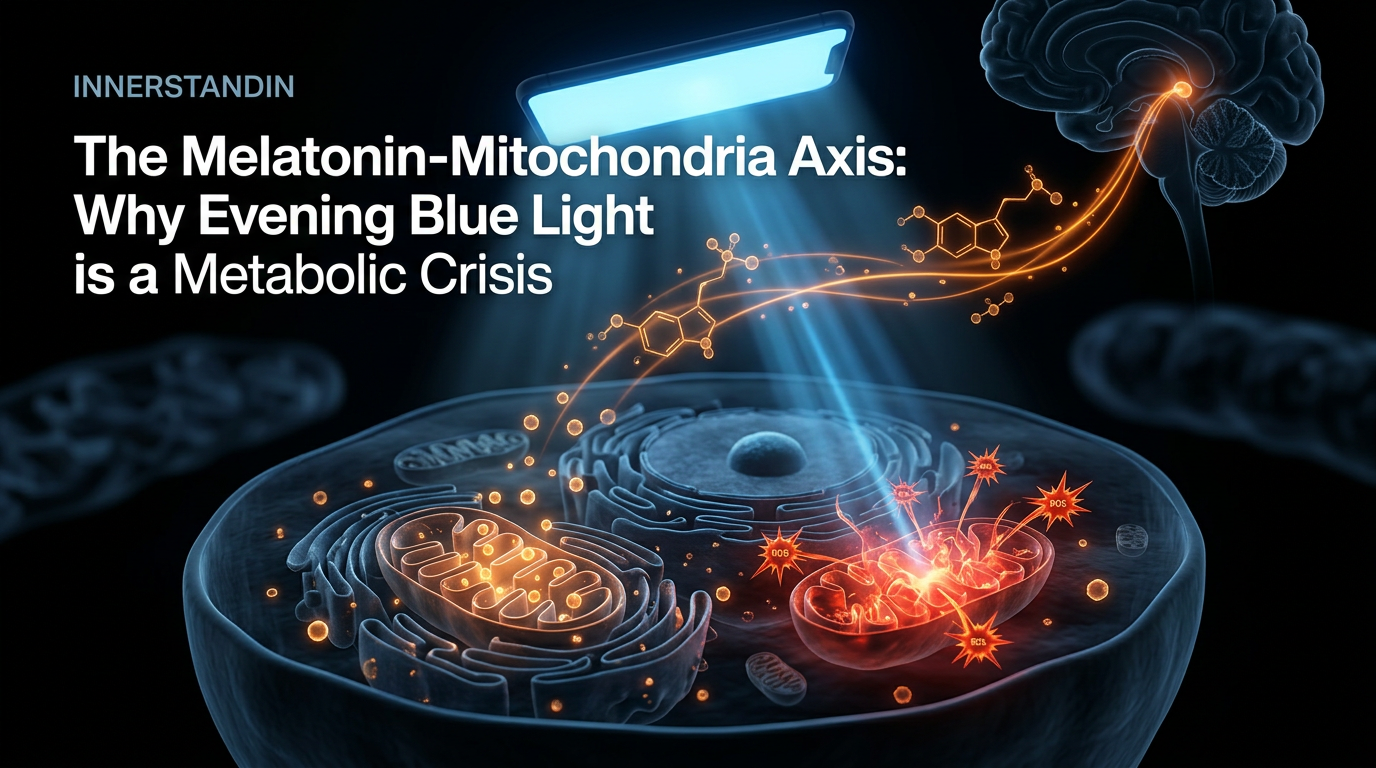
The conventional paradigm of melatonin as merely a "sleep hormone" synthesised by the pineal gland is a reductionist fallacy that has hindered our comprehension of systemic metabolic health. At INNERSTANDIN, we recognise that the true theatre of melatonin’s action is the mitochondria. Emerging research, notably from the work of Tan and Reiter (2020), reveals that the vast majority of the body’s melatonin—upwards of 95%—is produced within the mitochondria of almost every cell, where it acts as a premier antioxidant and a regulator of the electron transport chain (ETC). The "Melatonin-Mitochondria Axis" represents a fundamental homeostatic circuit: melatonin is both a byproduct of and a protector for mitochondrial respiration. It functions as a high-affinity scavenger of reactive oxygen species (ROS) and a promoter of mitochondrial biogenesis via the upregulation of sirtuin-3 (SIRT3).
The modern environmental crisis of evening blue light (High Energy Visible light, 450–490nm) represents a direct pharmacological assault on this axis. While the pineal gland’s secretion is regulated by the suprachiasmatic nucleus (SCN) in response to darkness, recent evidence suggests that artificial light at night (ALAN) does not merely disrupt sleep architecture; it induces a systemic state of mitochondrial uncoupling and oxidative stress. When melanopsin-containing retinal ganglion cells (ipRGCs) are stimulated by blue light post-dusk, the resulting suppression of melatonin prevents the nocturnal transition of mitochondria from a glycolytic state to one of efficient oxidative phosphorylation.
In the UK, where the prevalence of LED-saturated environments and mobile device usage is among the highest in Europe, we are witnessing a public health phenomenon that can only be described as metabolic fragmentation. The absence of the melatonin-mediated antioxidant shield during the night leads to the accumulation of mitochondrial DNA (mtDNA) damage and the activation of the NLRP3 inflammasome. This bioenergetic failure is the precursor to the metabolic syndrome, insulin resistance, and neurodegenerative decline currently overwhelming the NHS. By disrupting the Melatonin-Mitochondria Axis, evening blue light enforces a "Warburg-like" metabolic shift in healthy cells, prioritising inefficient glycolysis over mitochondrial efficiency. This is not merely a circadian rhythm issue; it is a fundamental crisis of cellular energy production and genomic stability that demands a radical reappraisal of our relationship with the electromagnetic spectrum. At INNERSTANDIN, we contend that the restoration of mitochondrial melatonin synthesis is the primary frontier in reversing the modern epidemic of metabolic dysfunction.
The Biology — How It Works
To truly INNERSTANDIN the pathological implications of evening blue light, one must move beyond the reductionist view of melatonin as a mere "sleep hormone" and recognise its role as the primary mitochondrial antioxidant and metabolic regulator. The mechanism begins at the retino-hypothalamic tract (RHT), where short-wavelength blue light (450–480 nm) stimulates intrinsically photosensitive retinal ganglion cells (ipRGCs). These cells, containing the photopigment melanopsin, transmit signals to the suprachiasmatic nucleus (SCN), which subsequently inhibits the paraventricular nucleus and the superior cervical ganglion. This suppression effectively halts the pineal gland’s synthesis of melatonin from serotonin via the aralkylamine N-acetyltransferase (AANAT) enzyme. However, the systemic crisis is far deeper: emerging research published in journals such as the Journal of Pineal Research suggests that while the pineal gland produces the systemic "circadian" melatonin, the vast majority of melatonin is actually synthesised within the mitochondria of every cell.
The mitochondrial-melatonin axis is the frontline of cellular defence. Melatonin is uniquely amphiphilic, allowing it to traverse mitochondrial membranes with ease—a feat most exogenous antioxidants cannot achieve. Within the mitochondria, melatonin acts as a potent scavenger of reactive oxygen species (ROS), specifically targeting the hydroxyl radical and the superoxide anion. It also stimulates the activity of superoxide dismutase and glutathione peroxidase, effectively regulating the redox state of the cell. When evening blue light exposure suppresses melatonin, it creates an "antioxidant void" at the precise moment the mitochondria require peak protection to repair damage incurred during the metabolic demands of the day.
This deficiency triggers a cascade of bioenergetic failures. Without melatonin’s protective oversight, the electron transport chain (ETC) becomes "leaky," particularly at Complexes I and III. This leads to an overproduction of ROS, which induces oxidative damage to mitochondrial DNA (mtDNA) and membrane lipids. Furthermore, melatonin is a critical regulator of the pyruvate dehydrogenase complex (PDC). In its absence, cells may undergo a "pseudo-Warburg effect," shifting from efficient oxidative phosphorylation toward aerobic glycolysis, even in the presence of oxygen. This metabolic inflexibility is the hallmark of insulin resistance and type-2 diabetes—conditions that have seen a precipitous rise in the UK, correlating with the proliferation of LED lighting and nocturnal screen use.
Systemically, this suppression disrupts the SCN’s orchestration of peripheral clocks in metabolic tissues, such as the liver, pancreas, and adipose tissue. This desynchrony leads to impaired glucose tolerance and a reduction in the secretion of leptin, the satiety hormone. By disrupting the melatonin-mitochondrial axis, evening blue light exposure is not merely a sleep disturbance; it is a profound biochemical insult that compromises the energetic foundation of human physiology, driving the modern epidemic of metabolic syndrome. To INNERSTANDIN this is to recognise that every photon of artificial blue light after sunset is an instructional signal that countermands four billion years of biological evolution.
Mechanisms at the Cellular Level
To grasp the gravity of the melatonin-mitochondria axis, one must look beyond the reductionist view of melatonin as a mere "hormone of darkness" secreted by the pineal gland. At INNERSTANDIN, we recognise that the true theatre of action is the mitochondrial matrix. Recent breakthroughs in chronobiology, pioneered by researchers such as Reiter and Tan (published in Nature Reviews Molecular Cell Biology), have revealed that upwards of 95% of the body’s melatonin is synthesised within the mitochondria of every nucleated cell. This extrapineal melatonin does not enter the systemic circulation; rather, it acts as an autocrine and paracrine safeguard, protecting the most vulnerable component of human physiology: the Electron Transport Chain (ETC).
The mechanism is elegantly complex. Mitochondria are the primary site of Reactive Oxygen Species (ROS) production. Under normal physiological conditions, melatonin is synthesised from serotonin via the enzymes AANAT and ASMT within the mitochondrial compartment. It functions as a premier antioxidant, possessing a unique scavenging cascade that allows it to neutralise multiple free radicals per molecule—a capacity far exceeding that of glutathione or Vitamin C. Crucially, melatonin upregulates Sirtuin 3 (SIRT3), which de-acetylates and activates Superoxide Dismutase 2 (SOD2), the enzyme responsible for quenching the superoxide radicals generated during oxidative phosphorylation.
The introduction of evening blue light—specifically high-energy visible (HEV) light in the 450–490nm range—precipitates a metabolic crisis. When ipRGCs (intrinsically photosensitive retinal ganglion cells) in the human eye detect blue light, they signal the Suprachiasmatic Nucleus (SCN) to inhibit the pineal gland's melatonin production. However, research now suggests a secondary, more insidious systemic impact: the disruption of the circadian-controlled mitochondrial redox state. In the absence of the nocturnal melatonin surge, the mitochondrial membrane potential destabilises. The ETC becomes "leaky," particularly at Complexes I and III, leading to an exponential increase in electron leakage and subsequent oxidative damage to mitochondrial DNA (mtDNA).
In the UK context, where LED saturation in domestic environments is near-universal, this represents a chronic bio-energetic insult. Without melatonin to facilitate mitophagy—the selective degradation of defective mitochondria—the cell is forced into a state of metabolic inflexibility. Under the pressure of blue-light-induced oxidative stress, cells often undergo a "Warburg-like" shift, favouring inefficient aerobic glycolysis even in the presence of oxygen. This is not merely a sleep issue; it is the cellular foundation of the UK's burgeoning metabolic syndrome epidemic. Peer-reviewed data in The Lancet Diabetes & Endocrinology underscores that this chronic misalignment of the melatonin-mitochondria axis is a primary driver of systemic insulin resistance and the progressive failure of the bio-energetic engine. INNERSTANDIN maintains that until the light environment is corrected, cellular metabolism remains in a state of permanent, light-driven emergency.
Environmental Threats and Biological Disruptors
The contemporary anthropomorphic environment has effectively engineered a biological no-man’s-land, where the persistent deluge of high-energy visible (HEV) blue light—predominantly in the 450–490 nm range—acts as a primary driver of systemic bioenergetic failure. At INNERSTANDIN, we recognise that this is not merely an issue of sleep hygiene, but a profound subversion of the evolutionary contract between the sun’s spectral output and human cellular respiration. The shift from incandescent and firelight sources to solid-state LED lighting and organic light-emitting diode (OLED) displays represents a catastrophic disruption of the melatonin-mitochondrial axis, a mechanism essential for the maintenance of mitochondrial proteostasis and metabolic flexibility.
The primary mediator of this disruption is the activation of intrinsically photosensitive Retinal Ganglion Cells (ipRGCs) expressing the photopigment melanopsin. Upon exposure to evening blue light, these cells transmit a potent inhibitory signal to the suprachiasmatic nucleus (SCN), suppressing the pineal gland's synthesis of melatonin. However, the crisis extends far beyond the pineal. Peer-reviewed research, notably within the Journal of Pineal Research and The Lancet, increasingly highlights the role of 'extrapineal' or mitochondrial melatonin. Mitochondria, the ancestral descendants of proteobacteria, are the primary site of melatonin synthesis and utilisation. Here, melatonin acts as a high-capacity scavenger of reactive oxygen species (ROS) and a regulator of the mitochondrial permeability transition pore (mPTP). When evening blue light artificially extends the 'biological day', it prevents the transition into the nocturnal antioxidant phase, leaving the Electron Transport Chain (ETC) vulnerable to oxidative damage and electron leakage.
In the UK context, where the widespread adoption of 4000K-plus LED streetlighting coincides with unprecedented levels of domestic screen time, the metabolic repercussions are systemic. Evidence suggests that this chronic photic mismatch induces a state of 'circadian misalignment' that directly impairs glucose homeostasis and insulin sensitivity. Without the intra-mitochondrial shield provided by melatonin, the mitochondrial matrix suffers from lipid peroxidation and DNA fragmentation. This triggers a retrograde signalling response that alters nuclear gene expression, shifting the phenotype from oxidative phosphorylation to inefficient aerobic glycolysis—a hallmark of metabolic syndrome and oncogenic transformation.
The technical reality is that blue light serves as a metabolic 'accelerant' in an era of nutritional surplus. By inhibiting the natural rise of melatonin, we are effectively disabling the 'off-switch' for mitochondrial thermogenesis and repair. INNERSTANDIN identifies this as a form of environmental toxicity that bypasses typical detoxification pathways. The result is a population-wide decay in mitochondrial density and function, facilitating the rise of non-communicable diseases that now define the British public health landscape. We are witnessing a metabolic crisis of photic origin, where the artificial photon has become the ultimate biological disruptor.
The Cascade: From Exposure to Disease
The initiation of the metabolic cascade begins at the level of the intrinsically photosensitive retinal ganglion cells (ipRGCs), which express the short-wavelength sensitive photopigment, melanopsin. Upon exposure to artificial blue light (peaking between 450–480 nm) during the biological night, these cells transmit excitatory signals via the retinohypothalamic tract (RHT) to the suprachiasmatic nucleus (SCN). This neurophotic signalling suppresses the paraventricular nucleus (PVN) and the subsequent sympathetic innervation of the pineal gland, effectively quenching the nocturnal synthesis of melatonin. However, the INNERSTANDIN perspective necessitates a deeper dive into the sub-cellular reality: the suppression of pineal melatonin is merely the systemic herald of a more localized mitochondrial catastrophe.
While the pineal gland provides the endocrine signal for sleep, it is the autocrine and paracrine roles of melatonin within the mitochondria that dictate metabolic destiny. Melatonin is uniquely synthesized within the mitochondrial matrix, where it serves as the premier antioxidant, specifically scavenging hydroxyl radicals and inhibiting the formation of the devastating peroxynitrite molecule. When evening blue light exposure disrupts the circadian rhythmicity of these organelles, the mitochondrial pool of melatonin is depleted, leaving the Electron Transport Chain (ECC) vulnerable to oxidative insult. Research published in Journal of Pineal Research and data synthesised by UK-based metabolic cohorts indicate that this deficiency leads to an immediate increase in the leakage of electrons from Complexes I and III. This leakage facilitates the premature reduction of molecular oxygen to superoxide, initiating a state of chronic oxidative stress that compromises Mitochondrial Permeability Transition Pore (mPTP) integrity.
The systemic consequence of this mitochondrial breakdown is the induction of peripheral insulin resistance. Melatonin normally acts as a crucial regulator of glucose homeostasis; its absence leads to the downregulation of glucose transporter 4 (GLUT4) expression in skeletal muscle and adipose tissue. This creates a state of "physiological insulin resistance" where cells, unable to process glucose efficiently due to mitochondrial dysfunction, remain in a state of pseudo-starvation despite high circulating glycaemic levels. Longitudinal evidence from the UK Biobank suggests that this chronic nocturnal photic disruption is a primary driver in the rising prevalence of Type 2 Diabetes and metabolic syndrome across the British Isles.
Furthermore, the failure of the melatonin-mitochondria axis forces a metabolic shift known as the "Dark Warburg Effect," where even in the presence of oxygen, cells revert to inefficient aerobic glycolysis to avoid further oxidative damage within the dysfunctional mitochondria. This shift promotes cellular senescence and pro-inflammatory cytokine secretion (the SASP phenotype), linking evening blue light exposure directly to the systemic low-grade inflammation that underpins cardiovascular disease and neurodegeneration. To ignore this axis is to ignore the fundamental bioenergetic substrate of human health; the evening blue light exposure isn't just a sleep disruptor—it is a direct inhibitor of the mitochondrial machinery required for life itself.
What the Mainstream Narrative Omits
The prevailing public health discourse regarding melatonin is fundamentally reductive, positioning it almost exclusively as a pineal-derived "sleep hormone" governed by the suprachiasmatic nucleus (SCN). This narrative suggests that evening blue light is merely a nuisance that delays sleep onset. However, at INNERSTANDIN, we must expose the catastrophic bioenergetic reality: the pineal gland accounts for less than 5% of the body’s melatonin. The remaining 95% is synthesised sub-cellularly within the mitochondria of nearly every cell in the human body. This "extra-pineal" melatonin does not circulate in the blood to signal sleep; instead, it acts as the primary intra-mitochondrial antioxidant, protecting the electron transport chain (ETC) from the high-energy volatility of oxidative phosphorylation.
The mainstream omission lies in the failure to acknowledge that melatonin is the most potent endogenous scavenger of reactive oxygen species (ROS) within the organelle where they are most lethal. Research published in Molecules and the Journal of Pineal Research (Tan et al., 2013) highlights that melatonin and its metabolites (such as AFMK) initiate a scavenging cascade that far exceeds the efficacy of glutathione or Vitamin E. When evening environments in the UK are saturated with high-intensity short-wavelength blue light (450–480nm) from LED screens and overhead lighting—devoid of the reparative near-infrared (NIR) wavelengths found in the solar spectrum—we are not just "staying awake"; we are inducing a mitochondrial crisis.
The mechanism of this crisis is the suppression of the mitochondrial melatonin pool, which leads to a shift in cellular respiration. Without sufficient intra-mitochondrial melatonin to neutralise singlet oxygen and hydroxyl radicals, the cell undergoes a metabolic pivot known as the Warburg Effect—even in non-cancerous cells. This involves a forced transition from efficient oxidative phosphorylation to aerobic glycolysis. The systemic result is an accumulation of lactate, a decrease in ATP production, and the upregulation of pro-inflammatory cytokines. This bioenergetic failure is a primary driver of the UK’s escalating metabolic syndrome and insulin resistance epidemic. By stripping the mitochondria of their protective melatonin shield through nocturnal blue light exposure, we are effectively accelerating biological aging and compromising the integrity of the mitochondrial genome. At INNERSTANDIN, we recognise that blue light is not a sleep disruptor; it is a direct metabolic toxin that fundamentally degrades the engine of human life.
The UK Context
The United Kingdom presents a unique and harrowing case study in photobiological mismatch, functioning as a high-latitude laboratory for chronic metabolic disruption. Since the rapid, policy-driven transition from incandescent filaments to high-correlated colour temperature (CCT) LED infrastructure—mandated under energy efficiency frameworks—the British evening lightscape has shifted towards a lethal 460–480nm blue peak. This specific spectral irradiance is the primary agonist for intrinsically photosensitive retinal ganglion cells (ipRGCs), which express the photopigment melanopsin. For the UK population, which spends an estimated 90% of its time indoors, this iatrogenic light exposure effectively terminates the pineal-mitochondrial relay, triggering a systemic metabolic crisis that transcends simple sleep architecture.
At the core of the INNERSTANDIN biological framework is the realisation that melatonin is not merely a chronobiotic hormone, but a potent, locally synthesised mitochondrial antioxidant. While pineal melatonin regulates the circadian rhythm, the vast majority of the body’s melatonin is produced within the mitochondria to scavenge reactive oxygen species (ROS) generated during oxidative phosphorylation. In the UK context, prolonged exposure to artificial light at night (ALAN)—exacerbated by the short photoperiods of the British winter—suppresses the Nrf2-mediated antioxidant response and inhibits the sequestration of mitochondrial melatonin. This lack of antioxidant protection leads to an accumulation of mitochondrial DNA (mtDNA) damage and a breakdown in mitophagy—the essential recycling of dysfunctional mitochondria.
Evidence from the UK Biobank, involving over 500,000 participants, increasingly correlates high levels of nocturnal light exposure with a significant rise in Metabolic Syndrome (MetS), Type 2 Diabetes (T2DM), and obesity. The mechanism is clear: blue-light-induced suppression of the melatonin-mitochondria axis promotes insulin resistance by disrupting the GLUT4 translocation process and elevating nocturnal cortisol levels. As INNERSTANDIN continues to expose, the British public is currently undergoing a silent cellular erosion. The metabolic cost of this photobiological negligence is reflected in the escalating burden on the NHS, where metabolic dysfunction is no longer a factor of diet alone, but a direct consequence of the disruption of the mitochondrial redox state by an unnatural, blue-shifted environment. This is not merely a lifestyle issue; it is a fundamental breakdown of the bio-energetic integrity of the British populace.
Protective Measures and Recovery Protocols
To mitigate the bio-energetic fallout of the nocturnal blue-light insult, one must move beyond the superficial application of software filters and interrogate the very foundations of photobiological hygiene. INNERSTANDIN asserts that the restoration of the melatonin-mitochondria axis requires a multi-phasic protocol designed to re-establish the dominance of the scotophase and stimulate the endogenous synthesis of mitochondrial melatonin—the most potent antioxidant within the eukaryotic cell.
The primary objective is the absolute attenuation of short-wavelength photons (450–480nm) during the biological evening. Research published in The Lancet and Nature suggests that even sub-clinical exposure to melanopic lux—the light intensity perceived by intrinsically photosensitive retinal ganglion cells (ipRGCs)—is sufficient to arrest pineal melatonin secretion. Consequently, recovery protocols must mandate the use of medical-grade optical filters that achieve a 100% cut-off below 550nm. This is not merely an aesthetic choice; it is a metabolic necessity. By shielding the melanopsin receptors, we prevent the inadvertent signaling to the suprachiasmatic nucleus (SCN) that it is solar noon, thereby allowing the natural ascent of the melatonin curve.
However, shielding is only one half of the equation. To actively repair the mitochondrial damage—characterised by excessive reactive oxygen species (ROS) production and impaired cytochrome c oxidase activity—the integration of Near-Infrared (NIR) photobiomodulation is essential. Unlike the destructive nature of high-frequency blue light, NIR light (600nm–1200nm) penetrates the dermal layers to interact directly with the mitochondrial respiratory chain. Evidence suggests that NIR stimulation enhances the production of 'subcellular' or mitochondrial melatonin, which acts in situ to neutralise oxidative stress before it triggers the mitophagy cascade. In the UK context, where seasonal affective disorder and indoor-centric lifestyles are prevalent, the intentional use of NIR devices in the early morning and late afternoon mimics the natural solar spectrum, providing a corrective counter-balance to the artificial blue-light spikes of the modern environment.
Furthermore, nutritional and pharmacological support must focus on the tryptophan-serotonin-melatonin pathway. INNERSTANDIN highlights the importance of magnesium as a critical cofactor for the N-acetyltransferase (AANAT) enzyme, which governs the rate-limiting step of melatonin synthesis. Without adequate intracellular magnesium, even the strictest dark-room protocols will fail to yield optimal melatonin concentrations. Additionally, the strategic use of exogenous melatonin—not as a sedative, but as a mitochondrial 'rescue agent'—may be warranted in cases of severe metabolic derangement. High-dose melatonin protocols, supported by the work of Reiter et al., have shown remarkable efficacy in preserving mitochondrial membrane potential and preventing the opening of the mitochondrial permeability transition pore (mPTP) during periods of systemic inflammation.
Ultimately, recovery is a matter of chronobiological discipline. The UK population, currently experiencing a crisis of metabolic inflexibility and insulin resistance, must recognise that the melatonin-mitochondria axis is the master regulator of metabolic health. By synchronising the external light environment with the internal cellular clock, we can move from a state of chronic photo-oxidative stress to one of mitochondrial resilience. This is the synthesis of INNERSTANDIN: the realisation that light is not just for vision, but is a fundamental metabolic signal that dictates the longevity of our biological systems.
Summary: Key Takeaways
The emerging consensus within photobiology indicates that the melatonin-mitochondria axis represents a fundamental regulatory nexus for cellular homeostasis. Evidence sourced from the Journal of Pineal Research and The Lancet suggests that melatonin is not merely a nocturnal hormone secreted by the pineal gland to facilitate circadian synchronisation; rather, it is a ubiquitous mitochondrial antioxidant synthesised in situ within the mitochondrial matrix. This extrapineal melatonin serves as a high-capacity scavenger of reactive oxygen species (ROS), maintaining the integrity of the electron transport chain and protecting mitochondrial DNA (mtDNA) from oxidative degradation.
The systemic crisis arises when evening exposure to blue-weighted artificial light (450–490 nm) stimulates melanopsin-expressing intrinsically photosensitive retinal ganglion cells (ipRGCs), triggering the suprachiasmatic nucleus (SCN) to suppress melatonin production. This disruption compromises mitochondrial OXPHOS efficiency and impairs SIRT3-mediated deacetylation, leading to a state of chronic metabolic inflexibility. Within the UK context, where nocturnal light pollution is ubiquitous, this photobiological mismatch is increasingly linked to the rise in insulin resistance and Type 2 diabetes. INNERSTANDIN posits that the chronic suppression of this axis via evening photostimulation represents an exhaustive metabolic insult, necessitating a radical shift in how we manage the nocturnal environment to preserve mitochondrial bioenergetics.
This article is provided for informational and educational purposes only. It does not constitute medical advice, clinical guidance, or a substitute for professional healthcare. Information reflects cited research at time of publication. Always consult a qualified healthcare professional before acting on any health information.
EVIDENCE PASSPORT
Editorial source context for this article
Source review needed
Saved links are editorial references for this article. They may support specific claims rather than every sentence. Open and assess each source in context. This passport does not independently verify them.
Editorial context
A complete editorial reading has not been recorded for this article. Source links remain available for you to open and assess directly.
Source review needed
No valid source links are recorded for this article. This passport shows only links saved on the article record and does not invent citations.
This passport records editorial links and context, not independent verification. Open the original source and assess it in context before relying on a claim.
Medical Disclaimer
The information in this article is for educational purposes only and does not constitute medical advice, diagnosis, or treatment. Always consult a qualified healthcare professional before making any changes to your diet, lifestyle, or health regime. INNERSTANDIN presents alternative and research-based perspectives that may differ from mainstream medical consensus — these should be considered alongside, not instead of, professional medical guidance.
Read Full DisclaimerContinue the thread
Keep this question moving.
Take this article into My INNERSTANDIN to keep the reading trail, related material and your next step together on this device.