
Understanding the Migrating Motor Complex: The Real Key to Preventing SIBO Relapse
Updated May 2026
Explore the vital role of the Migrating Motor Complex (MMC) in small intestinal health and why a sluggish gut is the primary driver of bacterial overgrowth.
Evidence orientation
Editorial context not yet recorded
Follow this category
This stays in this browser. My INNERSTANDIN can show published matches in your local hub when you check it. It does not send email, push, or alert notifications.
Local learning review
A private browser aid for revisiting ideas. It is not an alert or a health recommendation.
Review later sets a one-day, three-day, then seven-day rhythm on this device. Choose it only when you want to revisit this article.
For the millions suffering from chronic bloating, abdominal pain, and altered bowel habits, the diagnosis of Small Intestinal Bacterial Overgrowth (SIBO) often feels like the end of a long, exhausting search for answers. Yet, for many, the initial relief of a successful treatment cycle is short-lived. Statistics suggest that SIBO relapse rates remain stubbornly high, with some studies indicating that over 60% of patients experience a recurrence of symptoms within nine months of finishing antibiotics or herbal antimicrobials.
At INNERSTANDING, we believe the focus has been dangerously narrow. The medical establishment remains obsessed with the guests—the bacteria—whilst ignoring the housekeeping of the house they inhabit. The missing link in permanent SIBO resolution is not a stronger antibiotic, but the restoration of the Migrating Motor Complex (MMC).
The Biological Engine: What is the MMC?
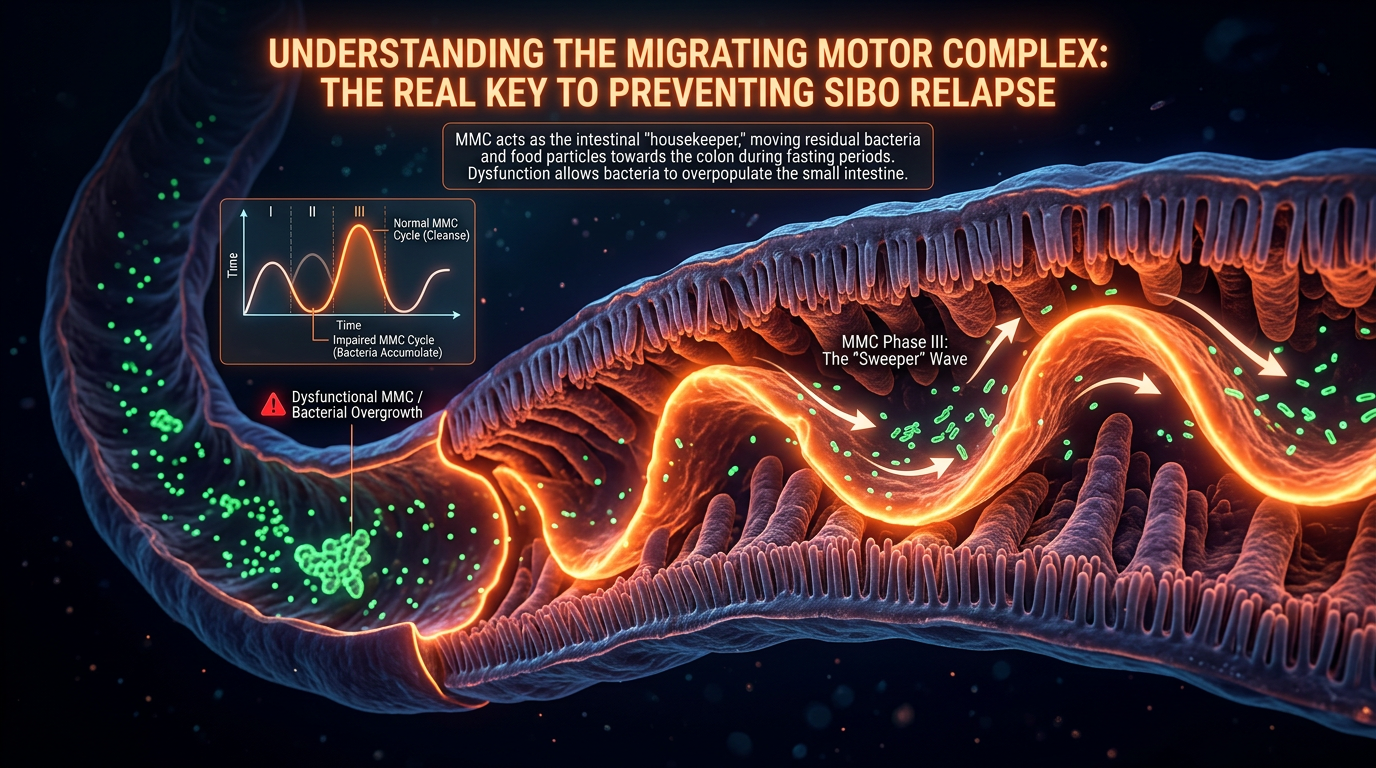
The Migrating Motor Complex is a distinct, electromechanical pattern of GI motility that occurs exclusively during the inter-digestive state (fasting). Often referred to as the 'street sweeper' of the small intestine, its primary function is to propel undigested food particles, cellular debris, and, crucially, excess bacteria out of the small intestine and into the colon.
Unlike peristalsis, which occurs after eating to move food through the digestive tract, the MMC only wakes up once the stomach and small intestine are empty. It operates in a cycle that repeats every 90 to 120 minutes.
The Four Phases of the Street Sweeper
The MMC is categorised into four distinct phases, though Phase III is the most critical for SIBO prevention:
- Phase I: A period of relative quiescence with infrequent contractions.
- Phase II: A period of irregular electrical activity and sporadic contractions.
- Phase III: The "Cleaning Wave." This is a short, 5-to-10-minute burst of high-amplitude, rhythmic contractions that originate in the stomach (or proximal duodenum) and migrate all the way to the ileum. This wave clears the lumen of any residual matter.
- Phase IV: A brief transition period back to Phase I.
When Phase III is absent or diminished, the small intestine becomes a stagnant pond rather than a flowing stream. This stagnation allows colonic bacteria to migrate upwards and colonise the nutrient-rich environment of the small intestine.
The Truth Exposed: Why SIBO is a Motility Disorder, Not an Infection
Mainstream gastroenterology frequently treats SIBO as an acute infection. The "kill-and-clear" approach—using Rifaximin or Neomycin—may reduce bacterial load, but it does nothing to address why the bacteria were able to accumulate in the first place.
According to the British Society of Gastroenterology, Irritable Bowel Syndrome (IBS) affects between 10% and 20% of the UK population. Recent meta-analyses suggest that up to 78% of these IBS cases are actually driven by SIBO. Despite this, the underlying failure of the MMC is rarely addressed in primary care consultations.
The truth is that SIBO is, in the vast majority of cases, a secondary symptom of a broken MMC. To focus only on the bacteria is akin to mopping up water from an overflowing sink without bothering to turn off the tap or clear the blocked drain.
The Molecular Mimicry: How Food Poisoning Breaks the MMC
One of the most significant breakthroughs in our "innerstanding" of SIBO is the discovery of post-infectious autoimmunity. For many, a single episode of food poisoning (Gastroenteritis) serves as the catalyst for a lifetime of digestive woe.
When you are exposed to pathogens like Campylobacter, Salmonella, or E. coli, these bacteria release a toxin called Cytolethal Distending Toxin B (CdtB). The human body produces antibodies to fight CdtB. However, through a process known as molecular mimicry, these antibodies begin to attack a structural protein in the gut lining called vinculin.
Vinculin is essential for the healthy functioning of the Interstitial Cells of Cajal (ICCs)—the "pacemakers" of the gut. When anti-vinculin antibodies damage these cells, the electrical signals required to initiate the MMC are disrupted. This is why SIBO often feels "incurable"; the physical machinery required to keep the gut clean has been compromised by an autoimmune response.
Environmental and Lifestyle Disruptors
Whilst autoimmunity is a primary driver, several modern environmental factors serve to further suppress the MMC, creating a "perfect storm" for SIBO relapse.
The Grazing Culture
The modern dietary advice of eating "small, frequent meals" is perhaps the most damaging recommendation for someone with a compromised MMC. Because the MMC is inhibited by the hormone insulin and the presence of nutrients in the stomach, every snack, latte, or "healthy" bite resets the 120-minute clock. If you eat every three hours, your small intestine may never enter Phase III, meaning the "street sweeper" never leaves the garage.
The Autonomic Disconnect
The MMC is under the control of the Enteric Nervous System (ENS), which communicates directly with the brain via the Vagus nerve. The Vagus nerve is the primary component of the parasympathetic nervous system (the 'rest and digest' state).
- Chronic Stress: High levels of cortisol and sympathetic dominance (fight or flight) actively shut down the MMC.
- Blue Light and Circadian Disruption: The MMC follows a circadian rhythm. Disruption of sleep-wake cycles through excessive evening blue light exposure can desynchronise gut motility patterns.
Pharmaceutical Interference
Many commonly prescribed medications in the UK are "pro-SIBO" agents:
- Proton Pump Inhibitors (PPIs): By reducing stomach acid, PPIs remove the first line of defence against bacterial entry and alter the pH of the small intestine, which can inhibit motilin secretion.
- Opioids: These are notorious for slowing GI transit and completely arresting the MMC.
- Anticholinergics: Often used for overactive bladder or depression, these block the signals required for gut contraction.
The INNERSTANDING Recovery Protocol: Restoring the Rhythm
To prevent SIBO relapse, we must move beyond the "kill" phase and into the "restore" phase. Healing the MMC requires a multi-faceted approach that addresses biochemistry, neurology, and timing.
1. Strategic Meal Spacing
This is the foundational step. To allow the MMC to complete its cycles, one must adopt a strict "no-grazing" policy.
- Aim for a minimum of 4 to 5 hours between meals.
- Implement a 12-to-14-hour overnight fast to allow for multiple MMC cycles during sleep.
- Consume only water, plain black coffee, or herbal tea between meals.
2. Pharmacological and Natural Prokinetics
A prokinetic is a substance that enhances gastrointestinal motility by increasing the frequency or strength of contractions. These are not laxatives; they specifically target the MMC.
- Pharmaceuticals: Low-dose Erythromycin (acting as a motilin agonist) or Prucalopride (a 5-HT4 receptor agonist) are often prescribed at bedtime to stimulate Phase III.
- Nutraceuticals: Ginger and Artichoke extract have been shown to be effective natural prokinetics. Ginger stimulates antral contractions, while artichoke supports bile flow and small bowel motility.
3. Vagal Nerve Optimisation
Since the Vagus nerve is the "master controller" of the MMC, its tone must be improved to ensure the signal to "sweep" actually reaches the gut.
- Deep Breathing: Diaphragmatic breathing for 10 minutes before meals can shift the body from sympathetic to parasympathetic dominance.
- Cold Exposure: Brief cold showers or splashing the face with ice-cold water stimulates the Vagal reflex.
- Gargling and Singing: The Vagus nerve passes by the vocal cords and muscles at the back of the throat. Vigorous gargling or loud singing can physically stimulate the nerve.
4. Visceral Manipulation
Physical adhesions from past surgeries (such as appendectomies or C-sections) or inflammatory conditions like endometriosis can physically "kink" the small intestine. This mechanical obstruction can impede the MMC wave. Specialist visceral massage or osteopathic manipulation can help release these restrictions, restoring the physical pathway for motility.
The Role of Motilin and Ghrelin: The Chemical Messengers
To truly "innerstand" the MMC, one must appreciate the roles of two key hormones: Motilin and Ghrelin.
Motilin is the primary hormone responsible for the initiation of Phase III contractions. It is secreted by the M-cells in the duodenum. Interestingly, motilin secretion is cyclical and aligns with the MMC. Ghrelin, the "hunger hormone," also plays a synergistic role. When the stomach is empty, ghrelin levels rise, which in turn stimulates motilin and the MMC.
This explains why "feeling hungry" is actually a sign of a healthy gut. The growling sound often heard (borborygmi) is not necessarily a plea for food, but rather the sound of the MMC Phase III wave doing its work. By suppressing hunger with constant snacks, we suppress the very mechanism designed to keep us healthy.
Summary of the Path to Permanent Resolution
Preventing SIBO relapse is not about finding a more potent herbal blend; it is about respecting the biological rhythms of the human body. The "truth-exposing" reality is that our modern lifestyle is fundamentally anti-MMC.
- Recognise that SIBO is a symptom of motility failure.
- Identify the root cause (Autoimmunity, stress, medication, or adhesions).
- Space meals to allow the 120-minute MMC cycle to complete.
- Stimulate the system with prokinetics and Vagal toning.
- Nurture the Interstitial Cells of Cajal through anti-inflammatory protocols.
The Migrating Motor Complex is the body’s innate system of detoxification and microbial balance. When we align our lifestyle with this complex biological engine, we move away from the cycle of relapse and toward a state of lasting "innerstanding" and health.
In the UK, the reliance on symptomatic management for digestive issues costs the NHS billions annually. A shift toward motility-focused recovery could not only save resources but fundamentally change the quality of life for millions of chronic sufferers.
Final Thought: The Sovereignty of the Gut
We have been taught to fear bacteria, but the real enemy is stagnation. A gut that moves is a gut that heals. By prioritising the Migrating Motor Complex, you are not just treating a condition; you are restoring the sovereign rhythm of your internal ecosystem. Stop killing the guests, and start cleaning the house.
This article is provided for informational and educational purposes only. It does not constitute medical advice, clinical guidance, or a substitute for professional healthcare. Information reflects cited research at time of publication. Always consult a qualified healthcare professional before acting on any health information.
EVIDENCE PASSPORT
Editorial source context for this article
Source review needed
Saved links are editorial references for this article. They may support specific claims rather than every sentence. Open and assess each source in context. This passport does not independently verify them.
Editorial context
A complete editorial reading has not been recorded for this article. Source links remain available for you to open and assess directly.
Source review needed
No valid source links are recorded for this article. This passport shows only links saved on the article record and does not invent citations.
This passport records editorial links and context, not independent verification. Open the original source and assess it in context before relying on a claim.
Medical Disclaimer
The information in this article is for educational purposes only and does not constitute medical advice, diagnosis, or treatment. Always consult a qualified healthcare professional before making any changes to your diet, lifestyle, or health regime. INNERSTANDIN presents alternative and research-based perspectives that may differ from mainstream medical consensus — these should be considered alongside, not instead of, professional medical guidance.
Read Full DisclaimerContinue the thread
Keep this question moving.
Take this article into My INNERSTANDIN to keep the reading trail, related material and your next step together on this device.
Explore this in the Body Map
See where this hits your biology. Interactive anatomy, threats, and protective protocols.
Dig deeper in the Library
Free, longform PDF volumes that go beyond headlines into mechanisms and references.