
The Molecular Foundation: How Photobiomodulation Activates Cellular Repair
Updated May 2026
A comprehensive guide exploring the interaction between 660nm and 850nm light wavelengths and cytochrome c oxidase within the mitochondria to stimulate ATP production.
Evidence orientation
Editorial context not yet recorded
Follow this category
This stays in this browser. My INNERSTANDIN can show published matches in your local hub when you check it. It does not send email, push, or alert notifications.
Local learning review
A private browser aid for revisiting ideas. It is not an alert or a health recommendation.
Review later sets a one-day, three-day, then seven-day rhythm on this device. Choose it only when you want to revisit this article.
In the modern epoch, humanity has inadvertently disconnected itself from the most fundamental catalyst of biological life: the sun’s electromagnetic spectrum. While we have focused on macronutrients and chemical supplements, we have neglected the primary energy source that has dictated mammalian evolution for eons. Photobiomodulation (PBM)—the use of specific wavelengths of red and near-infrared light to stimulate cellular function—is not merely a 'wellness trend'. It is a corrective biological intervention.
To truly understand PBM, one must move beyond the surface-level aesthetics of 'red light therapy' and delve into the sub-cellular theatre where photons translate into physiological signals. This is the molecular foundation of healing.
The Mitochondrial Engine: The Primary Chromophore
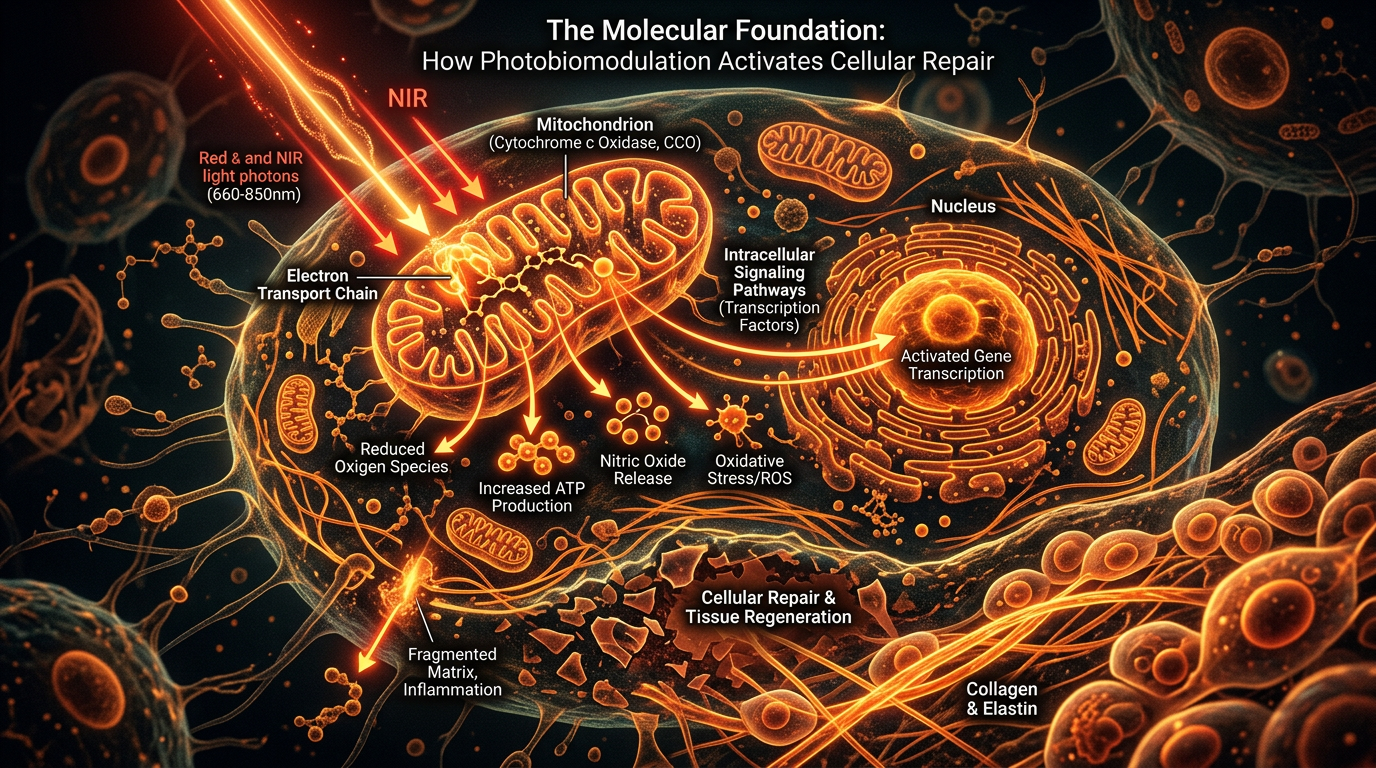
At the heart of photobiomodulation lies the mitochondrion. Long oversimplified as the "powerhouse of the cell," the mitochondrion is, in reality, a sophisticated environmental sensor and an electromagnetic transducer. The primary mechanism of PBM involves a specific enzyme within the mitochondrial respiratory chain: Cytochrome c Oxidase (CcO).
The Photo-Acceptor Mechanism
Cytochrome c Oxidase functions as a chromophore—a molecule capable of absorbing light. When photons in the red (600–700nm) and near-infrared (800–1000nm) ranges strike the cell, they are absorbed by CcO. This absorption triggers a cascade of events that resolves a critical biological bottleneck.
In a state of stress—whether due to toxicity, ageing, or lack of natural light—mitochondria produce excessive Nitric Oxide (NO). This NO binds to Cytochrome c Oxidase, effectively 'clogging' the respiratory chain and preventing oxygen from binding. This inhibition halts the production of Adenosine Triphosphate (ATP), the currency of cellular energy.
- Dissociation of Nitric Oxide: PBM triggers the dissociation of NO from CcO. This "clears the pipes," allowing oxygen to return to its rightful place.
- Enhanced Electron Transport: With NO removed, the flow of electrons through the respiratory chain is accelerated.
- ATP Synthesis: The resulting increase in the mitochondrial membrane potential leads to a significant surge in ATP production.
This is not a 'boost'; it is a restoration of the cell’s innate capacity to function. When a cell has surplus energy, it can divert resources toward repair, replication, and the maintenance of structural integrity.
Beyond Energy: Retrograde Signalling and Gene Expression
If PBM only increased ATP, it would be a temporary stimulant. However, its effects are profound and long-lasting because it initiates retrograde signalling. This is the process where signals from the mitochondria travel back to the cell nucleus, altering gene expression.
The Role of Reactive Oxygen Species (ROS)
While high levels of ROS (oxidative stress) are damaging, PBM produces a brief, controlled 'burst' of ROS. This serves as a vital signalling molecule. It activates transcription factors such as NF-kB and AP-1, which in turn switch on genes associated with:
- Cytoprotection: Increasing the production of antioxidants like superoxide dismutase (SOD) and glutathione.
- Cell Survival: Stimulating anti-apoptotic (anti-cell death) pathways.
- Growth Factors: Triggering the release of Vascular Endothelial Growth Factor (VEGF) for tissue repair and angiogenesis.
According to data from the UK’s Health and Safety Executive and various public health reviews, the average British citizen now spends upwards of 90% of their time indoors. This 'Indoor Age' has created a profound deficit in near-infrared exposure, leading to what some researchers term 'biological darkness', even under bright LED lights.
The Water Factor: The Fifth Phase of Biology
Recent breakthroughs in biophysics, notably the work regarding the "Exclusion Zone" (EZ) of water, have added a new layer to our understanding of PBM. The human body is approximately 70% water by molecule count, and the water inside our cells is not 'bulk' water; it is structured.
Near-infrared light (specifically around 810nm–830nm) is absorbed by the water molecules within the mitochondria. This absorption decreases the viscosity of the water, making it 'slicker'.
The ATP synthase motor, which rotates at speeds up to 9,000 RPM to manufacture ATP, must spin within this water. By reducing the viscosity (the friction) of the mitochondrial water, PBM allows this molecular motor to spin with less resistance. This is an elegant mechanical advantage provided by light, ensuring that the cellular machinery operates at peak efficiency.
Environmental Disruptors: The Toxicity of Modern Light
To understand the necessity of PBM, we must expose the truth about our current environment. We are currently living through a massive, uncontrolled biological experiment. The shift from incandescent bulbs to Light Emitting Diodes (LEDs) and the prevalence of 'Low-E' glass have stripped our environment of the healing frequencies of the sun.
The Blue Light Hazard and NIR Deficiency
Natural sunlight is a balanced spectrum. The high-energy blue light of the morning is always accompanied by a vast amount of restorative near-infrared (NIR).
- Modern LEDs: These bulbs are "blue-pumped," meaning they provide a sharp spike in high-energy blue light with almost zero red or near-infrared counter-balance.
- Retinal Stress: Chronic exposure to blue light without NIR triggers mitochondrial dysfunction in the RPE (Retinal Pigment Epithelium) cells of the eye.
- The Glass Barrier: Modern window coatings (Low-E glass) are designed to reflect heat. In doing so, they filter out the NIR spectrum while allowing visible blue light to pass through. We are effectively living in 'light-depleted' silos.
Melatonin: The Mitochondrial Guardian
The most startling revelation in recent chronobiology is that 95% of the body's melatonin is not produced in the pineal gland for sleep. Instead, it is produced inside the mitochondria in response to near-infrared light.
Subcellular melatonin acts as a master antioxidant, mopping up the damage produced during energy metabolism. By living behind glass and under LEDs, we have deprived our mitochondria of the signal to produce their own protection. PBM acts as a surrogate for the missing solar NIR, re-initiating this internal antioxidant defence system.
A study published in the British Journal of Ophthalmology highlights that the lack of natural outdoor light exposure is a primary driver in the global myopia epidemic, suggesting that the absence of specific solar wavelengths fundamentally alters the structural development of the human eye.
Systematic Recovery: Protocols for Cellular Restoration
Applying PBM is both an art and a science. It follows a Biphasic Dose-Response (the Arndt-Schulz Law), meaning there is a 'sweet spot' for healing. Too little light provides no benefit; too much can lead to a diminishment of results as the cell becomes overwhelmed by the signalling.
1. Dosing for Different Depths
Wavelength determines penetration.
- 660nm (Red): Ideal for skin, superficial wounds, and hair follicles. Most of this light is absorbed in the first few millimetres of tissue.
- 850nm (Near-Infrared): Possesses the ability to penetrate deep into the body—reaching muscles, bone, and even the brain (transcranial PBM).
2. The Importance of Power Density (Irradiance)
High authority PBM requires sufficient irradiance, measured in mW/cm². Without adequate power density, the photons will not reach the target depth in a reasonable timeframe. However, the 'flicker' present in low-quality LED devices can negate these benefits by inducing neurological stress. True therapeutic devices must be flicker-free and low-EMF.
3. Timing and Circadian Alignment
While PBM can be used at any time, using it in the morning mimics the 'infrared sunrise', preparing the cells for the oxidative stress of the day. Conversely, evening use on the body (avoiding bright light to the eyes) can assist in systemic recovery and inflammation reduction after the day's environmental insults.
4. The Bystander Effect
PBM possesses a unique 'systemic' quality. When you treat one area of the body, the activated signalling molecules and 'energised' blood cells circulate throughout the vascular system. Irradiating the blood (often via the underside of the forearm or intranasally) can provide anti-inflammatory benefits to organs that the light never directly touches.
The Truth of the 'Innerstanding'
The medical establishment often views the body as a collection of chemical reactions to be manipulated by pharmaceutical agents. The molecular foundation of PBM suggests a different reality: we are bio-electric and bio-photonic beings.
The "Innerstanding" we must reach is that our health is a direct reflection of our relationship with the electromagnetic environment. The chronic diseases of the 21st century—neurodegeneration, metabolic syndrome, and chronic fatigue—are all fundamentally rooted in mitochondrial failure.
Photobiomodulation is not a 'cure-all'; it is a fundamental requirement for a species that evolved under a sun that provides 50% of its energy in the infrared spectrum. By utilising PBM, we are not 'hacking' our biology—we are returning it to its original, light-rich state of being.
Key Takeaways for the Practitioner:
- Prioritise NIR (810–850nm) for systemic health and deep tissue repair.
- Eliminate Flicker: Ensure all light sources (PBM and environmental) are high-quality to protect the nervous system.
- Respect the Dose: Use PBM for 10–20 minutes per area; more is not always better.
- Address the Environment: Supplement PBM with 'light hygiene'—get outside, open windows, and reduce artificial blue light exposure after sunset.
Conclusion
The molecular foundation of photobiomodulation reveals a profound truth about our biological heritage. We are not separate from the light; we are powered by it. As we move further into a digitised, indoor existence, the deliberate application of red and near-infrared light becomes less of a luxury and more of a biological imperative. To activate cellular repair is to re-engage with the very frequencies that sparked life into existence. Through PBM, we find the bridge between ancient solar wisdom and modern molecular science.
This article is provided for informational and educational purposes only. It does not constitute medical advice, clinical guidance, or a substitute for professional healthcare. Information reflects cited research at time of publication. Always consult a qualified healthcare professional before acting on any health information.
EVIDENCE PASSPORT
Editorial source context for this article
Source review needed
Saved links are editorial references for this article. They may support specific claims rather than every sentence. Open and assess each source in context. This passport does not independently verify them.
Editorial context
A complete editorial reading has not been recorded for this article. Source links remain available for you to open and assess directly.
Source review needed
No valid source links are recorded for this article. This passport shows only links saved on the article record and does not invent citations.
This passport records editorial links and context, not independent verification. Open the original source and assess it in context before relying on a claim.
Medical Disclaimer
The information in this article is for educational purposes only and does not constitute medical advice, diagnosis, or treatment. Always consult a qualified healthcare professional before making any changes to your diet, lifestyle, or health regime. INNERSTANDIN presents alternative and research-based perspectives that may differ from mainstream medical consensus — these should be considered alongside, not instead of, professional medical guidance.
Read Full DisclaimerContinue the thread
Keep this question moving.
Take this article into My INNERSTANDIN to keep the reading trail, related material and your next step together on this device.
Explore this in the Body Map
See where this hits your biology. Interactive anatomy, threats, and protective protocols.
Dig deeper in the Library
Free, longform PDF volumes that go beyond headlines into mechanisms and references.