
The Molecular Impact: How Hyperbaric Oxygen Therapy Triggers Cellular Repair
Updated May 2026
An exploration of the physiological mechanisms behind HBOT, focusing on angiogenesis, stem cell mobilization, and the reduction of systemic inflammation.
Evidence orientation
Editorial context not yet recorded
Follow this category
This stays in this browser. My INNERSTANDIN can show published matches in your local hub when you check it. It does not send email, push, or alert notifications.
Local learning review
A private browser aid for revisiting ideas. It is not an alert or a health recommendation.
Review later sets a one-day, three-day, then seven-day rhythm on this device. Choose it only when you want to revisit this article.
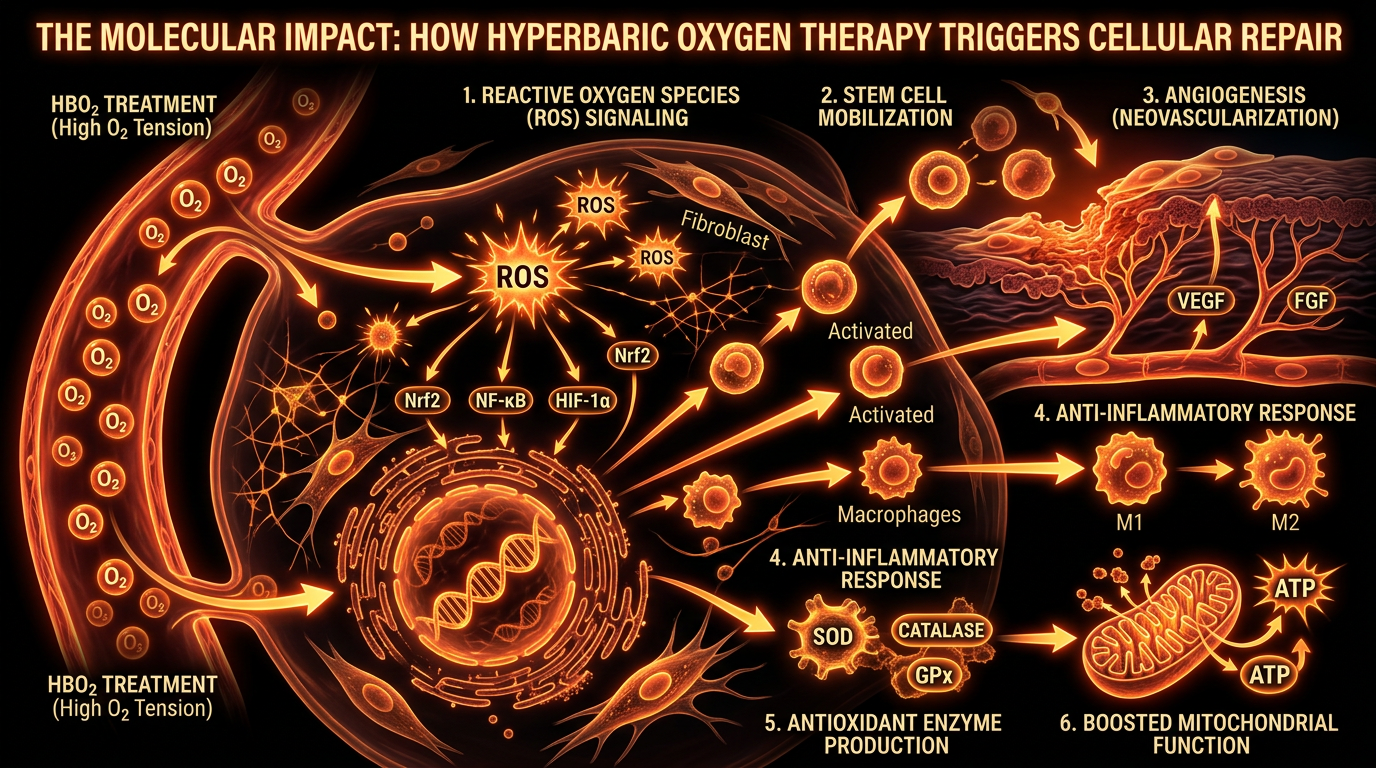
In the hierarchy of human survival, oxygen is the absolute sovereign. While we can endure weeks without food and days without water, the cessation of cellular oxygenation terminates consciousness in seconds and biological life in minutes. However, a silent crisis is unfolding within the modern physiology: a state of chronic, sub-clinical hypoxia. Driven by environmental degradation, sedentary lifestyles, and the ubiquitous burden of systemic inflammation, our cells are effectively suffocating in a 21% oxygen atmosphere.
Hyperbaric Oxygen Therapy (HBOT) is frequently mischaracterised by the mainstream medical establishment as a niche intervention for decompression sickness or non-healing diabetic ulcers. This reductionist view ignores the profound molecular alchemy that occurs when the human body is subjected to increased atmospheric pressure and pure oxygen. To understand HBOT is to understand the physics of gas dissolution and the epigenetics of cellular survival.
The Physics of Sovereignty: Henry’s Law and Plasma Saturation
Under standard conditions, oxygen transport is bottlenecked by the carrying capacity of haemoglobin. In a healthy individual, red blood cells are already roughly 97–99% saturated. Simply breathing more oxygen at normal atmospheric pressure (1.0 ATA) yields negligible gains in systemic delivery because the 'buses' (haemoglobin) are already full.
HBOT bypasses this biological bottleneck by employing Henry’s Law, which states that the amount of a gas dissolved in a liquid is proportional to its partial pressure. When a patient enters a hyperbaric chamber—typically pressurised to between 1.5 and 2.5 ATA—oxygen is forced directly into the blood plasma, cerebrospinal fluid, and interstitial fluids.
This creates a state of hyperoxia that is independent of red blood cell count. In this state, oxygen can reach tissues where circulation is compromised by oedema, scarring, or vascular inflammation—areas where bulky red blood cells cannot physically pass, but oxygen-rich plasma can seep.
In the United Kingdom, chronic wounds cost the NHS an estimated £8.3 billion annually. A significant proportion of these cases involve ischaemic tissue where standard oxygen delivery has failed, yet hyperbaric interventions remain underutilised despite their ability to hyper-oxygenate compromised tissue sites.
The Molecular Switch: From Survival to Regeneration
The impact of HBOT is not merely a transient "oxygen bath." It is a potent epigenetic trigger. Research indicates that a single session of HBOT can modulate the expression of over 8,000 genes, specifically upregulating those responsible for growth and repair while downregulating those associated with pro-inflammatory cytokines.
Mitochondrial Biogenesis and ATP Flux
The primary site of HBOT’s action is the mitochondria. Under hypoxic or inflammatory stress, the electron transport chain becomes sluggish, leading to a drop in Adenosine Triphosphate (ATP) production—the body’s fundamental energy currency.
By flooding the system with dissolved oxygen, HBOT restores the mitochondrial membrane potential. This doesn't just "refuel" the cell; it triggers mitochondrial biogenesis—the creation of new mitochondria. Enhanced ATP availability allows the cell to transition from a state of "emergency maintenance" to "active repair."
The HIF-1α Paradox
One of the most fascinating mechanisms of HBOT is the "Hyperoxic-Hypoxic Paradox." Under normal conditions, a protein called Hypoxia-Inducible Factor 1-alpha (HIF-1α) is the primary driver of the body’s response to low oxygen. It triggers the release of growth factors like VEGF (Vascular Endothelial Growth Factor).
During HBOT, the body experiences a massive surge in oxygen. When the session ends and oxygen levels return to normal, the body perceives this relative drop as a state of hypoxia, even though levels are still sufficient. This triggers a robust surge in HIF-1α, effectively "tricking" the body into stimulating massive regenerative pathways—including the growth of new capillary networks (angiogenesis)—without the actual danger of tissue starvation.
Stem Cell Mobilisation: The Eight-Fold Surge
Perhaps the most compelling evidence for HBOT’s role in cellular repair is its impact on the bone marrow. Stem cells are the body’s internal repair kit, capable of transforming into whatever cell type is required for healing. However, as we age or suffer from chronic illness, our stem cell niches become dormant or depleted.
In a landmark study, researchers found that a course of HBOT (20 sessions) increased the concentration of circulating CD34+ stem cells by 800%.
- Nitric Oxide Stimulation: The pressure increase triggers a release of Nitric Oxide (NO) in the bone marrow.
- Enzymatic Activation: NO activates enzymes that detach stem cells from their niches.
- Systemic Deployment: These cells are then released into the bloodstream, where they home in on areas of injury and inflammation to initiate tissue reconstruction.
Environmental Disruptors: The Invisible Hypoxia
To understand why HBOT is no longer a luxury but a biological necessity for many, we must examine the environmental factors that degrade our oxygen-utilization efficiency.
- Atmospheric Pollution: Nitrogen dioxide and particulate matter (PM2.5) in British urban centres cause chronic airway inflammation, reducing the efficiency of gas exchange at the alveolar level.
- Microplastics and Endocrine Disruptors: These substances interfere with mitochondrial membranes, making it harder for cells to utilise the oxygen that does manage to reach them.
- The Sedentary Trap: Lack of movement leads to "capillary rarefaction"—the literal vanishing of small blood vessels due to disuse. This increases the diffusion distance oxygen must travel to reach cells.
- Chronic Oxidative Stress: Paradoxically, while we need oxygen, the body's inability to manage Reactive Oxygen Species (ROS) due to poor diet and stress creates a "rusting" effect at the cellular level.
HBOT acts as a "hormetic" stressor. By providing a controlled burst of hyperoxia, it stimulates the body’s internal antioxidant defences (such as superoxide dismutase and glutathione), essentially "training" the cells to be more resilient to the toxic modern environment.
Neurological Restoration: Beyond the Blood-Brain Barrier
The brain is the body’s most oxygen-hungry organ, consuming 20% of our total intake despite making up only 2% of our mass. Neurological conditions—from "brain fog" and TBI (Traumatic Brain Injury) to neurodegenerative diseases—are often characterised by "idling neurons." These are cells that are still alive but do not have enough energy (ATP) to fire electrically.
HBOT is uniquely capable of crossing the blood-brain barrier via plasma saturation. It reduces cerebral oedema (swelling) and reactivates these idling neurons.
Public Health England data suggests a rising trend in neurovascular incidents among younger demographics. Standard post-stroke protocols often overlook the "penumbra"—the area of salvageable brain tissue surrounding a stroke site that remains in a state of metabolic hibernation, waiting for the oxygen surge HBOT provides.
Protocols for Recovery: The Architecture of Healing
HBOT is not a "one-off" miracle; it is a cumulative physiological process. The "Standard Protocol" often cited in clinical literature involves:
1. The Induction Phase
The first 10–20 sessions are focused on quenching systemic inflammation and restoring mitochondrial function. This is where the patient often notices improvements in sleep, cognitive clarity, and energy levels.
2. The Proliferation Phase
Between sessions 20 and 40, the "HIF-1α Paradox" takes full effect. This is the peak period for angiogenesis (new blood vessel growth) and the massive mobilisation of stem cells. This is when deep tissue repair, such as ligament healing or neurological rewiring, occurs.
3. The Consolidation Phase
Beyond 40 sessions, the focus shifts to long-term epigenetic stability. Research into telomere biology has shown that specific HBOT protocols can actually lengthen telomeres—the protective caps on our DNA—effectively reversing cellular ageing by years.
- Pressure Matters: For neurological repair, lower pressures (1.3 to 1.5 ATA) are often preferred to avoid excessive oxidative stress. For wound healing and bone repair, higher pressures (2.0 to 2.4 ATA) are typically required.
- Frequency is Key: To trigger the necessary gene expression, sessions should be frequent (often 5 days a week) to prevent the body from reverting to its previous hypoxic baseline.
The Truth-Exposing Reality: Why Isn't This Universal?
The pharmaceutical model of medicine is predicated on the "one pill for one ill" philosophy. HBOT, by contrast, is a systemic biological intervention. It does not target a single symptom; it restores the fundamental substrate of life itself.
Because oxygen cannot be patented and the physics of pressure are a law of nature, there is little financial incentive for "Big Pharma" to fund the large-scale, multi-centre trials required to make HBOT a first-line treatment for chronic disease. Consequently, the UK remains decades behind in the integration of hyperbaric medicine compared to nations like Israel or even the United States, where "Hyperbaric Centres of Excellence" are becoming staples of regenerative health.
Conclusion: Reclaiming the Cellular Breath
Hyperbaric Oxygen Therapy is the ultimate "truth" in biological restoration. It strips away the complexities of modern symptomatic management and addresses the core requirement of every one of our 37 trillion cells: the ability to produce energy and repair damage.
By manipulating the very air we breathe through the lens of physics, we can trigger a cascade of molecular events—from stem cell surges to gene silencing—that were once thought impossible. In an age of environmental suffocation, HBOT is not just a medical treatment; it is an act of cellular rebellion, a way to reclaim the high-oxygen environment our ancestors evolved in, and a vital tool for anyone seeking to transition from a state of mere survival to one of thriving biological sovereignty.
The molecular impact is clear: when you give the body the oxygen it needs at the pressure it requires, the "miracle" of healing becomes a matter of simple, undeniable science.
This article is provided for informational and educational purposes only. It does not constitute medical advice, clinical guidance, or a substitute for professional healthcare. Information reflects cited research at time of publication. Always consult a qualified healthcare professional before acting on any health information.
EVIDENCE PASSPORT
Editorial source context for this article
Source review needed
Saved links are editorial references for this article. They may support specific claims rather than every sentence. Open and assess each source in context. This passport does not independently verify them.
Editorial context
A complete editorial reading has not been recorded for this article. Source links remain available for you to open and assess directly.
Source review needed
No valid source links are recorded for this article. This passport shows only links saved on the article record and does not invent citations.
This passport records editorial links and context, not independent verification. Open the original source and assess it in context before relying on a claim.
Medical Disclaimer
The information in this article is for educational purposes only and does not constitute medical advice, diagnosis, or treatment. Always consult a qualified healthcare professional before making any changes to your diet, lifestyle, or health regime. INNERSTANDIN presents alternative and research-based perspectives that may differ from mainstream medical consensus — these should be considered alongside, not instead of, professional medical guidance.
Read Full DisclaimerContinue the thread
Keep this question moving.
Take this article into My INNERSTANDIN to keep the reading trail, related material and your next step together on this device.
Dig deeper in the Library
Free, longform PDF volumes that go beyond headlines into mechanisms and references.