
Photobiomodulation: The Cellular Mechanism of Light-Based Pain Relief
Updated May 2026
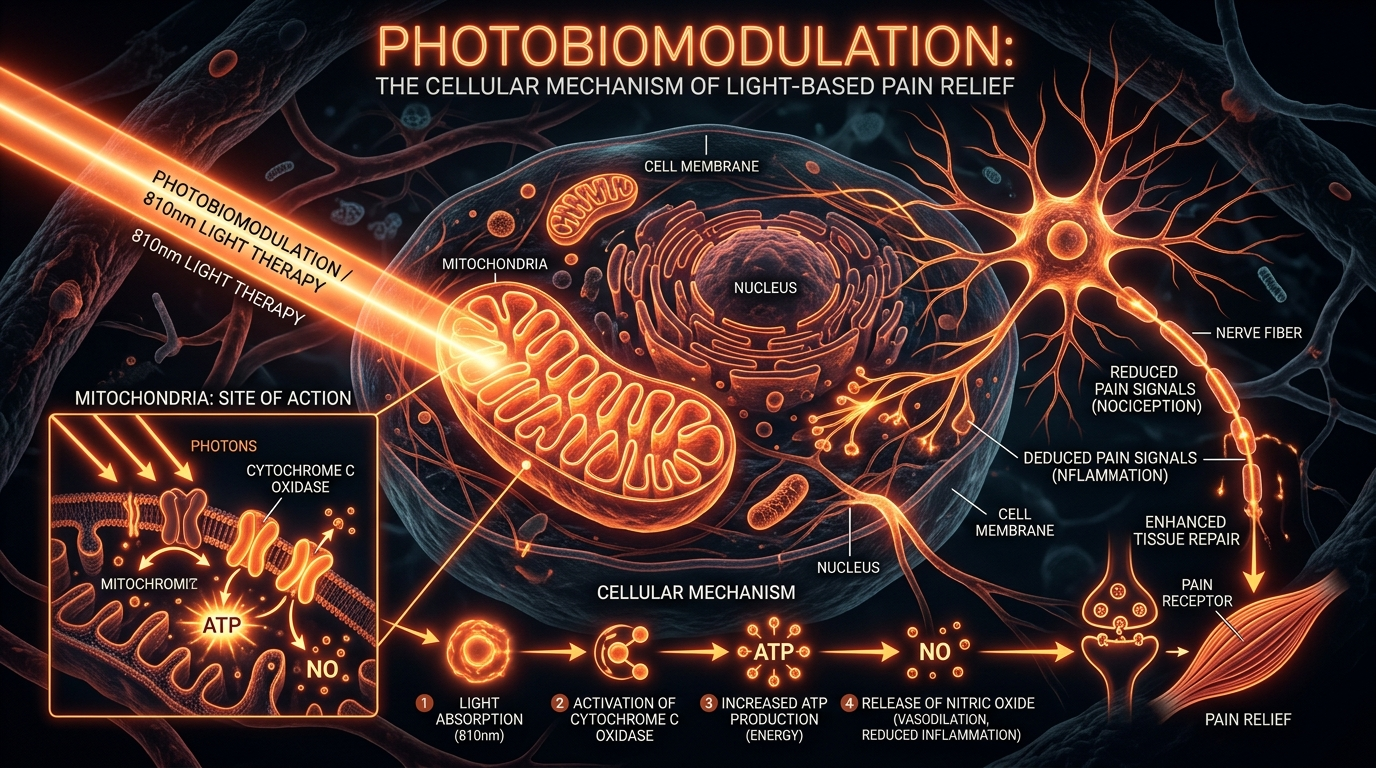
Red and near-infrared light interact with cytochrome c oxidase in the mitochondria to accelerate tissue repair and reduce inflammation. This biological process offers a non-toxic alternative to systemic NSAID use.
Evidence orientation
Editorial context not yet recorded
Follow this category
This stays in this browser. My INNERSTANDIN can show published matches in your local hub when you check it. It does not send email, push, or alert notifications.
Local learning review
A private browser aid for revisiting ideas. It is not an alert or a health recommendation.
Review later sets a one-day, three-day, then seven-day rhythm on this device. Choose it only when you want to revisit this article.
Overview
In the contemporary landscape of medical science, we find ourselves at a critical juncture where the biochemical model of health is increasingly revealing its limitations. For decades, the dominant paradigm for managing chronic pain has relied almost exclusively on pharmaceutical intervention—specifically, the systemic use of Non-Steroidal Anti-Inflammatory Drugs (NSAIDs) and opioids. However, as the global burden of chronic pain intensifies, a revolutionary discipline is emerging from the shadows of fringe therapy into the spotlight of rigorous biophysics: Photobiomodulation (PBM).
Photobiomodulation, formerly known as Low-Level Laser Therapy (LLLT), describes the use of non-ionising optical radiation—specifically in the red and near-infrared (NIR) spectra—to elicit beneficial therapeutic effects in biological systems. Unlike the thermal lasers used in surgery to cut or cauterise tissue, PBM operates on a photochemical basis, similar to photosynthesis in plants. It is a process whereby photons are absorbed by specific cellular chromophores, triggering a cascade of metabolic events that accelerate tissue repair, down-regulate pro-inflammatory cytokines, and restore homeostatic balance to the nervous system.
At INNERSTANDING, we recognise that the human body is not merely a collection of chemical reactions, but a sophisticated bioelectrical engine. Every thought, movement, and healing process is fueled by the production of Adenosine Triphosphate (ATP) within our mitochondria. Chronic pain, in its essence, is a signal of bioenergetic failure—a state where the demand for cellular energy exceeds the supply, leading to oxidative stress and persistent inflammatory signaling. PBM addresses this failure at its root. By interacting directly with the mitochondrial respiratory chain, red and near-infrared light provide a non-toxic, non-invasive "fuel" that enables the body to bypass the roadblocks of injury and chronic degeneration.
In the United Kingdom, it is estimated that approximately 28 million adults are living with chronic pain, a figure that represents nearly 43% of the population. Despite this staggering number, the mainstream clinical approach remains tethered to a "pill for every ill" philosophy that often masks symptoms while exacerbating underlying mitochondrial decay.
This article serves as a comprehensive exploration into the biophysics of light-based healing. We will dissect the intricate dance between photons and proteins, expose the environmental factors that have left the modern human "light-malnourished," and provide a roadmap for reclaiming biological vitality through the strategic application of photomedicine.
##
The Biology — How It Works
To understand Photobiomodulation, one must first appreciate the "Optical Window" of human tissue. The human body is relatively opaque to most wavelengths of the electromagnetic spectrum. Ultraviolet light is largely absorbed by DNA and proteins in the outer layers of the skin, while longer infrared wavelengths (far-infrared) are absorbed by water molecules, generating heat. However, there exists a specific range—roughly between 600nm and 1100nm—where light can penetrate deeply into the dermis, muscle tissue, and even bone. This is the spectrum of Red (600nm–700nm) and Near-Infrared (700nm–1100nm) light.
The fundamental principle of PBM is that certain molecules within our cells act as "light receptors" or chromophores. In the same way that chlorophyll absorbs sunlight to create glucose in plants, humans possess a critical enzyme in our mitochondria called Cytochrome c Oxidase (CCO). This enzyme is the primary target of PBM.
When red or NIR light photons reach the mitochondria, they are absorbed by CCO, which sits at Complex IV of the Electron Transport Chain (ETC). This absorption is not merely passive; it is a catalyst for a profound shift in cellular respiration. In a healthy cell, the ETC moves electrons through a series of complexes to create a proton gradient, which ultimately drives the synthesis of ATP. However, in states of stress, injury, or inflammation, this process is inhibited by the accumulation of Nitric Oxide (NO).
Nitric Oxide is a gasotransmitter that, while beneficial in the vasculature, becomes a "clog" in the mitochondrial machinery when it binds to Cytochrome c Oxidase. It displaces oxygen, effectively suffocating the cell at a microscopic level and halting ATP production. This state of "metabolic hypoxia" is a hallmark of chronic pain conditions. PBM works by "photodissociating" Nitric Oxide from the CCO enzyme. The energy of the photon essentially kicks the NO molecule off the binding site, allowing oxygen to rush back in and resume the production of energy.
The Power of Wavelength and Coherence
Not all light is created equal. The efficacy of PBM is strictly dependent on the "Three Pillars of Dosimetry": Wavelength, Irradiance (power density), and Fluence (energy density).
- Red Light (630nm–670nm): This range is highly effective for superficial tissue, such as skin rejuvenation, wound healing, and treating small joints. It is absorbed more readily by the blood and surface-level tissues.
- Near-Infrared Light (810nm–850nm): These longer wavelengths possess superior penetrative capabilities. They can reach deep into the musculature, tendons, and even the brain (transcranial PBM), making them the gold standard for deep-seated chronic pain and neurological recovery.
The bio-energetic shift triggered by these wavelengths is almost instantaneous, yet the downstream effects—what we call the "second messenger cascade"—can last for hours or even days after exposure.
##
Mechanisms at the Cellular Level
The magic of PBM lies in its ability to modulate the cellular redox state. When photons displace Nitric Oxide and stimulate Cytochrome c Oxidase, a series of intracellular signals are initiated that transcend mere energy production.
1. The Sudden Burst of ROS (Mitohormesis)
One of the most misunderstood aspects of PBM is the brief, controlled spike in Reactive Oxygen Species (ROS). While chronic high levels of ROS (oxidative stress) are damaging, a transient pulse of ROS acts as a potent signaling mechanism. This is a classic example of hormesis—where a small amount of stress triggers a robust protective and adaptive response. This ROS pulse activates transcription factors such as NF-kB and Hypoxia-Inducible Factor (HIF-1), which in turn switch on hundreds of genes related to cellular repair, antioxidant production, and protein synthesis.
2. Retrograde Signaling and Gene Expression
The mitochondria are not just "powerhouses"; they are the "environmental sensors" of the cell. Through a process called retrograde signaling, the changes in mitochondrial activity caused by PBM are communicated back to the cell nucleus. This leads to the up-regulation of:
- Growth Factors: Such as Nerve Growth Factor (NGF) and Brain-Derived Neurotrophic Factor (BDNF), crucial for repairing damaged nerves in neuropathic pain.
- Anti-inflammatory Cytokines: PBM shifts the macrophage phenotype from M1 (pro-inflammatory) to M2 (healing/anti-inflammatory), effectively "turning off" the fire of chronic inflammation without the systemic side effects of drugs.
3. The Water Phase Transition (The Fourth Phase)
Recent pioneering research into "Exclusion Zone" (EZ) water suggests another profound mechanism. The water inside our cells, particularly surrounding the mitochondrial membranes, is not "bulk water." It is structured, gel-like water. Near-infrared light has been shown to reduce the viscosity of this interfacial water layer. By making this water "thinner" or more fluid, the molecular "motor" of ATP synthase can spin with less resistance. This physical change in the cellular environment allows for a significant increase in the efficiency of energy production, regardless of the chemical state of the cell.
4. Systemic Effects (The Abscopal Effect)
Perhaps the most remarkable mechanism of PBM is its systemic influence. You do not necessarily need to shine the light on every square inch of the body to receive benefits. Irradiation of the blood (either through the skin or intranasally) can lead to systemic anti-inflammatory effects. As blood circulates through the area being treated, the white blood cells and platelets absorb the photonic energy. These "primed" cells then travel throughout the body, releasing anti-inflammatory signals and promoting systemic healing. This explains why treating the lower back might occasionally lead to improvements in a patient’s overall mood or cognitive clarity.
##
Environmental Threats and Biological Disruptors
In our pursuit of progress, modern civilisation has inadvertently created a "photobiological desert." Our ancestors spent the vast majority of their time outdoors, exposed to a full spectrum of solar radiation that is rich in near-infrared light, especially during sunrise and sunset. Today, the average person in the UK spends upwards of 90% of their time indoors, under artificial lighting that is biologically discordant.
The Blue Light Plague
Most modern LED and fluorescent lighting, as well as the screens of our smartphones and computers, are heavily weighted toward the blue end of the spectrum (400nm–480nm). While blue light is useful for daytime alertness, it is "naked" light—it lacks the counter-balancing red and infrared frequencies found in sunlight. Excess blue light, particularly at night, suppresses melatonin production and creates a state of mitochondrial stress. It induces the overproduction of ROS without the regenerative "rescue" signal of NIR light, leading to a state of chronic cellular exhaustion.
The Glass Barrier
A little-known fact of modern architecture is that standard window glass is designed to be energy-efficient by blocking infrared radiation (specifically "thermal" IR). In doing so, it also filters out a significant portion of the NIR spectrum. This means that even if you are sitting in a sunlit office, you are being robbed of the very wavelengths required for mitochondrial repair. We are effectively living in a state of "Light Malnutrition."
Research indicates that the lack of Near-Infrared exposure is a primary contributor to the rise in seasonal affective disorder (SAD) and the worsening of chronic pain symptoms during the winter months in the UK.
Electromagnetic Interference (EMFs)
Furthermore, the proliferation of non-ionising radiation from Wi-Fi, 5G, and Bluetooth creates an "electrosmog" that interferes with the voltage-gated calcium channels (VGCCs) in our cell membranes. When these channels are over-stimulated by artificial EMFs, calcium floods the cell, further increasing Nitric Oxide production and inhibiting mitochondrial respiration. PBM serves as a vital corrective to this environmental interference, helping to re-stabilise the mitochondrial membrane potential and flush out the excess NO.
##
The Cascade: From Exposure to Disease
What happens when this light malnutrition and mitochondrial inhibition become chronic? We witness the "Cascade of Degeneration."
It begins with Bioenergetic Failure. When the mitochondria cannot produce enough ATP to meet the demands of the tissue, the cell enters a state of "survival mode." It stops performing luxury functions like repair and regeneration and focuses solely on staying alive. This leads to the accumulation of cellular waste products and damaged proteins (autophagy failure).
Next comes Chronic Low-Grade Inflammation (Inflammaging). The stressed mitochondria leak DNA and ROS into the cytoplasm, which are recognised by the immune system as "danger signals." This triggers the activation of the Inflammasome, a protein complex that initiates the release of pro-inflammatory cytokines like IL-1β and TNF-α. In the context of the nervous system, this manifests as "Central Sensitisation"—the biological basis of chronic pain, where the nerves become hyper-reactive to even minor stimuli.
This cascade eventually leads to the "Diseases of Modernity":
- Fibromyalgia: A condition now increasingly understood as a systemic mitochondrial disorder.
- Neuropathy: Where the long axons of the nerves fail to receive enough energy to maintain their myelin sheaths, leading to "misfiring" and pain.
- Osteoarthritis: Not merely "wear and tear," but a failure of the chondrocytes (cartilage cells) to repair the extracellular matrix due to metabolic exhaustion.
The pharmaceutical response to this cascade is usually to prescribe NSAIDs (Ibuprofen, Diclofenac, etc.). While these may provide temporary relief by blocking the COX-2 enzyme, they do nothing to address the mitochondrial failure. In fact, long-term NSAID use is known to damage mitochondrial membranes and impair the gut barrier, leading to "leaky gut" and fueling the very inflammation they were intended to treat. It is a pharmaceutical "Sisyphus" loop—one that PBM is uniquely positioned to break.
##
What the Mainstream Narrative Omits
The question must be asked: If Photobiomodulation is so effective, scientifically validated, and safe, why is it not the first line of treatment in every NHS GP surgery? The answer lies in the structural biases of the modern medical-industrial complex.
The Intellectual Property Problem
The primary driver of modern medical "validation" is the large-scale Randomised Controlled Trial (RCT). These trials cost hundreds of millions of pounds. Because light—like oxygen or water—cannot be patented, there is little financial incentive for "Big Pharma" to fund the definitive trials required for PBM to become "Standard of Care." Medical devices for PBM exist, but they are sold as equipment, not as a recurring monthly prescription. In a system built on "lifetime value per patient," a therapy that actually heals the tissue and renders the patient independent of medication is a threat to the bottom line.
The Chemical Hegemony
Our medical education system is heavily focused on biochemistry. Doctors are trained to think of the body as a "bag of chemicals" where every problem is solved by adding a new chemical. The field of Biophysics—the study of how light, sound, and electromagnetism affect biology—is relegated to the status of an elective or "alternative" medicine. This is despite the fact that our own heart rhythm is monitored by electrical signals (ECG) and our brains operate on electromagnetic frequencies (EEG).
The "Dose" Difficulty
In drug therapy, a dose is simple: take 400mg of a pill. In PBM, the "dose" is complex. It involves power density, time, distance from the skin, and frequency of treatment. Many early studies on PBM "failed" because they used the wrong parameters—too much light can be as ineffective as too little (the Arndt-Schulz Law). The mainstream narrative often uses these inconsistent early studies to dismiss the entire field, ignoring the thousands of successful peer-reviewed papers that have refined the dosimetry for specific conditions.
It is a profound irony that the very same "scientific" establishment that dismisses light therapy as "pseudo-science" uses blue light to treat neonatal jaundice and UV light to treat psoriasis—acknowledging the power of photons only when it suits a narrow clinical niche.
##
The UK Context
The United Kingdom presents a unique and urgent case for the adoption of Photobiomodulation. Our northern latitude means that for at least six months of the year (October to March), the solar angle is too low for the atmosphere to allow sufficient UV-B for Vitamin D production, and the overall intensity of restorative NIR light is significantly diminished.
The Opioid Crisis in the UK
While the "Opioid Crisis" is often framed as an American problem, the UK has seen a dramatic increase in opioid prescriptions over the last two decades. Between 1998 and 2018, opioid prescriptions in England rose by 127%. Many of these patients are "stuck" on long-term medications for chronic back pain and fibromyalgia—medications that the National Institute for Health and Care Excellence (NICE) now admits are largely ineffective for primary chronic pain.
The Economic Burden
The cost of chronic pain to the UK economy is estimated at £10 billion per year in direct healthcare costs and lost productivity. The NHS is currently buckling under the weight of an ageing population with multiple chronic inflammatory conditions. PBM offers a solution that is not only clinically superior for many of these patients but also immensely cost-effective. A high-quality PBM device is a one-time investment that can provide thousands of treatments, reducing the burden on primary care and physiotherapy services.
The "Indoor" British Lifestyle
The British climate further compounds the issue. The grey, overcast skies and the tendency to remain indoors mean that the average Briton is suffering from a "double hit" of light deprivation: lack of natural sunlight and over-exposure to harsh, artificial indoor lighting. This "Light Hunger" is a hidden driver of the UK's chronic pain and mental health epidemic.
##
Protective Measures and Recovery Protocols
Reclaiming your mitochondrial health requires a two-pronged approach: Mitigation of harmful light and Optimisation through strategic Photobiomodulation.
1. Dosimetry for Pain Relief
To use PBM for pain, you must ensure the light reaches the target tissue.
- Frequency: For chronic pain, 3–5 sessions per week are typically required for the first 4–6 weeks.
- Timing: PBM is best used in the morning or early afternoon to align with natural circadian rhythms.
- Direct Contact: Near-infrared light should be applied directly to the skin (not through clothing) to minimise reflection and scattering.
- The "Sweet Spot": For deep tissue (back pain, knee arthritis), look for devices that provide at least 50mW/cm² of irradiance at the surface.
2. Environmental Mitigation
- Block the Blue: Wear high-quality blue-blocking glasses after sunset to preserve your mitochondrial melatonin.
- Incandescent Lighting: Replace "cold" LED bulbs in your living areas with "warm" incandescent or halogen bulbs, which naturally emit more red and NIR light.
- Sun-Drenching: Even on a cloudy day in the UK, spend at least 20 minutes outdoors. The NIR light from the sun penetrates through clouds and provides a baseline "nutrient" level of photons.
3. Synergistic Support
PBM does not work in a vacuum. Its effects are amplified when the body has the necessary building blocks for repair.
- Redox Support: Ensure adequate intake of Magnesium and CoQ10, both of which are essential for the Electron Transport Chain where PBM works.
- Hydration: Since PBM affects the structure of cellular water, being well-hydrated is critical. "Structured" water from organic fruits and vegetables is particularly beneficial.
- Grounding (Earthing): Connecting your skin to the Earth (walking barefoot on grass or using a grounding mat) provides a source of free electrons. This "antioxidant" effect works in perfect harmony with the "energy-boosting" effect of red light.
4. Moving Beyond NSAIDs
For those looking to transition away from systemic NSAIDs, PBM should be integrated as part of a "Mitochondrial Rehabilitation" protocol. This involves gradually reducing medication under supervision while "up-regulating" the body's internal antioxidant systems through light therapy, cold exposure, and an anti-inflammatory diet (low in processed seed oils and high in omega-3 fatty acids).
##
Summary: Key Takeaways
The science of Photobiomodulation represents a paradigm shift in how we approach human health and recovery. It moves us from a model of "chemical suppression" to one of "bioenergetic support."
- The Primary Target: PBM works by stimulating Cytochrome c Oxidase in the mitochondria, the engine of the cell.
- Energy and Signaling: By displacing Nitric Oxide, light restores ATP production and triggers a "second messenger" cascade of healing genes.
- Beyond the Surface: Near-infrared light (800nm–1000nm) can penetrate deep into joints, muscles, and nerves, providing relief where topical treatments cannot.
- A Non-Toxic Alternative: Unlike NSAIDs, which damage the gut and mitochondria, PBM is "mitohormetic"—it strengthens the cell’s own antioxidant and repair mechanisms.
- Environmental Necessity: In an age of blue-light toxicity and indoor living, supplemental red and NIR light are no longer "optional" luxuries; they are essential biological requirements.
- The UK Mandate: With millions suffering from chronic pain and a healthcare system in crisis, PBM offers a scientifically-backed, cost-effective, and safe path forward.
At INNERSTANDING, we believe that the truth about health is often hidden in plain sight. Light is the most fundamental source of energy in the universe. It created life, it sustains life, and through the rigorous application of Photobiomodulation, it has the power to restore life to those trapped in the darkness of chronic pain. The future of medicine is not just chemical—it is luminous.
This article is provided for informational and educational purposes only. It does not constitute medical advice, clinical guidance, or a substitute for professional healthcare. Information reflects cited research at time of publication. Always consult a qualified healthcare professional before acting on any health information.
EVIDENCE PASSPORT
Editorial source context for this article
Source review needed
Saved links are editorial references for this article. They may support specific claims rather than every sentence. Open and assess each source in context. This passport does not independently verify them.
Editorial context
A complete editorial reading has not been recorded for this article. Source links remain available for you to open and assess directly.
Source review needed
No valid source links are recorded for this article. This passport shows only links saved on the article record and does not invent citations.
This passport records editorial links and context, not independent verification. Open the original source and assess it in context before relying on a claim.
Medical Disclaimer
The information in this article is for educational purposes only and does not constitute medical advice, diagnosis, or treatment. Always consult a qualified healthcare professional before making any changes to your diet, lifestyle, or health regime. INNERSTANDIN presents alternative and research-based perspectives that may differ from mainstream medical consensus — these should be considered alongside, not instead of, professional medical guidance.
Read Full DisclaimerContinue the thread
Keep this question moving.
Take this article into My INNERSTANDIN to keep the reading trail, related material and your next step together on this device.
Explore this in the Body Map
See where this hits your biology. Interactive anatomy, threats, and protective protocols.
Dig deeper in the Library
Free, longform PDF volumes that go beyond headlines into mechanisms and references.