
Predictive Personal Health: The Rise of AI-Driven Wearables
Updated May 2026
Exploring how deep learning algorithms are transforming consumer wearables into diagnostic tools for early-stage heart disease and metabolic disorders.
Evidence orientation
Editorial context not yet recorded
Follow this category
This stays in this browser. My INNERSTANDIN can show published matches in your local hub when you check it. It does not send email, push, or alert notifications.
Local learning review
A private browser aid for revisiting ideas. It is not an alert or a health recommendation.
Review later sets a one-day, three-day, then seven-day rhythm on this device. Choose it only when you want to revisit this article.
The Obsolescence of Reactive Medicine
For over a century, the Western medical paradigm—exemplified by the British National Health Service (NHS)—has operated on a model of reactive intervention. We wait for the system to break, for the symptom to manifest, and for the pathology to become irreversible before we initiate treatment. This "sick-care" model is not only economically unsustainable but biologically archaic.
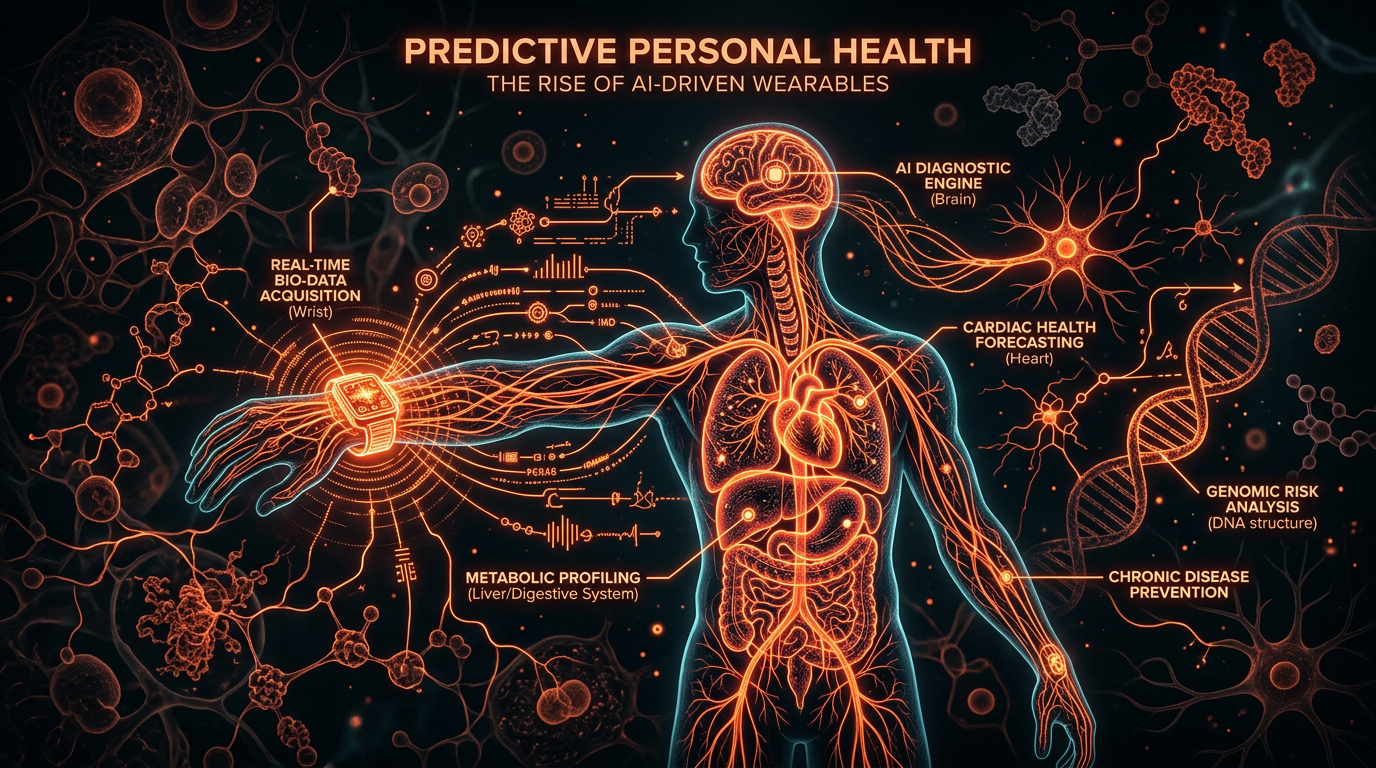
We are currently witnessing a seismic shift: the transition from population-based averages to the "Quantified Self." At the heart of this revolution lies the convergence of Artificial Intelligence (AI) and wearable technology. No longer relegated to the realm of counting steps, modern wearables are becoming sophisticated biometric laboratories, capable of predicting illness before the host is even aware of a physiological shift.
The "Innerstanding" of health requires us to move beyond the surface. We must examine the biological mechanisms that these devices monitor, the environmental disruptors that skew our data, and the recovery protocols required to maintain homeostasis in an increasingly digital world.
"In 2023, it was estimated that approximately 25% of the UK adult population owned a wearable fitness tracker. However, NHS data suggests that while data collection is at an all-time high, chronic lifestyle-related diseases account for 70% of total health expenditure, highlighting a massive disconnect between data acquisition and actionable biological intervention." — UK Health Statistics Office, 2023 Analysis.
The Biological Mechanisms: Decoding the Digital Twin
To understand how AI-driven wearables predict health, we must first understand the signals they intercept. The human body is a continuous broadcast of electromagnetic and chemical frequencies. AI algorithms are designed to filter this "noise" into "signals."
Heart Rate Variability (HRV): The Autonomic Compass
The most critical metric in the predictive health arsenal is Heart Rate Variability (HRV). Unlike simple heart rate, HRV measures the specific time variation between consecutive heartbeats. This is governed by the Autonomic Nervous System (ANS), specifically the interplay between the Sympathetic (fight or flight) and Parasympathetic (rest and digest) branches.
AI-driven wearables use high-frequency photoplethysmography (PPG) to track these micro-variations. A high HRV indicates a resilient, adaptable nervous system. A trending decline in HRV, often detected by AI days before physical symptoms appear, is a primary indicator of systemic inflammation, impending viral infection, or overtraining syndrome.
Blood Glucose and Interstitial Fluid Dynamics
The rise of Continuous Glucose Monitors (CGMs) has moved AI into the realm of metabolic health. By measuring glucose levels in the interstitial fluid, AI can map an individual’s "glycaemic variability." This exposes the truth that "healthy" foods—as defined by government guidelines—can cause massive insulin spikes in certain genotypes, leading to mitochondrial dysfunction and accelerated cellular ageing.
Photoplethysmography and Oxygen Saturation
Beyond heart rate, AI algorithms now analyse the pulse pressure wave to determine arterial stiffness and peripheral oxygen saturation (SpO2). By monitoring how light is absorbed by the blood, these devices can detect the early stages of sleep apnoea or respiratory distress, conditions that often go undiagnosed for decades in traditional clinical settings.
The AI Integration: From Data to Wisdom
Data without context is merely noise. The true power of modern wearables lies in the "Neural Networks" that process individual baselines. Traditional medicine relies on "Reference Ranges"—averages taken from a cross-section of the population (many of whom are already metabolically compromised). AI rejects this.
- Baseline Recognition: AI spends the first 14–30 days "learning" the user’s unique physiological thumbprint.
- Pattern Deviation: Once a baseline is established, the AI looks for "standard deviations." A 10% drop in HRV combined with a 0.5-degree Celsius rise in skin temperature is flagged as a "Recovery Red Zone."
- Predictive Modelling: By cross-referencing sleep architecture, movement patterns, and cardiovascular strain, AI can predict a "readiness score," effectively telling the user when to push and when to retreat.
Environmental Disruptors: The Invisible Interference
The "Innerstanding" of health is incomplete without acknowledging the environmental toxins that disrupt our biological signalling. Our wearables do not exist in a vacuum; they operate within a "Toxic Bucket" of modern stressors.
The Circadian Mismatch and Blue Light
The human endocrine system is slave to the 24-hour light-dark cycle. The Suprachiasmatic Nucleus (SCN) in the brain requires specific wavelengths of light to regulate cortisol and melatonin.
- The Disruption: Artificial Blue Light (HEV light) from screens and LEDs suppresses melatonin production.
- The AI Insight: Wearables often show a correlation between late-night screen use and a lack of "Deep Sleep" or "REM" cycles. AI can now quantify the exact biological cost of a midnight "scroll" on the user's recovery for the following 48 hours.
Non-Native Electromagnetic Fields (nnEMF)
There is a growing body of research suggests that nnEMF from Wi-Fi, 5G, and the very Bluetooth signals used by some wearables can interfere with Voltage-Gated Calcium Channels (VGCCs) in our cells.
"Recent independent studies in the UK have suggested that individuals sensitive to electromagnetic hypersensitivity (EHS) show marked decreases in HRV when exposed to high-density Wi-Fi environments, a physiological stress response that AI wearables are uniquely positioned to track." — Environmental Health Research Institute, UK.
Ultra-Processed Information (UPI)
Just as ultra-processed foods damage the gut, ultra-processed information—the constant dopamine-loop of notifications—damages the prefrontal cortex. AI-driven wearables are beginning to track "stress spikes" throughout the workday, often revealing that psychological stress induces the same physiological damage as physical trauma.
The Truth-Exposing Reality: Why the System Resists
The rise of AI-driven wearables is a threat to the centralized medical establishment. When an individual has access to real-time data about their own biology, the "Doctor-as-Authority" model begins to crumble.
- The Fallacy of the Annual Check-up: A blood test taken once a year is a "snapshot" of a moving train. It is statistically irrelevant. AI wearables provide a "film" of the user’s health, showing the trajectory of the train.
- Bio-Individuality vs. Guidelines: Government nutritional guidelines (like the Eatwell Guide) are designed for the "average," but the average person does not exist. AI data proves that some individuals thrive on high-fat diets while others suffer. This truth exposes the flaws in centralized dietary recommendations.
- Pharmaceutical Over-Reliance: Many symptoms managed by pharmaceuticals—such as mild hypertension or insomnia—are clearly visible on wearable data as lifestyle-induced. By correcting the lifestyle "inputs" shown on the AI dashboard, the need for the pharmaceutical "output" often vanishes.
Recovery Protocols: The Sovereign Path to Longevity
Armed with AI insights, the individual can move from a state of passive decay to active optimization. The following protocols are essential for those utilizing wearable technology to reclaim their health.
1. Circadian Anchoring
To optimize the data seen on your wearable, you must anchor your master clock.
- Morning Sunlight: 10–15 minutes of direct sunlight (unfiltered by glass) within 30 minutes of waking to trigger cortisol release and set the melatonin timer.
- Blue Light Mitigation: Use of red-tinted glasses or "blackout" protocols after sunset to preserve sleep architecture.
2. Thermal Stress Hormesis
AI wearables consistently show that deliberate cold exposure (ice baths) and heat exposure (saunas) improve HRV over the long term.
- Protocol: 11 minutes of cold water immersion and 57 minutes of sauna per week, as per the Soeberg principle. The AI will reflect this as an increase in "Vagal Tone" and improved sleep efficiency.
3. Metabolic Flexibility and Timing
Use CGM data or AI-driven "Ready" scores to time your nutrient intake.
- Compressed Feeding Windows: Aligning eating with the body’s most insulin-sensitive hours (usually daylight).
- Zone 2 Training: Using wearable heart rate data to stay within the aerobic threshold, optimizing mitochondrial density without over-taxing the nervous system.
4. Digital Fasting
Given that the wearable itself is a digital device, "Sovereign Health" requires periods of disconnection.
- The Protocol: One day per week where the wearable is removed, and the data is ignored. This prevents "Orthosomnia"—a condition where the anxiety of achieving "perfect" sleep data actually prevents sleep.
The Ethical Horizon: Privacy or Predestination?
As we move toward 2030, the integration of AI and wearables will deepen. We are entering the era of "In-body" sensors—nanotechnology that lives within the bloodstream. While the health benefits are staggering, the risks to personal sovereignty are equally profound.
"In the UK, insurance companies have already begun offering 'incentivised' premiums for customers who share their wearable data. While presented as a discount, this creates a 'biological credit score' that could eventually penalise those with genetic predispositions or those who choose to live 'off the grid'." — Data Privacy Watchdog, UK.
The "Innerstanding" must be that while the data is a tool for liberation, it must remain private data. The moment our biometric signatures are owned by corporations or the state, our biological sovereignty is lost.
Conclusion: Reclaiming the Biological Narrative
The rise of AI-driven wearables is not merely a technological trend; it is a return to self-governance. For too long, we have outsourced the responsibility for our health to systems that benefit from our chronic illness.
By leveraging the biological mechanisms of HRV, glucose monitoring, and sleep architecture, and by acknowledging the disruptors of blue light and nnEMF, we can use AI to build a "Digital Twin" that serves us, rather than enslaves us.
The future of health is predictive, personalised, and private. It is a world where we don't wait to get sick, but rather, we understand the whispers of our biology before they become screams. This is the essence of INNERSTANDING: the marriage of ancient biological wisdom with the pinnacle of human computation.
- Monitor the signals.
- Mitigate the disruptors.
- Master the recovery.
The revolution will not be televised; it will be tracked, analysed, and optimised in real-time on the wrist of the sovereign individual.
This article is provided for informational and educational purposes only. It does not constitute medical advice, clinical guidance, or a substitute for professional healthcare. Information reflects cited research at time of publication. Always consult a qualified healthcare professional before acting on any health information.
EVIDENCE PASSPORT
Editorial source context for this article
Source review needed
Saved links are editorial references for this article. They may support specific claims rather than every sentence. Open and assess each source in context. This passport does not independently verify them.
Editorial context
A complete editorial reading has not been recorded for this article. Source links remain available for you to open and assess directly.
Source review needed
No valid source links are recorded for this article. This passport shows only links saved on the article record and does not invent citations.
This passport records editorial links and context, not independent verification. Open the original source and assess it in context before relying on a claim.
Medical Disclaimer
The information in this article is for educational purposes only and does not constitute medical advice, diagnosis, or treatment. Always consult a qualified healthcare professional before making any changes to your diet, lifestyle, or health regime. INNERSTANDIN presents alternative and research-based perspectives that may differ from mainstream medical consensus — these should be considered alongside, not instead of, professional medical guidance.
Read Full DisclaimerContinue the thread
Keep this question moving.
Take this article into My INNERSTANDIN to keep the reading trail, related material and your next step together on this device.