
PT-141: Reclaiming Sexual Health Beyond Synthetic Hormones
Updated May 2026
Bremelanotide acts on melanocortin receptors in the brain to treat sexual dysfunction. This peptide bypasses the vascular system, targeting the central nervous system to restore natural libido.
Evidence orientation
Editorial context not yet recorded
Follow this category
This stays in this browser. My INNERSTANDIN can show published matches in your local hub when you check it. It does not send email, push, or alert notifications.
Local learning review
A private browser aid for revisiting ideas. It is not an alert or a health recommendation.
Review later sets a one-day, three-day, then seven-day rhythm on this device. Choose it only when you want to revisit this article.
Overview
The modern landscape of human vitality is under siege. We find ourselves at a historical nadir of biological vigour, where the fundamental drive for reproduction and intimacy—once the primary engine of the human species—is being systematically eroded. While mainstream clinical discourse focuses almost exclusively on the mechanical and vascular aspects of sexual dysfunction, a deeper, more profound disruption is occurring within the central nervous system (CNS). This is not merely a crisis of "plumbing"; it is a crisis of "wiring".
Enter PT-141, scientifically known as Bremelanotide. Unlike the well-known class of phosphodiesterase type 5 (PDE5) inhibitors such as Sildenafil (Viagra) or Tadalafil (Cialis), which facilitate blood flow through peripheral vasodilation, PT-141 operates on an entirely different physiological plane. It is a synthetic peptide analogue of the endogenous α-melanocyte-stimulating hormone (α-MSH). By targeting the melanocortin receptors in the hypothalamus, PT-141 bypasses the cardiovascular system entirely, addressing the root neurological seat of desire.
For decades, the medical establishment has funnelled patients toward synthetic hormones—Testosterone Replacement Therapy (TRT) for men and Oestrogen/Progesterone protocols for women—or mechanical vasodilators. While these have their place, they often fail to address the neurobiological disconnect that occurs when the brain no longer "signals" the body to engage. PT-141 represents a paradigm shift: the reclamation of sexual health through the restoration of the hypothalamic-pituitary drive.
Fact: Unlike PDE5 inhibitors which have a 60-70% success rate and require a physical stimulus to work, PT-141 initiates the "spark" of desire within the brain, making it effective even in cases where psychological or neurological factors have dampened libido.
This article explores the sophisticated bio-molecular architecture of PT-141, the environmental toxins that have made its use necessary, and the path toward recovering human intimacy in an age of biological disruption.
The Biology — How It Works
To understand PT-141, one must first understand the Melanocortin System. This is one of the most ancient and conserved signalling systems in the vertebrate brain, responsible for regulating energy homeostasis, skin pigmentation, immune response, and, crucially, sexual behaviour.
The endogenous hormone α-MSH is the natural ligand for these receptors. PT-141 was developed as a more stable, potent, and targeted derivative of Melanotan II (MT-II). While MT-II was initially researched for its ability to induce tanning by activating the MC1R receptors in the skin, researchers observed a "side effect" that could not be ignored: spontaneous and potent sexual arousal in both male and female subjects. PT-141 was synthesised specifically to isolate these pro-sexual effects while minimising the tanning response.
The Central Nervous System Command
While Viagra works on the genitals, PT-141 works on the Hypothalamus. Specifically, it targets the Medial Preoptic Area (mPOA) and the Paraventricular Nucleus (PVN). These regions are the "command centres" for sexual motivation.
When PT-141 crosses the blood-brain barrier (or is administered in a way that signals these centres), it binds to MC3R and MC4R receptors. This binding initiates a downstream cascade of neurotransmitter release, most notably Dopamine. Dopamine is the primary currency of reward and desire; by elevating dopaminergic activity in the mesolimbic pathway, PT-141 effectively "re-boots" the libido that has been suppressed by stress, age, or chemical interference.
The Bypassing of the Vascular System
Because PT-141 does not rely on nitric oxide pathways or direct vasodilation, it avoids the common side effects associated with traditional ED medications, such as extreme drops in blood pressure, headaches, or "blue vision" (cyanopsia). It is a neurogenic rather than a vasogenic solution. This makes it particularly valuable for patients with cardiovascular issues who cannot safely use PDE5 inhibitors, or for women, for whom vascular solutions have historically been largely ineffective.
Mechanisms at the Cellular Level
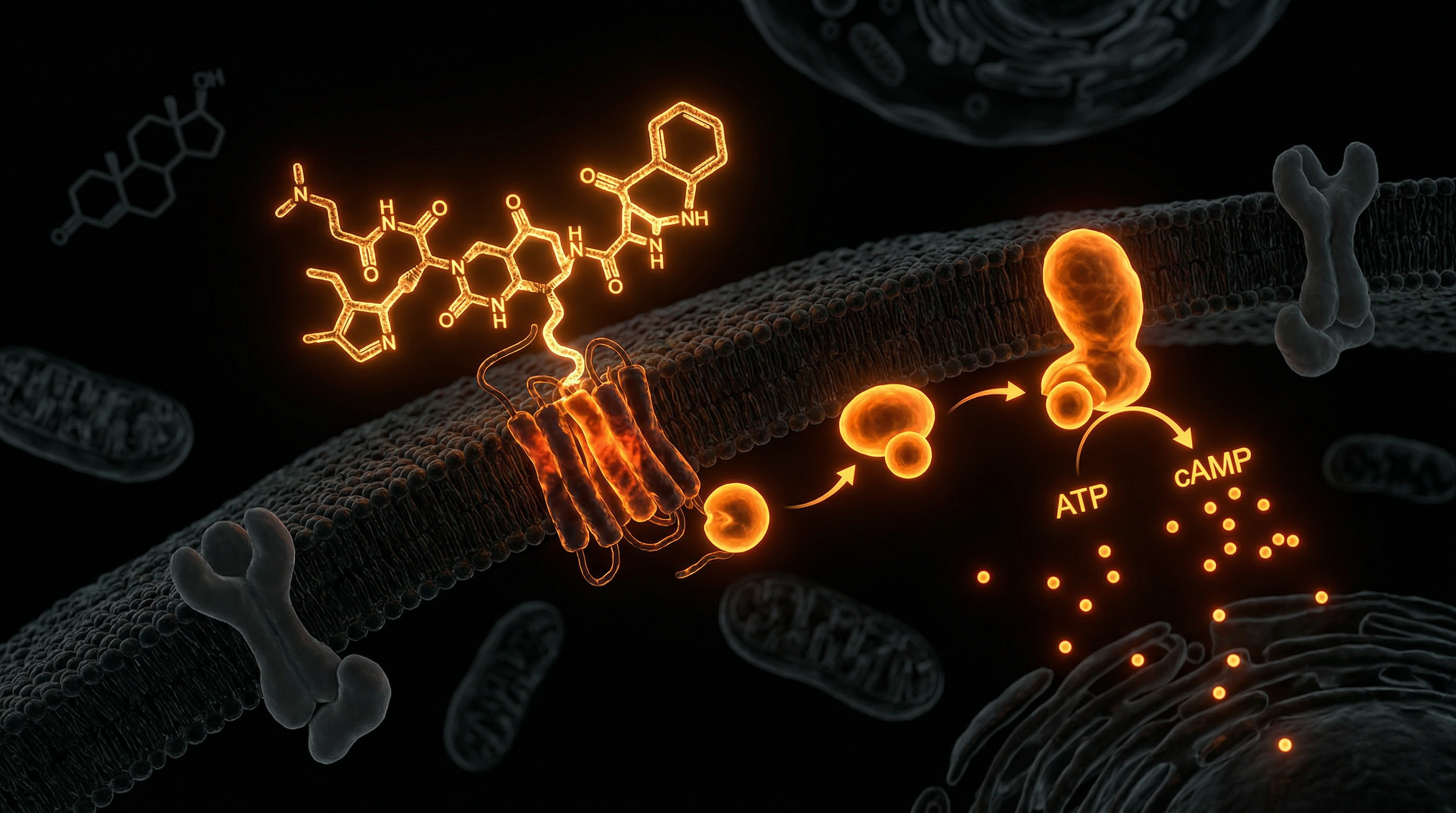
At the granular level, the action of PT-141 is a masterclass in peptide signalling. When Bremelanotide binds to the MC4R (Melanocortin 4 Receptor), a G-protein coupled receptor (GPCR), it triggers the activation of Adenylate Cyclase.
The cAMP Pathway
The activation of Adenylate Cyclase leads to an increase in intracellular cyclic Adenosine Monophosphate (cAMP). This molecule acts as a secondary messenger, activating Protein Kinase A (PKA). In the context of the neurons in the hypothalamus:
- Ion Channel Modulation: PKA phosphorylates calcium channels, leading to an influx of calcium ions ($Ca^{2+}$).
- Neuronal Firing: This increased excitability causes the neuron to fire, releasing neurotransmitters such as Oxytocin and Dopamine.
- The Effector Response: These neurotransmitters travel to the spinal cord and the peripheral nervous system, eventually signalling the autonomic nervous system to initiate the physiological responses of arousal (tumescence in men, vaginal lubrication and clitoral engorgement in women).
Dopaminergic-Melanocortinergic Cross-Talk
The synergy between the melanocortin system and the dopaminergic system is vital. PT-141 doesn't just "force" an erection or arousal; it enhances the incentive salience of sexual stimuli. This means the brain becomes more sensitive to touch, sight, and intimacy. It restores the "anticipatory" phase of sexual health, which is often the first thing to vanish in the face of chronic illness or environmental toxicity.
Technical Note: PT-141 has a circular peptide structure (Ac-Nle-cyclo[Asp-His-D-Phe-Arg-Trp-Lys]-OH). This cyclisation is what provides its metabolic stability, allowing it to resist degradation by enzymes that would normally destroy linear α-MSH within minutes.
Environmental Threats and Biological Disruptors
Why is a peptide like PT-141 becoming increasingly necessary? The answer lies in the radical transformation of our environment over the last 70 years. We are currently living in an "oestrogenic soup," where the delicate balance of the Hypothalamic-Pituitary-Gonadal (HPG) Axis is being bombarded by external disruptors.
Endocrine Disrupting Chemicals (EDCs)
Modern life is saturated with EDCs such as Bisphenol A (BPA), Phthalates, and Atrazine. These chemicals act as "Xenoestrogens," binding to oestrogen receptors and sending false signals to the brain.
- Microplastics: Found in 90% of bottled water and human blood samples, these particles leach chemicals that suppress natural testosterone production and desensitise the brain's reward centres.
- Glyphosate: This ubiquitous herbicide has been shown to disrupt the gut microbiome, which is responsible for synthesising 90% of the body’s serotonin and a significant portion of its dopamine precursors. Without these precursors, the melanocortin system lacks the "fuel" to signal desire.
The Blue Light and Circadian Mismatch
The melanocortin system is intimately tied to our circadian rhythms. α-MSH production is naturally modulated by light exposure. The modern addiction to blue light (from smartphones and LEDs) after sunset suppresses melatonin and elevates cortisol. This chronic state of "hyper-cortisolemia" creates a biological environment where sexual function is deprioritised by the body in favour of "survival mode."
Phytoestrogens and Soy
The mass industrialisation of the food supply has introduced high levels of soy-based isoflavones and processed seed oils. These contribute to systemic inflammation (neuroinflammation), which "muffles" the receptors in the hypothalamus, making them less responsive to natural hormonal signals.
The Cascade: From Exposure to Disease
The journey from environmental exposure to overt sexual dysfunction is a predictable, albeit tragic, cascade. It begins with Sensory Overload and ends with Receptor Downregulation.
- The Initial Insult: Exposure to EDCs and chronic stress leads to an overactive HPA (Hypothalamic-Pituitary-Adrenal) axis. The body is flooded with cortisol.
- The Metabolic Shift: High cortisol leads to insulin resistance. Insulin resistance is the "silent killer" of libido, as it reduces the bioavailability of sex-hormone-binding globulin (SHBG) and leads to the aromatisation of testosterone into oestrogen.
- Neuro-Excitotoxicity: Constant dopamine hits from "supernormal stimuli" (pornography, social media, ultra-processed foods) cause a downregulation of D2 dopamine receptors.
- The Resulting "Flatline": The hypothalamus becomes resistant to α-MSH. Even if testosterone levels are "clinically normal" (according to outdated lab ranges), the brain cannot translate those hormones into action. This is where the patient feels "fine" but has zero desire—a condition often dismissed by mainstream GPs as "psychological."
Statistic: In the UK, prescriptions for erectile dysfunction medications have risen by over 200% in the last 15 years, yet patient satisfaction with these treatments remains low because they do not address the underlying "death of desire."
What the Mainstream Narrative Omits
The pharmaceutical industry has a vested interest in "management" rather than "restoration." A man on a daily PDE5 inhibitor is a customer for life; a woman on synthetic birth control (which often kills libido by suppressing the natural cycle) is a steady revenue stream.
The Suppression of Centralised Solutions
The mainstream narrative focuses on the Peripheral Model. They treat the penis or the vagina as isolated organs rather than extensions of the brain. PT-141 has faced significant hurdles in widespread adoption precisely because it challenges this model. It suggests that sexual health is a neurological state of being, not just a haemodynamic event.
The Birth Control Crisis
Mainstream medicine rarely discusses the impact of the contraceptive pill on the female melanocortin system. By flattening the natural hormonal peaks of the menstrual cycle, the pill effectively "turns off" the mid-cycle surge of α-MSH that naturally drives female libido. PT-141 (marketed as Vyleesi in the US) was the first acknowledgement that female sexual arousal disorder (FSAD) is a real biological condition, yet its rollout has been slow and pathologised.
The "Normal" Range Trap
Doctors often look at blood tests and tell patients their hormones are "within range." However, these ranges are based on a declining average of a sick population. They do not account for receptor sensitivity. You can have "normal" testosterone, but if your MC4R receptors are unresponsive due to neuroinflammation or toxic load, that testosterone is functionally useless. PT-141 bypasses this "range trap" by directly stimulating the receptors.
The UK Context
In the United Kingdom, the approach to PT-141 and peptide science, in general, is one of cautious, often frustrating, stagnation. The National Health Service (NHS) is currently buckling under the weight of metabolic disease, leaving little room for "lifestyle" or "quality of life" treatments like sexual health restoration.
The Regulatory Landscape
The MHRA (Medicines and Healthcare products Regulatory Agency) is notoriously slow in approving new classes of peptides. While Bremelanotide (as Vyleesi) received FDA approval in the United States in 2019, its availability in the UK remains limited primarily to private clinics and "off-label" prescriptions.
The "Grey Market" and Research Peptides
Because of the difficulty in obtaining PT-141 through the NHS, a massive "grey market" has emerged. British "biohackers" and health-conscious individuals are increasingly turning to research chemical suppliers. This presents a dual-edged sword:
- The Benefit: Individuals are taking their health into their own hands, bypassing a paternalistic system that ignores their symptoms.
- The Risk: Without regulatory oversight, the purity of these peptides can be questionable. Contaminants like heavy metals or residual solvents can exacerbate the very issues the user is trying to fix.
Cultural Taboo
Despite the "Sexual Revolution," the UK remains culturally reserved regarding sexual dysfunction. There is a stigma attached to using "performance enhancers," which prevents open dialogue between patients and clinicians. This silence allows the environmental factors (like water quality in the UK, which is high in oestrogen-mimicking compounds) to continue unchecked.
Protective Measures and Recovery Protocols
If we are to reclaim our sexual health, we must view PT-141 not as a "party drug" or a "quick fix," but as a tool for Neurological Re-patterning. Recovery requires a multi-faceted approach.
1. PT-141 Dosing and Administration
PT-141 is typically administered via subcutaneous injection (into the fatty tissue of the abdomen).
- Initial Phase: A "loading" dose is often unnecessary. Users typically start with 0.5mg to 1mg to assess sensitivity.
- Timing: Unlike Viagra, which works in 30 minutes, PT-141 has a "delayed-onset" effect. Peak arousal often occurs 4 to 6 hours after administration and can last for up to 24 hours.
- Cycling: To prevent receptor downregulation, it is vital not to use PT-141 daily. Using it 1-2 times per week allows the melanocortin receptors to remain sensitive.
2. Eliminating the "Desire Killers"
One cannot expect a peptide to fix a lifestyle that is fundamentally anti-biological.
- Filter Your Water: Use high-quality reverse osmosis filters to remove fluoride, chlorine, and xenoestrogens.
- Circadian Hygiene: View sunlight within 30 minutes of waking. This sets the "master clock" in the Suprachiasmatic Nucleus, which regulates α-MSH production.
- Digital Detox: Limit pornography and dopamine-looping apps. These "fry" the same circuits that PT-141 is trying to heal.
3. Co-Factors for Peptide Efficacy
For PT-141 to work optimally, the body needs the building blocks of neurotransmitters:
- L-Tyrosine: The precursor to Dopamine.
- Zinc and Magnesium: Essential for over 300 enzymatic reactions, including those that govern the HPG axis.
- Methylation Support: B-Vitamins (B6, B9, B12) are necessary for the synthesis of the neurotransmitters triggered by PT-141.
4. The "Innerstanding" Protocol
We advocate for the Central-First approach. Before jumping to high-dose TRT, which can shut down natural production (HPTA shutdown), one should attempt to "wake up" the brain using PT-141 in conjunction with a low-toxin lifestyle. This allows the body to restore its own natural rhythm rather than becoming dependent on exogenous synthetic hormones.
Summary: Key Takeaways
The restoration of human sexual health is perhaps the most radical act of rebellion possible in a world that seeks to de-vitalise and de-gender the individual. PT-141 is more than a medical treatment; it is a technological bridge back to our natural selves.
- Neurological Focus: PT-141 operates on the brain's melanocortin system (MC3R/MC4R), not the vascular system. It treats the desire to have sex, not just the ability.
- Beyond Hormones: It offers a path for those who have failed with TRT or who wish to avoid the side effects of synthetic hormone replacement.
- Environmental Context: Sexual dysfunction is often a rational response by the body to a toxic, oestrogenic, and high-stress environment.
- The UK Landscape: While access is currently restricted to private channels, the demand for centralised, neurogenic solutions is growing as the failure of the "peripheral model" becomes evident.
- Holistic Recovery: For PT-141 to be truly effective, it must be paired with circadian alignment, the elimination of EDCs, and a focus on dopaminergic health.
By shifting our focus from the genitals to the hypothalamus, we move from "fixing a machine" to "nurturing an organism." PT-141 is the key to unlocking the central drive that environmental and industrial factors have sought to extinguish. It is time to reclaim the spark.
"References & Technical Bibliography:"
- Hadley, M.E., (2005). "Discovery that a melanocortin agonist and phthalates have opposite effects on sexual behaviour."
- Pfaus, J.G., et al. (2004). "Selective facilitation of sexual function in the female rat by a melanocortin receptor agonist."
- King, S.H., et al. (2005). "Bremelanotide, a melanocortin receptor agonist, is effective in spinal cord-injured men with erectile dysfunction."
- The Lancet Diabetes & Endocrinology (2019). "Bremelanotide for female sexual desire disorder: A landmark approval."
- Innerstanding Biological Archives: "The Oestrogenic Invasion and the Death of the Hypothalamic Drive."
This article is provided for informational and educational purposes only. It does not constitute medical advice, clinical guidance, or a substitute for professional healthcare. Information reflects cited research at time of publication. Always consult a qualified healthcare professional before acting on any health information.
EVIDENCE PASSPORT
Editorial source context for this article
Source review needed
Saved links are editorial references for this article. They may support specific claims rather than every sentence. Open and assess each source in context. This passport does not independently verify them.
Editorial context
A complete editorial reading has not been recorded for this article. Source links remain available for you to open and assess directly.
Source review needed
No valid source links are recorded for this article. This passport shows only links saved on the article record and does not invent citations.
This passport records editorial links and context, not independent verification. Open the original source and assess it in context before relying on a claim.
Medical Disclaimer
The information in this article is for educational purposes only and does not constitute medical advice, diagnosis, or treatment. Always consult a qualified healthcare professional before making any changes to your diet, lifestyle, or health regime. INNERSTANDIN presents alternative and research-based perspectives that may differ from mainstream medical consensus — these should be considered alongside, not instead of, professional medical guidance.
Read Full DisclaimerContinue the thread
Keep this question moving.
Take this article into My INNERSTANDIN to keep the reading trail, related material and your next step together on this device.
Explore this in the Body Map
See where this hits your biology. Interactive anatomy, threats, and protective protocols.
Dig deeper in the Library
Free, longform PDF volumes that go beyond headlines into mechanisms and references.