
The Retinal Bio-Clock: How Modern Lighting Disrupts Circadian Ocular Health
Updated May 2026
This article examines the impact of artificial light on retinal rhythmicity and the subsequent degradation of visual acuity. It explores the biological necessity of natural light cycles for photoreceptor regeneration and hormonal balance.
Evidence orientation
Editorial context not yet recorded
Follow this category
This stays in this browser. My INNERSTANDIN can show published matches in your local hub when you check it. It does not send email, push, or alert notifications.
Local learning review
A private browser aid for revisiting ideas. It is not an alert or a health recommendation.
Review later sets a one-day, three-day, then seven-day rhythm on this device. Choose it only when you want to revisit this article.
Overview
For the vast majority of human evolutionary history, our biology was governed by the rhythmic oscillation of the sun. Our ancestors lived in a world defined by the high-energy blue light of the midday sky and the restorative, low-energy amber hues of firelight and sunset. However, in the space of little more than a century—and more acutely within the last twenty years—the human species has undergone a radical, uncontrolled experiment. We have moved indoors, shielded ourselves from the full-spectrum brilliance of the sun, and submerged our nervous systems in a sea of artificial, biologically aggressive light.
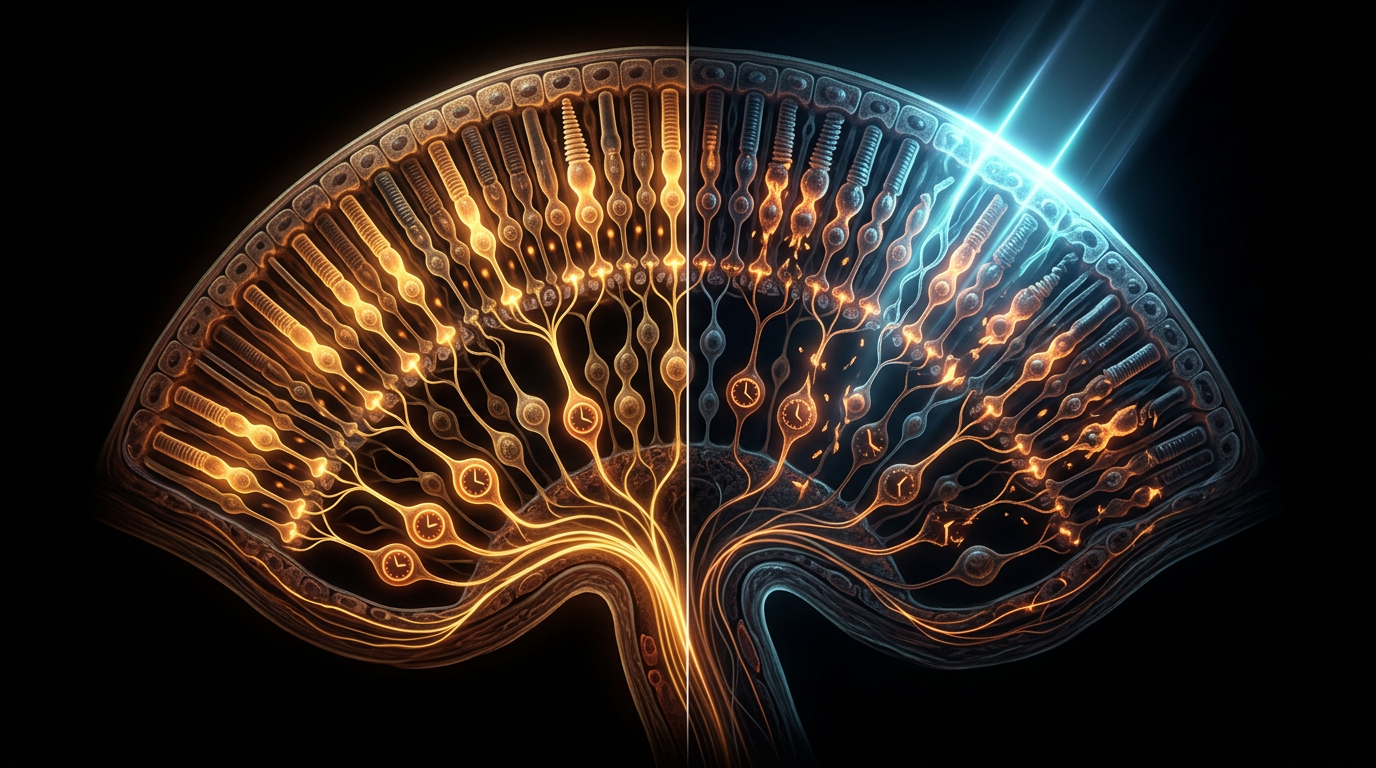
The primary victim of this shift is not merely our sleep quality, but the eye itself. At INNERSTANDING, we recognise that the eye is far more than a camera for the brain; it is a sophisticated circadian pacemaker. The retina contains a dedicated system of sensors that do not "see" images, but rather "sense" time. This retinal bio-clock regulates everything from hormonal secretion to the cellular regeneration of the very cells we use to see.
Modern lighting—characterised by the high-intensity blue spikes of Light Emitting Diodes (LEDs) and the omnipresence of digital screens—has induced a state of chronic photobiological mismatch. We are now witnessing a global epidemic of visual degradation, myopia, and macular degeneration that mainstream optometry often treats as "ageing" or "genetics." In reality, much of this is the result of circadian ocular disruption. This article will dismantle the myths of modern illumination and expose the cellular cost of our divorce from natural light.
The Biology — How It Works
To understand how modern light destroys ocular health, we must first understand the dual nature of the retina. Traditionally, we are taught that the retina consists of two types of photoreceptors: rods (for low light) and cones (for colour and detail). While these allow us to navigate the world, they are only part of the story.
The Third Receptor: Melanopsin and ipRGCs
In the late 1990s, researchers discovered a third class of photoreceptor: the Intrinsically Photosensitive Retinal Ganglion Cells (ipRGCs). Unlike rods and cones, these cells do not contribute to visual imagery. Instead, they contain a photopigment called melanopsin, which is exquisitely sensitive to short-wavelength blue light (approximately 460–480nm).
These cells serve as the "bridge" between the environment and the Suprachiasmatic Nucleus (SCN)—the master clock located in the hypothalamus of the brain. When blue light hits the ipRGCs, it signals to the SCN that it is daytime. This triggers a cascade of biological responses:
- The suppression of melatonin (the "vampire hormone" that facilitates sleep and cellular repair).
- The release of cortisol (to prime the body for activity).
- The regulation of body temperature and heart rate.
The Retinal Rhythmicity
The eye itself has its own internal clock, independent of the brain. Every layer of the retina—from the Retinal Pigment Epithelium (RPE) to the photoreceptors—operates on a 24-hour cycle. During the day, the eye focuses on photon capture and visual processing. At night, it shifts into a regenerative phase.
Fact: The retina is one of the most metabolically active tissues in the human body, consuming more oxygen per gram than even the brain or the heart.
This high metabolic rate creates a massive amount of "cellular waste." The retinal bio-clock ensures that this waste is cleared away while we sleep. If the "day" signal (blue light) never truly turns off, this cleaning process never truly begins.
Mechanisms at the Cellular Level
The degradation of the eye under modern lighting is not a vague phenomenon; it is a precise biochemical failure. To appreciate the gravity of the situation, we must look at the photoreceptor disc shedding process.
The Daily Clean-up: Disc Shedding and Phagocytosis
Our photoreceptors (rods and cones) are constantly bombarded by light. This causes the outer segments of these cells to become damaged by oxidation. To survive, the photoreceptor cells must "shed" their damaged tips every morning. These discarded "discs" are then eaten and recycled by the Retinal Pigment Epithelium (RPE)—a thin layer of cells that acts as the retina's janitor and nutritionist.
This process is strictly governed by the circadian rhythm. In a healthy cycle:
- Dawn: Light triggers the shedding of rod discs.
- Dusk: Darkness prepares the cones for their shedding cycle.
- Night: The RPE processes the waste and replenishes vital nutrients like Vitamin A.
When we are exposed to artificial blue light late at night, this rhythm is shattered. The RPE becomes "confused." Instead of recycling damaged tissue, it remains in a state of high-alert visual processing. The result is the accumulation of lipofuscin—a metabolic "sludge" that is a hallmark of macular degeneration.
The Local Melatonin Factory
While most people think of melatonin as a brain hormone, the retina actually produces its own local melatonin. This ocular melatonin acts as a powerful antioxidant, protecting the delicate retinal tissues from the oxidative stress caused by light exposure.
When we use smartphones or sit under bright LED "cool white" bulbs in the evening, we are not just telling our brains to stay awake; we are poisoning our eyes from the inside. By suppressing local retinal melatonin, we strip the eye of its primary defence mechanism against the very light we are staring at.
Fact: Retinal melatonin levels are typically 10 times higher at night than during the day, providing a critical "antioxidant shield" for the eye's delicate tissues.
Environmental Threats and Biological Disruptors
The modern light environment is "biologically dishonest." We evolved under the sun, which provides a continuous, balanced spectrum of light. Modern lighting is the opposite.
The "Blue Spike" of LEDs
Most modern LED bulbs and screens are actually blue lights coated with a yellow phosphor to appear white. When viewed through a spectroscope, these lights show a massive, narrow spike in the high-energy blue spectrum (450nm) and a total lack of healing near-infrared (NIR) light.
Blue light is high-energy. It penetrates deep into the eye, reaching the retina. While natural blue light from the sun is balanced by massive amounts of red and infrared light, LED light is "naked." This imbalance creates Reactive Oxygen Species (ROS)—free radicals that damage mitochondrial DNA within the retinal cells.
The Absence of Infrared (The "Missing Nutrient")
The sun is roughly 42% near-infrared light. This wavelength is invisible to our eyes but crucial for our biology. NIR light stimulates cytochrome c oxidase in the mitochondria, increasing ATP (energy) production and triggering cellular repair.
Incandescent bulbs, though inefficient in terms of electricity, were biologically superior because they emitted significant amounts of infrared heat. Modern LEDs provide zero infrared. We are essentially feeding our eyes "junk food" light—high in energy (blue) but devoid of the "micronutrients" (red/infrared) needed for repair.
Flicker and Temporal Disruption
Many cheap LEDs and digital screens do not emit a steady stream of light; they flicker at frequencies invisible to the conscious mind but detectable by the brain and retina. This flicker vertigo stresses the ciliary muscles and disrupts the electrical signalling of the optic nerve, leading to "digital eye strain" and chronic headaches.
The Cascade: From Exposure to Disease
What begins as simple eye strain eventually cascades into systemic pathology. The retinal bio-clock is the "master gear" in the body's clockwork; when it slips, the entire machine begins to fail.
The Myopia Epidemic
In East Asian cities, myopia (short-sightedness) rates among school-leavers now approach 90%. In the UK, rates are rising rapidly. While many blame "near work" (reading), the more potent driver is the lack of outdoor light.
The retina releases dopamine in response to bright, natural sunlight. This dopamine acts as a signal to the eye to stop growing. In the dim, artificial light of indoors (which is often 100 times weaker than outdoor light), dopamine levels remain low. The eye continues to elongate, resulting in myopia. This is not a genetic defect; it is a light deficiency syndrome.
Age-Related Macular Degeneration (AMD)
AMD is the leading cause of blindness in the UK. It is essentially the "rusting" of the central part of the retina. By exposing our eyes to blue-light-heavy LEDs at night, we accelerate this rusting process in three ways:
- Increasing oxidative stress via the "blue spike."
- Suppressing the antioxidant melatonin.
- Inhibiting the RPE’s ability to clear metabolic waste.
Metabolic Dysfunction and Diabetes
The link between light and the eye goes both ways. The retina is a projection of the central nervous system. When the retinal bio-clock is disrupted, it sends "false time" signals to the pancreas and liver. Research has shown that even dim light exposure during sleep can increase insulin resistance the following morning. The eye is not just observing the metabolism; it is directing it.
Fact: Exposure to just 40 lux of blue light—less than a typical bedside lamp—is enough to suppress melatonin production and alter glucose metabolism in humans.
What the Mainstream Narrative Omits
The mainstream medical and lighting industries have a vested interest in maintaining the status quo. The "energy efficiency" mandate has pushed LEDs into every home and streetlamp in the UK, often ignoring the biological consequences.
The "Blue Light Filter" Fallacy
Many people believe that using "Night Shift" on their phones or wearing cheap "blue blocker" glasses solves the problem. This is a dangerous half-truth. While these tools reduce the intensity of certain wavelengths, they do not fix the melanopic lux problem.
To truly reset the circadian clock, the intensity and duration of light matter as much as the colour. Furthermore, most "blue blockers" only filter up to 420nm, whereas the melanopsin peak is at 480nm. You are still being "circadianly blinded" by the light you think you are filtering.
The "Lux" Deception
Mainstream lighting standards are based on photopic lux—a measurement of how bright a light appears to the visual system. They completely ignore melanopic lux—how bright the light appears to our internal clock. A room can feel "dimly lit" but still be saturated with enough blue light to completely halt the retinal repair cycle.
The Importance of Darkness
The narrative focuses on "bad light," but rarely mentions the biological necessity of total darkness. In our modern "light-polluted" world, we rarely experience true blackness. Even the glow from a standby light on a television or the intrusion of an LED streetlamp through a curtain is enough to disrupt the retinal bio-clock. The retina requires periods of absolute zero-photon exposure to reset its chemical sensitivity.
The UK Context
The United Kingdom faces a unique set of challenges regarding retinal health, driven by our latitude and our infrastructure.
The High-Latitude Dilemma
For much of the year, the UK suffers from a lack of high-intensity sunlight. This leads to Seasonal Affective Disorder (SAD), which is fundamentally a retinal-circadian mismatch. Without the strong morning "reset" signal of the sun, the British population exists in a "circadian twilight" for six months of the year—not awake enough during the day, and not asleep enough at night.
Street Lighting and the "Great UK Retrofit"
Across the UK, local councils have replaced traditional, warm high-pressure sodium (HPS) streetlights with "energy-efficient" white LEDs. These new lights have significantly higher blue light content. For residents, this means that even with the lights off, the "sky glow" and light trespass into bedrooms are significantly more biologically disruptive than they were twenty years ago.
Fact: Research in the UK has shown that areas with high levels of artificial outdoor light at night have a statistically higher incidence of sleep disorders and certain hormone-related cancers.
The NHS and the Myopia Crisis
The NHS is currently overwhelmed with cases of "preventable" sight loss. However, the advice given is often reactive (stronger prescriptions, surgery) rather than proactive (light hygiene). There is a profound lack of public education regarding the "light diet" necessary for children to prevent permanent ocular elongation.
Protective Measures and Recovery Protocols
We cannot simply return to the pre-industrial age, but we can—and must—"re-wild" our light environment. At INNERSTANDING, we advocate for a protocol-driven approach to ocular hygiene.
1. The "Morning Anchor"
The most important thing you can do for your retinal health is to get natural sunlight in your eyes within 30 minutes of waking.
- Do not look through a window; glass filters out crucial UV and infrared wavelengths.
- Even on a cloudy British morning, the lux levels outside are significantly higher than the brightest indoor office.
- This "anchors" your SCN and starts the timer for melatonin production 16 hours later.
2. Spectral Hygiene in the Home
Replace "Cool White" LEDs with "Warm White" or, ideally, incandescent or halogen bulbs in living areas.
- In the evening, switch to red light. Red light (above 600nm) does not stimulate melanopsin and does not suppress melatonin.
- Utilise "low-blue" lighting solutions specifically designed for circadian health.
3. The Near-Infrared Supplement
Since we are deprived of solar infrared, we must seek it out. Red Light Therapy (Photobiomodulation) using 670nm to 850nm wavelengths has been shown in clinical trials to improve mitochondrial function in the retina, particularly in people over the age of 40. A few minutes of exposure to deep red light in the morning can "recharge" the retinal batteries.
Fact: A landmark study by University College London found that three minutes of deep red light (670nm) exposure once a week could significantly improve declining vision in older individuals by "recharging" retinal mitochondria.
4. Nutritional Fortification
The retina uses specific pigments to filter blue light naturally. These are Lutein and Zeaxanthin.
- These "internal sunglasses" are found in leafy greens (kale, spinach) and egg yolks.
- A "light-heavy" lifestyle demands a higher intake of these pigments to maintain the Macular Pigment Optical Density (MPOD).
5. Digital Fasting and Physical Barriers
- Use software like Iris or f.lux on all devices, but recognise they are not 100% effective.
- After sunset, wear high-quality orange or red-tinted glasses that block 100% of wavelengths below 500nm.
- Ensure your bedroom is a "black box." Use blackout curtains and cover all electronic LEDs with black tape.
Summary: Key Takeaways
The Retinal Bio-Clock is not a metaphor; it is a fundamental biological system that dictates the health of our eyes and our bodies. Our current reliance on artificial, blue-rich, infrared-depleted lighting is a direct assault on this system.
- The Eye is a Clock: The retina manages the body’s circadian rhythms via melanopsin-containing cells.
- The Blue Spike: Modern LEDs create oxidative stress and prevent the eye from repairing itself at night.
- Regeneration requires Darkness: Without true darkness, the RPE cannot clear the metabolic waste that leads to AMD.
- The Missing Infrared: We are "infrared deficient." Natural light provides a balance of damage (blue) and repair (red/IR) that artificial light lacks.
- UK Crisis: British residents must be particularly vigilant due to low winter light levels and the nationwide shift to LED street lighting.
We must stop viewing light as merely a tool for visibility and start viewing it as a pharmacological agent. Every time you flick a switch, you are dosing your retina with a chemical signal. For the sake of our long-term visual and metabolic health, it is time we began dosing ourselves with the light we were evolved to receive.
Author’s Note: This article is part of INNERSTANDING’s mission to expose the environmental stressors of the modern world. True ocular health begins not with a new prescription, but with a return to the rhythms of the natural world.
This article is provided for informational and educational purposes only. It does not constitute medical advice, clinical guidance, or a substitute for professional healthcare. Information reflects cited research at time of publication. Always consult a qualified healthcare professional before acting on any health information.
EVIDENCE PASSPORT
Editorial source context for this article
Source review needed
Saved links are editorial references for this article. They may support specific claims rather than every sentence. Open and assess each source in context. This passport does not independently verify them.
Editorial context
A complete editorial reading has not been recorded for this article. Source links remain available for you to open and assess directly.
Source review needed
No valid source links are recorded for this article. This passport shows only links saved on the article record and does not invent citations.
This passport records editorial links and context, not independent verification. Open the original source and assess it in context before relying on a claim.
Medical Disclaimer
The information in this article is for educational purposes only and does not constitute medical advice, diagnosis, or treatment. Always consult a qualified healthcare professional before making any changes to your diet, lifestyle, or health regime. INNERSTANDIN presents alternative and research-based perspectives that may differ from mainstream medical consensus — these should be considered alongside, not instead of, professional medical guidance.
Read Full DisclaimerContinue the thread
Keep this question moving.
Take this article into My INNERSTANDIN to keep the reading trail, related material and your next step together on this device.
Explore this in the Body Map
See where this hits your biology. Interactive anatomy, threats, and protective protocols.
Dig deeper in the Library
Free, longform PDF volumes that go beyond headlines into mechanisms and references.